
Studied hard for hours or re-read your notes three times and still blanked on the test? That isn't laziness, and it isn't a bad memory.
Re-reading makes a page feel familiar, and familiar feels like knowing. But on test day, the page is closed.
The fix is simple and backed by decades of research: test yourself, then come back to it later.
This guide is for students ages 8 to 17 and the parents helping them.
Why re-reading fools us
When you read something again, your brain says, "I've seen this before." That's recognition. A test asks for something harder: pulling the answer out of your head with nothing to look at. That's recall, and you only get better at it by practicing it.
In a well-known 2006 study at Washington University in St. Louis, Henry Roediger and Jeffrey Karpicke had college students learn a short passage. One group read it about 14 times. Another read it about 3 times and spent the rest of the time recalling it from memory. A week later, the readers remembered 40%. The recallers remembered 61%, even though they read it far fewer times. Right after studying, the readers actually did slightly better. That's exactly why re-reading feels like it works.
A large 2013 review led by John Dunlosky rated 10 popular study methods. Only 2 got the top rating: practice testing and spreading study out over time.
Re-reading, highlighting and summarizing were rated low. The review found that practice testing helps learners of many ages, not just college students.
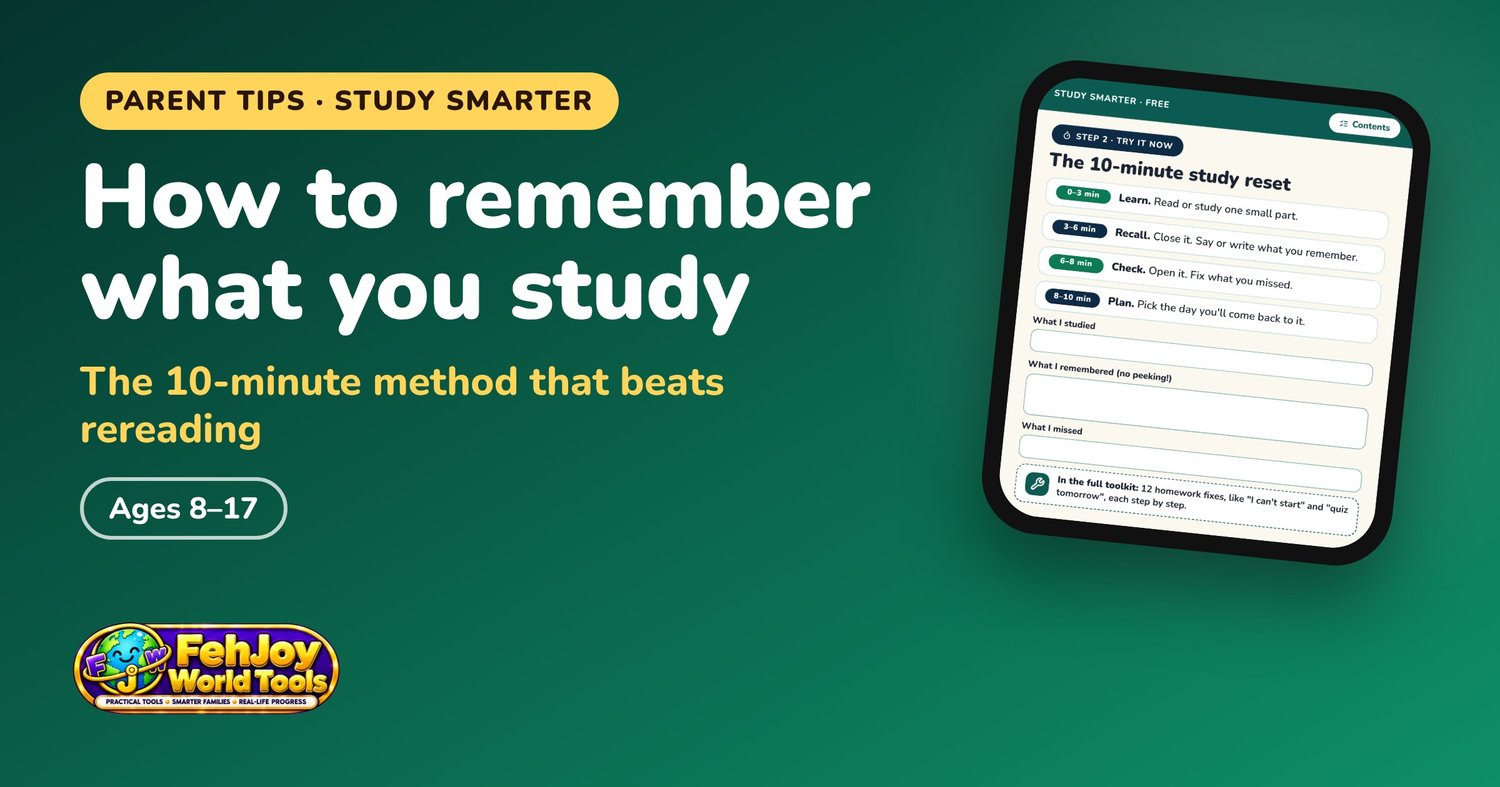
The 10-minute study reset
This turns the research into one short routine. It works for spelling, history, science or anything with facts to learn.
- Minutes 0–3, Learn: read or study one small part. Not the whole chapter.
- Minutes 3–6, Recall: close it. Say or write everything you remember.
- Minutes 6–8, Check: open it. Fix what you missed.
- Minutes 8–10, Plan: pick the day you'll come back to it.
The recall step should feel a little hard. That effort is what makes the memory stick.
Come back on purpose
We forget fast, but each short recall slows the forgetting. Instead of one long night of cramming, plan short come-backs:
- Tomorrow: recall first, then check.
- In 3 days: recall again.
- In a week: one more time.
Got it all right? Wait longer next time. Still shaky? Come back sooner. For younger kids, this can be as simple as practicing spelling words on Monday, quizzing on Tuesday and Thursday, and testing on Friday.
3 recall games for any subject
- Blurt it (2 minutes): close everything, then write or say every fact you remember. Check what's missing.
- Flip the heading (5 minutes): turn each heading into a question. "Volcanoes" becomes "What makes a volcano erupt?" Answer without looking.
- Teach the toy (5 minutes): explain the topic to a toy, a pet or a person in your own words, with no notes. Teens can record a 1-minute voice note instead.
For parents: help without doing the work
The most useful question isn't "Did you study?" or "Did you read it?"
It's "What do you remember?" That one question turns any moment, even the drive home, into recall practice.
When your child is stuck, climb a hint ladder, and stop as soon as they can keep going:
- "Show me what you understand so far."
- "Look at the example. What's the same?"
- "What's the first step?"
- "Let's do this line together. You do the next."
Praise the method, not just the grade: "You found your mistake and fixed it."
Quick answers
Is highlighting bad? Not bad, just not enough. Highlight on the first read if it helps, then close the book and recall.
What if my child gets a lot wrong when they test themselves? That's normal, and it's useful. A mistake found during practice is one you can fix before the test.
Does this work for young kids? Yes, in a playful form. Saying 3 things out loud to a grown-up is recall. So is teaching a toy.
Can an AI app help? Yes, as a quiz partner. Ask it to quiz you on your own notes, one question at a time, and answer before you look. Check its questions against your notes or textbook, because AI can make mistakes.
Try the 10-minute reset tonight, free
Our free Study Smarter Quick Start (ages 8–17) puts the 60-second "do I really know it?" test, the 10-minute reset, come-back days, the 3 games and the hint ladder on your phone, with boxes to type in. Get the free Quick Start
Want the whole Smarter Studies system? The Study Smarter School Success Toolkit ($7.99, 93 pages) adds 12 step-by-step homework fixes, 12 study games, 15 fillable planners and a 10-page parent guide. See the toolkit
More Parent Tips
- First Phone for Kids and Online Safety: 7 Parental Controls for iPhone & Android
- How to Use ChatGPT & AI for Beginners: Practical Before-and-After Prompts for Busy Parents
Written by the team behind FehJoy World, the family video page followed by more than 550,000 people. General study guidance, not a promise of grades. Always follow your school's and teacher's rules.
Sources
- Washington University in St. Louis: Repeated test-taking better for retention than repeated studying (2006)
- Association for Psychological Science: Which study strategies make the grade? (Dunlosky and others, 2013)
Comments ()