

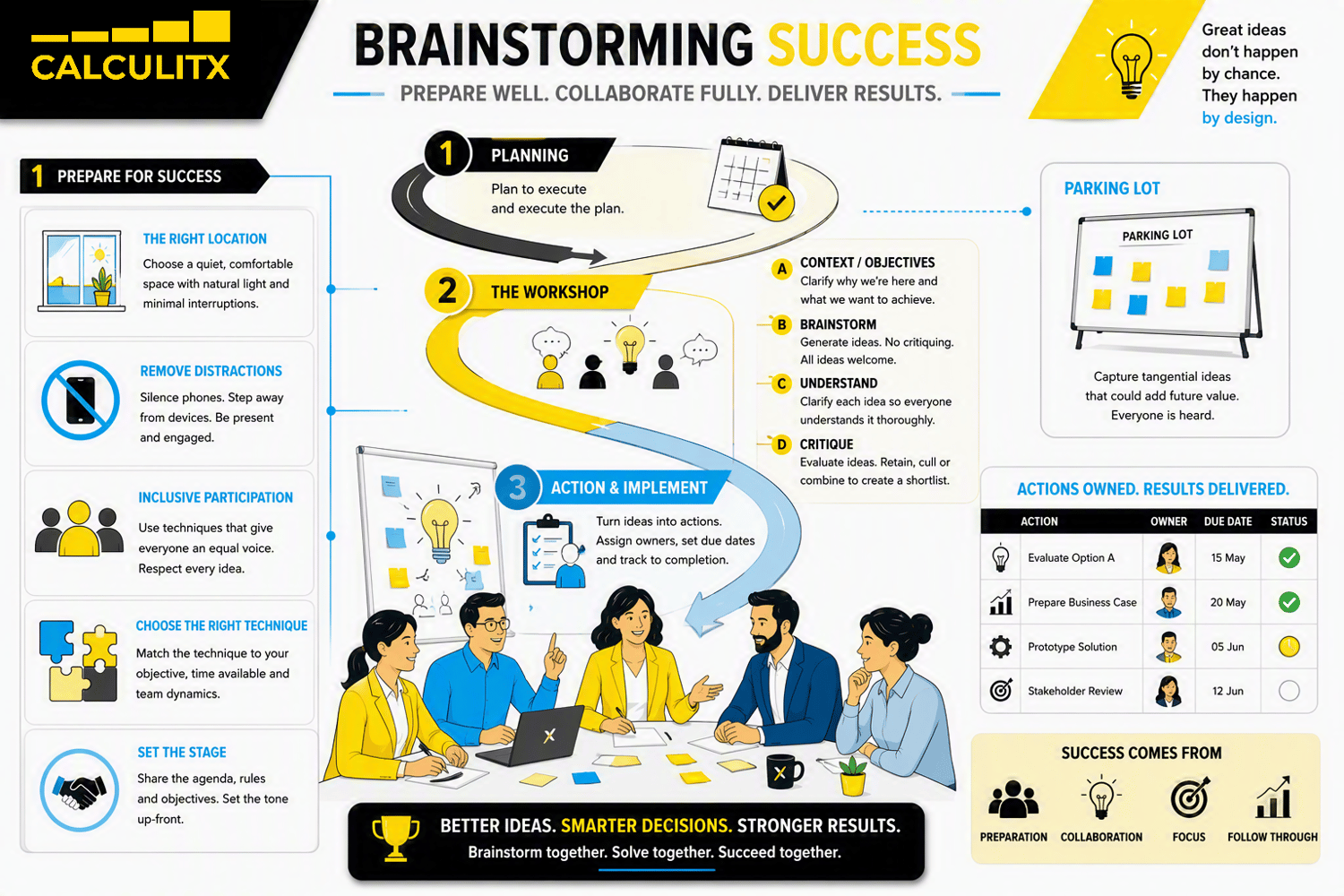
Successful brainstorming doesn't just happen so before we jump into specific brainstorming techniques let's take some time to consider how to set yourself up for success.
Location
"Where" is important! You need your team to be able to focus. Brainstorming is about identifying options, and being creative and innovative. Whilst some people may be able to do this standing up in a crowded train, most people cannot. Most of us need to have our daily distractions removed, so choose somewhere that reduces the likelihood of interruptions. Hiring a conference room "off-site" is one option. Where your budget doesn't allow this, choose a room people don't often frequent, particularly a room where your team's coworkers don't frequent. Close the door and open the window shades to source some natural light.
Devices
A phone call that arrives just as your team is entering a "flow state" will distract everyone. I recognise that there are times where someone is "on call" or is waiting for an "important call", but most of the time people can live without their phone for an hour during the brainstorming phase. Turn phones to silent or leave them at the door.
In some workplaces, everyone takes a laptop or tablet to every meeting. For some meetings this is efficient use of time. For brainstorming sessions it isn't. If you can't break people's co-dependency with their laptop choose a brainstorming technique that uses butchers paper and hand everyone a sharpie. Going "old school"…that'll fool 'em.
Personalities
Consider who will be attending. If you have a team that is comfortable with each other and willingly share ideas then the world is your oyster. Choose any brainstorming technique that makes sense for the problem you want to solve.
Many times, teams have one or two "big" personalities. You know the types, the ones who have all the answers, who talk over the top of others and squash other's ideas prematurely. Open or unstructured brainstorming techniques are likely to fail when one or two people dominate the conversation. If this is a risk, select a brainstorming technique that gives everyone an equal say. Structured Brainstorming and Brain-boarding are valuable tools that democratise a brainstorming session. I write about each of these in blogs 3 and 7 respectively.
Prep Materials
Also consider the topic and whether those attending are familiar with it. If the topic is complex or new, provide background information beforehand. You should summarise the key points at the start of the workshop. Participants generate stronger ideas when they understand the problem they're trying to solve. It gives their unconscious mind time to "mull it over" before arriving.
Phases of Brainstorming
Obtaining a successful brainstorming outcome results from multiple phases each playing their part:
1. Planning Phase
"Plan to execute and execute the plan!" Decide the location. Determine how you will utilise/manage device-use during your session. Choose a sensible brainstorming technique that both matches the outcome you need and the personalities that will be present. Then book the conference room and send out the meeting invitation.
2. The Workshop
What occurs in the workshop depends on how much time you have. A lot of brainstorming can occur in 30 to 60 minutes. It's the value that happens around the brainstorming that locks-in the value of the workshop so if you have time, the following agenda will enrich the delivered outcomes:
- Context/Objectives: Describe why you are meeting and what you want to achieve from the session.
- Brainstorm: obtain your team's wisdom. In this phase, the following rules are inviolable:
- No critiquing during the brainstorming phase:
- All ideas are good ideas.
- Whilst brainstorming, quantity beats quality.
- A crazy idea might trigger a fantastic idea so this is not the time to belittle your team-mates.
- Capture every idea first! Evaluate later!
- Don't talk over other people: respect encourages attendees to participate.
- Share these rules with attendees before you start brainstorming. Set the tone up-front.
- Understand: When brainstorming is complete, review each idea with the team. Ask the writer to describe it to the team and move on only once everyone understands it thoroughly.
- Critique: Review each idea and decide whether it should be retained, culled or coalesced with another idea. This process will deliver a shortlist of paths forward.
Reality sometimes dictates the time available. It's OK to take "understanding" and "critique" off-line, outside the meeting but Context/Objectives and Brainstorming are a team effort.
3. Action and Implement
The value from a brainstorming session is to obtain a list of actionable items. Assign an owner to each action. Agree a completion date. Then track each action through to completion. A brainstorming session without follow-through is merely entertainment. Value is created only when ideas are converted into actions and delivered outcomes. (Check out the CalculitX Project Action Tracker if you need a tool to do this OR my blog called The complete guide to effective meeting actions: Series introduction if you want more information on how to do this well).
Parking Lot
Brainstorming workshops have the potential to generate ideas that are tangential to the focus topic. Use a white board or butcher's paper (or electronic equivalent) to list items that aren't relevant to the focus topic BUT could be very beneficial to the organisation if developed further. This allows attendees to feel heard and extracts value above and beyond the stated workshop objectives. Review the Parking Lot at the end of the session and assign ownership to any item worth further investigation.
Join me in the next post as we explore the benefits of Unstructured Brainstorming.
I'm keen for you to share your thoughts on setting up brainstorming sessions for success. What worked for you? What failed for you? Share your thoughts below so others can learn…
…and once you have a list of actions, the CalculitX Project Action Tracker can track each action through to completion and report progress along the journey. Check it out here.
#Brainstorming, #CreativeThinking, #Ideation, #Creativity, #Innovation, #ProblemSolving, #DesignThinking, #IdeaGeneration, #Productivity, #Learning, #BrainstormingWorkshops
Comments ()