


In Part 1, we looked at the green flags–those things to look for when identifying authentic spiritual leaders and teachers. These patterns of behavior are rooted in deep ethics. They aren’t just spoken; they’re lived.
A Quick Recap:
- Competency & Humility – Has verifiable experience/training, credits sources, and acknowledges limitations.
- Empowerment & Autonomy – Aims to make you self-sufficient, not dependent. Encourages critical thinking and personal intuition.
- Maintains Clear Boundaries – Professional in conduct, transparent about the nature of relationships and services.
- Compassion & Integrity – Creates a safe, respectful space for questions and struggle.
But knowing what ethical leadership looks like alone doesn’t always help with watching out for potential dangers. Even the most upstanding among us have our off days or periods of struggle in which our better selves slip into potentially harmful habits. (Yes, even me!)
We need to know the red flags, too. Be on the look out for the tell-tale signs to walk away from a spiritual leader before our own lives get distorted, or worse. Read on for a breakdown and tips for staying safe in your journey for trustworthy spiritual guides.
How to Spot a Cult
My all-time favorite system for determining if a religious group is safe is the ABCDEF (The Advanced Bonewits’ Cult Danger Evaluation Frame), “used by parents, reporters, law enforcement agents, social scientists and others interested in evaluating the actual dangers presented by a given group or movement.” Isaac Bonewits first created this tool in 1979, and it has proven its worth again and again.
The ABCDEF lets you quickly assess the potential danger level of a spiritual or religious group to keep you and your loved ones safe from psychological and physical harm. (It’s also great for working out whether a local minority religious group is something to be concerned about or safe to invite into your interfaith relations committee.)
That said, if you’re just trying to work out if a particular spiritual guide is right for you, this tool isn’t that helpful. It requires actually researching and getting involved with a group to assess its score along several factors, which can take months. While it’s fantastic for identifying if the group is potentially dangerous, the search for a spiritual guide to follow, work with, or receive counseling from shouldn’t require that level of detective-like work.
To make your life easier and search for authentic spiritual guidance quicker, we’ll focus on major red flags you can easily spot within hours (or minutes) instead.

Red Flags & Patterns of Caution
If you’ve ever had that visceral “something isn’t right here” feeling about a person in a position of authority, then you already know that our gut instincts, intuitive “hits”, and psychic senses can ring out when in the presence of an untrustworthy leader. As much as I encourage you to trust those instincts, you should also know the logical, rational, observable signs that confirm you need to walk away.
Why? Because some people are really good at sounding trustworthy, exuding charisma that overrides our senses, and preventing our intuition from picking up on any warnings. Among those who are religious, spiritual, and esoteric practitioners, you’ll find those who are authentic in their practice, but otherwise dangerous as a guide without ethical boundaries. They may know how to evade psychic defenses, whether they’re intentionally seeking to cause harm or simply protecting their ego, brand, or bank account.
Typical Red Flags to Watch Out For:
- Lack of transparency about background
- Credentials cannot be verified and/or the person’s stated background does not match independent records.
- They claim expertise in a specialized area without evidence of relevant education, training, or experience.
- Fostering "us versus them" dynamics
- Public and private communication frequently focuses on differences between followers and non-followers
- Divisive or polarizing language replaces careful engagement with complex issues.
- Questioning the leader or group is framed as betrayal, disloyalty, or spiritual failure.
- Public shaming
- The leader attacks criticism or feedback rather than addressing it.
- They publicly identify and “call out” people or groups with whom they have no direct relationship or firsthand experience.
- They use humiliation to discourage others from asking questions.
- Claiming unique authority to sell a solution
- They position themselves as the only person who can help.
- They imply that leaving them or the group will cause spiritual, emotional, or physical harm.
- They use identity labels to insist that their perspective is the only legitimate one.
Examples of Spiritual Leaders Violating Ethical Principles
Sadly, there’s no shortage of ethical violations among spiritual leaders and communities. In this section, we’ll cover three areas of major red flags, the ethical principles they violate, and the lessons we can take away from them.
Abuse of Power & Exploitation
Between the Vatican scandals of recent decades and the Epstein Files alone, we’re all too aware of the horrific proliferation of sexual misconduct among leaders we were taught to trust. These cases are clearly abuses of power and direct exploitation of others. Other notable examples include the British & American "Slave Bible" omissions and false prophets among the Fundamentalist Church of Jesus Christ of Latter-Day Saints.
ASI principles violated:
- #15. Never manipulating, exploiting, or deceiving a student to satisfy our personal aspirations, needs, or desires.
- #16. Establishing and maintaining clear and wholesome professional boundaries with all students, employees, and associates.
- #17. Never abusing the trust of students by exploiting them with unfair, coercive, or deceptive attempts to obtain money or free labor.
- #18. Being particularly mindful of sexual boundaries with students—and honoring them at all times.
Lesson Learned: Spiritual authority never justifies personal exploitation.
Financial & Emotional Manipulation
If you want to get me fired up on spiritual business ethics, get me talking about TV evangelists and their “prosperity gospel”. Or “alternative science” and anti-science healers with zero training in science, medicine, or psychological health to base their claims on. Although far from the only examples, these are two of the most obvious spiritual manipulators aiming to separate you from your money–self-centered ends justifying whatever means they employ.
ASI principles violated:
- #4. Fostering autonomy, empowerment, self-sufficiency, and emotional maturity in our students.
- #7. Making only honest, realistic statements regarding the benefits of our teachings, practices, courses, and other offerings.
- #9. Being honest and transparent regarding business and financial matters relevant to our students, clients, donors, and other stakeholders.
Lesson Learned: Always be wary of teachings tied to continual financial investment or that prey on your insecurities.
Grandiosity & Fabricated Authority
This covers those religious figures with bogus credentials or touting miraculous claims. It also covers a significant portion of social media influencers who position themselves as experts on religious or spiritual matters without the knowledge and experience to support it. (Yes, this includes those “baby witches” with relatively high subscriber counts who talk—and decorate—as though they’ve been practicing for decades.) I won’t name names, but I’m sure your mind has already listed a few.
ASI principles violated:
- #1. Holding ourselves to the highest standards of ethics, right behavior, and professional competency, as commonly recognized by our peers.
- #6. Being self-aware, open, and humble about the limitations of our knowledge and experience.
- #8. Refraining from giving counsel in matters outside of our areas of training and expertise, and making appropriate referrals as needed.
Lesson Learned: Extraordinary claims require evidence. A real expert is not threatened by questions–or the existence of truly academic/scientific resources that require more than just skimming for the answers.
Where to Pay the Most Attention: How They Handle Questions, Complexity, and Mistakes
Not all untrustworthy spiritual leaders will fall under the extremes as we saw in the examples above. As such, here’s the “cheat sheet" on what to look out for.
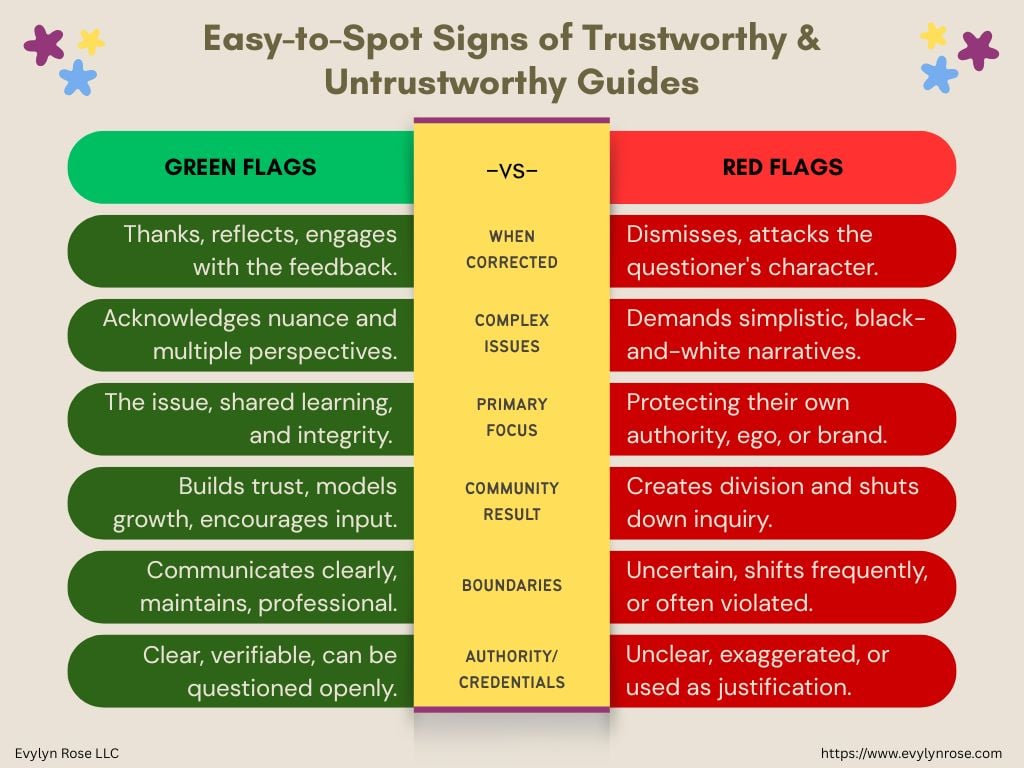
ASI principles to look for:
- #6. Being self-aware, open, and humble about the limitations of our knowledge and experience.
- #19. Cultivating and practicing honesty, integrity, compassion, humility, and empathy.
- #22. Encouraging feedback about our own methods and behavior—and taking that feedback seriously.
On The Nuance of Cultural Exchange: As you navigate assessing a spiritual leader’s trustworthiness, it’s important to note that being an expert or highly trained is not the same as being “all knowing.” No single person can reasonably be expected to know everything within their field of study or practice. That said, ethical practice involves respectful engagement with the spirit and history of a spiritual path; a real spiritual leader seeks to enhance their own learning and growth when presented with something they didn’t know before. The red flag to look for is a refusal to engage thoughtfully.
Conclusion: Trust Yourself
As always, I encourage you to trust your own intuition and exercise your right to ask questions. A good teacher welcomes respectful inquiry, while maintaining healthy boundaries. If something feels “off,” it’s okay to walk away. Likewise, if you find yourself in a situation or community that consistently raises red flags or diminishes your autonomy, then walk away.
We have enough finger-pointing, blame laying, baseless claims, and corruption in this world. You don’t need it from your spiritual leaders and teachers, too.
A true spiritual guide will welcome respectful discernment, as it is the foundation of genuine trust and growth. So be your glorious discerning self, and find the guide that’s right–and safe!–for you.
If you still find yourself on the fence about whether a potential spiritual guide is safe and trustworthy, book a free 15-minute call with me for guided questions to help you decide.
In Light & Love, Evylyn




















Comments ()