


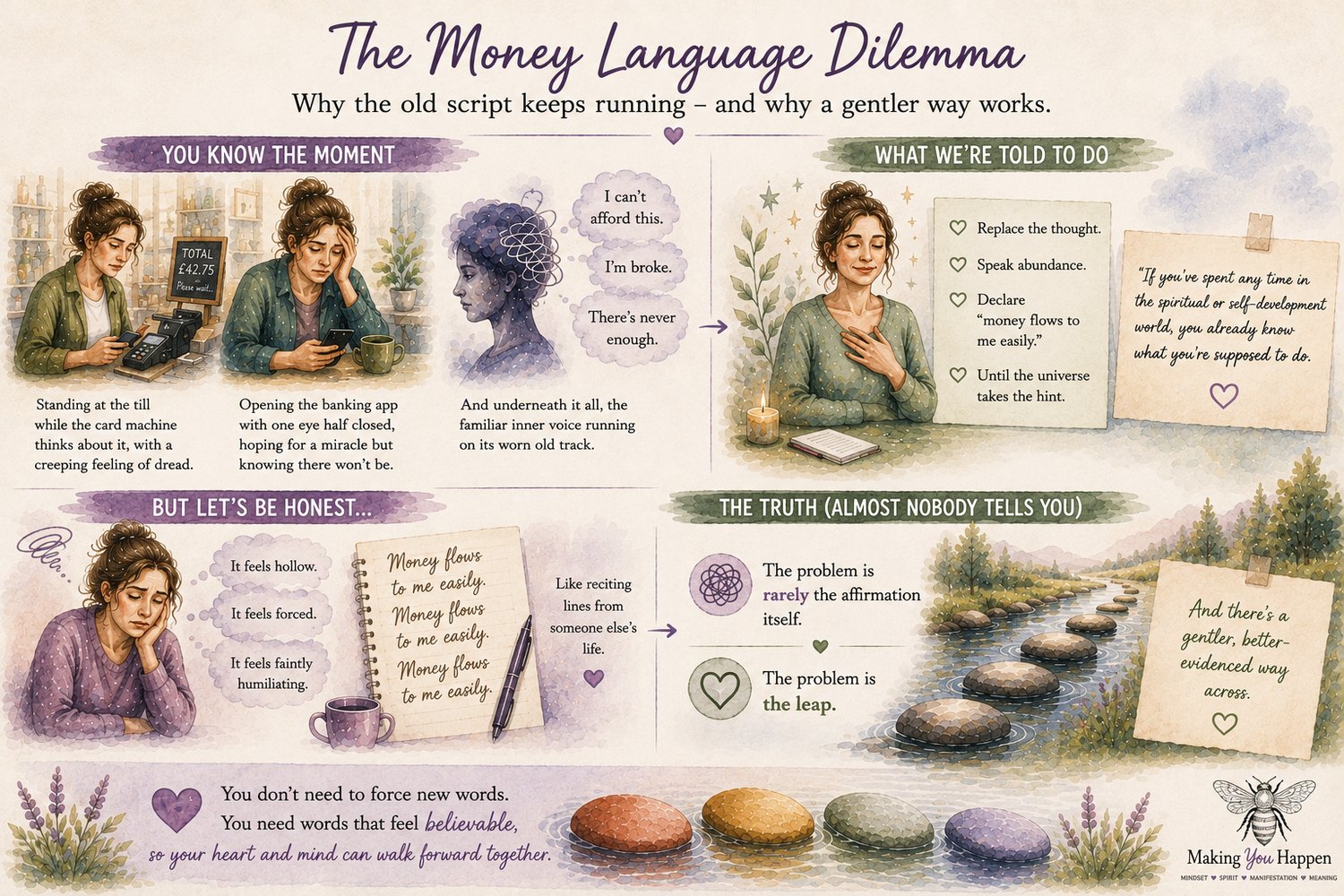
You know the moment. Standing at the till while the card machine thinks about it, with a creeping feeling of dread. Opening the banking app with one eye half closed, hoping for a miracle but knowing there won’t be one. And underneath it all, the familiar inner voice running on its worn old track: I can't afford this. I'm broke. There's never enough.
If you've spent any time in the spiritual or self-development world, you already know what you're supposed to do with that sentence. Replace it. Speak abundance. Declare "money flows to me easily" until the universe takes the hint.
And if you're honest, you also know how that usually feels: hollow, forced, faintly humiliating. Like reciting lines from someone else's life.
Here's what almost nobody tells you. The problem is rarely the affirmation itself. The problem is the leap. And there's a gentler, better-evidenced way across.
Your words are doing more than you think
Before we get to what works, it's worth understanding why your inner money language matters at all.
This is where the science becomes genuinely encouraging, because researchers have spent the past two decades confirming something spiritual traditions have said for far longer: the words you rehearse shape the reality you experience.
Negative words switch on the stress response
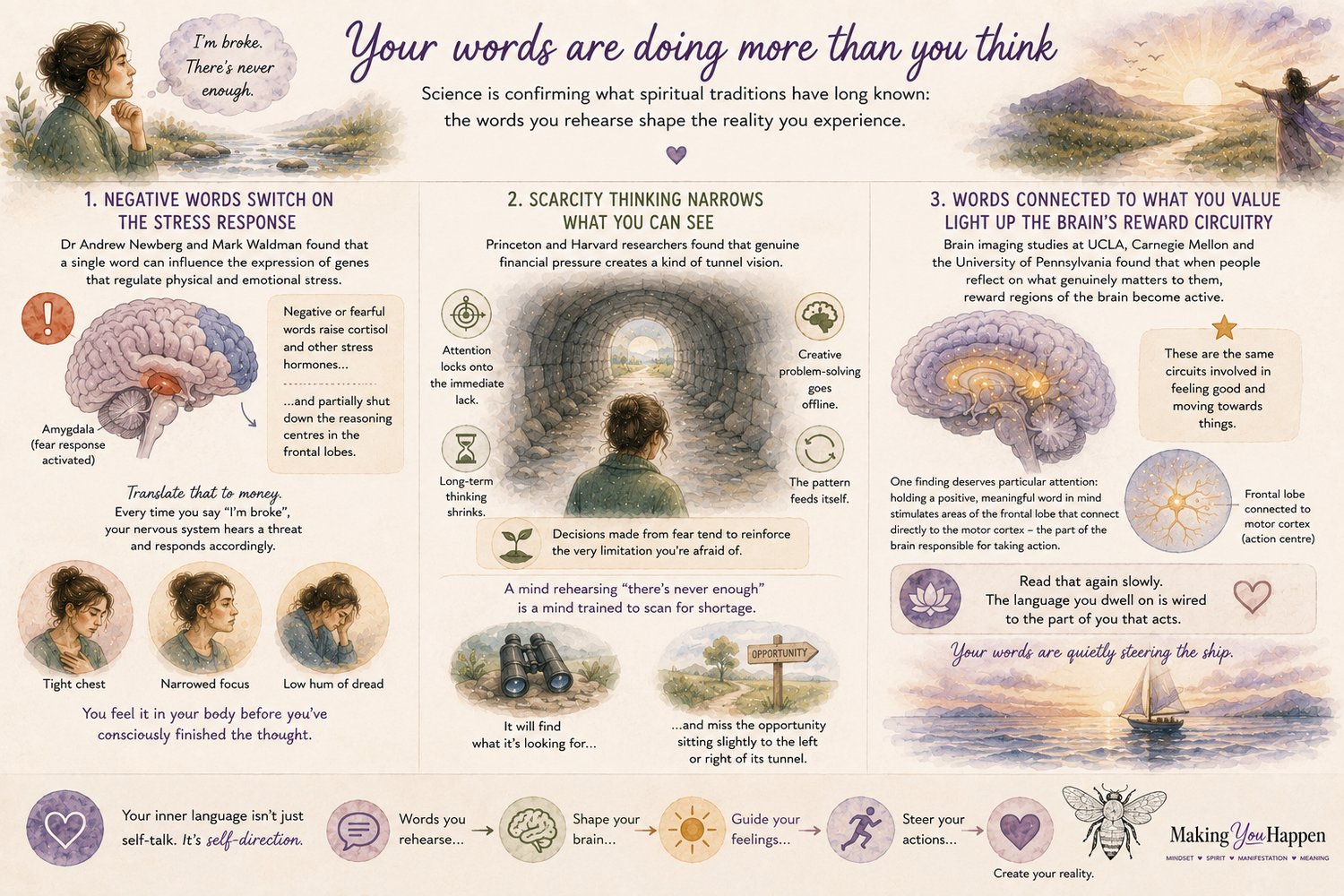
Dr Andrew Newberg, a neuroscientist at Thomas Jefferson University, and communications expert Mark Waldman spent years studying what language does inside the brain. Their conclusion, published in Words Can Change Your Brain, is striking: a single word can influence the expression of genes that regulate physical and emotional stress.
Negative words activate the brain's fear response, raising cortisol and other stress hormones, and angry or fearful language partially shuts down the reasoning centres in the frontal lobes.
Translate that to money. Every time you say "I'm broke", your nervous system hears a threat and responds accordingly. Tight chest, narrowed focus, the low hum of dread. You feel it in your body before you've consciously finished the thought.
Scarcity thinking narrows what you can see
Researchers at Princeton and Harvard studied what genuine financial pressure does to the mind, and found that scarcity creates a kind of tunnel vision. Attention locks onto the immediate lack, long-term thinking shrinks, and creative problem-solving quietly goes offline. Worse, the pattern feeds itself: decisions made from fear tend to reinforce the very limitation you're afraid of.
So a mind rehearsing "there's never enough" is a mind trained to scan for shortage. It will find what it's looking for, and it will miss the opportunity sitting slightly to the left or right of its tunnel.
Words connected to what you value light up the brain's reward circuitry
Now the hopeful part. Brain imaging studies at UCLA, Carnegie Mellon and the University of Pennsylvania found that when people reflect on what genuinely matters to them, reward regions of the brain become active, the same circuitry involved in feeling good and moving towards things.
One finding deserves particular attention: holding a positive, meaningful word in mind stimulates areas of the frontal lobe that connect directly to the motor cortex, the part of the brain responsible for taking action.
Read that again slowly. The language you dwell on is wired to the part of you that acts. Your words are quietly steering the ship.
Why aren't my money affirmations working, then?
If words are this powerful, standard abundance affirmations should work beautifully. Often they don't, and there's a well-known study that explains why.
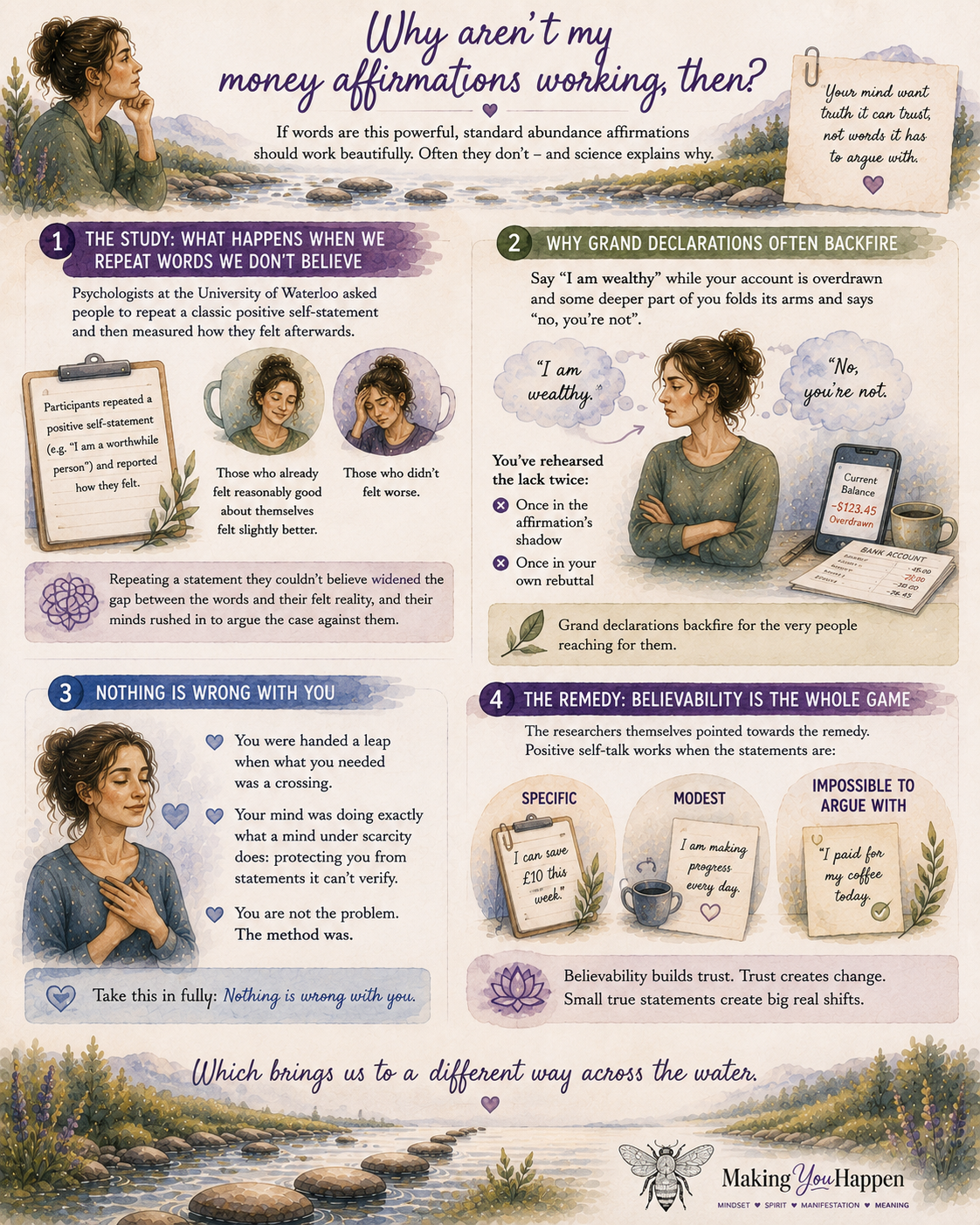
Psychologists at the University of Waterloo asked people to repeat a classic positive self-statement and then measured how they felt afterwards. Those who already felt reasonably good about themselves felt slightly better. Those who didn't felt worse. Repeating a statement they couldn't believe widened the gap between the words and their felt reality, and their minds rushed in to argue the case against them.
This is the finding that quietly undermines half the manifestation industry. Grand declarations backfire for the very people reaching for them. Say "I am wealthy" while your account is overdrawn and some deeper part of you folds its arms and says “no, you're not”, and now you've rehearsed the lack twice: once in the affirmation's shadow, once in your own rebuttal.
If you've tried affirmations and concluded that something must be wrong with you, take this in fully. Nothing is wrong with you. You were handed a leap when what you needed was a crossing. Your mind was doing exactly what a mind under scarcity does: protecting you from statements it can't verify.
The researchers themselves pointed towards the remedy. Positive self-talk works when the statements are specific, modest and impossible to argue with. Believability is the whole game.
Which brings us to a different way across the water.
Introducing The Money Language Stepping Stones Framework
Think of the distance between "I'm broke" and "I am abundant" as a river.
The gurus tell you to jump it. The Money Language Stepping Stones Framework invites you to cross it one stone at a time, with each stone bearing your full weight before you move to the next. Every step is drawn from research, and every step is something you can actually say without your inner sceptic filing an objection.
There are four stones. You'll likely spend days or weeks on each, and that's the design. This is a practice of retraining your brain, and retraining honours its own pace.
🤎 Stepping Stone One: Loosen the Grip
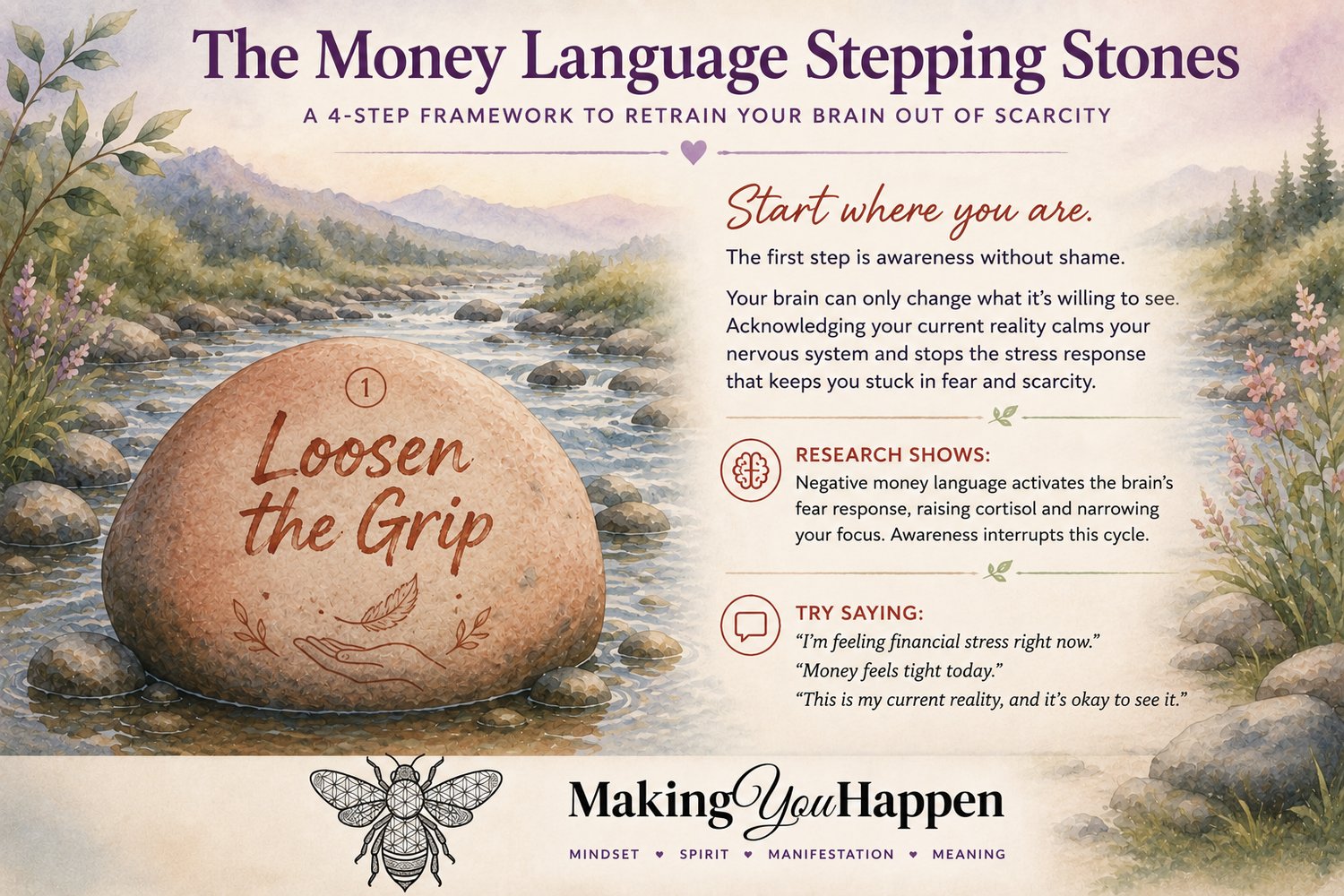
The first move changes nothing about your circumstances and everything about your relationship to the thought. You simply stop letting a money thought pose as a permanent identity.
"I'm broke" is an identity statement. It sounds like a fact about who you are. "Money is tight right now" describes a season, and seasons pass. That single added word, right now, restores time to a sentence that freezes it.
You can go one step further with a technique from acceptance-based psychology, which treats thoughts as passing narratives rather than fixed truths. Instead of "I have no money", try "I'm noticing the thought that I have no money". You haven't argued with the thought or dressed it up. You've stepped back far enough to watch it move through, like weather.
Some research suggests an extra layer of ease comes from using your own name: "Sarah is having a scarcity moment" creates more psychological distance than "I'm panicking about money". It sounds odd until you try it, and then it feels like setting down a bag you didn't realise you were carrying.
Try these first-stone shifts:
I'm broke - becomes - Money is tight this season
I have no money - becomes - I'm noticing the thought that there's no money
I'm terrible with money - becomes - I've had a difficult relationship with money so far
🧡 Stepping Stone Two: Ask, Don't Declare

Here is one of the most delightfully counterintuitive findings in the whole field.
Researchers at the University of Illinois compared two kinds of self-talk before a problem-solving task. One group told themselves ‘I will’ complete it. The other group asked themselves ‘will I?’ The questioners solved significantly more problems, close to 25 per cent more, because a question opens an inner search for reasons and routes, while a flat declaration closes the conversation.
Applied to money, this transforms the most common scarcity sentence of all. "I can't afford it" is a door slamming; while "How could I create room for this?" is a door opening, and your mind, which is an obedient search engine, starts looking for answers the moment you ask.
Notice what this does to the old manifestation rule that you must never voice doubt. The research suggests a well-formed question outperforms a forced certainty. Your curiosity is a manifesting tool.
Try these second-stone shifts:
I can't afford it - becomes - How could I make room for this?
I'll never get out of this hole - becomes - What's one small move available to me this week?
Money never comes to me - becomes - Where has money reached me before, and how?
💚 Stepping Stone Three: Say What's Believably True
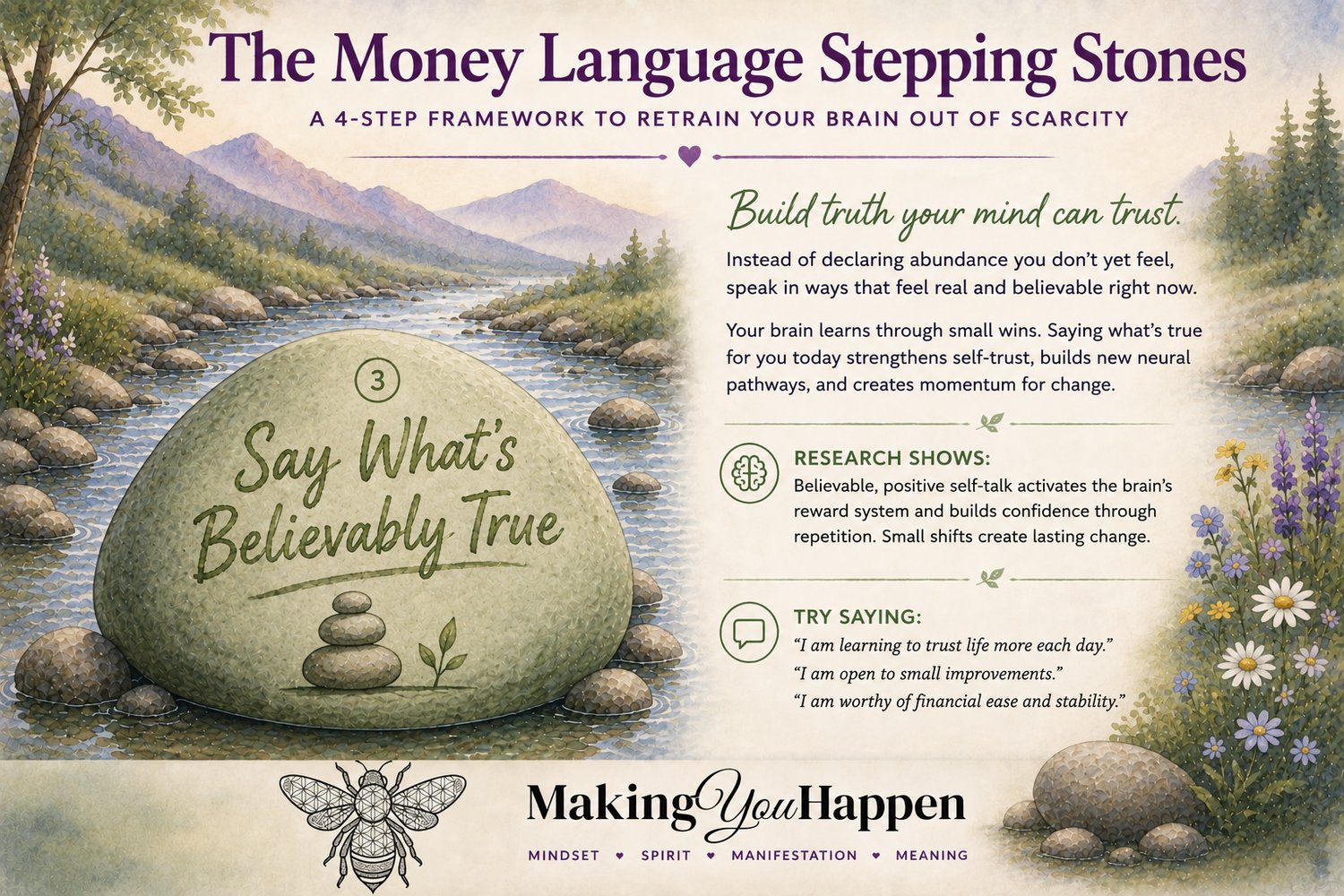
Now, and only now, do positive statements enter, and they enter wearing believable clothes.
The Waterloo researchers found that self-talk helps when it's specific enough to be undeniable. Sweeping identity claims invite argument; small true statements slip past the guard and begin their quiet work.
The craft here is finding sentences that are genuinely positive and genuinely yours. Process language works better than identity language.
"I am learning to receive" is a claim about direction, and direction is always available. "I have handled tight seasons before" is a claim about history, and your history is full of evidence. "Money has moved through my hands my whole life" is simply true; it arrived, it left, it arrived again, which quietly disproves the story that it never comes.
These sentences won't give you the fireworks of declaring yourself a money magnet. What they give you instead is compounding: statements your whole system can agree with, repeated daily, gradually become the new default track. And a nervous system that isn't braced against its own affirmations is a nervous system finally able to relax around money, which is the state every abundance teacher is actually pointing at.
Try these third-stone shifts:
I am wealthy - becomes - I am learning to receive
Money flows to me easily - becomes - Money has found its way to me before
I always struggle - becomes - I have moved through hard seasons and I'm still here
💜 Stepping Stone Four: Train your Attention on What's Already Flowing
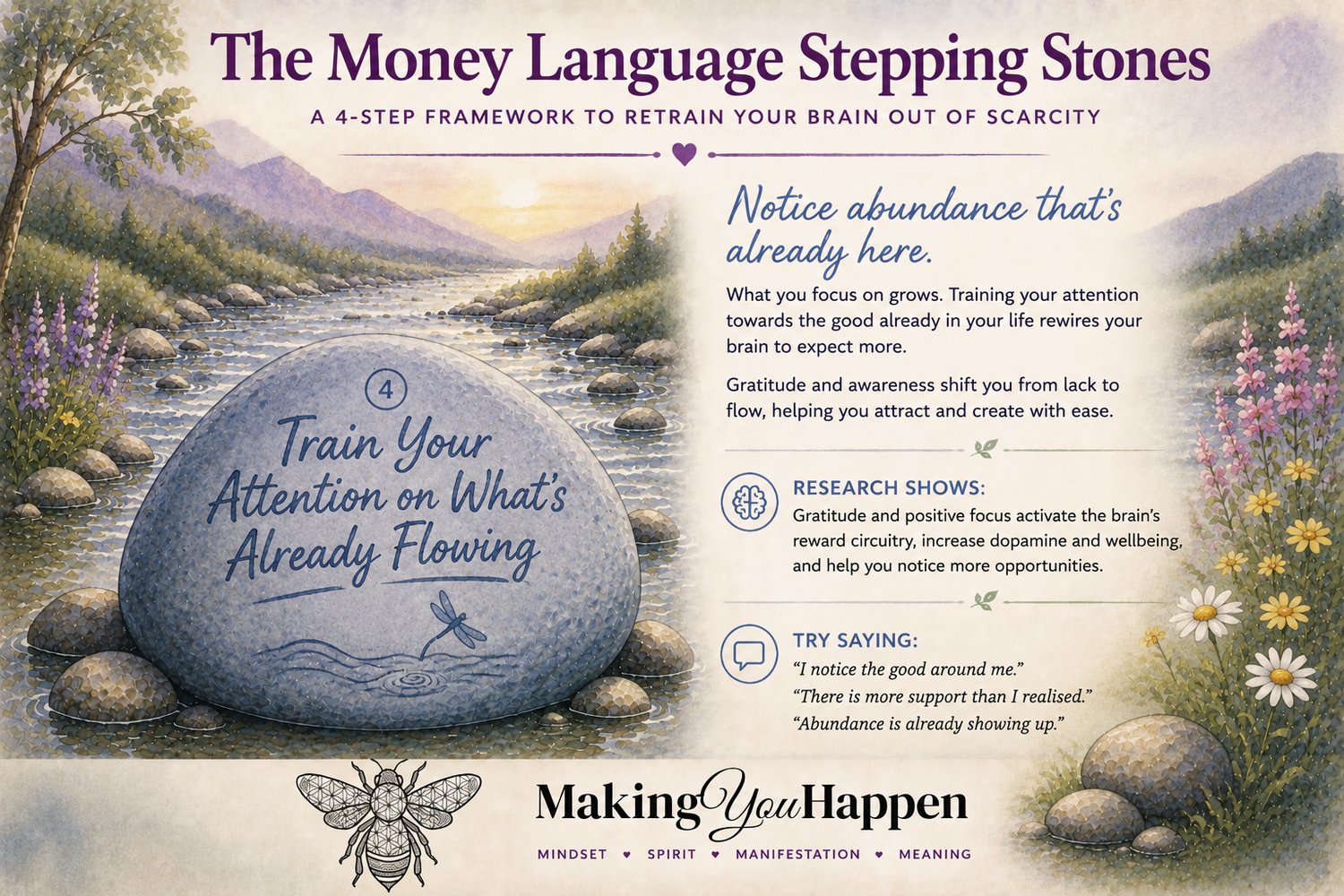
The final stone is where the deeper identity statements, the ones you couldn't say at the start, finally become available, because now they have evidence beneath them.
This is where gratitude earns its place in serious inner work, well beyond the greetings-card version. Research consistently finds that regular gratitude practice retrains the brain's attention towards sufficiency: you begin scanning for what arrived, what held, what was provided, which is the precise reversal of the scarcity tunnel described earlier. You are teaching your mind a new search pattern.
For money specifically, this means deliberately noticing the flow you already live inside. The wage that landed, however modest. The meal that appeared. The friend who covered the coffee. The roof, the kettle, the library, the sun on the kitchen table costing nothing at all. None of this denies difficulty. It widens the frame until difficulty stops being the only thing in the picture.
After some weeks of this noticing, try the higher sentences again:
I am someone support finds.
Abundance moves towards me in more forms than money.
I am grateful for all the abundance that flows easily and consistently to me everyday.
You may be surprised to find your inner sceptic staying quiet, because this time the words rest on a foundation of observed truth.
Putting the stepping stones into an ordinary day
A practice survives when it's small enough to keep. Try these three mini anchors each day:
- One catch a day. Notice a single scarcity sentence as it happens and walk it one Money Language Stepping Stone forward. One is enough; you're building a reflex.
- One written question. Each morning or evening, write one open money question in a notebook: How could I create a little more ease this month? Let it sit. Answers tend to arrive sideways, in the shower, or on a walk, or while cooking dinner.
- One noticing at night. Before sleep, name one way life provided for you today. Thirty seconds, done lying down. This is the evidence file your new sentences will draw on.
That's the whole practice. No vision boards required, no performance of positivity, and never a sentence you don't believe.

The listener who never stops hearing you
Manifestation teaching often frames your words as a broadcast to the universe.
The research offers a humbler and perhaps more beautiful picture: your words are a broadcast to yourself, received by a nervous system that never stops listening, and everything you say lands somewhere in the systems that govern your stress, your attention and your willingness to act.
Change the sentences and you change the listener, and the listener changes what becomes possible. We're not saying the universe isn't listening - just that you listen first, and how you respond is what you broadcast to the universe.

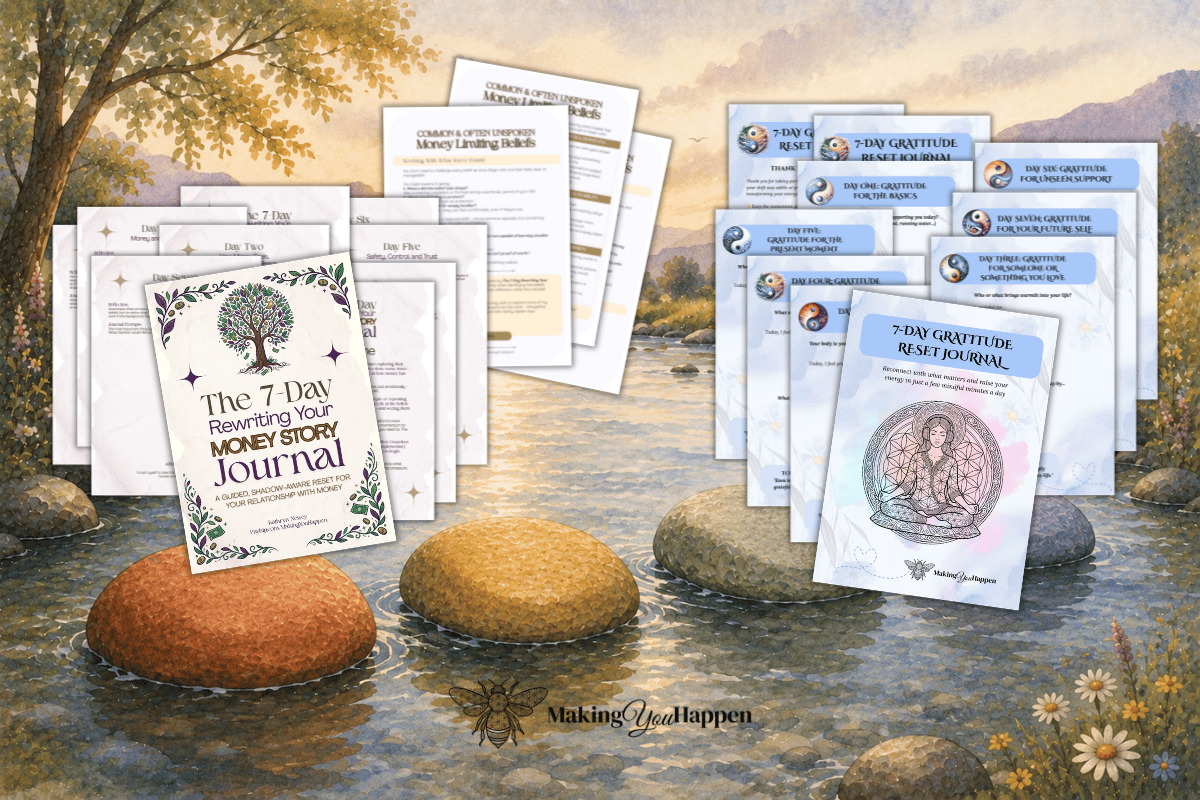
If this resonates, two of my journals were made in exactly this spirit.
The 7-Day Rewriting Your Money Story Journal is the companion to the first three stones. Over seven short daily reflections it helps you trace where your money sentences came from, notice the inherited beliefs still running underneath them, and choose balanced, credible shifts, the kind your whole self can agree to. If you'd like extra support identifying those beliefs, the Common & Unspoken Money Limiting Beliefs checklist pairs naturally with Day Three of the journal.
The 7-Day Gratitude Reset Journal is the companion to the fourth stone. Seven guided days of noticing what supports and sustains you, with no forced positivity anywhere in it, moving you gently from scarcity into appreciation in five to ten mindful minutes a day.
Begin whenever you're ready. The river will wait, and the stones will hold.
And there's a bonus for those who read all the way to here! Because you're serious about your money language, here's the FREE 12-page Money Language Steeping Stones Guide - simply click the link, fill in your name and email, and you'll get an instant download. Yours to keep for whenever your money affirmations feel a little wobbly.
Further reading
- Newberg, A. and Waldman, M. R. (2012). Words Can Change Your Brain. Penguin. On how single words influence stress genetics, cortisol and the brain's reasoning centres.
- Wood, J. V., Perunovic, W. Q. E. and Lee, J. W. (2009). Positive self-statements: power for some, peril for others. Psychological Science, 20(7), 860-866. The study showing unbelievable affirmations can backfire.
- Senay, I., Albarracín, D. and Noguchi, K. (2010). Motivating goal-directed behavior through introspective self-talk: the role of the interrogative form of simple future tense. Psychological Science, 21(4), 499-504. Why questions outperform declarations.
- Dutcher, J. M., Creswell, J. D. et al. (2016). Self-affirmation activates the ventral striatum: a possible reward-related mechanism for self-affirmation. Psychological Science, 27(4), 455-466. Brain imaging evidence that value-connected words engage reward circuitry.
- Mullainathan, S. and Shafir, E. (2013). Scarcity: Why Having Too Little Means So Much. Penguin. The research behind scarcity's tunnel vision.
- Cascio, C. N., Falk, E. B. et al. (2016). Self-affirmation activates brain systems associated with self-related processing and reward. Social Cognitive and Affective Neuroscience, 11(4), 621-629. Further neural evidence for affirmation done well.
Comments ()