The Peak Guide
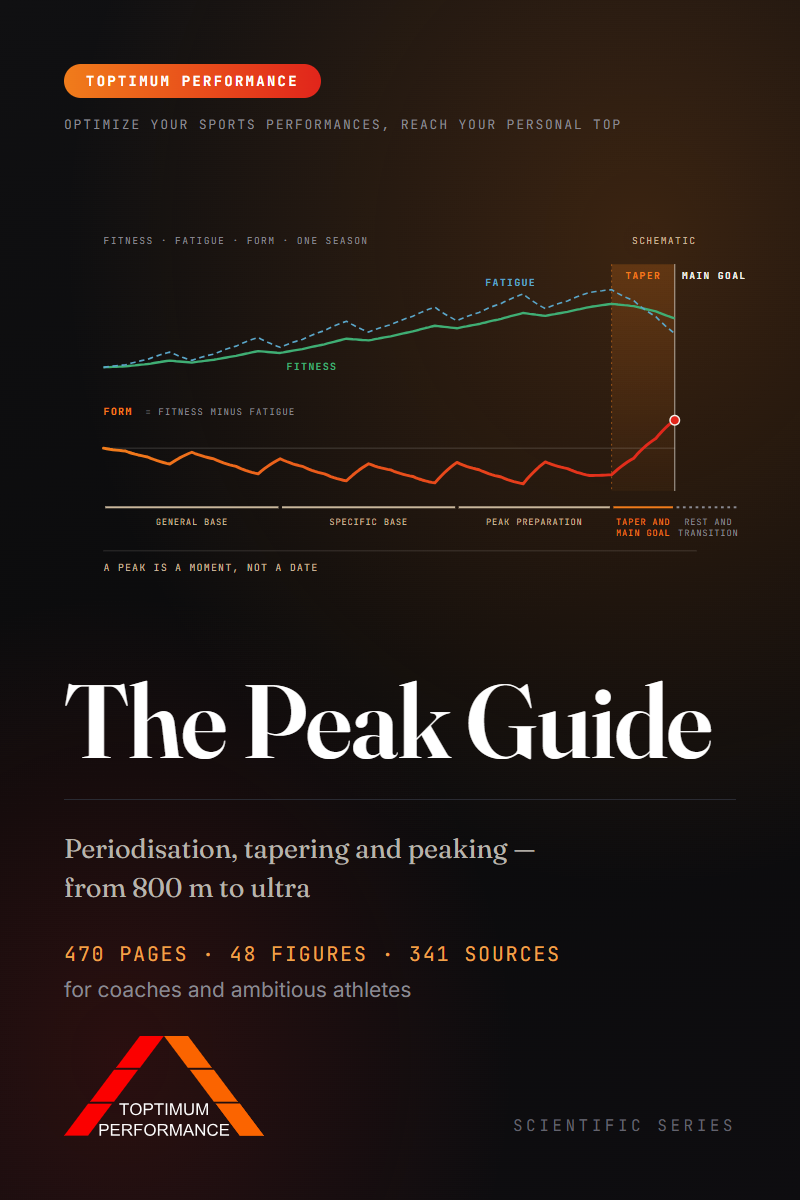
A main race has a date; a peak does not. The peak is the period in which a runner’s form is at its highest, and no plan can pin it down to the day in advance. What a plan can do is distribute load and recovery over the months so that this period coincides as closely as possible with the race that counts. Arranging them in this way is called periodisation, and it is the subject of this book.
There are many models of how best to do this, and few comparisons between them. With the same total load, the controlled studies in endurance athletes do not single out any model that clearly improves performance more than the others, and in runners such studies hardly exist. What studies and descriptions of good runners do support, taken together, is smaller and more usable: a stable base that remains in place throughout the year, emphases that shift gradually towards the race, fatigue that is managed rather than left to accumulate unplanned, and a taper that removes part of the volume but maintains the intensity and the rhythm of the sessions.
That is the idea on which the whole book rests: the peak is built in the months before the race. In the final weeks, the taper above all lets fatigue fall away, and so reveals what has been built in those months. It can sharpen the peak further, but it does not replace the build-up.
The book therefore promises neither a winning model nor a formula for the peak day. For each topic, it sets side by side what has been measured, what good runners and their coaches describe and what can only be inferred, and it keeps those three apart. Each chapter states in a box of its own how firmly its content is grounded: well supported, mainly practice or still open. If a value comes from swimming, cycling or cross-country skiing, this is stated with the finding. And if an approach rests on practice rather than on research, the book calls it just that: a practice-based approach. This is how Renato Canova’s funnel is included — the image in which the long, slower work and the short, faster work move towards race pace — with a figure of its own and the note that no study has compared it with another way of building the season.
What's inside
- The framework — where the periodisation models come from, what they promise, what is left standing when the research is set beside them, and what good runners actually do.
- The biology beneath the plan — how load leads to adaptation, how fitness, fatigue and form are related, overreaching and overtraining, and what is lost when training stops.
- Building the year — counting back from the main goal, blocks and recovery weeks, shifting emphases, one timeline for strength, altitude, heat and nutrition, and the year by distance.
- Measuring and adjusting — monitoring without a miracle metric, testing at the turning points of the plan, and adjusting when illness, an injury or a busy period disrupts the plan.
- The taper — why a taper works, what the meta-analyses say, how it differs by distance and level, and what happens in the weeks before it.
- Peaking — one peak or more, championships with heats and finals, and race week and race day. On multiple peaks the evidence is the weakest in the whole book, and the book says so.
- Special populations and the long term — the female runner, masters and the recreational runner with little time, the young runner and the career, and the season on one page: ten decisions from the main goal to the transition, with an annual chart to fill in.
Each chapter ends with a “For the coach” box and a summary. With seven reference lists — one per part — and a glossary of 159 terms, each with the meaning it has in this book.
For whom
Coaches and ambitious athletes who build a season towards one or a few races that count: anyone who draws up an annual plan, maps out a taper or adjusts a plan when the season does not go as planned. The book covers the running spectrum from 800 m to the marathon; trail and ultra are dealt with briefly, because no controlled research on periodisation or tapering exists for those runners. How a threshold is determined and how a lactate test is conducted are covered in The Threshold Guide and The Lactate Guide.
The book gives no medical advice and no personal plan. Where it deals with illness, overtraining or the heart, it describes the signs a coach can recognise; the diagnosis belongs with a doctor. The tables and approaches offer a structure; a personal plan requires knowledge of the athlete and, for the zones, a test.
Extent
470 pages · 27 chapters · 48 figures · 27 tables · 341 sources (with DOI where available) · seven reference lists · glossary of 159 terms