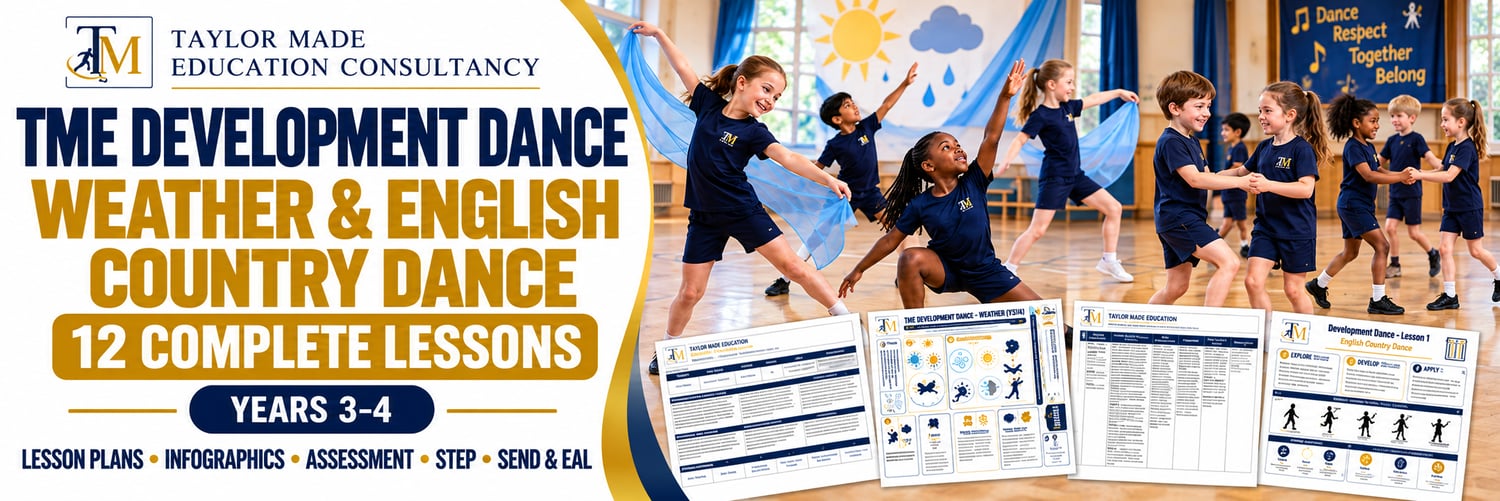
TME Development Dance Years 3–4 | Ages 7–9 | Lower KS2
Inspire expressive movement with six progressive Weather Dance lessons created for Years 3–4 and designed to fill approximately 55–60 minutes each.
Pupils investigate weather dynamics before exploring wind pathways, rain rhythms and canon, storm-inspired levels and contrast, composition and transitions, and a final performance and evaluation. The familiar theme gives children a meaningful stimulus while helping them understand how body actions, space, timing, relationships and dynamics affect the mood and clarity of a dance.
The scheme opens with curriculum, assessment and inclusion guidance. Every lesson is supplied as a detailed written plan alongside a matching visual infographic. Resources include clear Know and Show outcomes, vocabulary, lesson timings, organisation, assessment questions, Head–Heart–Hands criteria, STEP differentiation, SEND and EAL support, safety guidance and Plan–Monitor–Reflect prompts.
This scheme is especially valuable because creativity is carefully scaffolded without prescribing every movement. Pupils make choices, explain their intentions and refine their work using feedback. Strong links with science, music, communication and vocabulary make it a rich cross-curricular resource as well as an engaging dance unit.Introduce Years 3–4 pupils to the rhythm, cooperation and cultural character of English Country Dance through six carefully sequenced lessons of approximately 55–60 minutes.
The scheme develops pulse, phrasing and traditional country steps before introducing partner figures and the Patacake Polka. Pupils then experience longways sets and the Farmer’s Jig, investigate further figures and formations, compose and record their own material, and prepare a final sharing performance. Respectful partnering, spatial awareness and considerate physical interaction are reinforced throughout.
Two introductory pages support curriculum planning, assessment and inclusion. Each lesson includes a comprehensive written plan and a matching visual infographic, together with outcomes, vocabulary, equipment, timings, organisation, AfL questions, Head–Heart–Hands assessment, STEP adaptations, SEND and EAL support, safety guidance and Plan–Monitor–Reflect prompts.
The scheme combines authentic dance structures with pupil creativity. Repetition makes the dances achievable, while changing partners and formations develops cooperation, counting, listening and adaptability. It offers enough detail to give non-specialists confidence while retaining the depth required for purposeful performance, composition and evaluation.