
Supporting Situational Speech Loss
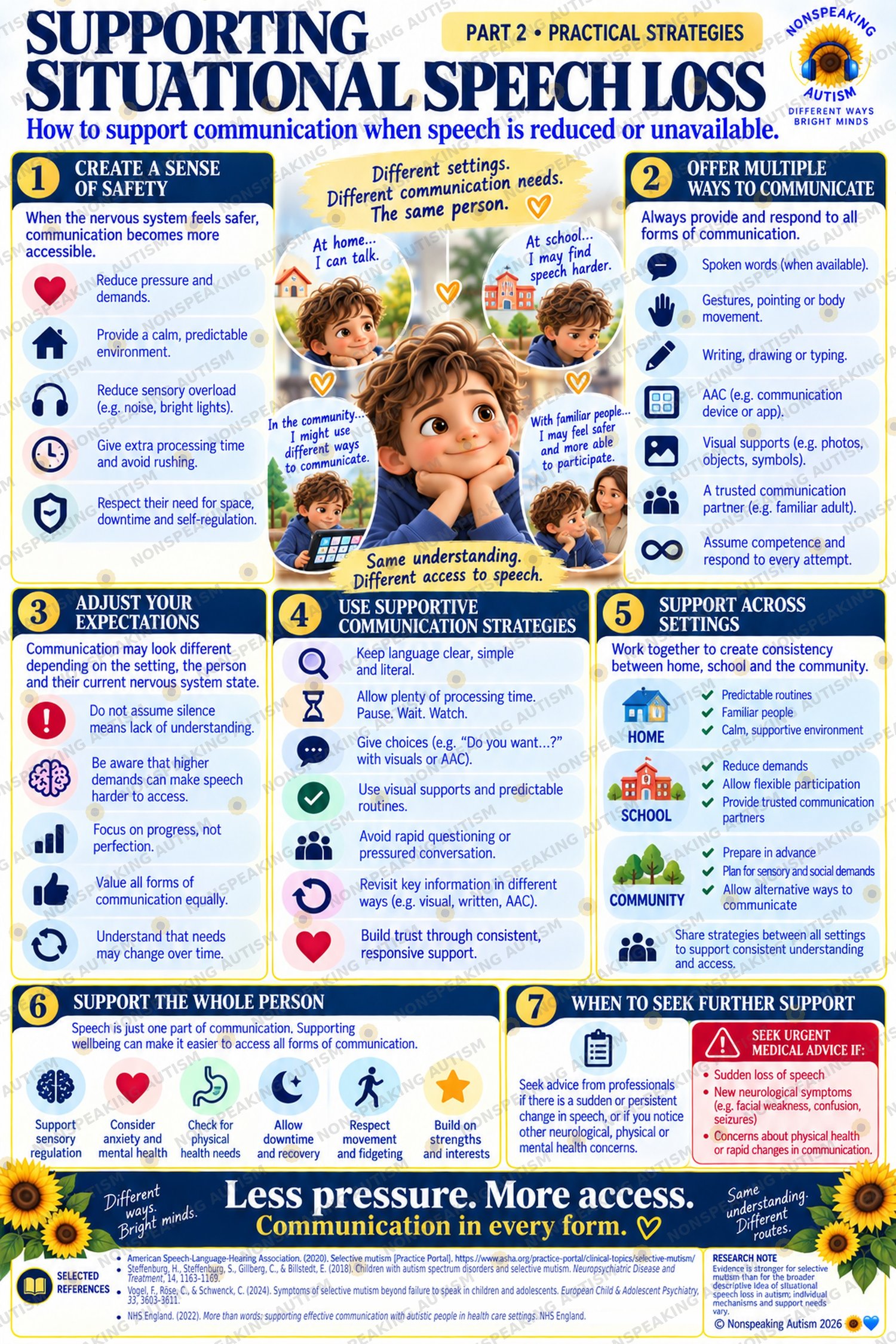
Supporting Situational Speech Loss — Part 2: Practical Strategies
How to support communication when speech is reduced or unavailable
A child may speak freely at home but struggle to access speech at school.
They may communicate verbally with familiar people but become quiet in unfamiliar environments.
They may use speech when regulated, yet rely on AAC, gestures, pointing, writing, typing or visual communication when overwhelmed.
This does not automatically mean they are refusing to speak.
Supporting Situational Speech Loss — Part 2: Practical Strategies is a practical, neurodiversity-affirming educational poster designed to help parents, caregivers, educators and professionals support communication when spoken language becomes reduced, difficult or temporarily unavailable.
Rather than increasing pressure to produce speech, this resource focuses on safety, communication access, processing time, sensory support and responsive communication.
The central message is:
Less pressure. More access. Communication in every form. 💛
🧠 What This Poster Explores
This practical guide focuses on seven areas:
1️⃣ Create a Sense of Safety
2️⃣ Offer Multiple Ways to Communicate
3️⃣ Adjust Your Expectations
4️⃣ Use Supportive Communication Strategies
5️⃣ Support Across Settings
6️⃣ Support the Whole Person
7️⃣ Know When to Seek Further Support
The aim is not to make someone speak on demand.
It is to make sure they still have a way to communicate when speech is difficult.
❤️ 1️⃣ Create a Sense of Safety
Communication can become harder when someone is experiencing high levels of stress, sensory overload, anxiety or processing demand.
During these moments, increasing pressure may make communication even more difficult.
Support can begin by considering the environment around the person.
This may include:
reducing pressure and unnecessary demands
creating a calmer, more predictable environment
reducing overwhelming noise or bright lighting
allowing additional processing time
avoiding rushing
respecting the person's need for space
allowing preferred forms of self-regulation
The goal is not to make the person appear calm.
The goal is to reduce unnecessary barriers so that communication becomes more accessible.
🏠 Different Settings — Different Communication Needs
A person's access to speech can vary considerably between environments.
Someone might:
🏡 At Home
Speak relatively comfortably in a familiar, predictable environment.
🏫 At School
Find speech more difficult because of increased sensory, social, language or performance demands.
🌳 In the Community
Prefer AAC, gestures, writing or another communication method.
👨👩👧 With Familiar People
Feel safer and find communication more accessible.
This variation does not automatically mean the person is choosing when to speak.
It reminds us that communication happens within an environment.
Same person. Different setting. Different communication needs.
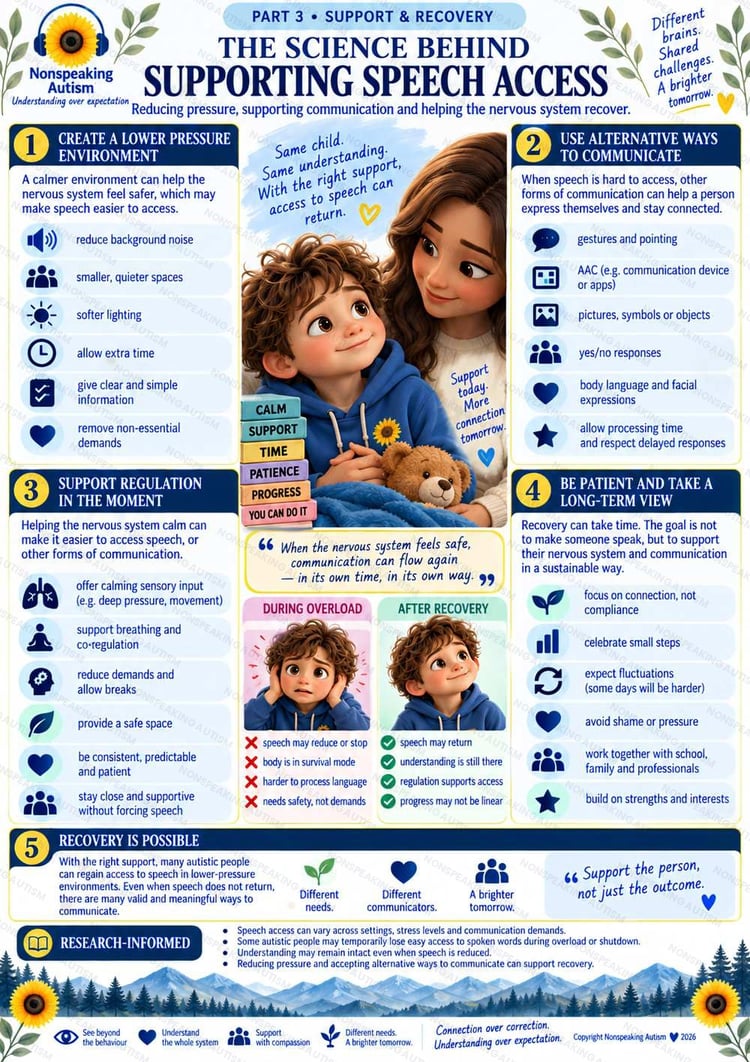
💬 2️⃣ Offer Multiple Ways to Communicate
Speech should never be the only available route to communication.
Depending on the individual, communication may include:
spoken words when available
gestures
pointing
body movement
writing
drawing
typing
AAC
communication devices or apps
photos
objects
symbols
yes/no responses
a trusted communication partner
A person should not have to demonstrate that speech is completely unavailable before they are permitted to use another method.
If a communication method works for the person, respond to it.
📱 Keep AAC Available
If someone uses AAC, their communication system should remain accessible even when speech is present.
Speaking in one situation does not necessarily mean speech will remain equally accessible:
later in the day
when tired
when overwhelmed
in another environment
with unfamiliar people
during anxiety or distress
AAC is not simply a backup for people who never speak.
For some people, it is one part of a multimodal communication system.
Speech and AAC can coexist.
3️⃣ Adjust Your Expectations
Communication may look different depending on:
the setting
the people present
sensory load
fatigue
anxiety
processing demands
language demands
the person's current state
This means support should be flexible.
Do Not Assume Silence Means Lack of Understanding
Reduced speech does not automatically demonstrate reduced comprehension.
At the same time, we should not assume we know exactly what someone understands simply because they can speak in another setting.
Provide accessible information and communication support without judging understanding solely from spoken output.
Higher Demands May Make Speech Harder to Access
Long questions, rapid conversation, repeated prompting or pressure to answer immediately can increase communication demands.
Focus on Progress — Not Perfection
Successful communication does not have to look like fluent spoken conversation.
Value Different Communication Modes
A typed answer, gesture, AAC message or point can be just as meaningful as a spoken response.
Understand That Needs Can Change
Communication support may need to change across environments and over time.
⏳ 4️⃣ Use Supportive Communication Strategies
Small changes in how adults communicate can make a significant difference.
🔍 Keep Language Clear
Use clear, meaningful language and avoid unnecessary verbal overload.
⏳ Allow Processing Time
Ask or communicate — then wait.
Avoid filling every silence with another question.
💬 Offer Accessible Choices
Where appropriate, use simple choices supported by visuals or AAC.
👁️ Use Visual Information
Visual schedules, written information, symbols and predictable routines may reduce the amount of information that must be processed through speech alone.
👥 Avoid Rapid Questioning
Repeated questions can turn communication into a performance demand.
🔄 Present Information in Different Ways
Important information may be easier to understand when it is available through:
spoken language
written information
visuals
AAC
or a combination.
❤️ Build Trust Through Responsive Support
Communication becomes more meaningful when people learn that their messages will be noticed and respected.
🛑 Don't Turn Communication Into a Test
When someone is struggling to speak, repeated demands such as:
“Tell me.”
“What's wrong?”
“Use your words.”
“You can talk to me.”
“Say it.”
may increase pressure.
Instead, try making communication available without requiring a particular response.
For example:
“You can tell me, show me, point, type or use your device.”
Then allow time.
Sometimes support means creating an opportunity to communicate and not immediately demanding that the person use it.
🏡 5️⃣ Support Across Settings
Communication support is often most effective when the important people around the person share information and strategies.
At Home
Helpful approaches may include:
predictable routines
familiar communication partners
a calm and supportive environment
reliable access to AAC
At School
Consider:
reducing unnecessary communication demands
allowing flexible participation
keeping AAC accessible
providing trusted communication partners
allowing additional processing time
avoiding forced verbal participation
In the Community
Support may include:
preparing in advance
planning for sensory and social demands
allowing alternative communication
carrying accessible AAC or visual supports
identifying quieter spaces
having a familiar support person where useful
Consistency does not mean every environment must be identical.
It means the person should not lose access to communication simply because the setting changes.
🌻 6️⃣ Support the Whole Person
Speech is only one part of communication.
And communication is only one part of the whole person.
If speech becomes difficult, consider what else may be happening.
🧠 Support Sensory Regulation
Is the environment noisy, crowded, bright or otherwise overwhelming?
❤️ Consider Anxiety & Mental Health
Is the person frightened, uncertain or experiencing substantial social pressure?
🩺 Consider Physical Needs
Pain, illness, hunger, thirst, gastrointestinal discomfort, medication effects and other physical factors can influence communication.
🌙 Allow Downtime & Recovery
Fatigue can affect communication access.
🚶 Respect Movement & Fidgeting
Movement may help some people regulate while communicating.
⭐ Build on Strengths & Interests
Communication is often easier and more meaningful when it connects to something the person genuinely cares about.
🌿 Regulation Before Performance
Sometimes adults focus so strongly on obtaining an answer that they miss the conditions making communication difficult.
If someone is overwhelmed, the priority may need to become:
reduce the load
support regulation
keep communication accessible
allow recovery
rather than:
“Get them to answer.”
Communication support should help the person express themselves, not simply demonstrate a skill on demand.
🚨 7️⃣ When to Seek Further Support
Changes in speech should not automatically be attributed to autism, anxiety, shutdown or situational speech loss.
Seek appropriate professional advice when there is a sudden, persistent, significant or unexplained change in speech or communication, or where there are concerns about neurological, physical or mental health.
Seek urgent medical help for symptoms such as:
sudden loss of speech
new facial weakness
new confusion
seizures
loss or alteration of consciousness
other sudden neurological symptoms
rapid or concerning changes in communication accompanied by physical illness
In an emergency, follow the appropriate emergency medical guidance for your location.
🔬 Research-Informed
This resource draws on broader research and clinical guidance concerning autism, communication, AAC, selective mutism, anxiety and communication access.
Research supports several important principles:
Communication can vary substantially across settings and circumstances.
AAC and multimodal communication can provide meaningful communication access.
Communication should not be limited to speech.
Reducing communication pressure can be important where anxiety or distress is contributing to difficulty speaking.
However, an important distinction needs to be made.
Situational speech loss is not automatically the same as selective mutism.
Selective mutism is a recognized anxiety disorder with specific diagnostic criteria.
Some autistic people describe temporary reductions or loss of access to speech during overload, shutdown, stress or fatigue, but the research base specifically examining this broader phenomenon is currently more limited.
The terms should therefore not be used interchangeably without appropriate assessment.
📚 Selected References & Guidance
American Speech-Language-Hearing Association (ASHA). (2020). Selective Mutism — Practice Portal. Guidance on assessment, communication and support for people experiencing selective mutism.
Steffenburg, H., Steffenburg, S., Gillberg, C., & Billstedt, E. (2018). Children with autism spectrum disorders and selective mutism. Neuropsychiatric Disease and Treatment, 14, 1163–1169.
Vogel, F., Rose, C., & Schwenck, C. (2024). Symptoms of selective mutism beyond failure to speak in children and adolescents. European Child & Adolescent Psychiatry, 33, 3603–3611.
NHS England. (2022). More than words: supporting effective communication with autistic people in health care settings.
Research Note
Evidence concerning selective mutism is currently stronger than research specifically examining the broader experience often described as situational speech loss in autistic people.
This resource therefore uses situational speech loss as a descriptive educational term, rather than presenting it as a formal diagnosis or a single established neurological condition.
👨👩👧 Who Is This Resource For?
This resource may be useful for:
- autistic children and young people
- autistic adults
- people with variable or unreliable access to speech
- AAC users
- parents and caregivers
- families
- teachers and teaching assistants
- SENCOs and SEND professionals
- speech and language therapists
- occupational therapists
- psychologists and mental-health professionals
- support workers
- early-years practitioners
- autism and disability organizations
- professional-development environments
It can be used as a home reference, classroom visual, staff-training resource or conversation starter about communication access.
📦 What You Receive
This download includes:
1 × Supporting Situational Speech Loss — Part 2: Practical Strategies educational poster
1 × high-resolution printable PDF
The downloaded resource is supplied clear and without the promotional preview watermark shown on the Payhip listing image.
Watermarks visible on promotional images are used for preview and copyright protection only and will not appear on the downloadable resource.
FREE DIGITAL DOWNLOAD
This resource is being provided free of charge through Payhip to help make practical communication-support information more accessible.
Digital download only — no physical product will be shipped.
⚠️ Important Educational, Communication & Medical Disclaimer
This resource is provided for educational and informational purposes only.
It is not medical advice, diagnosis, a speech and language assessment, selective-mutism assessment, neurological assessment, psychological assessment, therapy or an individualized communication plan.
The term “situational speech loss” is used descriptively within this resource and should not be interpreted as a formal diagnosis.
Reduced or unavailable speech can have multiple causes. It should not automatically be attributed to autism, anxiety, sensory overload, shutdown or nervous-system regulation.
A new, sudden, persistent, severe or unexplained change in speech or communication requires appropriate professional or medical consideration.
Seek urgent medical assistance where sudden speech loss occurs alongside concerning symptoms such as facial weakness, weakness elsewhere in the body, confusion, altered consciousness, seizure activity or other acute neurological or physical changes.
Communication strategies should be individualized according to the person's communication profile, established AAC, language, sensory and motor needs, health, preferences and circumstances.
This resource should not be used to discourage speech when speech is accessible or to force speech when another reliable communication method is more accessible.
💛 The Message Behind the Resource
Imagine being able to speak comfortably at home but arriving at school and finding that the words will not come as easily.
Now imagine everyone around you responding by asking more questions.
Telling you to speak up.
Waiting for you to “use your words.”
Or assuming you are refusing.
There is another response.
Reduce the pressure.
Give time.
Keep AAC available.
Accept the gesture.
Read the written answer.
Notice the pointing.
Allow the pause.
Respect the silence.
Support regulation.
And make sure the person knows:
“You do not have to communicate in one particular way for me to listen to you.”
Different environments can create different communication demands.
Different moments can require different communication methods.
The person remains the same.
Less pressure. More access. Communication in every form. 💛
Same understanding. Different routes.
Different Ways. Bright Minds.
Connection over correction. Understanding over expectation.
© Nonspeaking Autism 2026 🌻💙