
🌻 Who Teaches a Nonspeaking Child How to Report Harm?
🌻 Who Teaches a Nonspeaking Child How to Report Harm?
Accessible communication, personal safety education and adults who are safe to approach
Safeguarding Awareness Poster | A2 Printable | UK Edition
A child should never have to learn to speak before being given a way to ask for protection.
Disabled children, including nonspeaking autistic children, face a higher risk of abuse, yet they are often the least likely to be taught about personal safety or given a way to tell someone. Many communication systems are built for requesting snacks and activities, but not for saying "stop", "hurt" or "I want to leave".
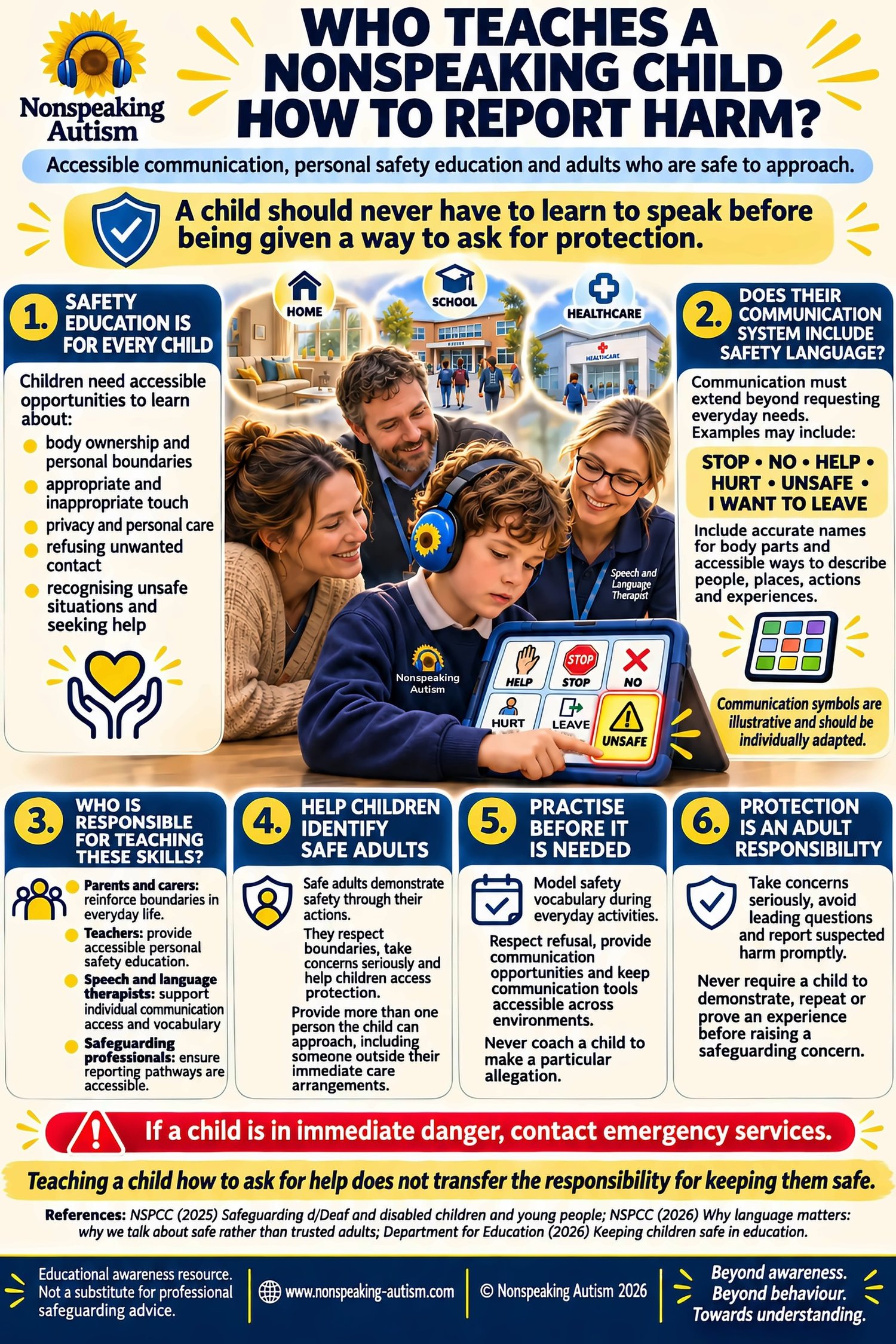
Who Teaches a Nonspeaking Child How to Report Harm? is an illustrated A2 poster that asks a simple but vital question, and sets out what parents, schools, therapists and safeguarding professionals can each do about it.
Teaching a child how to ask for help does not transfer the responsibility for keeping them safe.
🛡️ WHAT THIS POSTER COVERS
1. Safety education is for every child
Children need accessible opportunities to learn about body ownership and personal boundaries, appropriate and inappropriate touch, privacy and personal care, refusing unwanted contact, and recognising unsafe situations and seeking help.
2. Does their communication system include safety language?
Communication must extend beyond requesting everyday needs. Examples may include STOP, NO, HELP, HURT, UNSAFE and I WANT TO LEAVE. Include accurate names for body parts and accessible ways to describe people, places, actions and experiences.
3. Who is responsible for teaching these skills?
- Parents and carers: reinforce boundaries in everyday life.
- Teachers: provide accessible personal safety education.
- Speech and language therapists: support individual communication access and vocabulary.
- Safeguarding professionals: ensure reporting pathways are accessible.
4. Help children identify safe adults
Safe adults demonstrate safety through their actions. They respect boundaries, take concerns seriously and help children access protection. Provide more than one person the child can approach, including someone outside their immediate care arrangements.
5. Practise before it is needed
Model safety vocabulary during everyday activities. Respect refusal, provide communication opportunities and keep communication tools accessible across environments. Never coach a child to make a particular allegation.
6. Protection is an adult responsibility
Take concerns seriously, avoid leading questions and report suspected harm promptly. Never require a child to demonstrate, repeat or prove an experience before raising a safeguarding concern.
👨👩👧 WHO IS THIS POSTER FOR?
- Parents, carers and families
- Designated safeguarding leads and headteachers
- Teachers, teaching assistants and SENCOs
- Speech and language therapists
- Health, social care, residential and respite staff
- Anyone working with disabled or nonspeaking children
Ideal for staff rooms, safeguarding training, therapy rooms and parent workshops.
📦 WHAT YOU RECEIVE
- A2 print-ready PDF (420 x 594 mm)
- A2 high-resolution image (300 DPI)
Instant digital download. No physical product will be posted.
The downloadable files are provided without a watermark.
🔗 FURTHER RESOURCES
NSPCC Learning – Safeguarding d/Deaf and disabled children and young people
https://learning.nspcc.org.uk/safeguarding-child-protection/deaf-and-disabled-children
NSPCC Learning – Why language matters: why we talk about 'safe' rather than 'trusted' adults
https://learning.nspcc.org.uk/news/why-language-matters/safe-adults
Department for Education – Keeping children safe in education 2026
https://www.gov.uk/government/publications/keeping-children-safe-in-education--2
NSPCC Learning – Keeping children safe in education 2026: summary of changes
https://learning.nspcc.org.uk/research-resources/schools/keeping-children-safe-in-education-caspar-briefing
📚 RESEARCH & REFERENCES
Mapped to poster sections:
- 1. Safety education is for every child and 2. Does their communication system include safety language?: NSPCC (2025), Safeguarding d/Deaf and disabled children and young people (personal safety and relationships education not always accessible; using each child's preferred communication method, such as PECS or Makaton, and communication passports).
- 3. Who is responsible for teaching these skills?: Department for Education (2026), Keeping children safe in education; NSPCC (2025).
- 4. Help children identify safe adults: NSPCC (2026), Why language matters: why we talk about 'safe' rather than 'trusted' adults.
- 5. Practise before it is needed and 6. Protection is an adult responsibility: Department for Education (2026), Keeping children safe in education; NSPCC (2025) (making it easier for disabled children to report abuse).
Foundational references (printed on the poster):
1. NSPCC (2025). Safeguarding d/Deaf and disabled children and young people. NSPCC Learning.
2. NSPCC (2026). Why language matters: why we talk about safe rather than trusted adults. NSPCC Learning.
3. Department for Education (2026). Keeping children safe in education.
Sources:
- NSPCC – Why language matters: 'safe' rather than 'trusted' adults
- NSPCC – Safeguarding d/Deaf and disabled children and young people
- DfE – Keeping children safe in education 2026 (PDF)
- NSPCC – KCSIE 2026: summary of changes
⚠️ IMPORTANT DISCLAIMER
This resource is for educational and awareness purposes only. It is not a substitute for professional safeguarding advice, local safeguarding procedures or statutory guidance.
Communication symbols shown are illustrative and should be individually adapted with the support of a speech and language therapist.
If a child is in immediate danger, call 999.
If you are worried about a child, contact your local authority children's services or the NSPCC Helpline on 0808 800 5000.
Children and young people can contact Childline on 0800 1111.
Professionals should follow their organisation's safeguarding procedures and speak to their designated safeguarding lead.
©️ COPYRIGHT & PERMITTED USE
© 2026 Nonspeaking Autism. All rights reserved.
For use in one home, school or setting only.
Please keep the original branding and copyright notice intact. The digital file must not be resold, modified, redistributed, uploaded to other websites or included in commercial products without permission.
💛 PLEASE LEAVE US FEEDBACK
If you find this poster helpful, please consider leaving a review on Payhip. We would love to hear how you used it and what you would like us to create next.
Thank you for supporting Nonspeaking Autism! 🌻
Beyond awareness. Beyond behaviour. Towards understanding.
Nonspeaking Autism © 2026
nonspeaking-autism.com