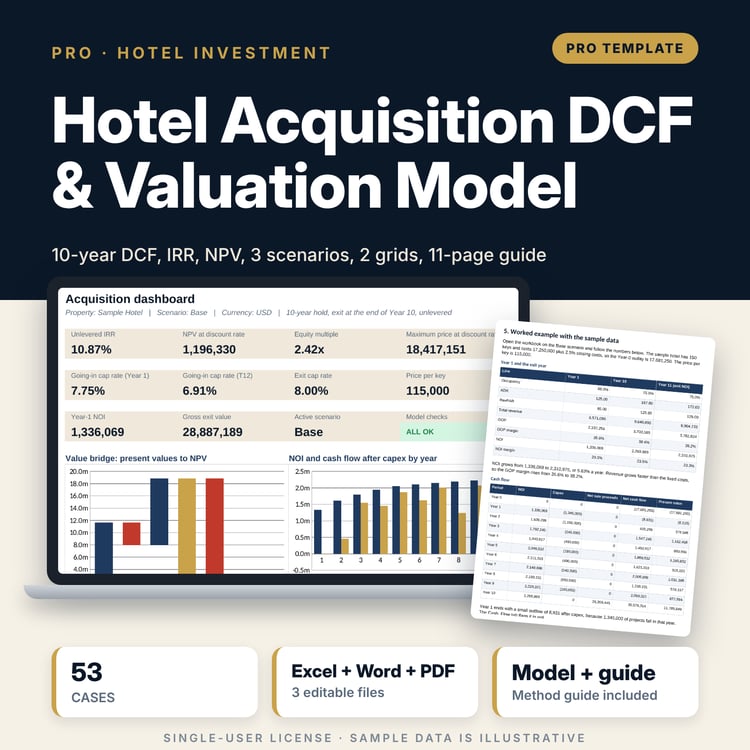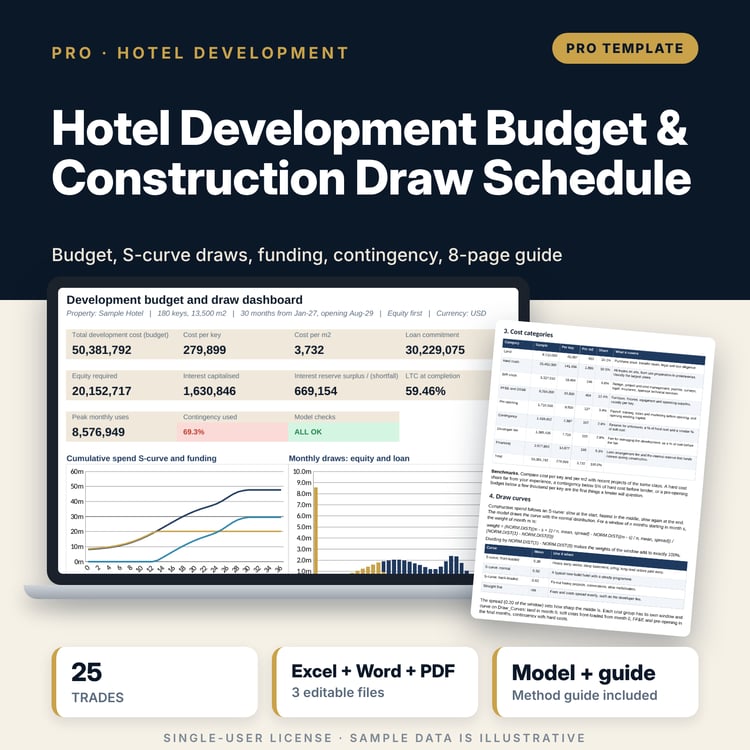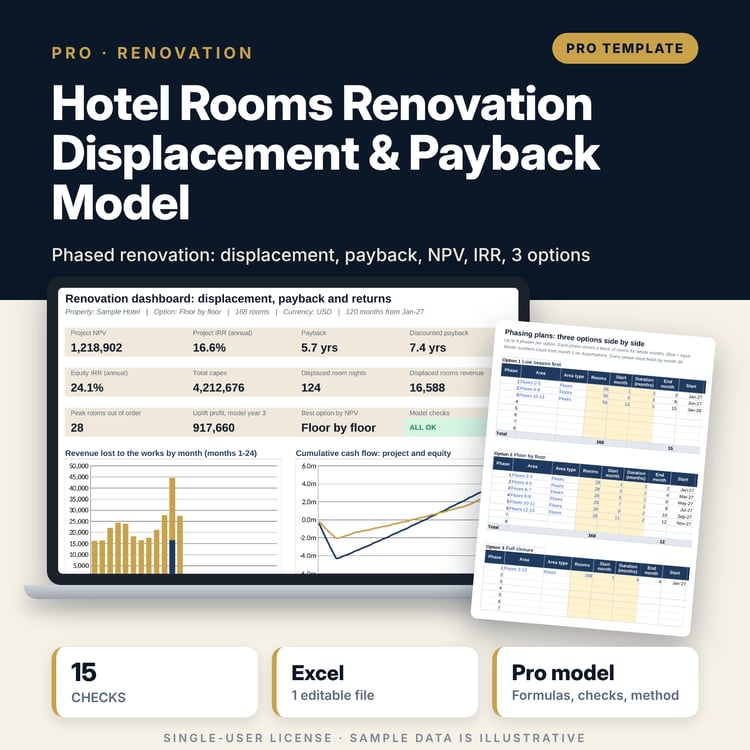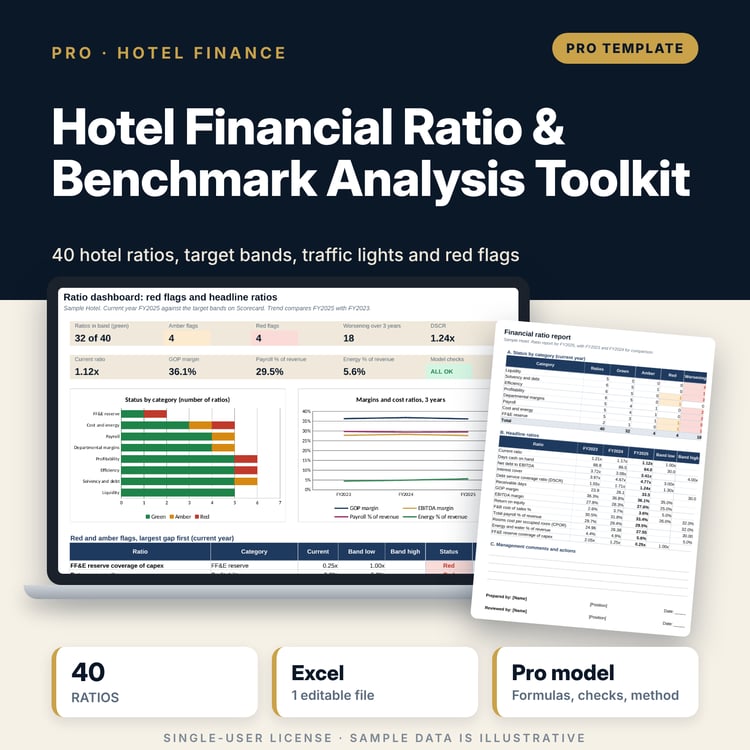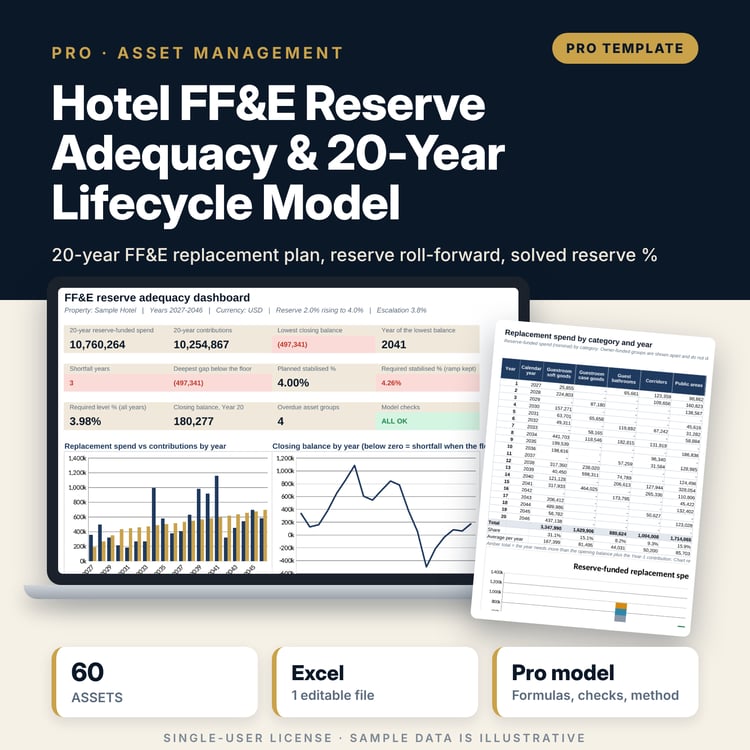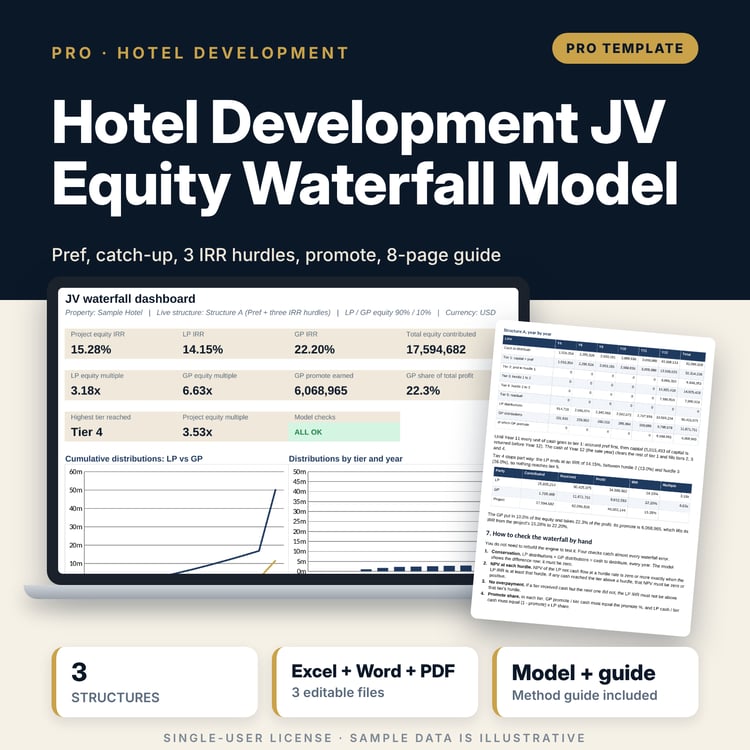


Hotel Cost of Capital & Discount Rate Builder: WACC and discount rate model for hotel valuations
Full description
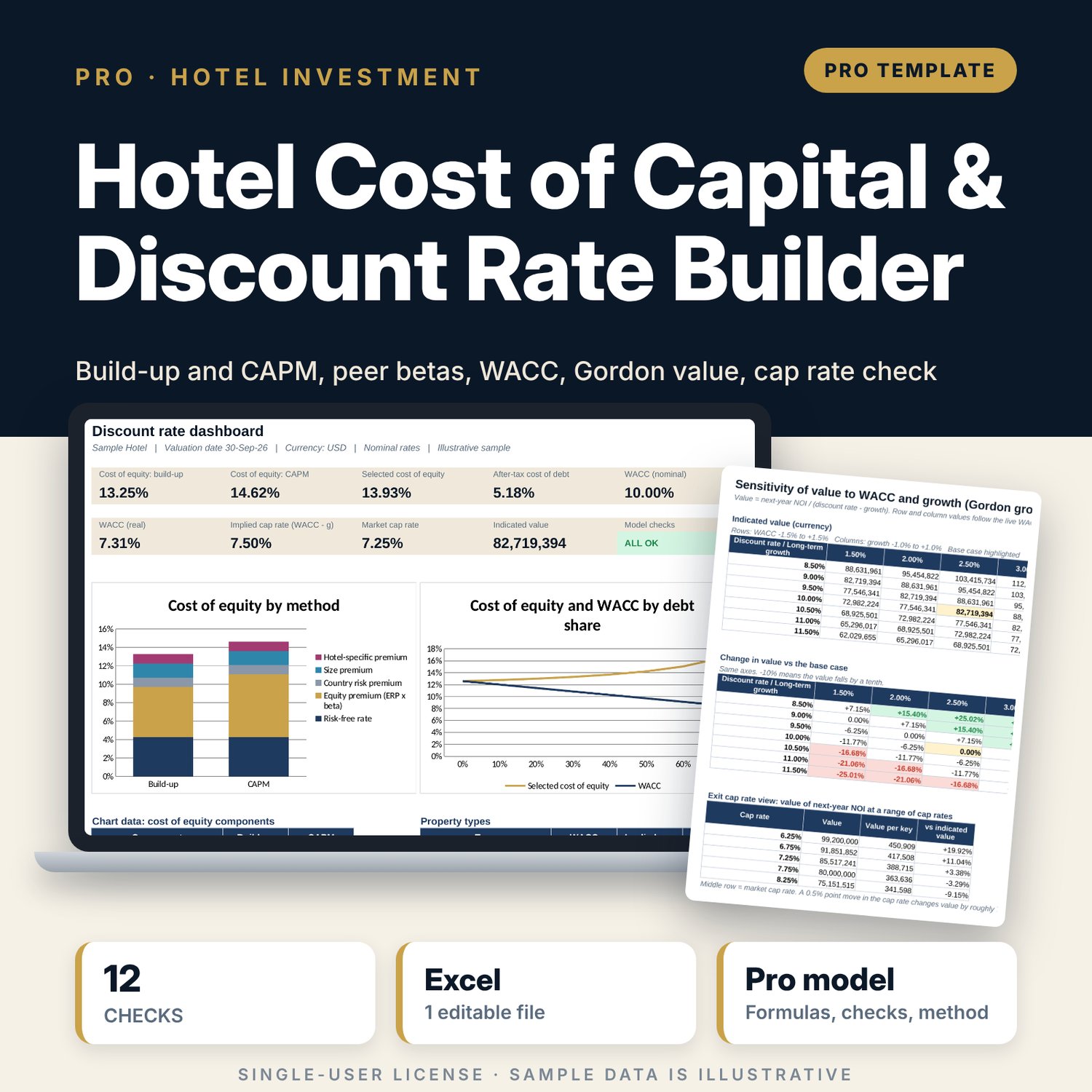
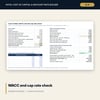
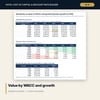
For asset managers, owners, financial controllers and general managers who value hotels or review a valuation. The workbook builds the cost of equity two ways: a build-up of risk-free rate, equity market premium and country, size and hotel-specific premiums; and CAPM with a beta taken from 60 months of listed peer returns (SLOPE, RSQ and the standard error shown), adjusted towards 1, unlevered with each peer's D/E and tax rate and relevered at your target debt share. Cost of debt comes from a lender quote or from an interest-cover table, with fees spread over the loan term and tax relief applied. WACC follows at the target structure, in nominal and real terms. Gordon growth on next-year NOI gives an indicated value and an implied cap rate (WACC - g) that is tested against the market cap rate from comparable sales. Five property types are compared side by side, and a sensitivity tab shows value across discount rates and growth rates. A Sources tab explains where to find each input and how to judge it.
Save with a bundle: this workbook is also in the Hotel Finance & Investment Pro Bundle, 25 workbooks for $59 instead of $329. All 100 Pro workbooks are in the Pro Library for $119, and all 241 templates and workbooks are in the Ultimate Hospitality Library for $149.
What is inside
- Hotel_Cost_of_Capital_Discount_Rate_Builder.xlsx: 12 tabs, 481 formulas, 2 native charts, 12 integrity checks, 17 drop-down and input rules, a Method tab with 16 calculation notes.
- Returns: 60 monthly returns for a market index and 8 listed peers, with volatility and correlation.
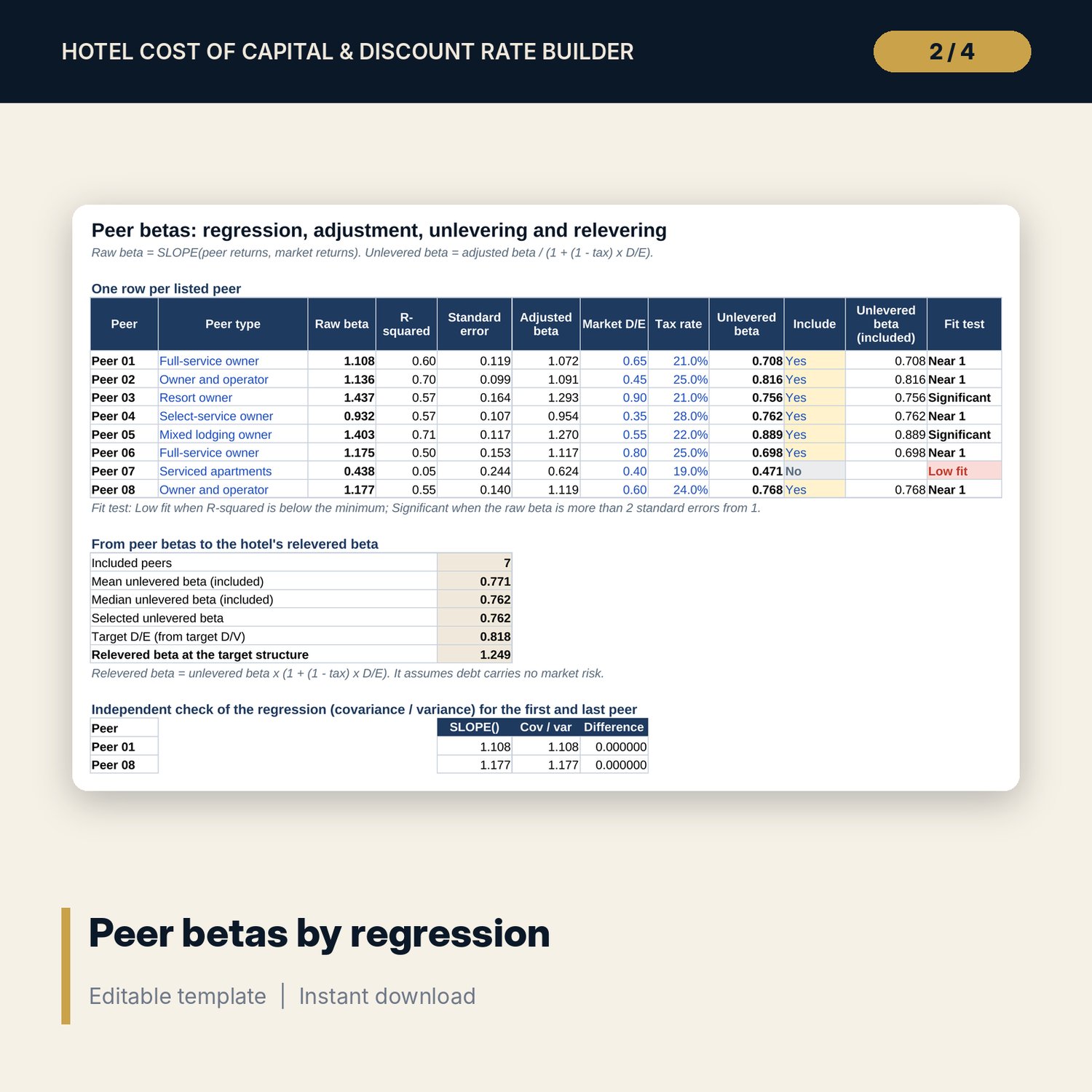
- Peer_Betas: raw beta, R-squared, standard error, adjusted and unlevered beta per peer, include switch, median or mean, relevered beta, and a covariance / variance check of the regression.
- Cost_of_Equity: build-up and CAPM component by component, reconciliation and a beta table.
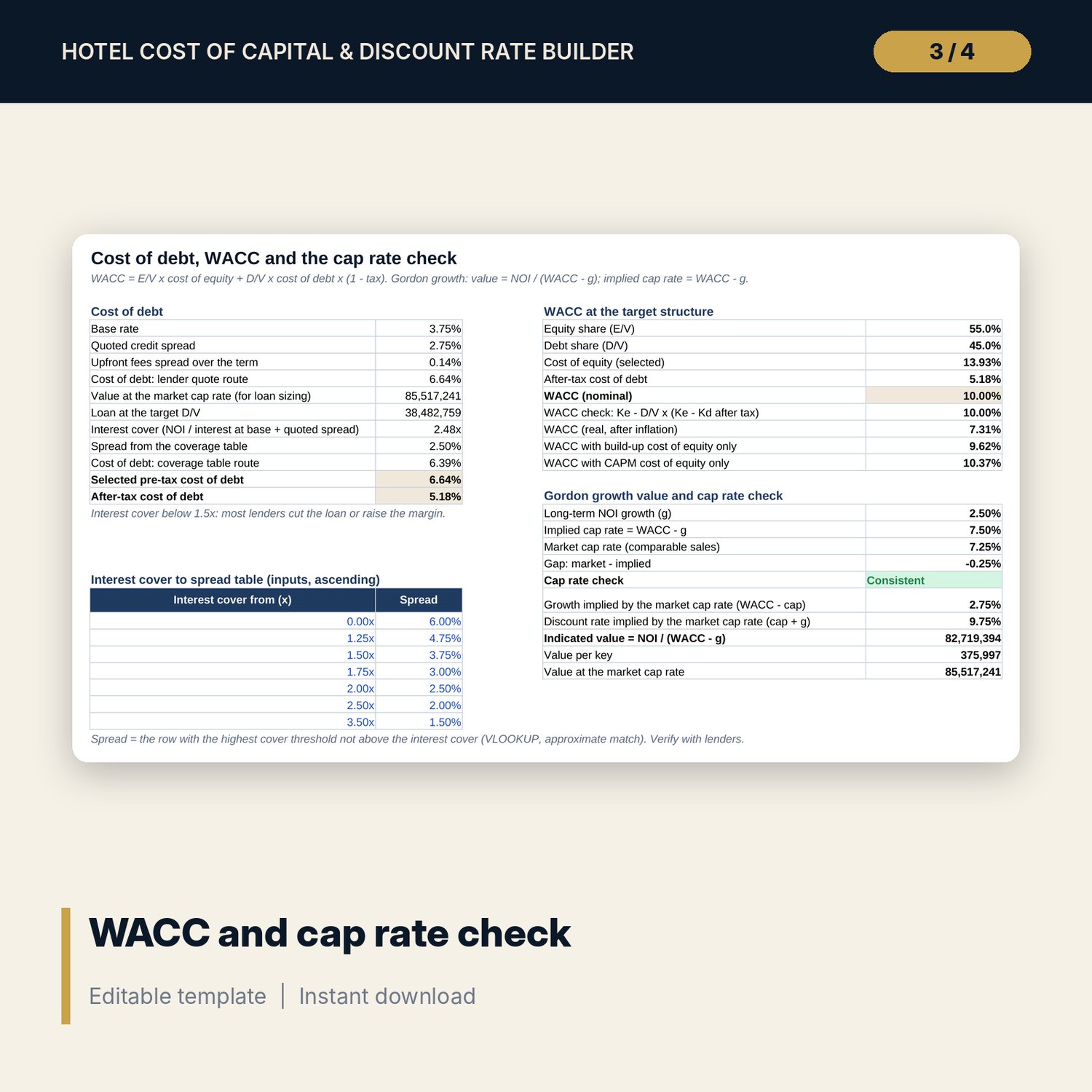
- Debt_and_WACC: two cost of debt routes, WACC at the target structure, Gordon value, value per key, cap rate check and WACC at 8 debt shares.
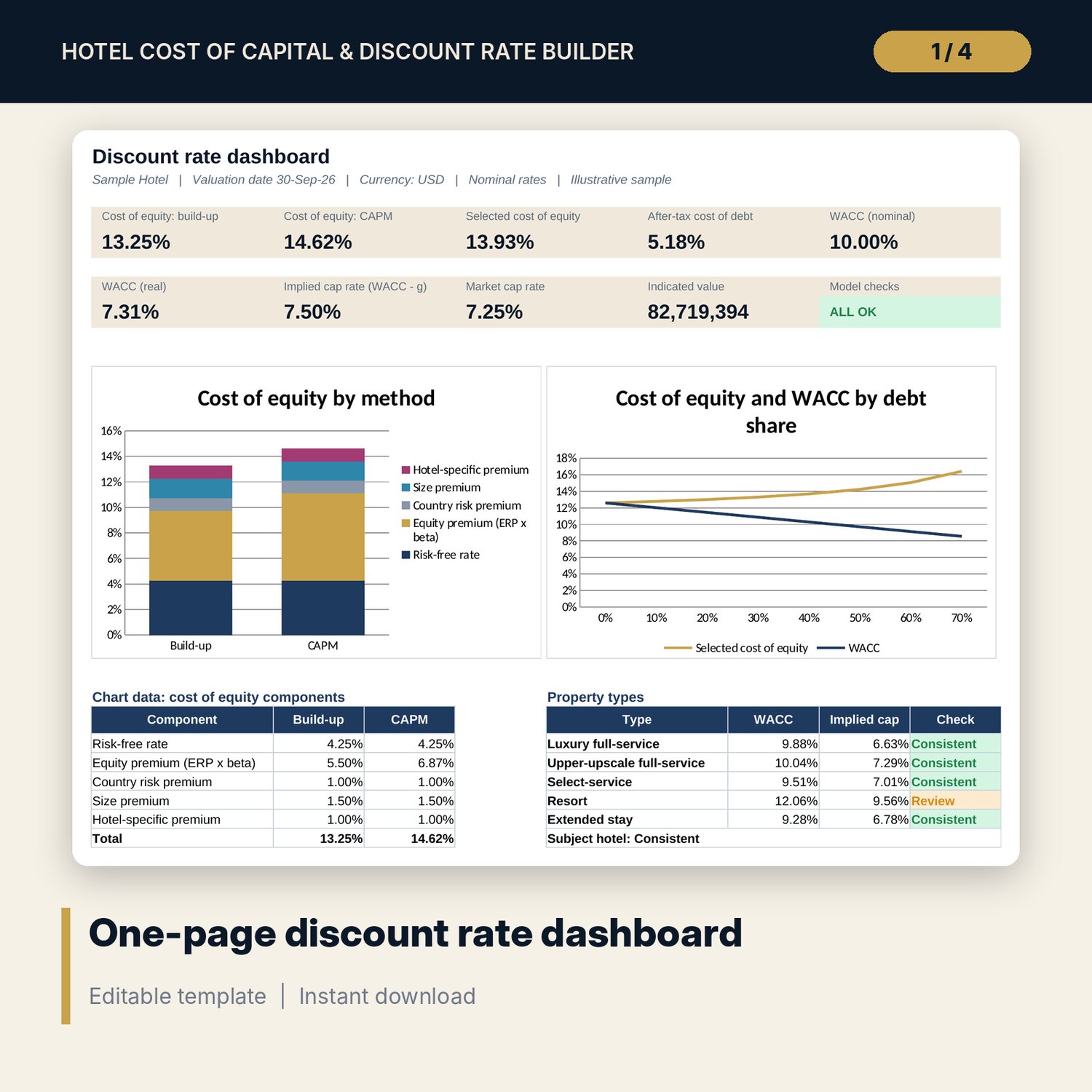
- Property_Types: WACC and implied cap rate for 5 property types.
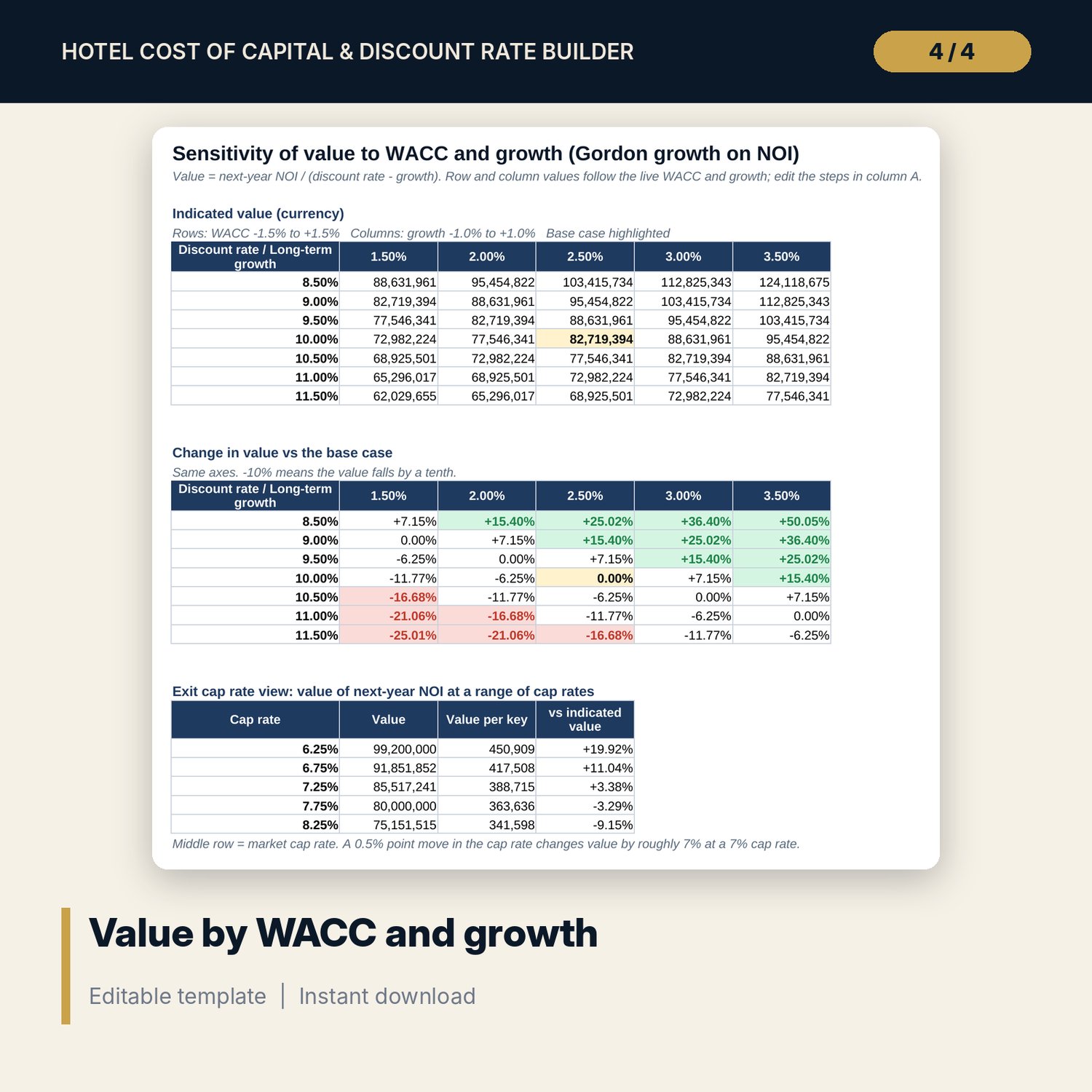
- Sensitivity: value and change in value for 7 discount rates x 5 growth rates, and value at 5 cap rates.
- Sources: 16 inputs with where to find them, a typical range, update frequency and judgement notes.
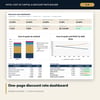
- Dashboard: 9 KPI tiles, a check tile, 2 charts and a property type summary, printable on one page.
- README.txt and LICENSE-and-Terms.txt.
How it works
- Enter the risk-free rate, equity premium, country, size and hotel-specific premiums, and the tax rate.
- Paste monthly returns for a market index and listed peers, then set each peer's D/E, tax rate and Include switch.
- Enter the base rate, spread, fees and target debt share, and choose the cost of debt route.
- Enter next-year NOI, long-term growth and the market cap rate; read WACC, value and the cap rate check.
- Stress the value on Sensitivity, compare property types and record your sources.
Details
- Format: one .xlsx workbook, English.
- Software: Excel 2016 or later, or LibreOffice Calc 7 or later.
- No macros, no data tables, no array formulas, no add-ins.
- Works in any currency; all rates nominal and annual, with real rates shown.
- Delivery: instant download.
Good to know
- Sample data is illustrative: market rates, peer returns and premiums are made up for the example.
- Not investment, valuation or tax advice. Verify local requirements for tax and use current market inputs.
- Gordon growth suits a stabilised hotel; use a full cash flow model for ramp-ups and renovations.
- Single-user license.
FAQ
Why two methods for the cost of equity?
Build-up is simple to explain and common for single assets; CAPM ties the rate to how listed hotel shares move with the market. Showing both, with a reconciliation, makes the chosen rate easier to defend.
Where do the betas come from?
From your own peer data: SLOPE of each peer's monthly returns on the market's monthly returns. The workbook shows R-squared and the standard error so you can drop peers with a weak fit.
How is the cap rate check done?
For a stabilised hotel, cap rate = discount rate - growth. The workbook compares WACC - g with the market cap rate and tells you whether they agree within your tolerance.
Can I use it for a levered equity return instead?
The selected cost of equity is the levered return on equity at the target structure. Use it to discount equity cash flows after debt service; use WACC for unlevered cash flows.
How do I know the formulas are right?
The Checks tab runs 12 tests, including SLOPE against covariance / variance, an unlever-relever round trip, WACC by two formulas and the value against the sensitivity grid.