
School Sensory Profile & Accommodation Checklist
School Sensory Profile & Accommodation Checklist — Part 2
Regulation, Participation & Support
A holistic school resource to help understand needs, reduce distress and increase access
Sensory needs do not stop at identifying whether a student is sensitive to sound, light, touch, movement, smell or other sensory input.
The next question is:
“What happens when those demands build — and what can we do to support the student?”
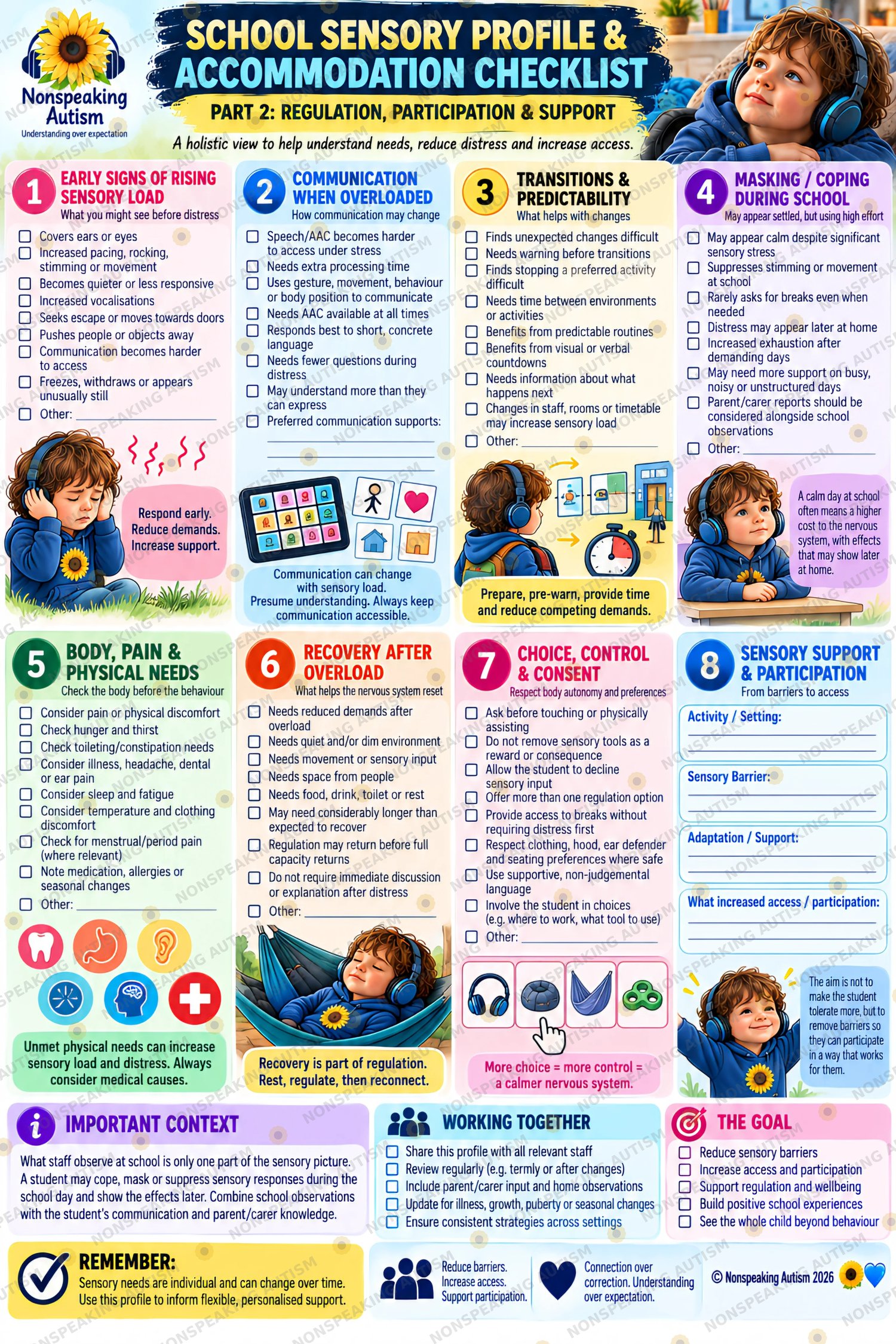
School Sensory Profile & Accommodation Checklist — Part 2: Regulation, Participation & Support is a practical, neurodiversity-affirming printable designed to help parents, caregivers, teachers, SENCOs and professionals look beyond isolated behaviours and understand the whole pattern surrounding sensory load, communication, transitions, masking, physical needs, recovery, autonomy and participation.
Designed as a companion to Part 1, this resource moves from identifying sensory differences towards understanding how those differences may affect the student's school day — and what individualized support may improve access.
The central principle is:
Reduce barriers. Increase access. Support participation. 💙
🧠 What This Checklist Explores
Part 2 brings together eight important areas:
1️⃣ Early Signs of Rising Sensory Load
2️⃣ Communication When Overloaded
3️⃣ Transitions & Predictability
4️⃣ Masking / Coping During School
5️⃣ Body, Pain & Physical Needs
6️⃣ Recovery After Overload
7️⃣ Choice, Control & Consent
8️⃣ Sensory Support & Participation
It also includes dedicated sections for:
Important Context
Working Together
and
The Goal
so that observations can be translated into meaningful, individualized support.
1️⃣ Early Signs of Rising Sensory Load
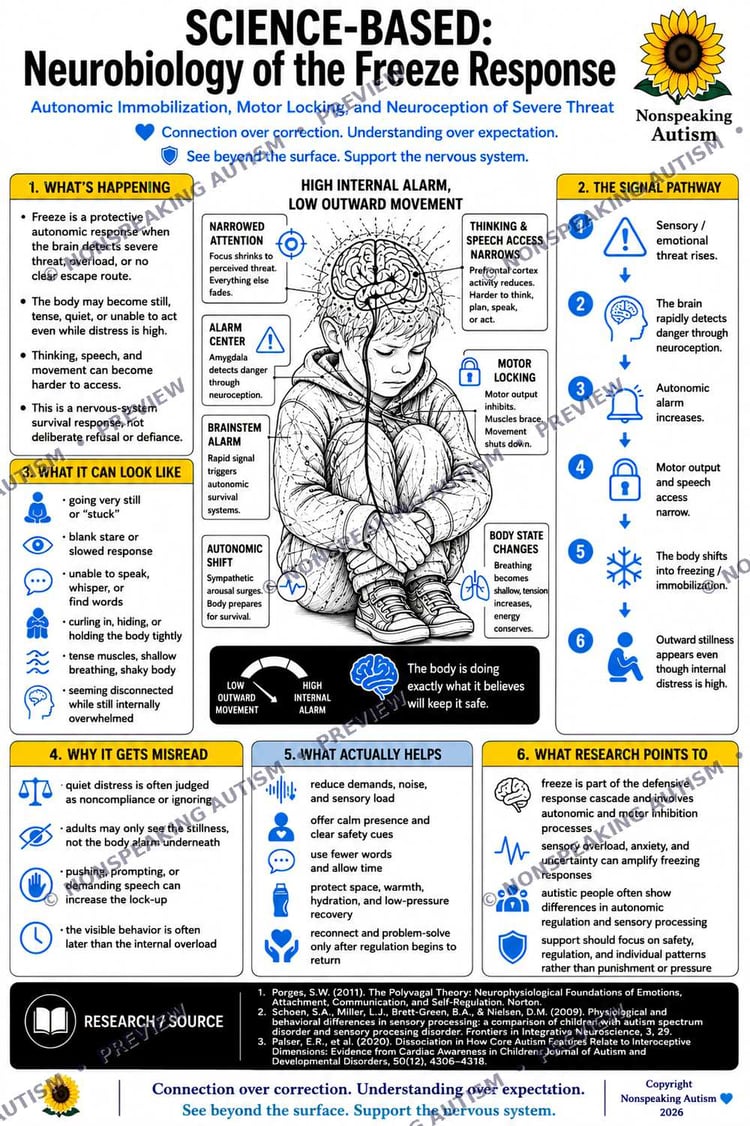
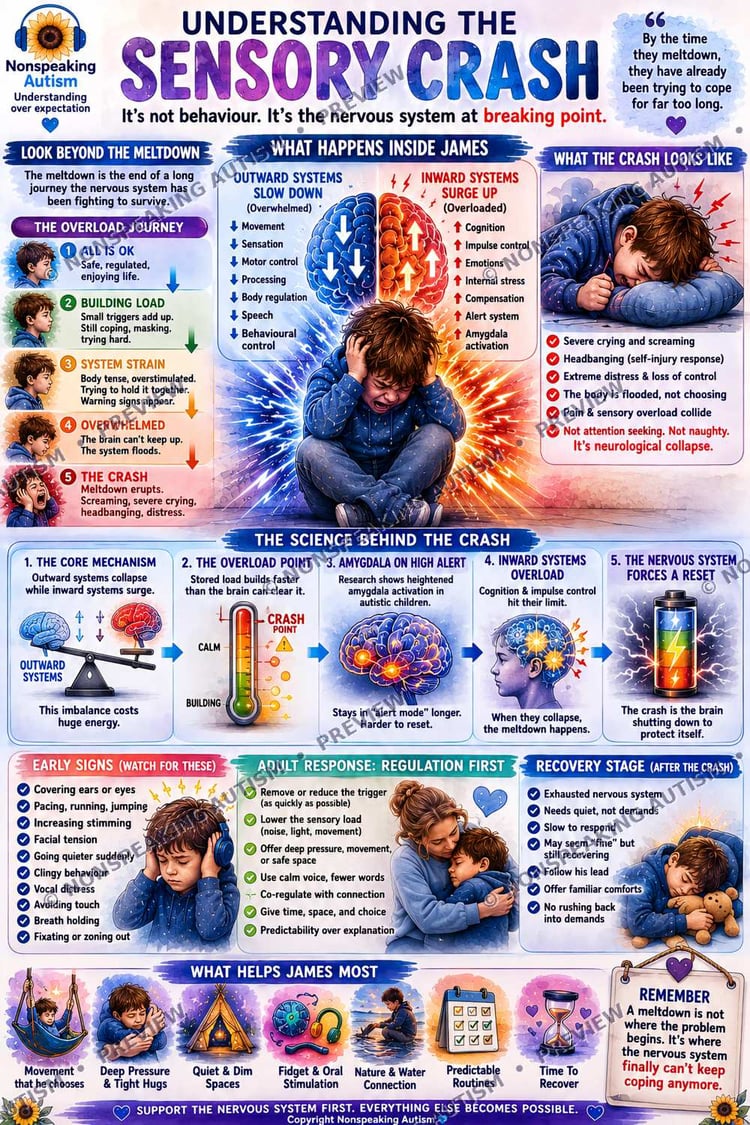
Distress does not always begin with an obvious meltdown or shutdown.
There may be earlier changes.
Depending on the individual, these could include:
covering ears or eyes
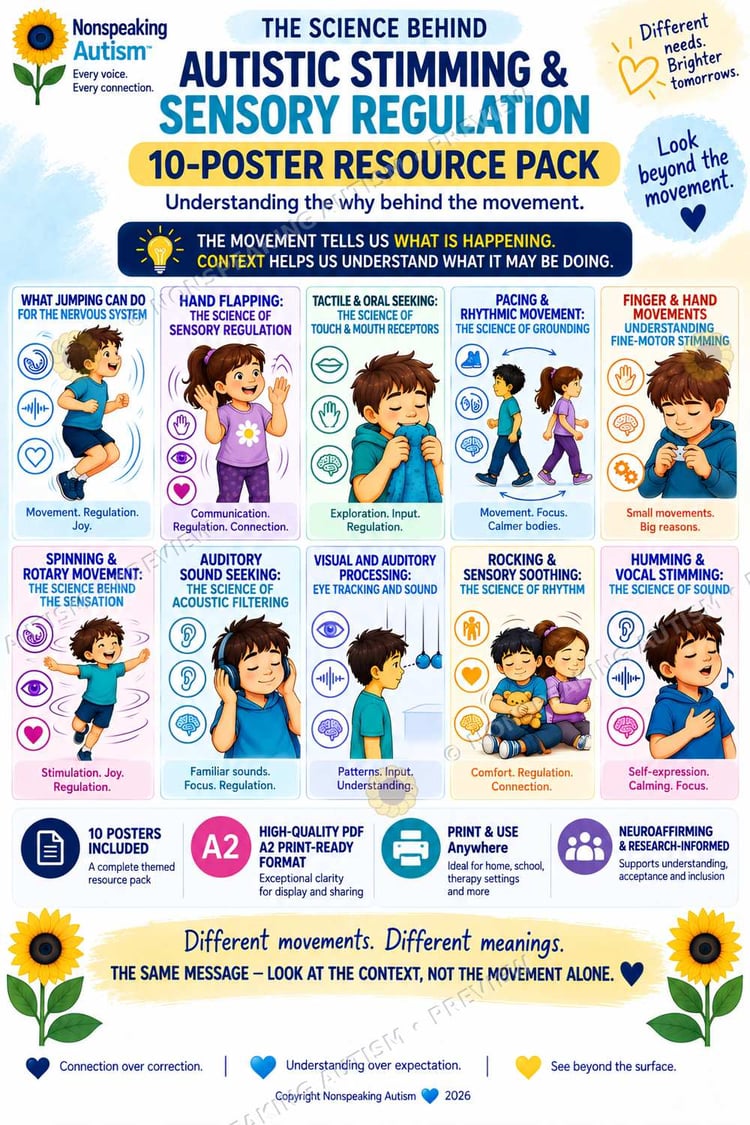
increased pacing, rocking, stimming or movement
becoming quieter or less responsive
increased vocalisations
seeking escape or moving towards exits
pushing people or objects away
communication becoming harder to access
freezing
withdrawing
or appearing unusually still.
These are possible signs, not universal rules.
The purpose of recording them is to learn what changes for this particular student as their sensory or emotional load increases.
Recognizing those changes early may provide an opportunity to reduce demands or modify the environment before distress escalates.
Respond early. Reduce demands. Increase support.
💬 2️⃣ Communication When Overloaded
Communication access can change during periods of sensory overload, anxiety, fatigue or distress.
A student may:
find speech or AAC harder to access
require additional processing time
communicate through gesture, movement or body position
need AAC available consistently
respond better to short, concrete language
need fewer questions
or appear to understand more than they can readily express at that moment.
This section also provides space to record the student's:
Preferred Communication Supports
These might include speech, AAC, symbols, writing, typing, gesture, visual supports, yes/no responses or another reliable communication method.
The principle is simple:
Communication can change with sensory load. Presume communication. Always keep communication accessible.
🔄 3️⃣ Transitions & Predictability
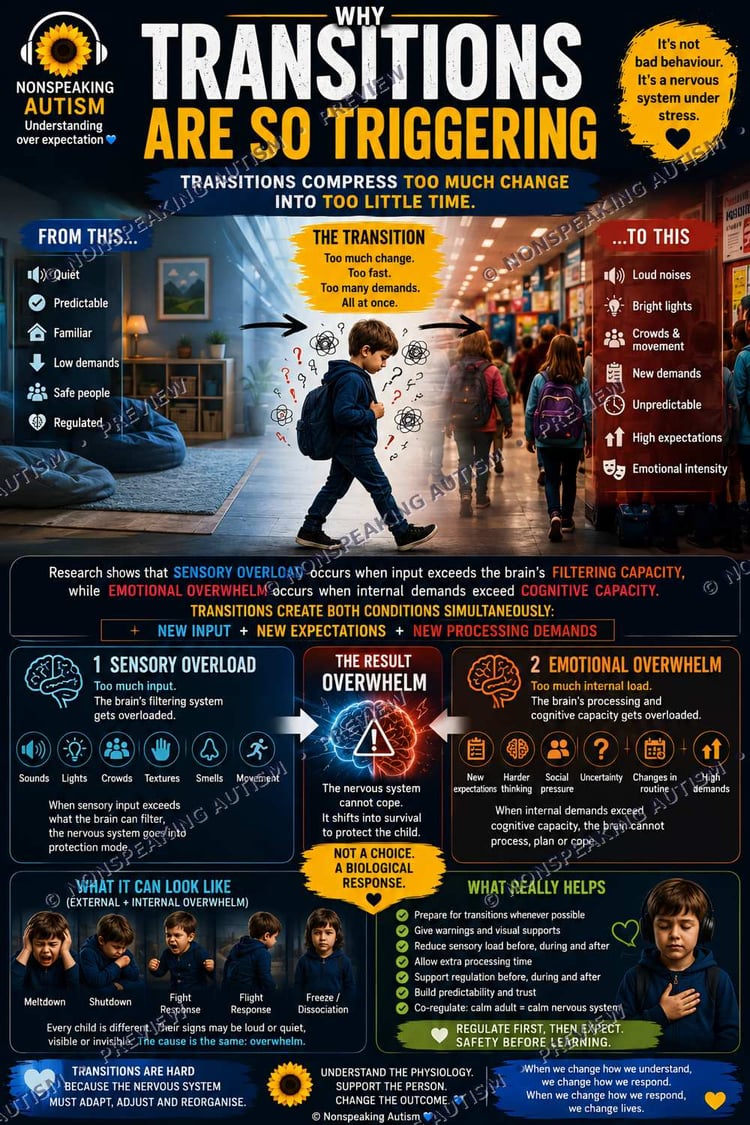
Transitions involve more than physically moving from one place to another.
A student may need to:
stop a preferred activity
shift attention
process what is happening next
move into a different sensory environment
adapt to different people
cope with uncertainty
and reorganize themselves for a new task.
The checklist helps identify whether the student:
finds unexpected changes difficult
benefits from advance warning
needs time between activities
responds well to predictable routines
benefits from visual or verbal countdowns
needs clear information about what happens next
or experiences increased sensory load when staff, rooms or timetables change.
Helpful support may therefore include:
Prepare. Pre-warn. Provide time. Reduce competing demands.
🎭 4️⃣ Masking / Coping During School
A student who appears calm is not necessarily experiencing a low level of internal demand.
Some autistic students may consciously or unconsciously suppress visible signs of discomfort or difference in certain environments.
Possible patterns might include:
appearing calm despite significant sensory stress
suppressing stimming or movement
rarely requesting breaks despite needing them
becoming significantly distressed after returning home
increased exhaustion following demanding school days
or requiring substantially more support after busy, noisy or unpredictable days.
This is why home and school can sometimes report very different versions of the same day.
Neither observation necessarily invalidates the other.
A calm day at school can sometimes come at a high cost to the nervous system, with effects that become visible later.
However, later distress should not automatically be assumed to prove masking. Sleep, health, hunger, accumulated demands, family context and other factors may also contribute.
🏠 Home Observations Matter
What school staff see is only one part of the sensory picture.
Some students may cope, suppress responses or use substantial effort throughout the school day and show the impact later at home.
This makes parent and caregiver observations valuable.
Questions might include:
What happens after school?
How much recovery is needed?
Are there particular days that consistently lead to greater exhaustion?
Does sleep change?
Is communication different?
Does the student seek considerably more or less sensory input?
School observations and family knowledge can be considered together, alongside the student's own communication.
🩺 5️⃣ Body, Pain & Physical Needs
Not every change in behaviour is sensory.
Before concluding that a student is experiencing sensory overload, consider whether their body may be communicating another need.
The checklist prompts adults to consider:
pain or physical discomfort
hunger
thirst
toileting needs
constipation
illness
headaches
dental pain
ear pain
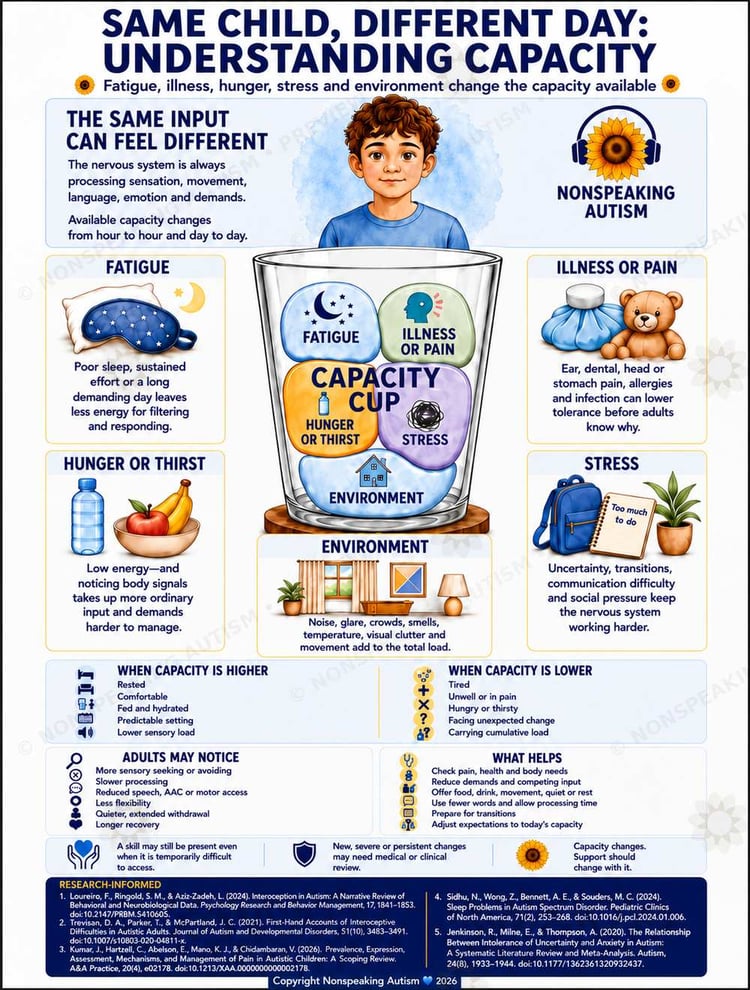
sleep and fatigue
temperature
clothing discomfort
menstrual or period pain where relevant
medication effects
allergies
and seasonal health changes.
This is particularly important for students who may communicate pain or internal body states differently.
Unmet physical needs can increase sensory load and distress. Always consider medical causes.
🌿 6️⃣ Recovery After Overload
The end of visible distress does not necessarily mean the person has fully recovered.
After overload, a student may benefit from:
reduced demands
a quiet or dimmer environment
preferred movement or sensory input
space away from people
food or drink
toileting
rest
or considerably more recovery time than adults expect.
A student's visible regulation may return before their full capacity for conversation, learning, decision-making or social participation has returned.
This is why immediate questioning such as:
“Why did you do that?”
or demanding a detailed explanation immediately after distress may be unhelpful.
Recovery is part of regulation.
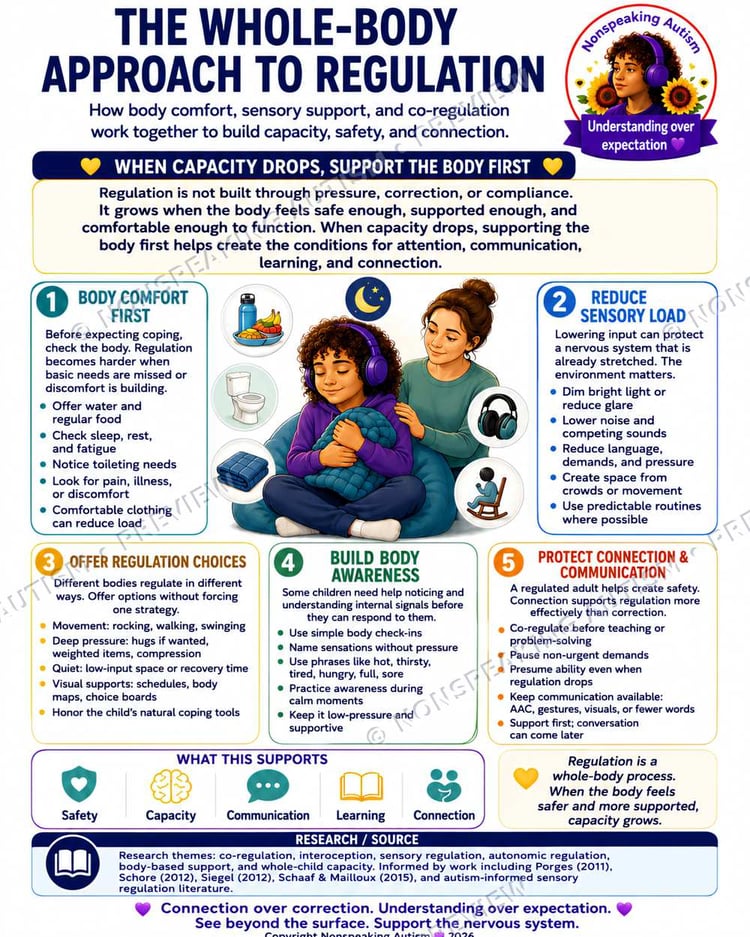
Rest. Regulate. Then reconnect.
💗 7️⃣ Choice, Control & Consent
Sensory support should not become something that is done to a student without their involvement.
Wherever possible, support should protect autonomy.
This can include:
asking before touching or physically assisting
not removing sensory tools as punishment or consequence
allowing the student to decline particular sensory input
offering more than one regulation option
providing access to breaks without requiring visible distress first
respecting clothing, hood, ear-defender and seating preferences where safe and feasible
using supportive, non-judgemental language
and
involving the student in choices about their own support.
For example:
Where would you prefer to work?
Would headphones help?
Would you like a movement break or quiet space?
More choice = more control = potentially less unnecessary stress.
Choice does not guarantee regulation, but autonomy should remain an important part of sensory support.
♾️ Communication Is Part of Consent
Consent and choice need to remain accessible to students who do not primarily communicate through speech.
Depending on the individual, choice may be communicated through:
AAC
symbols
yes/no systems
gesture
pointing
writing
typing
body movement
or other established communication methods.
A student's communication method should not determine whether their preferences are respected.
🎯 8️⃣ Sensory Support & Participation
This section helps move from observation into practical action.
For each relevant activity or setting, staff can record:
Activity / Setting
Where is the difficulty occurring?
Sensory Barrier
What appears to be making participation harder?
Adaptation / Support
What environmental change or support was introduced?
What Increased Access / Participation?
What actually helped?
This is important because the goal is not merely to accumulate sensory equipment.
It is to identify whether support changes access to meaningful activities.
For example:
Dining hall → overwhelming noise → quieter eating space → student able to eat more comfortably
or:
Assembly → unpredictable loud sound → advance warning + ear defenders → increased ability to participate
The focus moves from:
“Did we provide a sensory tool?”
to:
“Did this support reduce a barrier?”
🌻 Participation — Not Maximum Tolerance
The aim of sensory support is not necessarily to teach a student to tolerate increasingly distressing environments.
Sometimes support means changing the environment.
Sometimes it means changing the timing.
Sometimes it means offering a different route to participation.
Sometimes it means allowing recovery.
And sometimes it means recognizing that an activity is creating more harm than meaningful benefit in its current form.
The aim is not to make the student tolerate more, but to remove barriers so they can participate in a way that works for them.
🤝 Working Together
Effective sensory support rarely belongs to one adult.
Part 2 encourages teams to:
share the profile with relevant staff
review it regularly
include parent and caregiver observations
include the student's own communication
update support following illness, growth, puberty or seasonal changes
and aim for consistent strategies across relevant settings.
A profile should not be completed once and forgotten.
Sensory needs can change.
The environment changes.
The student develops.
Support should be able to change too.
🎯 The Goal
This resource is not about creating a perfectly calm student.
It is not about eliminating stimming.
It is not about making every student tolerate the same classroom.
And it is not about making sensory differences disappear.
The goals are to:
✓ Reduce sensory barriers
✓ Increase access and participation
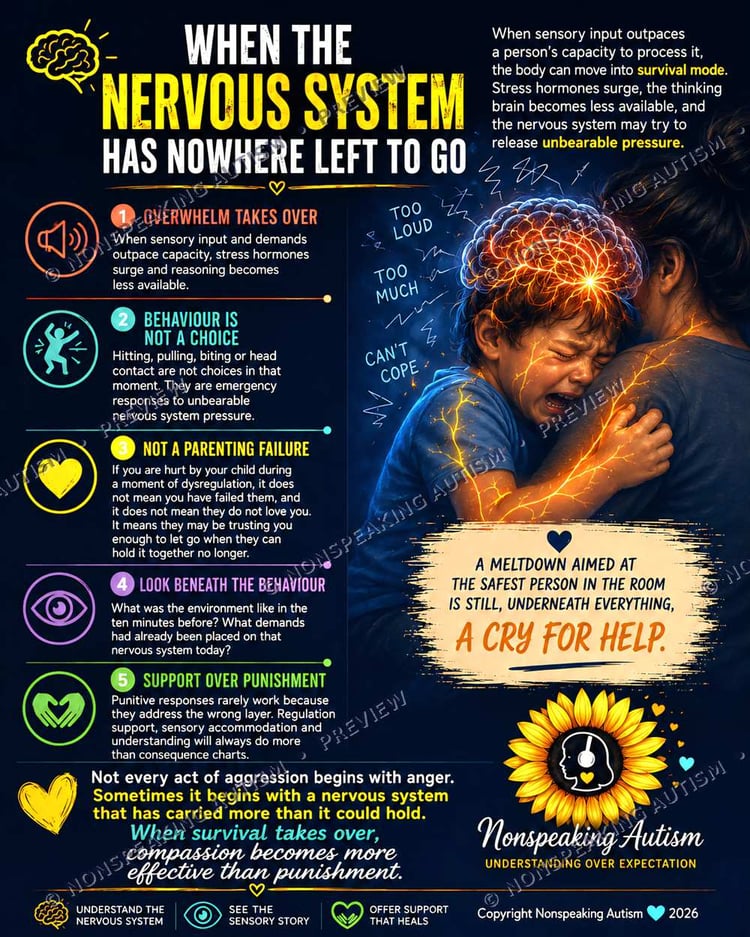
✓ Support regulation and wellbeing
✓ Build positive school experiences
✓ See the whole child beyond behaviour
🔬 Research-Informed
This resource is informed by research examining sensory processing in autism, participation in everyday activities, classroom outcomes, environmental accessibility, interoception, pain communication and individualized sensory support.
Research has documented substantial sensory differences among autistic children while also showing considerable individual variation.
Studies have also examined relationships between sensory processing and classroom performance, emotional or behavioural outcomes and participation in everyday activities.
Importantly, these findings are group-level evidence. They do not mean a particular behaviour has a single sensory cause or that every autistic student will benefit from the same accommodation.
The resource therefore follows an individualized approach:
Observe the pattern → identify possible barriers → provide appropriate support → review what actually improves access.
📚 Selected Research & Guidance
Tomchek, S. D., & Dunn, W. (2007). Sensory processing in children with and without autism: A comparative study using the Short Sensory Profile. American Journal of Occupational Therapy, 61(2), 190–200.
Ben-Sasson, A., et al. (2009). A meta-analysis of sensory modulation symptoms in individuals with autism spectrum disorders. Journal of Autism and Developmental Disorders, 39(1), 1–11.
Ashburner, J., Ziviani, J., & Rodger, S. (2008). Sensory processing and classroom emotional, behavioral, and educational outcomes in children with autism spectrum disorder. American Journal of Occupational Therapy, 62(5), 564–573.
Ismael, N., Lawson, L. M., & Hartwell, J. (2018). Relationship between sensory processing and participation in daily occupations for children with autism spectrum disorder. American Journal of Occupational Therapy, 72(3), 7203205030.
Dunn, W. (2007). Supporting children to participate successfully in everyday life by using sensory processing knowledge. Infants & Young Children, 20(2), 84–101.
Pfeiffer, B., et al. (2019). Effectiveness of noise-attenuating headphones on physiological responses for children with autism spectrum disorders. Frontiers in Integrative Neuroscience, 13, 65.
Black, M. H., et al. (2022). Considerations of the built environment for autistic individuals: A review of the literature. Autism, 26(8), 1904–1915.
Cermak, S. A., Curtin, C., & Bandini, L. G. (2010). Food selectivity and sensory sensitivity in children with autism spectrum disorders. Journal of the American Dietetic Association, 110(2), 238–246.
Garfinkel, S. N., et al. (2016). Discrepancies between dimensions of interoception in autism: Implications for emotion and anxiety. Biological Psychology, 114, 117–126.
Kinnaird, E., Stewart, C., & Tchanturia, K. (2019). Investigating alexithymia in autism: A systematic review and meta-analysis. European Psychiatry, 55, 80–89.
Johnson, E., van Zijl, K., & Kuyler, A. (2023). Pain communication in children with autism spectrum disorder: A scoping review. Paediatric & Neonatal Pain, 5(4), 127–141.
National Institute for Health and Care Excellence (NICE). (2013). Autism spectrum disorder in under 19s: Support and management (CG170).
Evidence Note
These references support the broader principles and relevant sections of this resource. They should not be interpreted as validating every individual checklist item as a specific intervention.
This is a research-informed practical resource, not a standardized or validated clinical sensory-profile instrument.
👨👩👧 Who Is This Resource For?
This printable may be particularly useful for:
- autistic students
- students with sensory differences
- parents and caregivers
- teachers
- teaching assistants
- SENCOs
- SEND teams
- occupational therapists
- speech and language therapists
- pastoral and wellbeing teams
- learning-support staff
- mainstream and specialist schools
- alternative provisions
- home-education settings
- multidisciplinary teams
It can be used alongside Part 1 or as a practical discussion and planning tool where a school is trying to understand why a student's ability to participate changes across the day or between environments.
📦 What You Receive
This download includes:
1 × School Sensory Profile & Accommodation Checklist — Part 2: Regulation, Participation & Support
1 × high-resolution printable PDF
The downloadable file is supplied clear and without the promotional preview watermark shown on the Payhip listing images.
Any watermarks visible on promotional previews are used for copyright protection only and will not appear on the downloaded resource.
💛 FREE DIGITAL DOWNLOAD
This resource is provided free of charge through Payhip to help families, schools and professionals access practical, neurodiversity-affirming sensory-support information.
Digital download only — no physical product will be shipped.
⚠️ Important Educational, Medical & Professional Disclaimer
This resource is provided for educational, observational and support-planning purposes only.
It is not a diagnostic tool, validated sensory assessment, occupational therapy assessment, psychological assessment, behaviour assessment, medical assessment or individualized treatment plan.
The checklist contains possible observations and possible accommodations. Checking an item does not establish its cause, prove that a student is experiencing sensory overload, or demonstrate that a particular strategy will be appropriate.
Terms such as sensory load, overload, regulation, masking and coping are used descriptively. Observable behaviour should always be interpreted cautiously and in context.
Distress, withdrawal, communication changes, increased movement, reduced responsiveness or other behavioural changes can have many possible causes, including pain, illness, fatigue, anxiety, communication difficulties, environmental demands and other physical, developmental or emotional factors.
New, severe, persistent or unexplained changes should not automatically be attributed to autism or sensory processing and may require appropriate professional or medical assessment.
Accommodations should be individualized, monitored and adjusted according to the student's communication, preferences, health, developmental profile, environment and circumstances.
Sensory support should not be used to force tolerance of distressing input, suppress harmless stimming, remove communication, punish sensory needs or override a student's consent and autonomy.
Where individualized assessment is required, advice should be sought from appropriately qualified professionals.
💛 The Message Behind the Resource
Sometimes the most important information about a school day appears before distress.
A hand moves towards the ears.
Communication becomes shorter.
Movement increases.
The student becomes unusually still.
A transition becomes harder.
A break is needed but never requested.
And sometimes the most important information appears after school.
Exhaustion.
Withdrawal.
Increased sensory seeking.
A need for silence.
A much longer recovery period than anyone at school realized.
Instead of asking only:
“What behaviour are we trying to stop?”
this resource encourages adults to ask:
“What is changing?”
“What might the student need?”
“What barrier can we reduce?”
“How can they communicate that something is becoming too much?”
“What helps them recover?”
“What gives them greater choice and control?”
and ultimately:
“What helps this student participate without unnecessarily sacrificing their wellbeing?”
The goal is not maximum tolerance.
The goal is meaningful access.
Reduce barriers. Increase access. Support participation. 💙
Connection over correction. Understanding over expectation.
© Nonspeaking Autism 2026 🌻💙