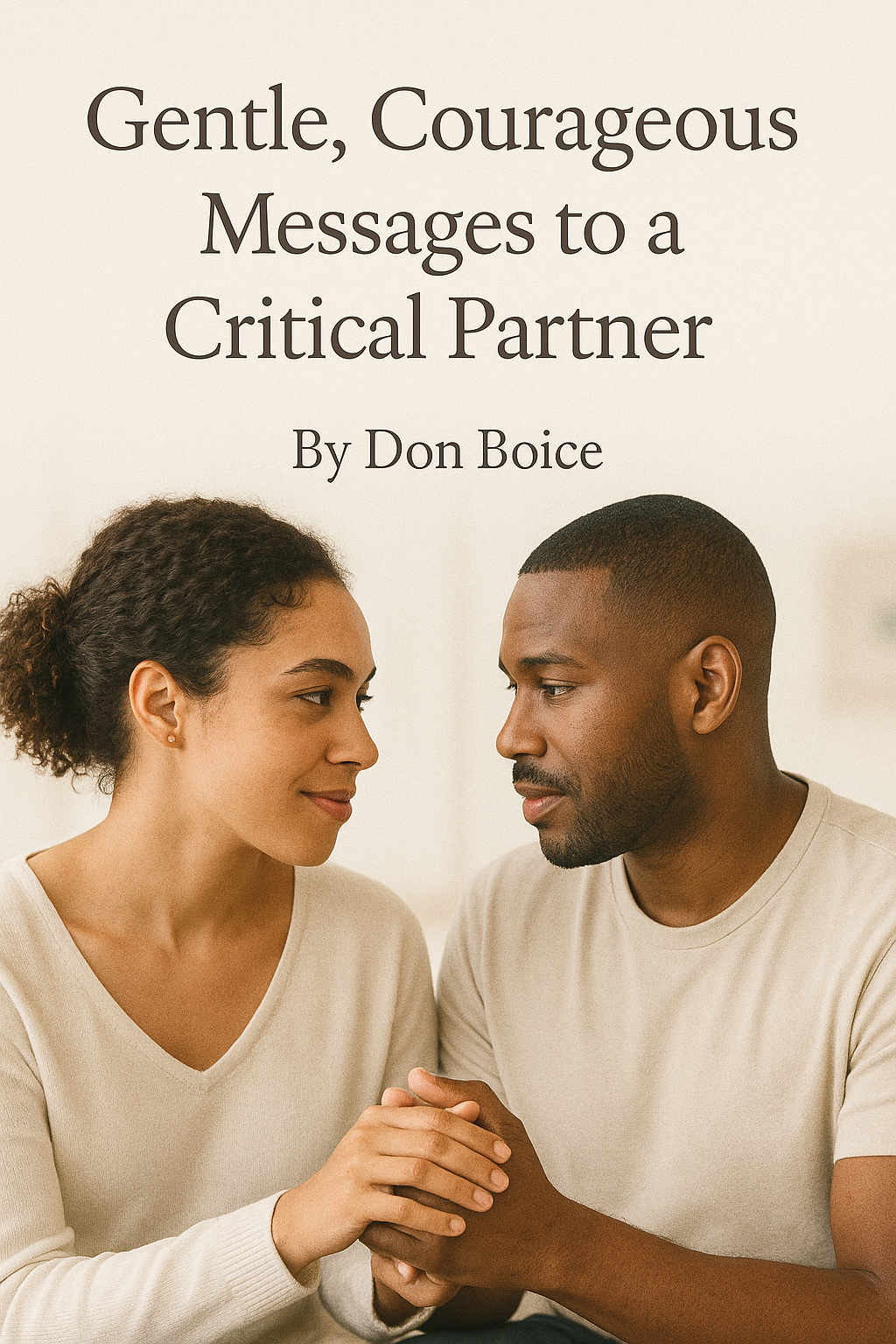
Gentle Courageous Messages to a Critical Partner
The following essays will help give you words and a process to have difficult conversations with a parent and a partner. Imagine having all these conversations in my office paying me for the time and all your transportation to and from. Compare and contrast that with coming in, having read this, having ideas to polish and solve problems. Cheaper and more effective- has my vote!
Most of us don’t have great role models, so I created conversations you can witness and re-read. The focus is on NVC, which stands for Non Violent Communication (Marshall Rosenberg).
What is included:
The Sting of Words- I Miss Feeling Like We’re on the Same Team
Protest Polka vs. NVC Feedback: 5 Relationship Topics
Role Play Practice: NVC Dialogue in Key Relationship Areas
NVC Role Plays: Speaking to a Parent with Respect and Boundaries
NVC Role Plays: Requesting Respect Despite Life Differences
NVC Role Plays: Exploring What We Each
Need From the Other
Couples Reflection Worksheet: Navigating
Religious Blame with NVC
NVC Role Plays: Navigating Differences as a Team
NVC Role Plays: After Painful Conflict or Yelling
When someone is critical, we learn to not like ourselves. We do not need more criticism and it might even be damaging.
Encouragement, goal setting, feedback loops and accountability to get the job done? Yes
How do you let the person know that the criticism is one of the four horsemen to avoid, not just them speaking their truth?
We might need to define some words and some approaches to life first.
No one likes to be criticized, unless they request it and even then, there are parameters. “Unsolicited feedback is never welcome,” was drilled into my head in counseling school.
Some people do not criticize well and need coaching to do it in a way that is not destructive. Then they get upset that the person experienced their criticism as an attack (which it was, they can’t see themselves as someone who attacks) and call them defensive or sensitive. It gets worse from there.
So, what are we to do when we are met with criticism repeatedly?
Consider if your partner has the capacity for a healthy relationship and whether you do, because criticism will test the relationship and might just ruin it. If the relationship is already struggling and criticism is new…
Asking someone to not criticize you is focusing on their behavior, not yours. When they say those words, your body responds, your brain starts to make up stories and your feelings kick in. Focus on what happens to you when you understand yourself to be criticized. Not, “you criticized me, so I got angry.” “You always do this, you are such a control freak!” Not helpful because you are name calling and blaming.
Try this, “When I heard you say x,y, z it hurt. My chest got tight, my jaw clenched and my stomach dropped. I feel hurt by those words and I find myself wanting to create distance between us when that happens. I wonder if that was the intent of your words. Would you like to do a do-over so that I understand your point?”
(24 pages)