

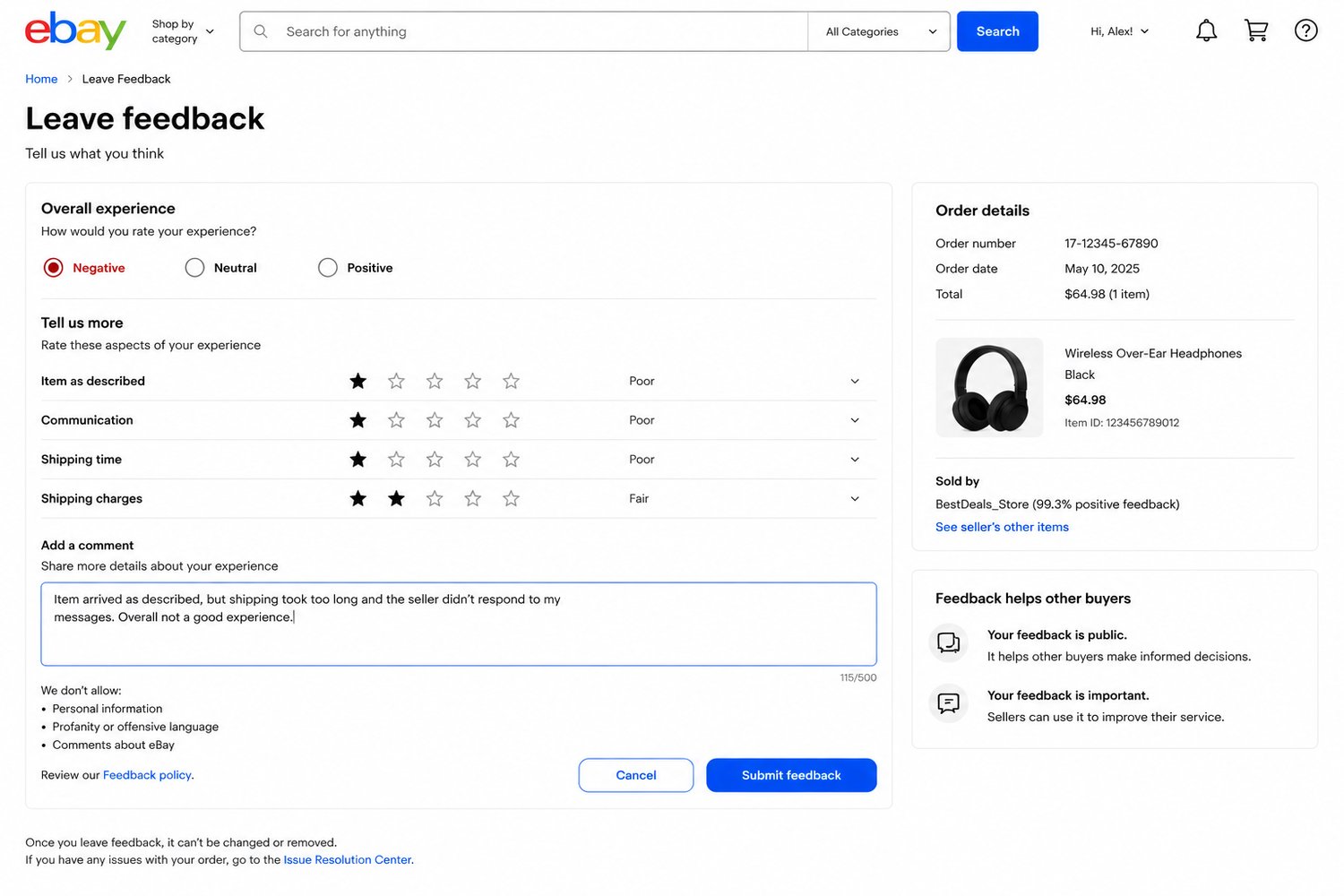
Discover why buyers leave eBay negative feedback even when products arrive correctly. Learn how communication gaps, delivery expectations, response delays, and trust erosion affect seller performance.
"The Item Was Perfect... So Why Did They Leave Negative Feedback?"
Every experienced eBay seller has faced this situation.
The order shipped on time.
The buyer received exactly what they ordered.
The product matched the listing.
Yet the feedback reads:
"Slow communication."
"Never updated me."
"Wouldn't buy again."
"Seller wasn't helpful."
Many sellers immediately focus on the review itself.
But negative feedback rarely begins when the buyer clicks the feedback button.
It usually begins much earlier.
In most cases, negative feedback reflects an operational experience—not simply a product problem.
Buyers Rate the Entire Experience
Many sellers believe buyers only review:
- product quality
- shipping speed
- item condition
In reality, buyers evaluate the complete purchasing journey.
That includes:
- communication
- shipping updates
- delivery expectations
- issue resolution
- confidence throughout the transaction
A buyer can receive the correct item and still feel disappointed.
Because satisfaction depends on the experience—not only the outcome.
Communication Gaps Create Doubt
One of the biggest drivers of eBay negative feedback is silence.
Buyers become uncomfortable when they don't know:
- whether the order shipped
- why tracking hasn't updated
- if the seller has seen their message
- what happens next
Most buyers don't expect constant communication.
They expect enough communication to feel informed.
When updates are missing, buyers often assume something is wrong.
Silence creates uncertainty.
Uncertainty creates frustration.
And frustration eventually becomes feedback.
Delivery Expectations Matter More Than Delivery Speed
Many sellers work hard to ship quickly.
But buyers compare reality to expectations—not effort.
Imagine this situation.
A listing suggests fast dispatch.
The buyer expects delivery within three days.
The package arrives in five.
Five days may still be acceptable.
But because expectations weren't met, the buyer feels disappointed.
The issue wasn't necessarily slow shipping.
It was an expectation mismatch.
This is why stores with fast fulfillment can still receive poor feedback.
Response Delays Damage Buyer Confidence
Many eBay sellers become busy as order volume grows.
Especially after reaching 10–30 orders per day, responding immediately becomes more difficult.
Messages wait longer.
Questions pile up.
Support becomes reactive.
To the seller, a delayed response may seem minor.
To the buyer, it can feel like being ignored.
When buyers don't receive timely responses, they often begin questioning everything else.
- Has my order shipped?
- Is something wrong?
- Will I receive my item?
- Can I trust this seller?
Trust begins to weaken long before feedback is left.
Negative Feedback Is Often About Trust
Negative feedback usually follows a simple pattern.
First, the buyer experiences uncertainty.
Then communication slows.
Questions remain unanswered.
Confidence decreases.
Finally, the buyer leaves feedback.
Notice something important.
The feedback isn't always about the product.
It's about how the experience made the buyer feel.
Trust is difficult to measure.
But buyers recognize immediately when it's missing.
Buyer Frustration Builds Quietly
Most buyers don't wake up intending to leave negative feedback.
Frustration develops gradually.
Common triggers include:
- unclear shipping updates
- tracking confusion
- delayed replies
- unexpected delivery timelines
- inconsistent communication
- unresolved concerns
Each issue may seem small by itself.
Together, they create a poor customer experience.
The feedback is often the final step—not the first warning sign.
Operational Problems Eventually Become Public
Negative feedback is one of the few operational problems everyone can see.
But by the time it appears publicly, the underlying issue has often existed for weeks.
Many sellers focus on removing negative feedback.
Fewer investigate why it occurred.
Questions worth asking include:
- Did communication create uncertainty?
- Were delivery expectations realistic?
- Did response times increase?
- Were operational bottlenecks affecting buyers?
- Were similar complaints appearing repeatedly?
These questions often reveal operational weaknesses before seller metrics begin declining.
Why Some eBay Sellers Rarely Receive Negative Feedback
High-performing sellers don't eliminate every problem.
That's impossible.
Instead, they reduce uncertainty.
They create confidence by:
- setting accurate expectations
- communicating proactively
- responding consistently
- monitoring fulfillment exceptions
- resolving issues before frustration grows
Their goal isn't perfection.
Their goal is predictability.
Buyers are remarkably understanding when they know what's happening.
Negative Feedback Is Operational Data
Many sellers see feedback as criticism.
Successful sellers see feedback as operational intelligence.
Every review reveals something about the buying experience.
Patterns often point toward:
- fulfillment bottlenecks
- communication gaps
- workflow inconsistencies
- expectation management issues
- customer service capacity
Instead of asking:
"How do I remove this feedback?"
Ask:
"What operational weakness allowed this experience to happen?"
That question leads to lasting improvement.
Final Thoughts
The real reason buyers leave eBay negative feedback is rarely the product alone.
More often, it reflects:
- communication gaps
- delivery expectation mismatches
- response delays
- trust erosion
- growing buyer frustration
By the time feedback appears, the operational issue has usually existed long before the review was written.
The sellers who consistently protect their reputation don't simply ship faster.
They create experiences that reduce uncertainty from the moment a buyer places an order until it arrives safely.
Because buyers don't remember every shipment.
They remember how confident they felt throughout the experience.
Related Reading
Why eBay Buyers Open "Item Not Received" Cases Even When Tracking Exists
Why eBay Seller Metrics Often Decline During Growth
Why Fast Shipping Doesn't Always Create Happy Customers
Why Customer Complaints Usually Start Before Customers Complain
Why Buyers Skip Messages and Go Straight to eBay Resolution
Download the Free eBay Seller Compliance Risk Audit
Negative feedback is often the last visible symptom of an operational problem.
Discover how better communication, clearer expectations, and consistent workflows can reduce buyer frustration before it affects your eBay reputation and seller performance.
👉 eBay Seller Compliance Risk Audit
 About the Author
I work with Shopify and eBay sellers to identify and stabilize operational systems before fulfillment pressure turns into customer complaints, refunds, and margin loss.
My focus is helping stores handling 10–30 orders per day build resilient workflows that scale without creating hidden operational stress.
👉 Download the free fulfillment audit: eBay Seller Compliance Risk Audit
📢 Share This
Found this useful? Share it with other operators: