

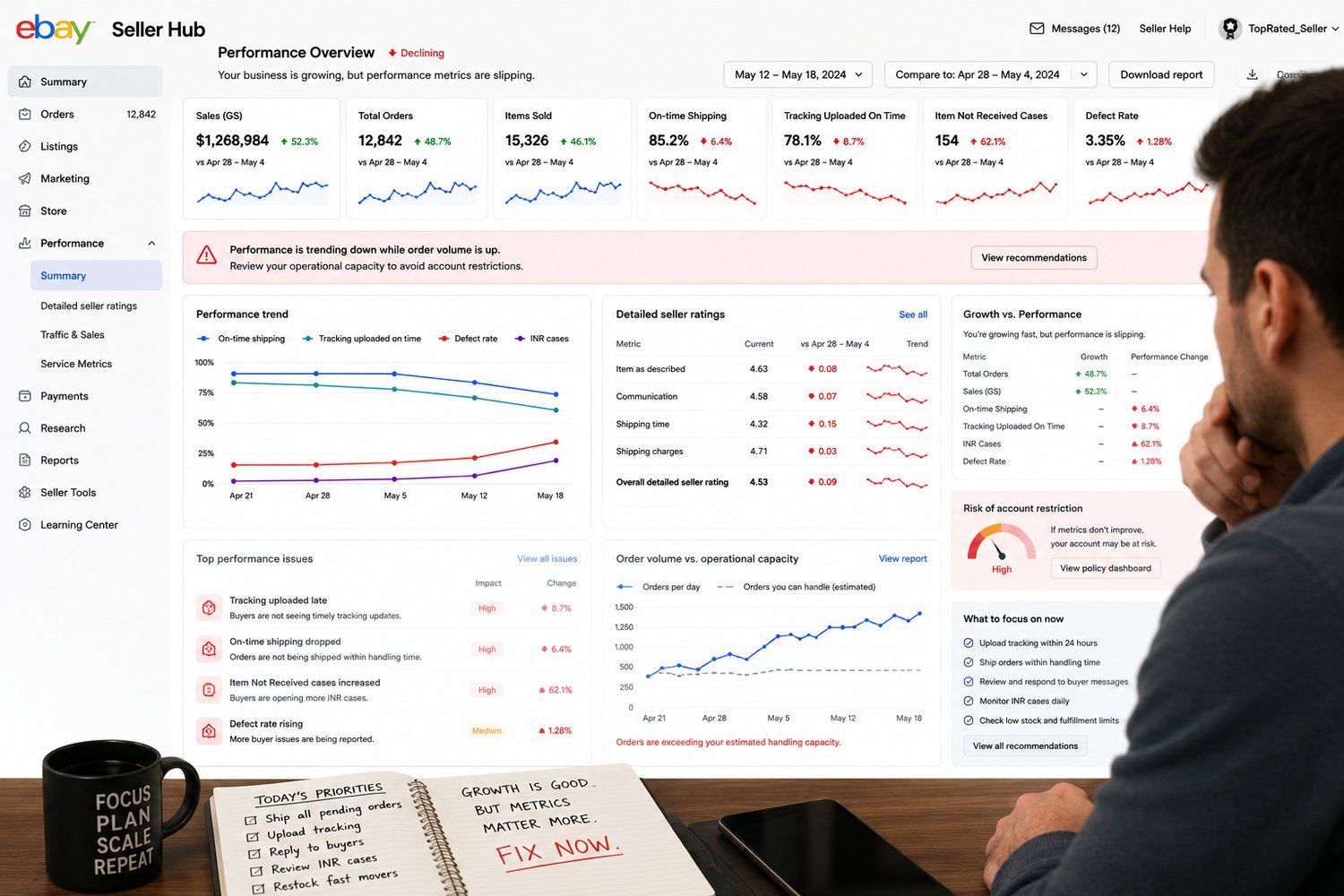
Discover why eBay seller performance often declines during growth. Learn how handling time pressure, inventory errors, fulfillment bottlenecks, and workflow breakdowns create account health risks.
"Sales Are Up... So Why Are My Metrics Getting Worse?"
This confuses many eBay sellers.
Sales increase.
Orders increase.
Revenue improves.
Yet seller performance starts moving in the wrong direction.
Suddenly sellers notice:
- more buyer complaints
- increased returns
- late shipment concerns
- negative feedback
- account health warnings
- growing operational stress
The assumption is often that growth caused the problem.
But growth usually doesn't create operational weaknesses.
Growth exposes weaknesses that already existed.
At lower volumes, many problems stay hidden.
As order volume increases, those same problems become impossible to ignore.
The Dangerous Stage: 10–30 Orders Per Day
Many eBay sellers experience this transition around 10–30 orders per day.
At lower volumes, store owners can manually manage almost everything.
They can:
- double-check inventory
- personally answer buyer messages
- monitor every shipment
- solve problems before customers notice
The system works because the owner compensates for operational weaknesses.
But growth changes the equation.
As orders increase:
- mistakes become harder to catch
- communication becomes reactive
- fulfillment becomes rushed
- visibility decreases
The business begins relying on systems instead of memory.
That's where performance problems often appear.
Handling Time Pressure Creates Hidden Risks
One of the first seller metrics affected by growth is handling performance.
At smaller volumes, processing orders feels manageable.
As volume increases:
- more orders arrive simultaneously
- packing takes longer
- shipping deadlines tighten
- fulfillment interruptions increase
Small delays start accumulating.
An order processed a few hours late may not seem significant.
But repeated delays create measurable performance impacts.
Many sellers don't realize handling pressure is increasing until late shipment metrics begin appearing.
By then, the operational stress has often existed for weeks.
Inventory Accuracy Starts Breaking First
Inventory problems are among the most common growth-related issues on eBay.
At lower volumes, inventory management often relies on:
- spreadsheets
- memory
- manual adjustments
- visual checks
As sales increase, these methods become unreliable.
The result is often:
- overselling
- stockouts
- canceled orders
- fulfillment delays
- frustrated buyers
Many sellers assume inventory errors are isolated incidents.
In reality, inventory inaccuracies often signal deeper operational weaknesses.
And eBay's performance systems eventually reflect those weaknesses.
Fulfillment Bottlenecks Create Performance Decline
Many sellers believe their operation is efficient because orders are shipping.
The question isn't whether orders are shipping.
The question is whether the process remains reliable under pressure.
Growth exposes bottlenecks such as:
- picking delays
- packing backlogs
- inventory searches
- supplier coordination issues
- shipping workflow interruptions
Initially, bottlenecks create stress.
Eventually, they create mistakes.
And mistakes affect buyer experience.
The impact shows up later through:
- negative feedback
- returns
- INR cases
- customer complaints
Workflow Breakdowns Multiply During Growth
Every ecommerce operation has workflows.
Some are documented.
Many exist only inside the owner's head.
This works surprisingly well at small scale.
Until volume increases.
When order volume grows, undocumented workflows begin failing.
Questions start appearing:
- Who handles shipping exceptions?
- Who updates inventory discrepancies?
- Who responds to delayed deliveries?
- Who manages buyer escalations?
Without clear processes, problems move slowly through the business.
Or worse, nobody handles them at all.
The result is inconsistency.
And inconsistency eventually impacts seller performance.
Account Health Problems Start Before Metrics Change
One of the biggest misconceptions among eBay sellers is that account health problems begin when metrics decline.
Actually, metrics are usually the final warning sign.
The operational breakdown often starts much earlier.
Common early indicators include:
- repeated buyer questions
- delayed responses
- fulfillment stress
- inventory corrections
- increasing support tickets
- frequent manual fixes
Most sellers focus on visible metrics.
Successful sellers monitor operational signals before metrics change.
Because by the time account performance declines, the underlying issue has usually existed for weeks or months.
Why More Effort Doesn't Always Fix Performance Problems
When metrics decline, many sellers work harder.
They spend longer hours.
They answer more messages.
They rush more orders.
This creates temporary relief.
But it rarely solves the root cause.
The problem is usually not effort.
The problem is system capacity.
Growth eventually reaches a point where personal effort can no longer compensate for operational weaknesses.
The businesses that continue scaling successfully are the ones that build systems before performance problems become severe.
What High-Performing eBay Sellers Do Differently
Strong sellers understand an important principle:
Account health is an operational outcome.
It reflects:
- inventory accuracy
- fulfillment consistency
- communication quality
- workflow reliability
- buyer confidence
Instead of reacting to performance declines, they focus on preventing them.
They monitor:
- processing times
- fulfillment bottlenecks
- inventory discrepancies
- support trends
- buyer concerns
This allows them to identify risks before eBay metrics reveal them.
Growth Doesn't Cause Problems—It Reveals Them
This may be the most important lesson for growing sellers.
When performance declines during growth, the issue is rarely growth itself.
Growth simply increases pressure.
That pressure exposes:
- weak workflows
- inventory weaknesses
- fulfillment inefficiencies
- communication gaps
- operational bottlenecks
The businesses that scale successfully are not the ones without problems.
They are the ones that identify operational weaknesses before growth magnifies them.
Final Thoughts
If your eBay seller performance declines while sales are increasing, you're not alone.
Many sellers experience:
- handling time pressure
- inventory accuracy issues
- fulfillment bottlenecks
- workflow breakdowns
- account health concerns
The important thing to understand is that these problems rarely appear overnight.
Growth exposes weaknesses that already existed beneath the surface.
The sellers who protect their account health are not necessarily working harder.
They're building stronger operational systems.
Because sustainable growth requires more than sales.
It requires operational consistency.
Related Reading
Why eBay Buyers Open "Item Not Received" Cases Even When Tracking Exists
Why More eBay Sellers Are Seeing Cases Reach the Issue Resolution Center
Why Fast Shipping Doesn't Always Create Happy Customers
Why Inventory Errors Multiply as Stores Scale
Why Some eCommerce Teams Create More Errors as They Grow
Download the Free eBay Seller Compliance Risk Audit
Growing sales should strengthen your business—not weaken your account health.
Learn how operational visibility, workflow consistency, and fulfillment systems help eBay sellers scale beyond 10–30 orders per day without sacrificing performance.
👉 eBay Seller Compliance Risk Audit
 About the Author
I work with Shopify and eBay sellers to identify and stabilize operational systems before fulfillment pressure turns into customer complaints, refunds, and margin loss.
My focus is helping stores handling 10–30 orders per day build resilient workflows that scale without creating hidden operational stress.
👉 Download the free fulfillment audit: eBay Seller Compliance Risk Audit
📢 Share This
Found this useful? Share it with other operators: