
Why Restlessness Looks Different in ADHD & Autism Understanding what may be driving movement, fidgeting and agitation
Why Restlessness Looks Different in ADHD & Autism
Understanding what may be driving movement, fidgeting and agitation
Science-Based: Differential Etiology of Psychomotor Agitation — Educational Infographic (Printable, A2)
You will receive the printable unwatermarked version of this infographic
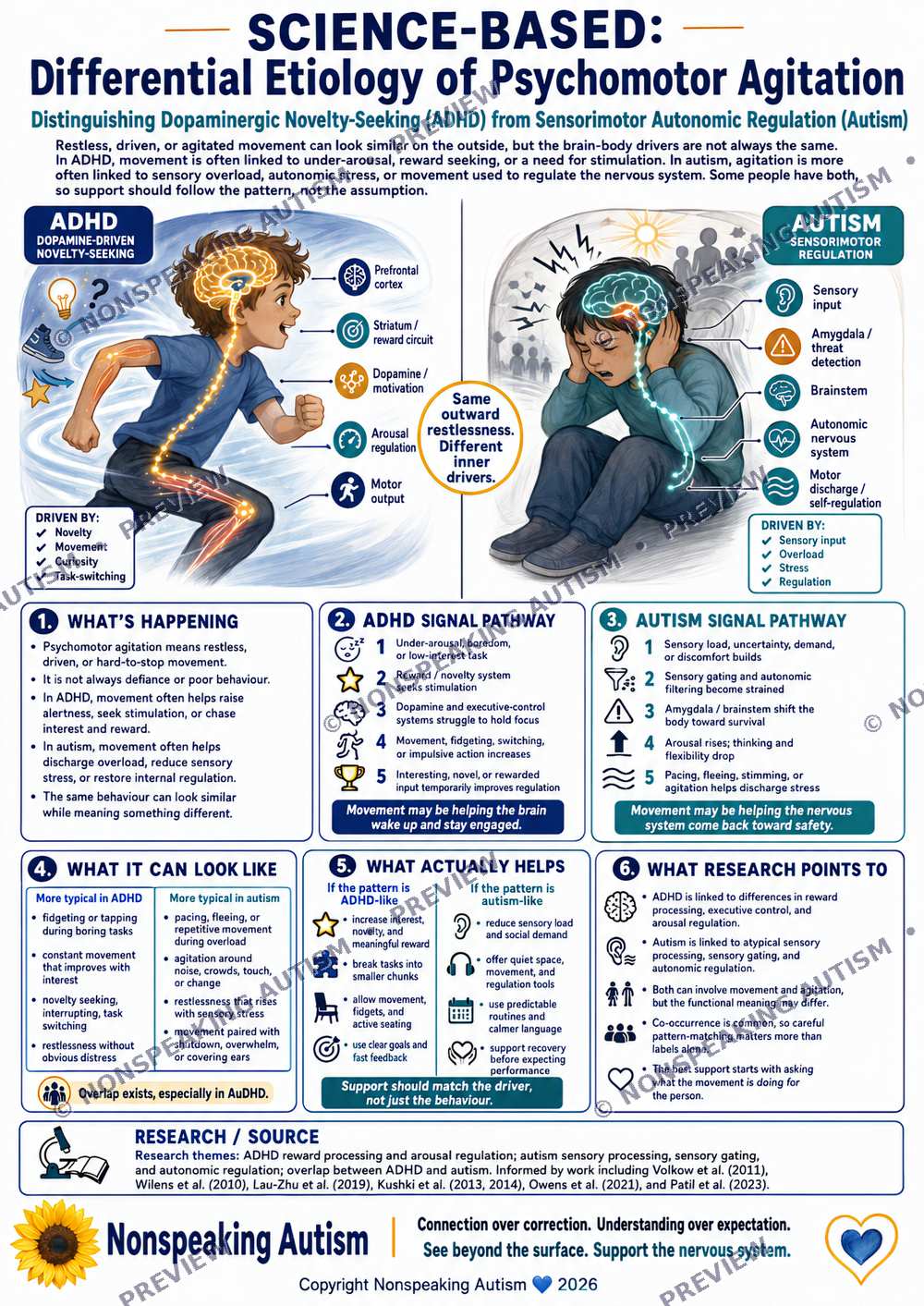
A detailed, research-grounded visual distinguishing dopaminergic novelty-seeking (ADHD) from sensorimotor autonomic regulation (autism) — restless or agitated movement can look similar on the outside, but the brain-body drivers are not always the same.
This infographic covers:
- ADHD (dopamine-driven novelty-seeking): driven by novelty, movement, curiosity, task-switching — prefrontal cortex, striatum/reward circuit, dopamine/motivation, arousal regulation, motor output
- Autism (sensorimotor regulation): driven by sensory input, overload, stress, regulation — sensory input, amygdala/threat detection, brainstem, autonomic nervous system, motor discharge/self-regulation
- ADHD signal pathway: under-arousal/boredom → reward/novelty system seeks stimulation → dopamine and executive-control systems struggle → movement/fidgeting increases → interesting or rewarded input temporarily improves regulation
- Autism signal pathway: sensory load builds → sensory gating and autonomic filtering become strained → amygdala/brainstem shift toward survival → arousal rises, thinking drops → pacing/fleeing/stimming helps discharge stress
- What it can look like: more typical in ADHD (fidgeting during boring tasks, novelty seeking) vs. more typical in autism (pacing/fleeing during overload, agitation around noise/crowds) — overlap exists, especially in AuDHD
- What actually helps: if ADHD-like (increase interest/novelty, break tasks into chunks, allow movement/fidgets) vs. if autism-like (reduce sensory load, offer quiet space, use predictable routines, support recovery before performance)
- Grounded in peer-reviewed research (Volkow et al. 2011; Wilens et al. 2010; Lau-Zhu et al. 2019; Kushki et al. 2013, 2014; Owens et al. 2021; Patil et al. 2023)
What you get:
- High-resolution PDF, print-ready and scalable up to A2 (420 × 594mm)
- Instant digital download
Perfect for: SEND and clinical training, therapy rooms, staff CPD, parent carer forums, and personal understanding.
For personal, classroom, and professional educational use. Not for resale or redistribution.
© Nonspeaking Autism
Disclaimer:
This resource is intended for educational and informational purposes only. It is designed to support understanding of autism, sensory processing, nervous system regulation, and behaviour from a neurodevelopmental perspective.
The information provided is not medical, psychological, therapeutic, or legal advice and should not be used as a substitute for assessment, diagnosis, or treatment by a qualified healthcare professional.
Every autistic person is unique. Strategies and supports should always be tailored to the individual's needs, strengths, and circumstances.
If a child displays a sudden change in behaviour, severe distress, signs of illness, injury, or behaviours that place themselves or others at risk, seek appropriate medical advice or emergency assistance where necessary.
While every effort has been made to ensure the information is accurate and reflects current understanding, knowledge in autism and neuroscience continues to evolve.
This resource is for the purchaser's personal, educational, or professional use only. It may not be copied, redistributed, resold, edited, shared publicly, or reproduced in whole or in part without prior written permission.
© Nonspeaking Autism 💙