





The 21 Day Burnout Reset
The 21-Day Burnout Reset
The 21-Day Burnout Reset
A mobile-native PDF workbook for the burned-out professional who can't quit. Audit your work week, implement three specific changes, and confirm they hold — in twenty-one days, with calendar invites and emails as proof.
The promise
By the end of twenty-one days, you will have three specific changes implemented and held for at least seven working days each — calendar restructure, deletion, delegation, or a boundary script — plus a quantified energy map of your work week and a written assessment of which changes are sticking.
Receipts: the calendar invites, the delegation emails, the deleted recurring meeting. Not a feeling. A measurable shift you can point to.
If you cried in the parking lot before walking in. Again.
You haven't taken a sick day in fourteen months. You keep saying "I can't keep doing this" but you keep doing it. You don't want a sabbatical you can't afford. You don't want to quit a job you actually do well at. You don't want another book about self-care.
You want to actually change your work week — not journal about how tired you are.
This workbook is built for that moment. Not for severe burnout requiring clinical care. Not for a healthy professional looking to optimize. For the middle: the experienced, exhausted, still-functioning professional who needs three specific changes that hold, with proof.
You won't fix everything. You'll change three things, on a schedule, with proof at the end.
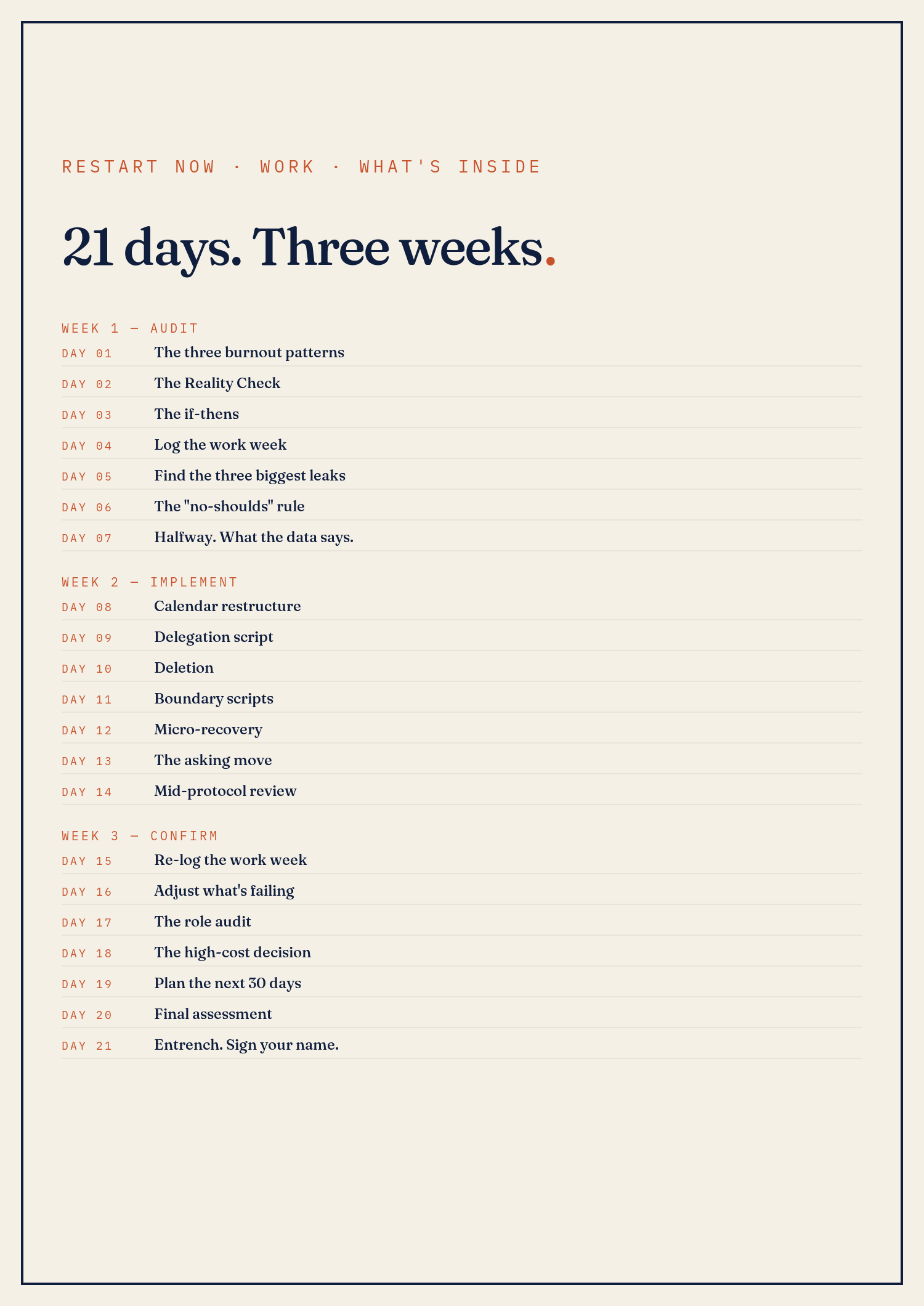
What's inside — three weeks
Twenty-one days, three weeks. Each day is one screen on your phone, five to fifteen minutes, one specific exercise in your notebook, one micro-action.
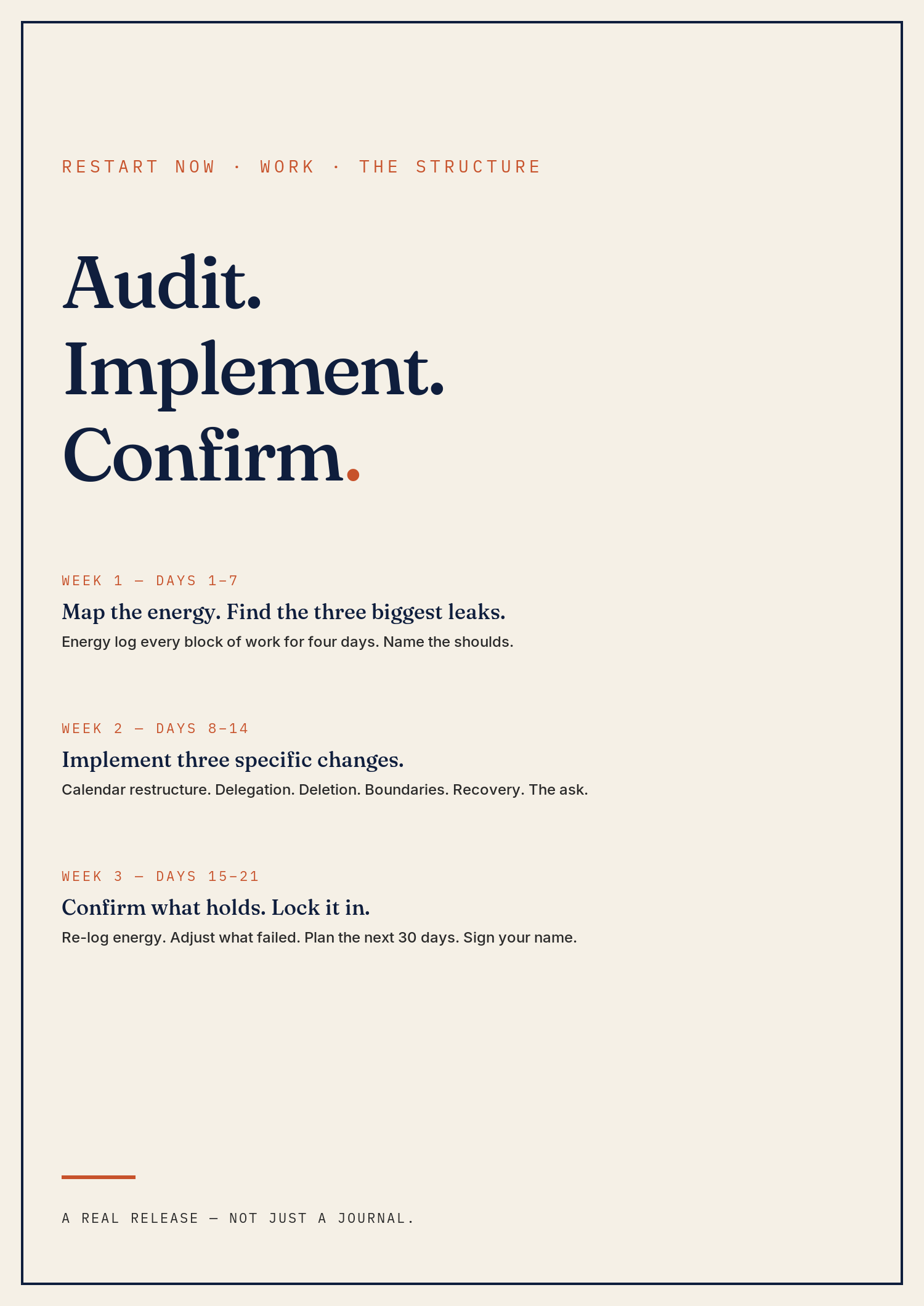
Week 1 — Audit (Days 1–7)
- Day 01 — The three burnout patterns. Maslach's framework: emotional exhaustion, cynicism, reduced accomplishment. Name yours.
- Day 02 — The Reality Check. WANT, WIN, BLOCK, MOVE applied to the work week.
- Day 03 — The if-thens. Pre-decided responses for the moments your old behavior wins.
- Day 04 — Log the work week. Energy log, not time log. Track the data.
- Day 05 — Find the three biggest leaks. From two days of data.
- Day 06 — The "no-shoulds" rule. List what's not actually required.
- Day 07 — Halfway. Pick the three Week-2 changes from the data.
Week 2 — Implement (Days 8–14)
- Day 08 — Calendar restructure. Two no-meeting blocks. One focus block.
- Day 09 — Delegation script. One specific delegation, sent today.
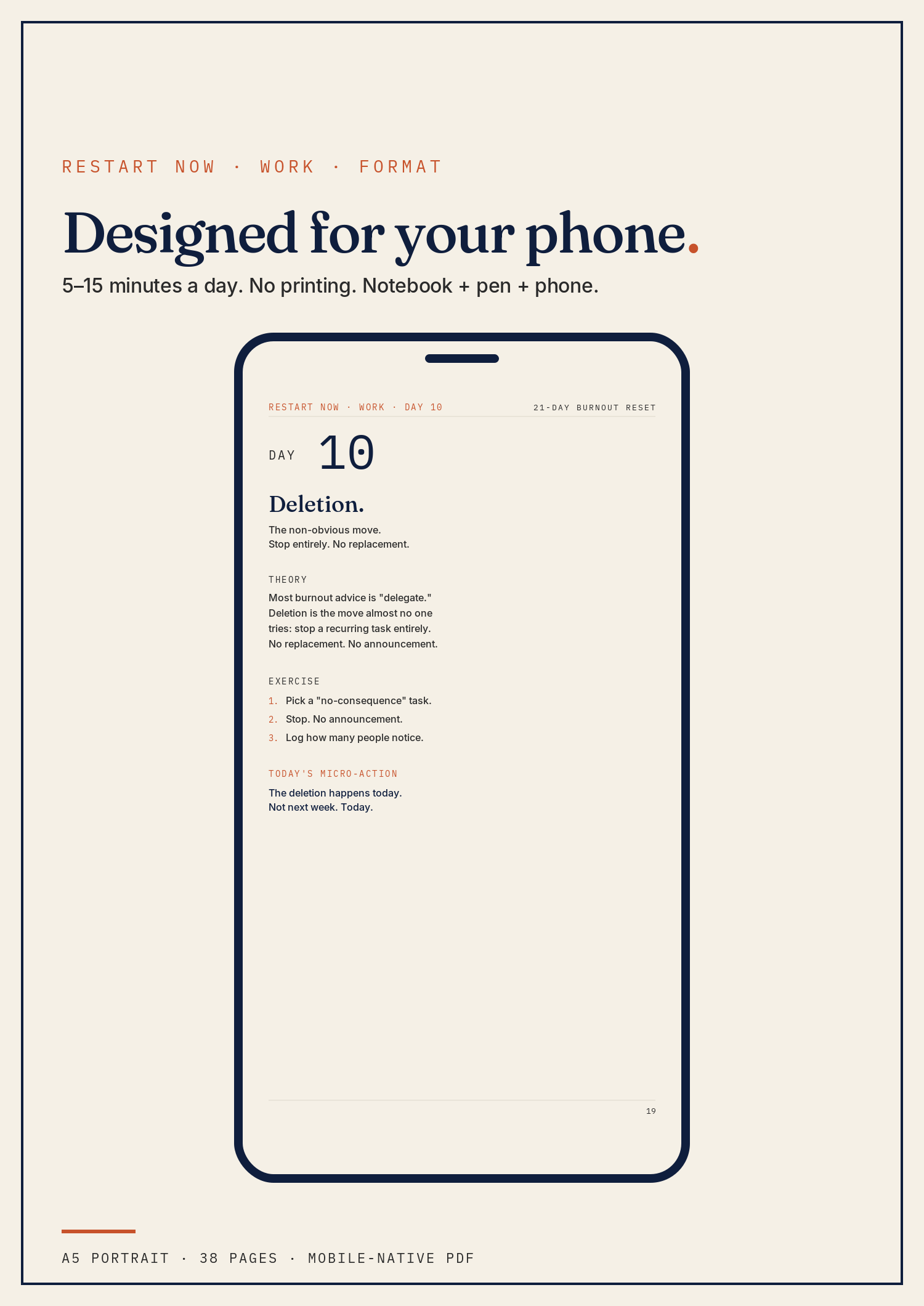
- Day 10 — Deletion. The non-obvious move. Stop entirely. No replacement.
- Day 11 — Boundary scripts. Three pre-written responses.
- Day 12 — Micro-recovery. Within the work day, not after.
- Day 13 — The asking move. Ask for one specific resource.
- Day 14 — Mid-protocol review. Which of the three are holding?
Week 3 — Confirm (Days 15–21)
- Day 15 — Re-log the work week. Compare to Week 1.
- Day 16 — Adjust what's failing. Smaller versions of changes that reverted.
- Day 17 — The role audit. Is this job sustainable as currently structured?
- Day 18 — The high-cost recurring decision. Pre-decide one drain.
- Day 19 — Plan the next 30 days. Stays. New. Defers.
- Day 20 — Final assessment. Re-rate Maslach dimensions.
- Day 21 — Entrench. Identity statement, three relapse-prevention if-thens, 30-day calendar entry.
Plus a contents page, energy log template, what-to-expect orientation, FAQ, troubleshooting, and citations.
Built on real research
This workbook is grounded in burnout-intervention research, not self-help platitudes.
The frameworks it's built on:
- Maslach Burnout Inventory — Maslach & Jackson (1981). The standard burnout assessment used in clinical research.
- Job Demands–Resources model — Demerouti et al. (2001). Burnout comes from chronic imbalance between demands and resources.
- Burnout intervention meta-analysis — Awa et al. (2010). 25 studies, medium effects on emotional exhaustion that persist past the intervention.
- Recovery during the workday — Sonnentag (2003). Short within-day recovery measurably reduces end-of-day exhaustion.
- Implementation intentions — Gollwitzer & Sheeran (2006). 94-study meta-analysis. If-then plans roughly double goal-achievement rates.
- Attention residue — Leroy (2009). Why context-switching burns so much energy.
If you want to go deeper after Day 21, the resources page lists Newport's Deep Work and Nagoski & Nagoski's Burnout.
Who this is for
Adults 30–50, professional or manager, 5+ years in your role. Exhausted but still functional. Burnout markers but not actively quitting. Common in healthcare, education, tech, management consulting, and any environment where the demands compound over years.
Who this is not for
This workbook is not:
- therapy. Burnout with co-occurring depression or severe anxiety needs clinical care.
- a quit-your-job plan. The protocol assumes you stay in the job.
- self-care prescription. No bath suggestions, morning routines, or journaling for its own sake.
- compatible with an actively unsafe workplace (harassment, abuse). Different problem, different tool.
If you have suicidal thoughts, severe depression, or substance dependence alongside burnout, see a therapist before doing this workbook alone. In the US: 988 (Suicide & Crisis Lifeline).
The format
A 38-page, A5 portrait, mobile-native PDF. Designed to read on your phone at fit-to-width — no pinch-to-zoom, no printer required. Each day's screen is dense with teaching and prompts; you write your answers in a separate notebook, not in the PDF.
You'll need three things:
- A notebook (any notebook).
- A pen.
- Your phone — for reading the PDF, calendar changes, delegation messages, and the recurring alarms the protocol depends on.
Don't print the PDF. It's designed for using it on mobile phones.
FAQ
What if my manager pushes back on the changes? Most don't, especially if framed as productivity, not relief. If yours does, the role audit (Day 17) becomes the more important conversation. The protocol can't fix a manager committed to over-extracting from you.
I tried Day 10's deletion and someone noticed. Now what? Use the script: "I'm focusing on higher-priority work this quarter. Happy to revisit if it's still needed." If actually needed, hand it back deliberately. If not, the question dies there.
Is this a substitute for therapy? No. If you're experiencing severe symptoms or thoughts of self-harm, see a clinician. This workbook is for moderate burnout in someone who can't quit and wants tools.
What if I have anxiety on top of burnout? The cross-sell pair is The 14-Day Anxiety Body Reset. Burnout-driven anxiety often eases with body-first tools. Run them in sequence.
What if the changes don't stick by Day 21? Most reverted changes were too ambitious. Try smaller versions (Day 16). If still failing, the structural mismatch may be the real issue (Day 17).
Refunds. If the PDF doesn't open, doesn't render correctly on your phone, or you decide it's not what you expected, email within 30 days for a refund.
What you'll have at Day 21
- Three burnout dimensions named, with Day 1 and Day 20 ratings.
- A specific WANT, WIN, BLOCK, MOVE on a single page.
- Two weeks of energy-log data.
- A list of three "shoulds" you no longer do.
- A restructured calendar with no-meeting blocks and a focus block.
- One delegation message sent.
- One deletion executed.
- A pinned boundary script in active use.
- Two daily micro-recovery alarms.
- One ask sent to your manager.
- A pre-decision that removes one recurring drain.
- A written 30-day plan.
- A signed identity statement and a 30-day calendar entry already scheduled.
The protocol is not the workbook. The protocol is the three changes + the 30-day plan + the monthly review, running for the next thirty days.
The 21-Day Burnout Reset · 38-page mobile-native PDF · $37