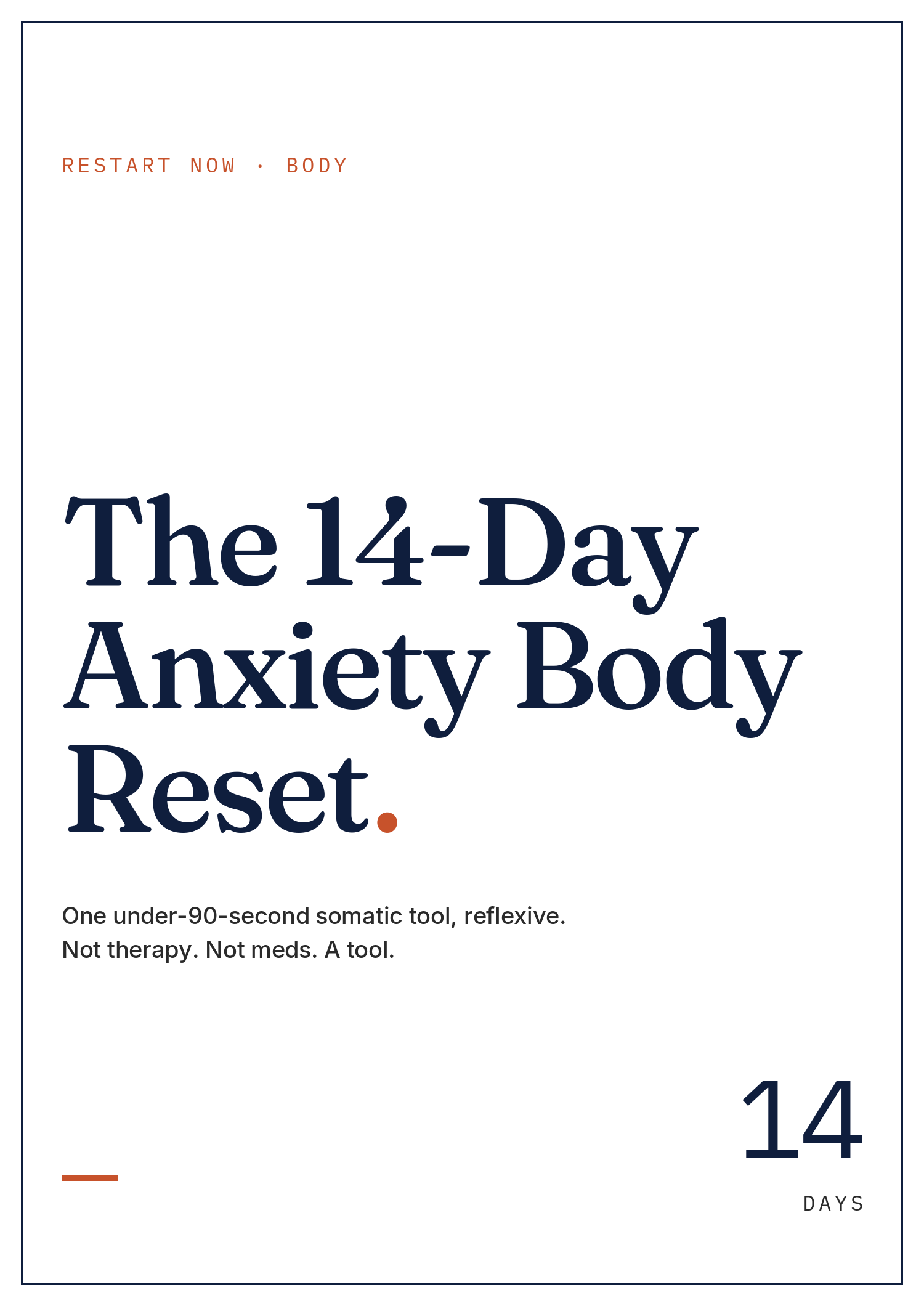

The 14 Day Anxiety Body Reset
The 14-Day Anxiety Body Reset
The 14-Day Anxiety Body Reset
A mobile-native PDF workbook for adults whose anxiety shows up in the body — racing heart, breath tightness, the wave of "I have to leave" mid-conversation. Sample six somatic tools across fourteen days. Pick one by data. Make it reflexive.
The promise
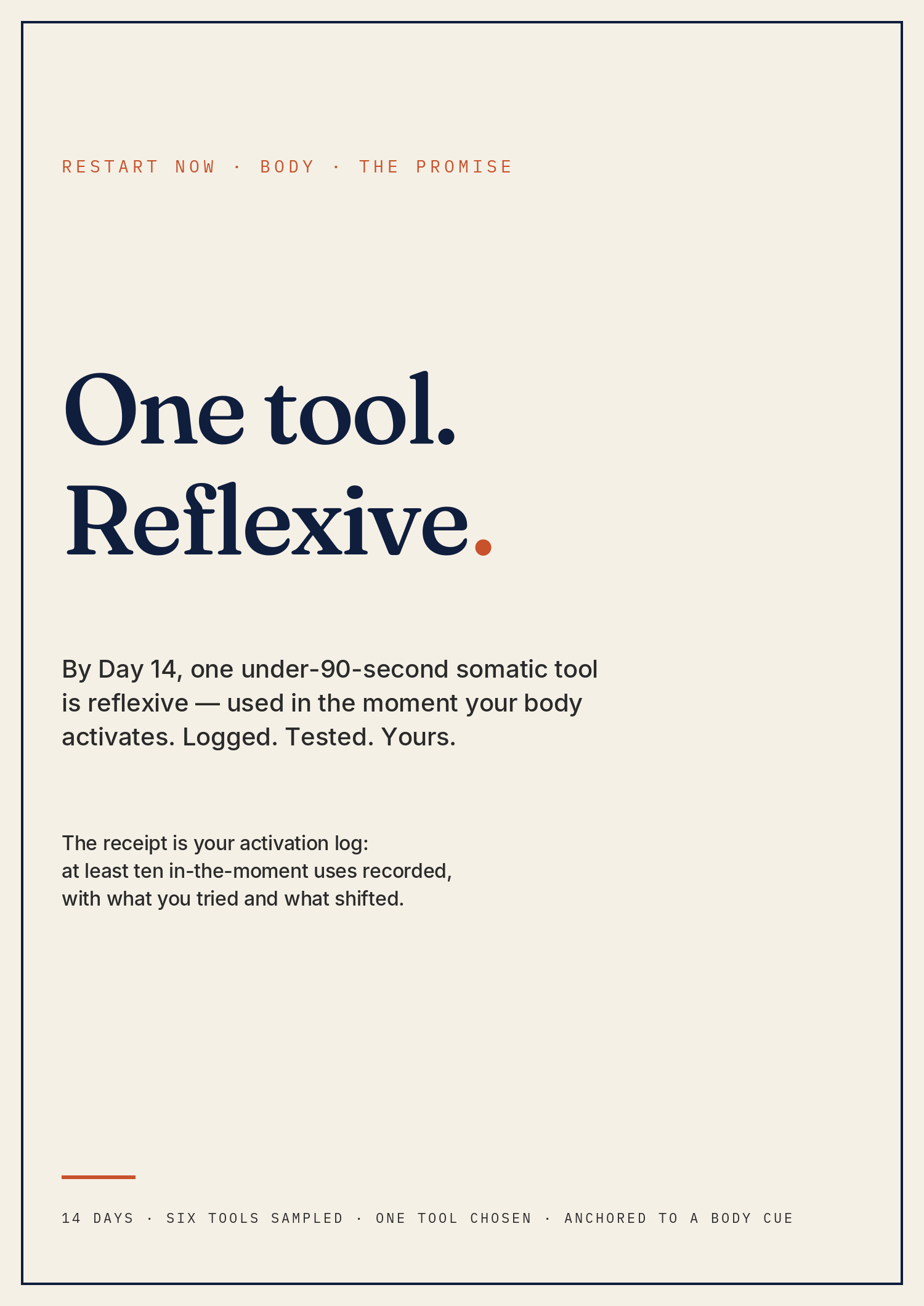
By the end of fourteen days, you will have one under-90-second somatic tool that you can use, reflexively, in the moment your body activates. The receipt is your activation log: at least ten in-the-moment uses recorded, with what you tried and what shifted.
This workbook will not "cure" anxiety. It will not "heal your nervous system forever." It does not replace therapy or medication. It is a fourteen-day toolkit of body-first practices — physiological sigh, paced breathing, cold exposure, grounding, bilateral self-tap — that gives your body a way to interrupt the wave.
If your heart is racing for no reason.
Three panic-adjacent moments at work this month. Heart racing in a meeting. Breathlessness on a call. The wave of "I have to leave" mid-conversation. You're not in therapy. You're not on meds. You're embarrassed.
You don't want a meditation app you'll abandon by Day 4. You don't want a book about polyvagal theory. You don't want to hear about journaling.
You want a tool. One that you can deploy in 30 seconds, in public, while activated, that actually does something measurable in your body.
This workbook is built for that. Not for severe panic disorder. Not for active trauma processing. For the middle: the experienced adult with everyday body-anxiety who needs a small, reflexive, evidence-based intervention they can run themselves.
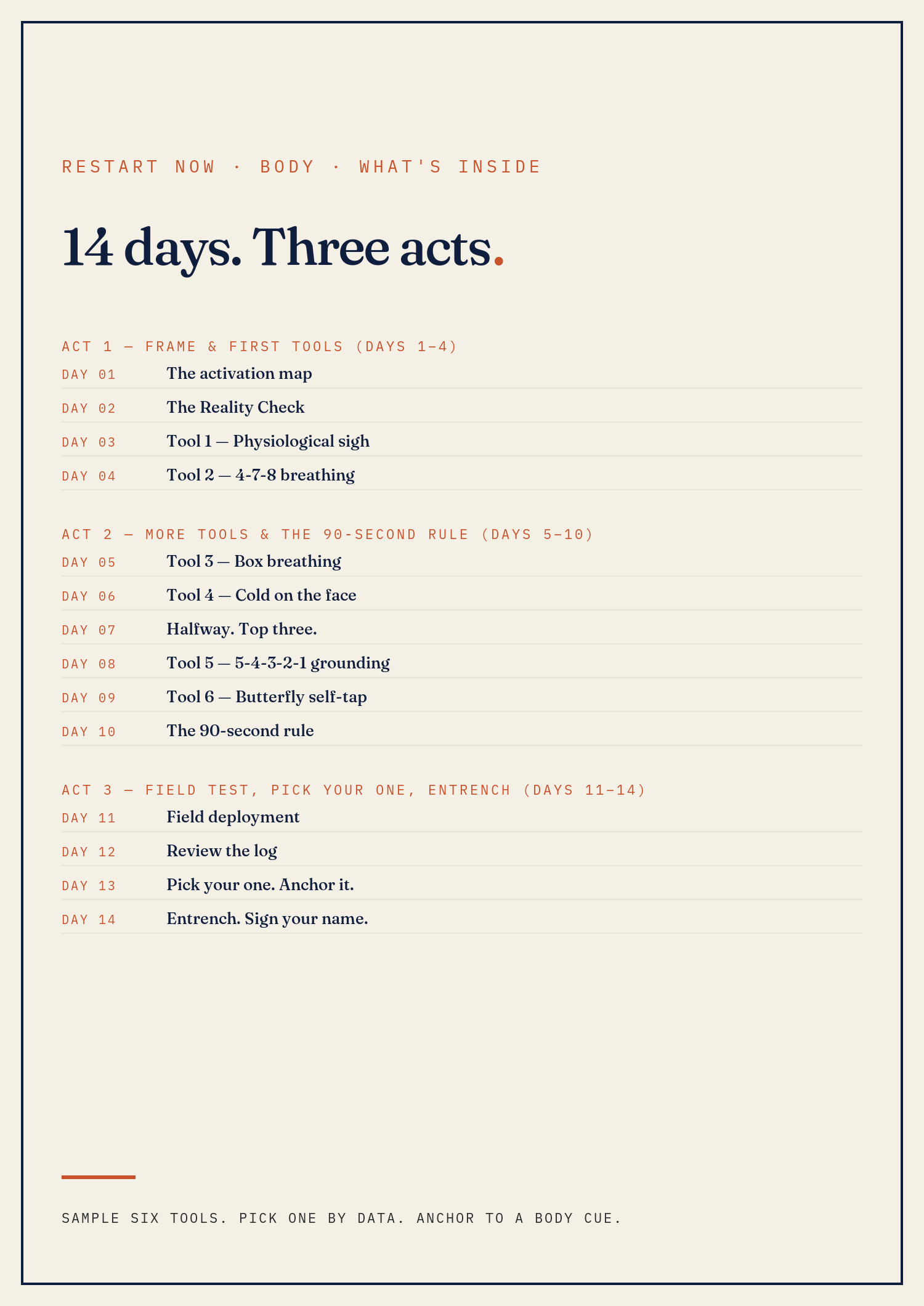
What's inside — fourteen days, three acts
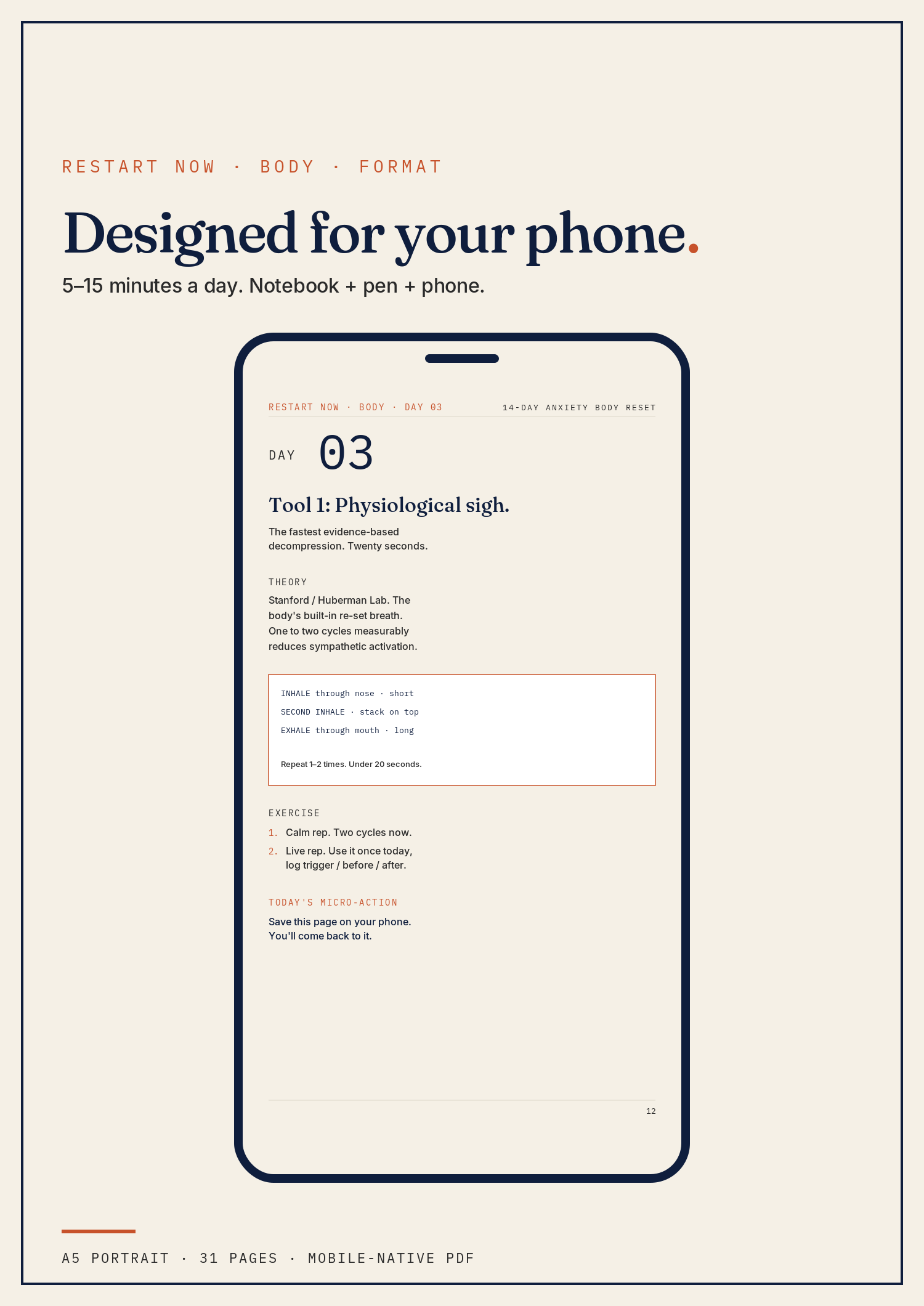
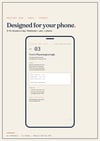
Each day is one screen on your phone, five to fifteen minutes, one specific exercise, one micro-action.
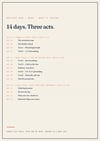
Act 1 — Frame & first tools (Days 1–4)
- Day 01 — The activation map. Three triggers, three body sensations, the wave's arc.
- Day 02 — The Reality Check. WANT, WIN, BLOCK, MOVE applied to the body.
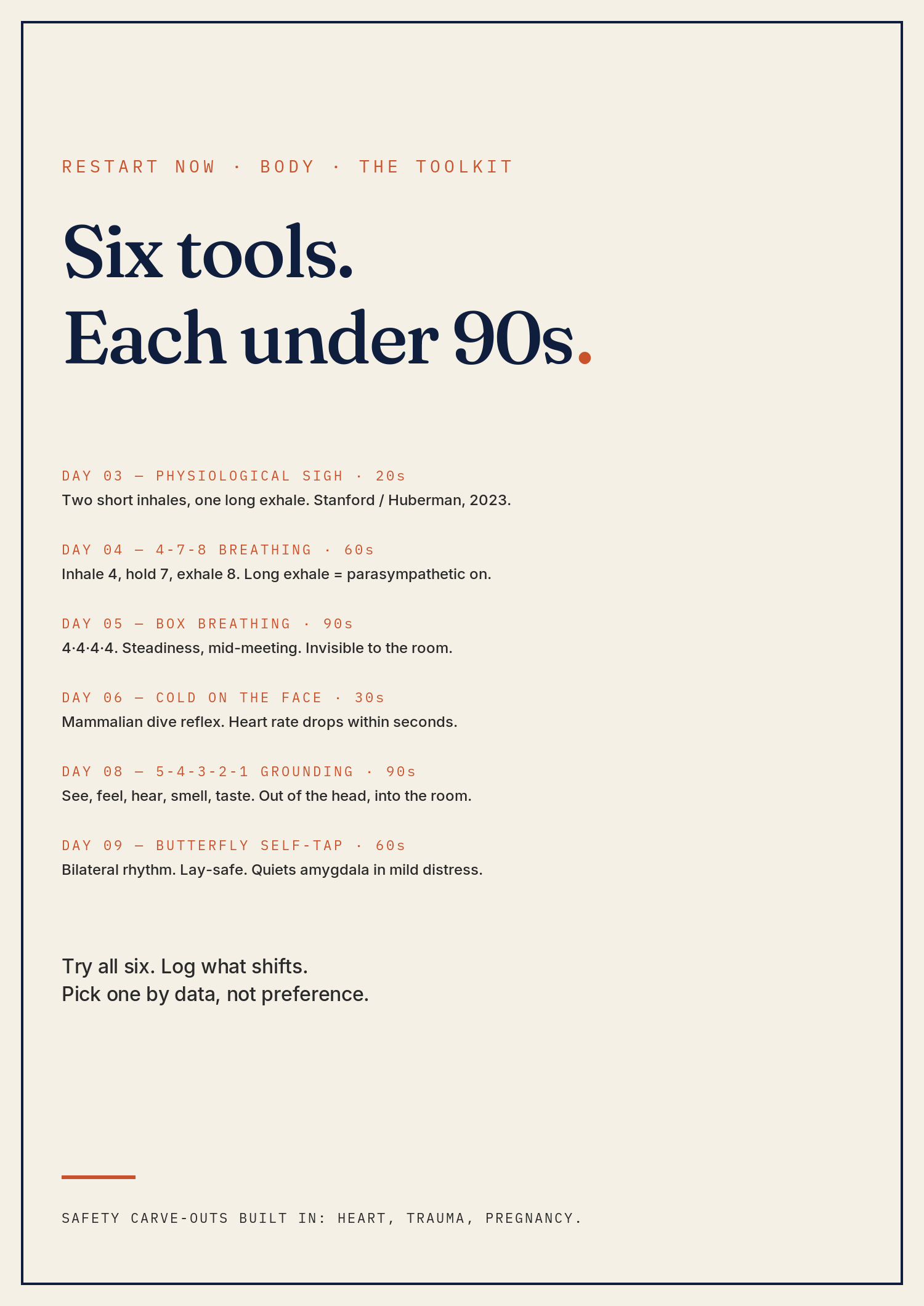
- Day 03 — Tool 1: Physiological sigh. Two cycles, twenty seconds. (Stanford, 2023.)
- Day 04 — Tool 2: 4-7-8 breathing. Long exhale = parasympathetic on.
Act 2 — More tools and the 90-second rule (Days 5–10)
- Day 05 — Tool 3: Box breathing. 4·4·4·4. Invisible mid-meeting.
- Day 06 — Tool 4: Cold on the face. Mammalian dive reflex. 30 seconds.
- Day 07 — Halfway. Pick top three.
- Day 08 — Tool 5: 5-4-3-2-1 grounding. Out of the head, into the room.
- Day 09 — Tool 6: Butterfly self-tap. Bilateral rhythm. Lay-safe.
- Day 10 — The 90-second rule. Why a wave passes if you don't refeed it.
Act 3 — Field test, pick your one, entrench (Days 11–14)
- Day 11 — Field deployment. Use one tool, real activation.
- Day 12 — Review the log. Which tool fits which trigger?
- Day 13 — Pick your one. Anchor it to a body cue.
- Day 14 — Entrench. Identity statement, relapse if-thens, 30-day check-in.
Plus a contents page, an activation log template, what-to-expect orientation, FAQ, an "if it's not working" page, and citations.
Built on real research
This workbook is grounded in current autonomic-nervous-system research, not wellness branding.
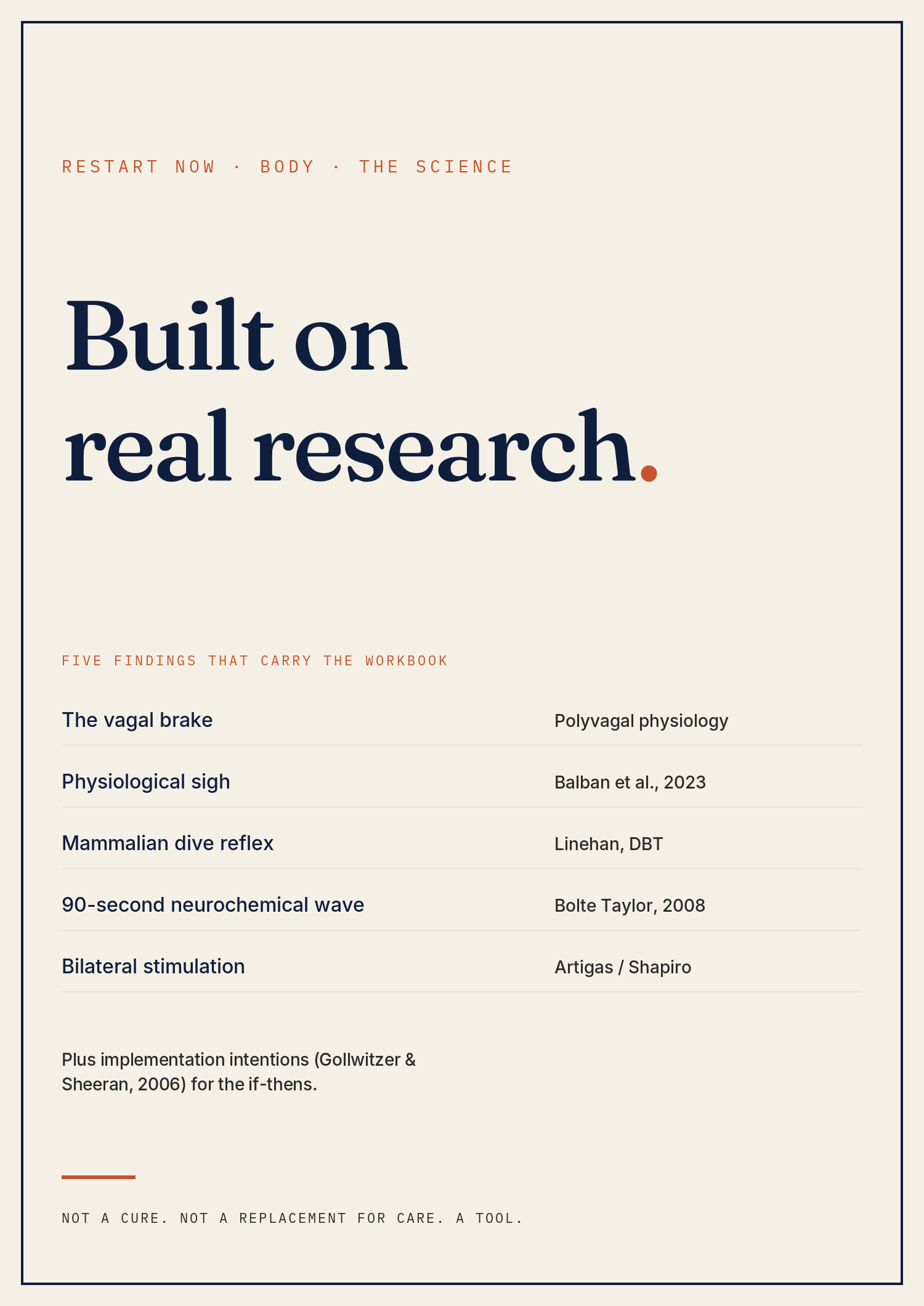
The five findings that carry the workbook:
- The vagal brake — Polyvagal physiology. Long exhales, paced breathing, and cold on the face activate the parasympathetic nervous system directly.
- Physiological sigh — Balban et al. (Cell Reports Medicine, 2023). Five minutes produced larger same-day reductions in anxiety than mindfulness meditation. Two cycles is enough in the moment.
- Mammalian dive reflex — Cold on the trigeminal-nerve area triggers a built-in slow-down. Used clinically in DBT (Linehan) for emotion regulation.
- The 90-second neurochemical wave — Bolte Taylor (2008). Emotional chemicals flush in ~90 seconds. After that, the wave continues only if the story keeps re-feeding it.
- Bilateral stimulation — Self-tapping (Artigas, 2000) quiets amygdala activation in mild distress. Lay-safe slice of EMDR; the full protocol requires a trained clinician.
Plus implementation intentions (Gollwitzer & Sheeran, 2006) for the Day 13 anchor.
Who this is for
Adults 28–50 who notice anxiety in the body — racing heart, breath tightness, wave of overwhelm — without a formal diagnosis or actively in treatment. Knowledge workers, parents, anyone whose week includes meetings, calls, and transitions where activation tends to spike.
Who this is not for
This workbook is not:
- therapy. Anxiety with co-occurring depression, panic disorder, PTSD, or substance use needs clinical care.
- medication advice. Don't change anything you're prescribed without a doctor.
- a cure. The tools shorten and soften activation; they don't promise it never returns.
- safe for everyone in every form. The cold-face tool is contraindicated for heart conditions, arrhythmia, eating disorders, or pregnancy. The bilateral self-tap is not for active trauma material — see a clinician for that.
If you are experiencing severe anxiety, frequent panic attacks, suicidal thoughts, or active substance use, see a clinician before running this workbook. US: 988 (Suicide & Crisis Lifeline). UK: 116 123 (Samaritans). EU: 112.
The format
A 31-page, A5 portrait, mobile-native PDF. Designed to read on your phone at fit-to-width — no pinch-to-zoom, no printer required. Each day's screen is dense with the theory and the exercise; you write your activation log in a separate notebook.
You'll need three things:
- A notebook (any notebook).
- A pen.
- Your phone — for reading the PDF and the if-then anchor pinned to your home screen.
No need to print the PDF. It's designed for mobile phone viewing.
FAQ
Will this replace therapy or medication? No. The tools are complementary. If you're in therapy, share your log with your clinician — many find it useful. If you're on medication, don't change anything without your prescriber.
What if I have a panic attack? Full panic attacks (peak in minutes, intense fear, fear of dying) are clinical territory. The tools may help between attacks; they are not the treatment. Talk to a clinician.
I'm embarrassed to do breathwork in public. Box breathing is invisible. Physiological sigh looks like a sniff and an exhale — also invisible. 4-7-8 needs privacy if the long exhale is audible. Cold-face needs a bathroom. Pick by setting.
Nothing's working by Day 7. Three things to check: have you been activated yet (calm reps don't really test the tool)? Are you logging real numbers, or guessing? Did you give the tool a fair live trial? See the "If it's not working" page for the full troubleshooting.
Anxiety that comes with bad sleep — same person? Yes. The cross-sell pair is The 14-Day Sleep Reset. Anxious bodies don't sleep; sleep-deprived bodies are more anxious. Run them in sequence.
Refunds. If the PDF doesn't open, doesn't render correctly on your phone, or you decide it's not what you expected, email within 30 days and you'll get a refund. After 30 days you've either followed the protocol or you haven't — the workbook is the workbook.
What you'll have at Day 14
- An activation map: three triggers, three body sensations, the wave's arc.
- A WANT, WIN, BLOCK, MOVE for the body.
- Six somatic tools tried, with body-knowledge of each.
- An activation log with at least ten entries.
- A clear understanding of the 90-second neurochemical wave.
- One tool chosen as your one, by data, not preference.
- An if-then anchor: cue + tool + time, pinned in three places.
- A signed identity statement and a 30-day calendar entry already scheduled.
The protocol is not the workbook. The protocol is one tool, one cue, used reflexively, for as many activations as the next year holds.
The 14-Day Anxiety Body Reset · 31-page mobile-native PDF · $27