
The 14 Day Sleep Reset
Start sleeping great, in just 14 days.
For adults stuck in the 3 AM loop. No melatonin. No tracking apps. No "just meditate."
→ Get the workbook for $27
✓ 30-Day Money-Back Guarantee ✓ Instant PDF download ✓ Secure checkout
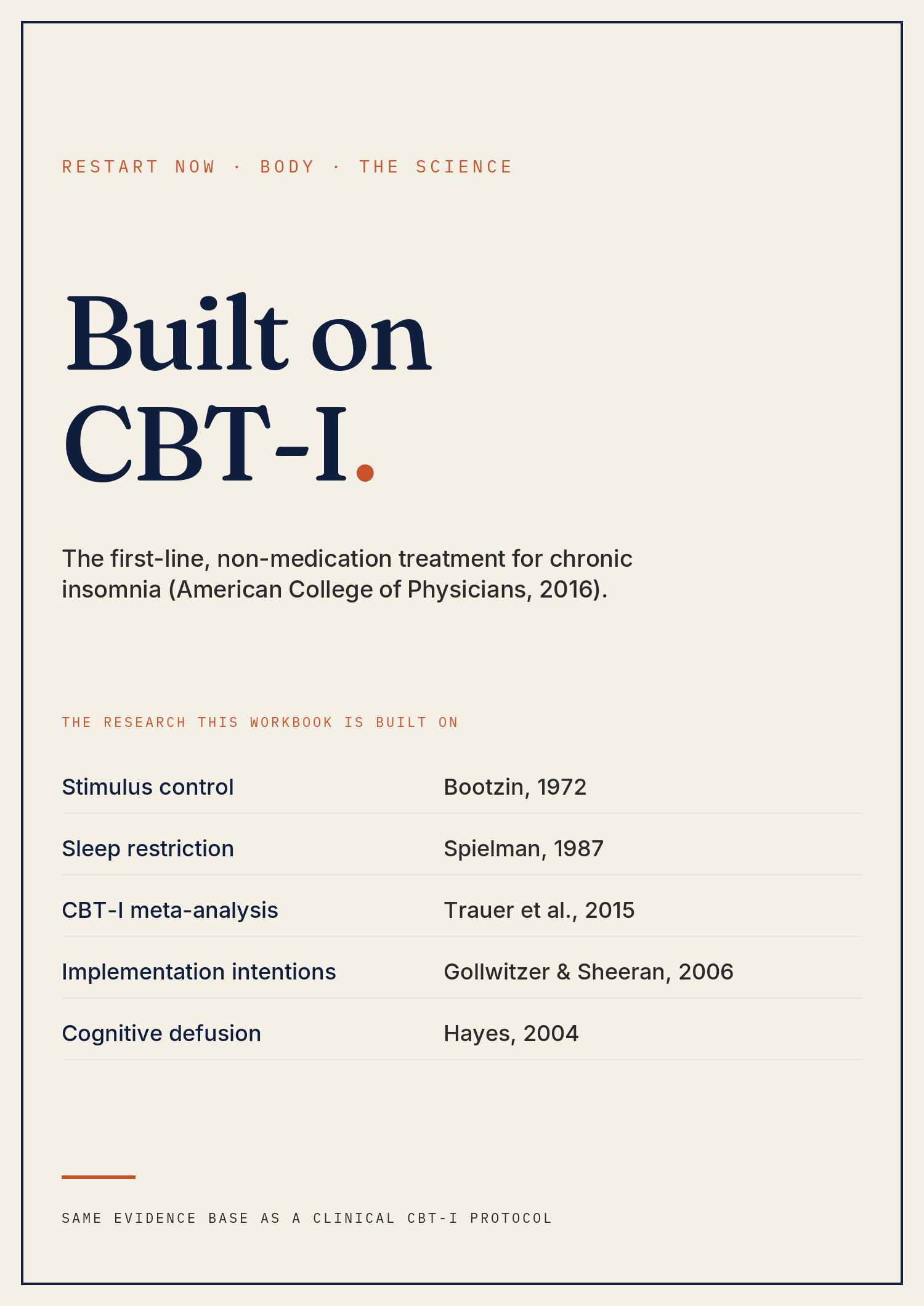
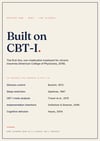
A workbook built on the clinical research behind CBT-I — the first-line treatment for insomnia recommended by the American College of Physicians.
You wake at 3 AM. Again.
You've tried melatonin, magnesium, the breathing thing, the cold room, "no screens after 8." Nothing holds. The Sleep Foundation says do this. Your friend's app says do that. None of it tells you exactly what to do tonight if your sleep is already broken.
This workbook does.
What this is
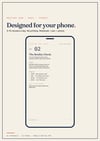
The 14-Day Sleep Reset is the evidence base of CBT-I — Cognitive Behavioral Therapy for Insomnia — distilled into a 14-day, on-your-phone protocol you can run alone.
The full clinical version takes 4–8 weeks with a therapist and costs $1,500–$3,000. This is the first 14 days, the part that does most of the work, structured for one person doing it themselves.
Why it works
CBT-I doesn't help you "relax." It rewires three specific things:
1. The bed–wake association. Your brain has learned that bed = trying to sleep, failing, and lying awake. Stimulus control breaks that link. (Bootzin, 1972; American Academy of Sleep Medicine clinical guideline, Edinger et al., 2021.)
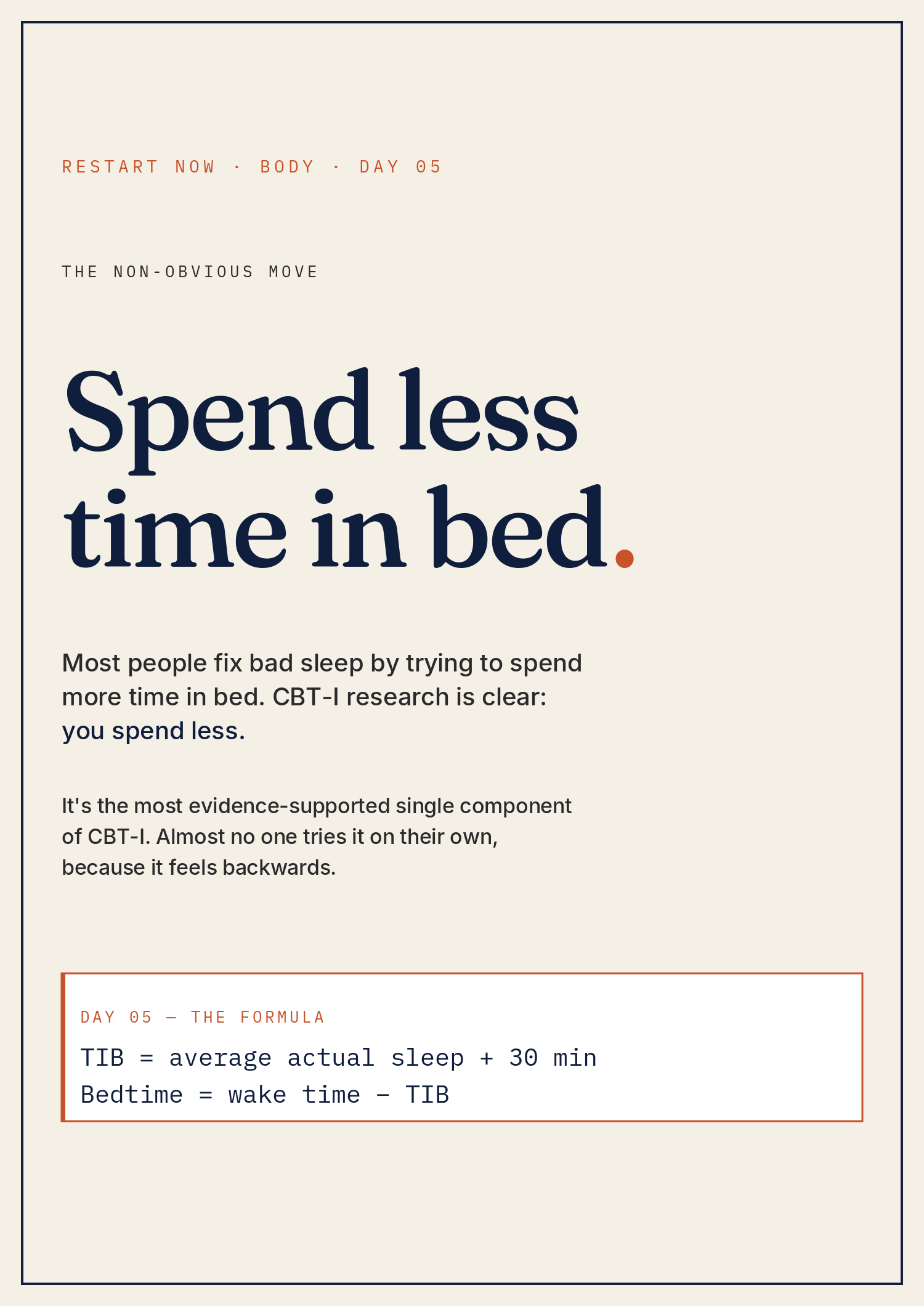
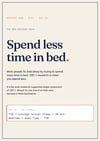
2. Your sleep drive. Spending 9 hours in bed for 5 hours of actual sleep keeps your sleep shallow and fragmented. Sleep restriction compresses your time-in-bed until pressure to sleep is high enough to consolidate it. (Spielman, Saskin, & Thorpy, 1987; Miller et al., 2014, meta-analysis.)
3. The 3 AM thought spiral. Cognitive defusion gives you a way to notice racing thoughts without engaging them — different from "trying to clear your mind." (Harvey, 2002.)
You don't need to remember any of this. The workbook walks you through it day by day.
What's inside
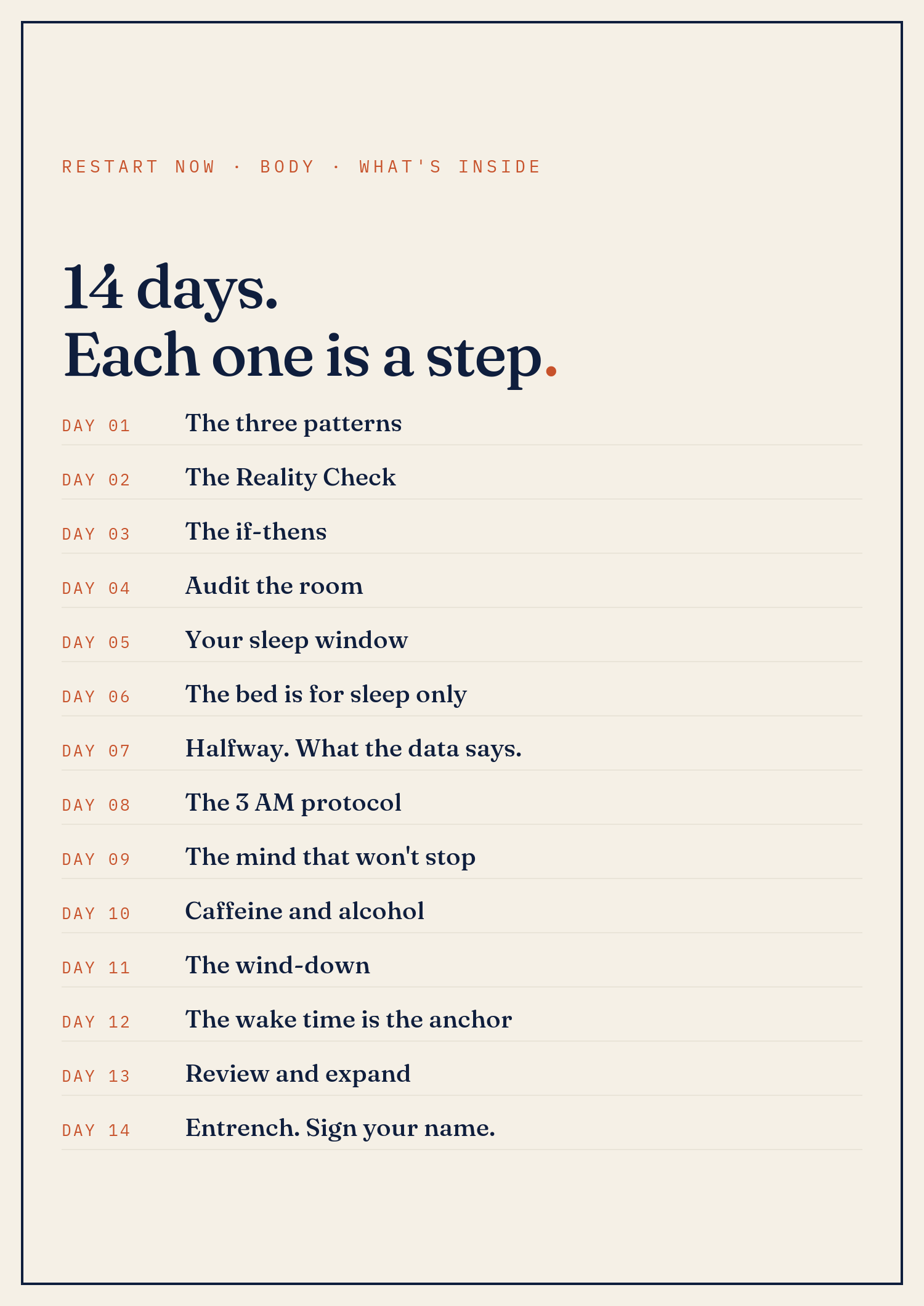
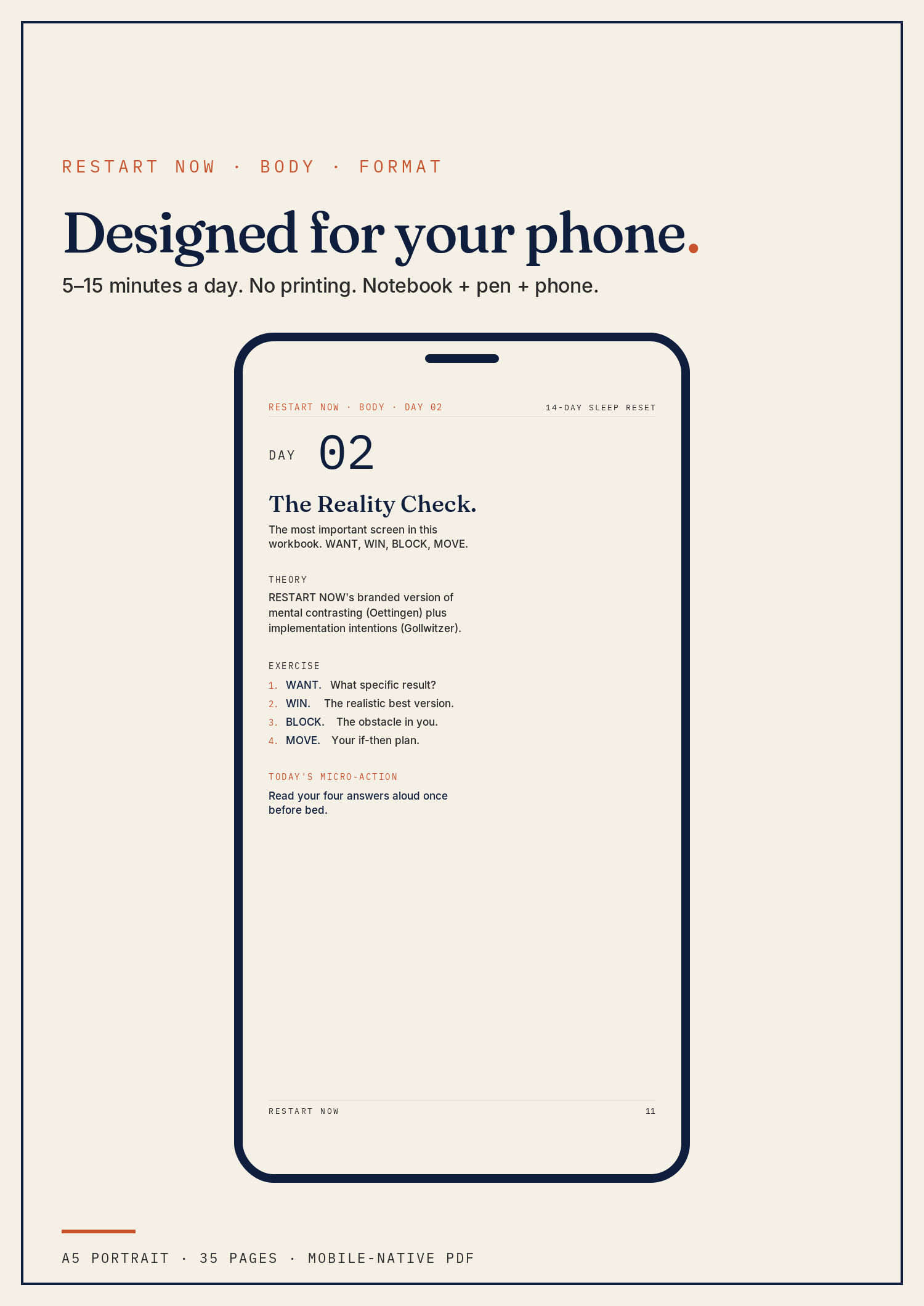
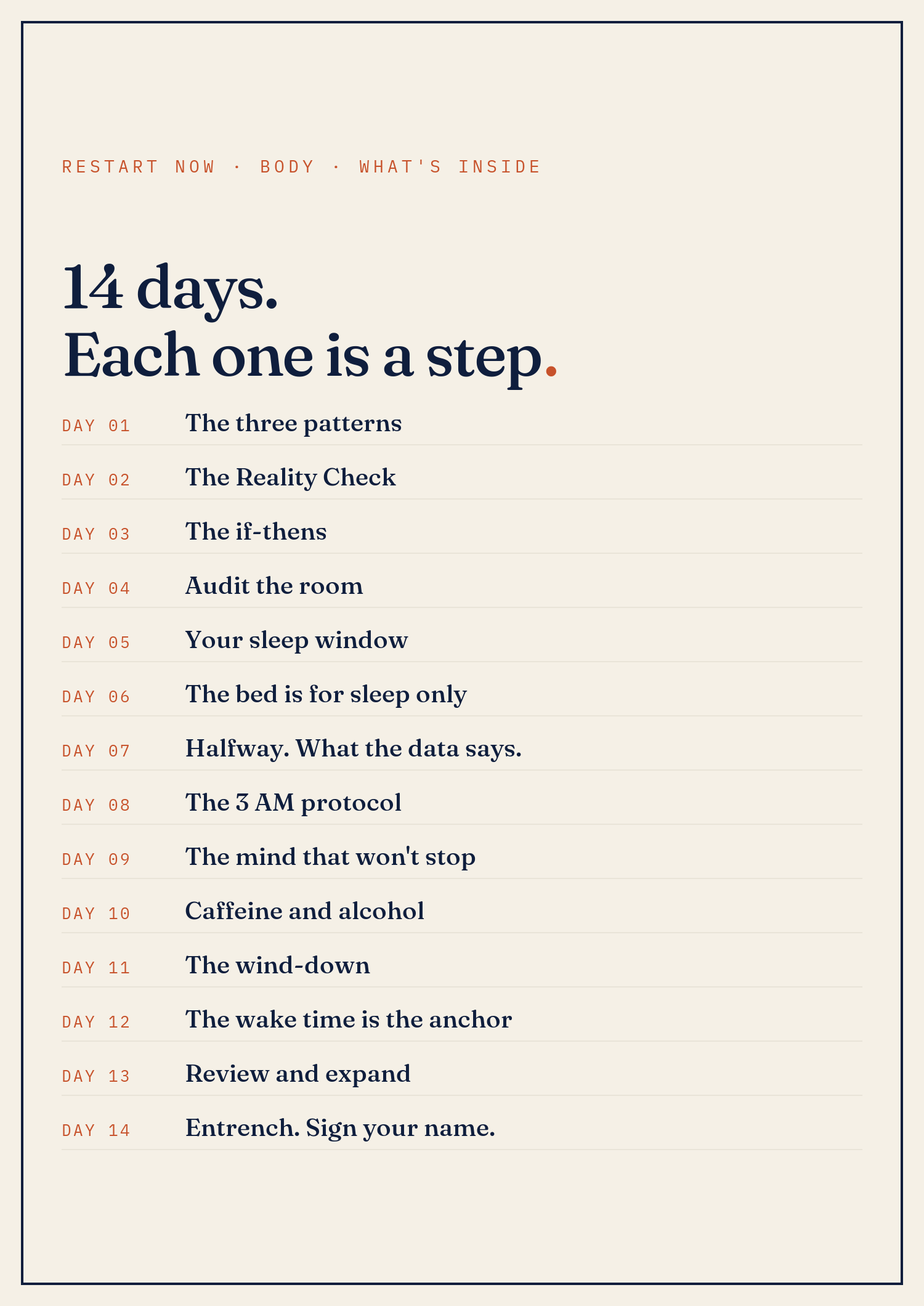
A 35-page A5 workbook (PDF). 14 daily entries. ~10 minutes a day to use.
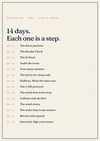
- Days 1–3 — Diagnose. Sleep log, sleep efficiency calculation, your personal sleep window.
- Days 4–7 — Set up. Stimulus control rules, custom wind-down, bedroom audit.
- Days 8–11 — Implement. Sleep restriction starts. Daily check-ins. Day 7 review branch if it isn't landing yet.
- Days 12–14 — Lock it in. Titrating the window, building a relapse plan, what to do on bad nights without breaking the protocol.
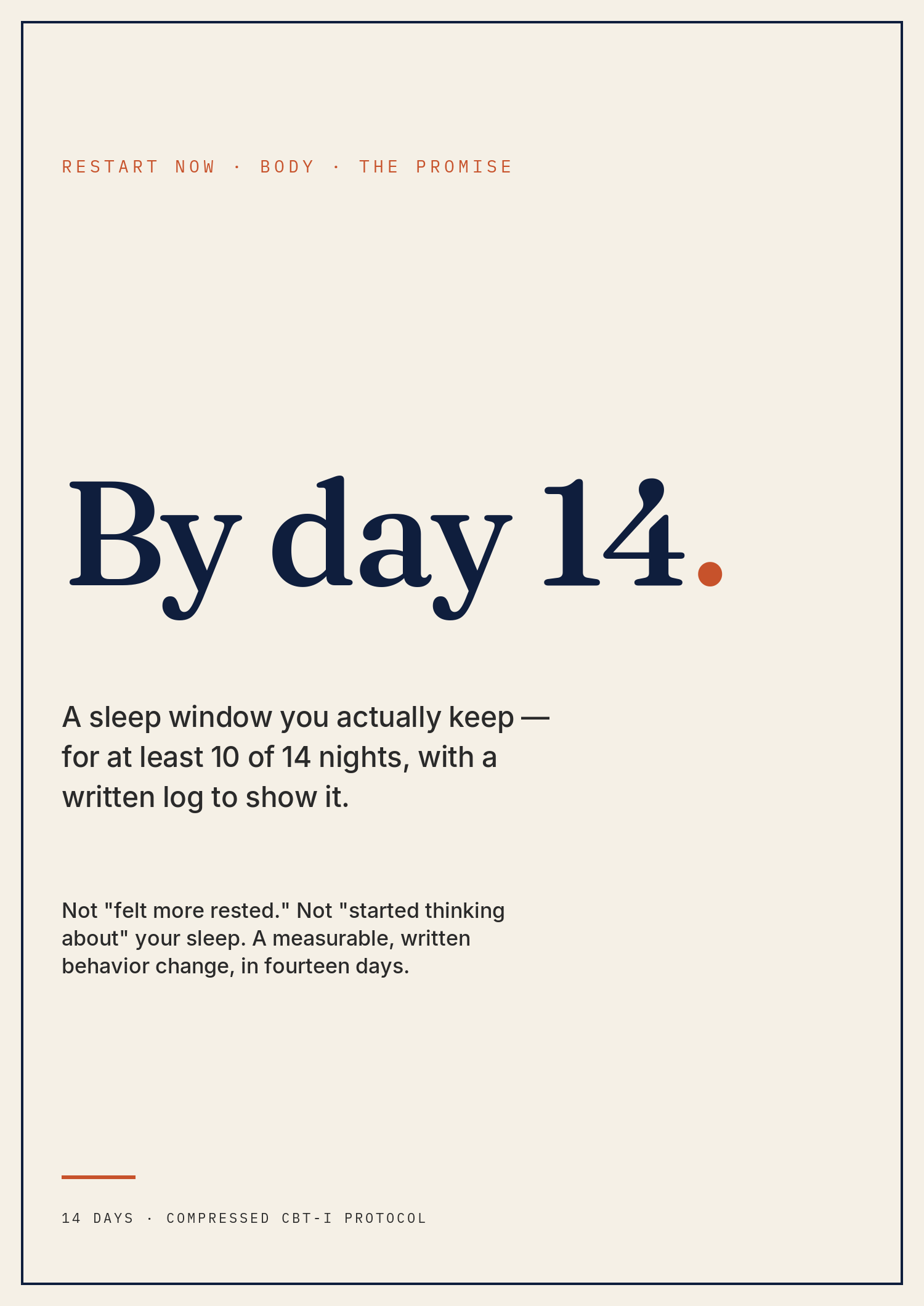
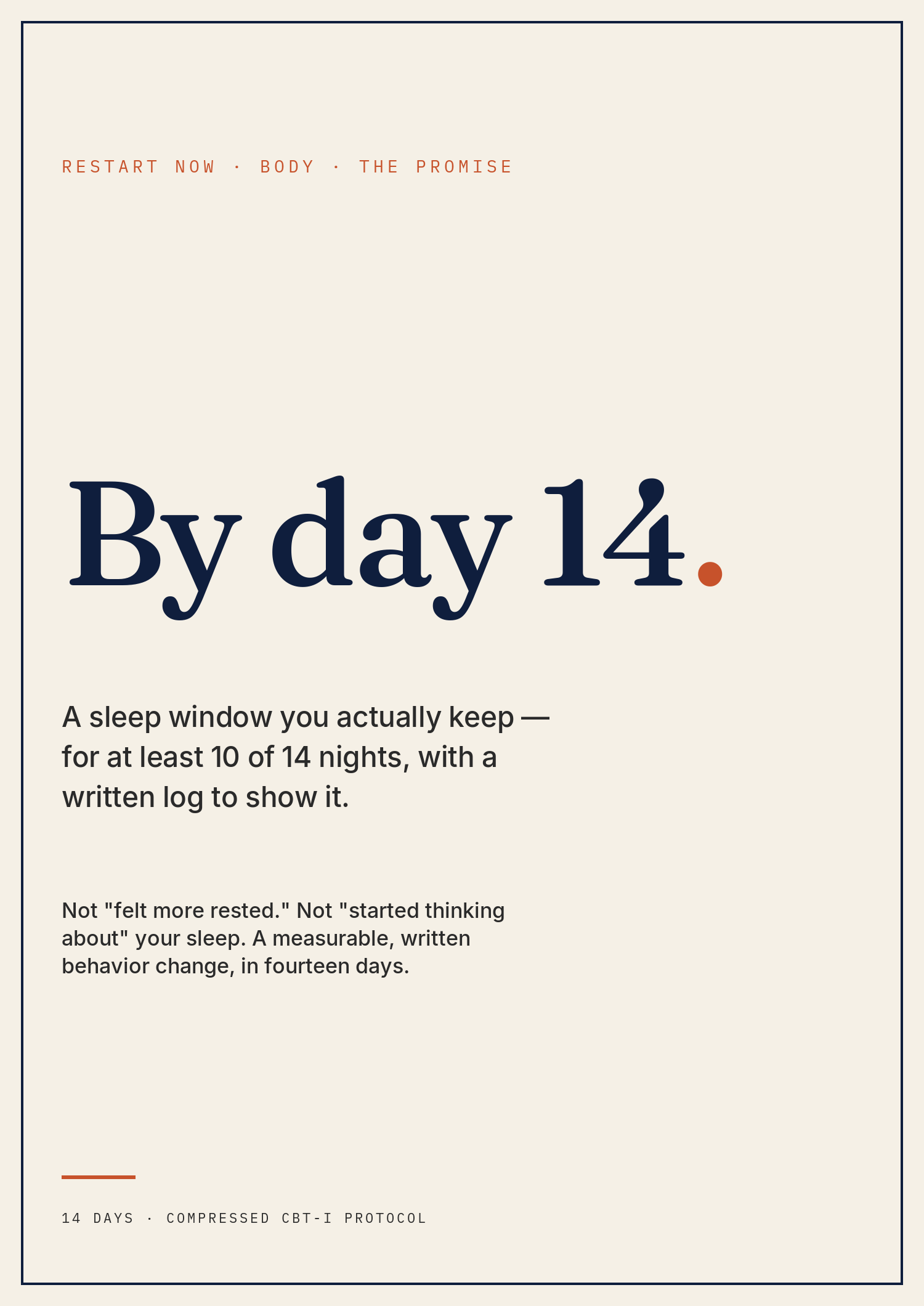
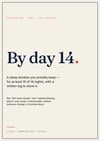
By Day 14 you have a sleep window — a fixed time-in-bed your body actually defends.
Who this is for
Adults 30–55 with mild-to-moderate chronic insomnia who want a protocol, not a vibe. People who've already tried supplements, apps, and meditation, and want the thing those things were supposed to be a substitute for.
Who this is NOT for
- Severe insomnia (less than ~4 hours of sleep most nights, for months)
- Untreated sleep apnea — get tested first
- Active treatment for depression, anxiety, or trauma — do CBT-I with your clinician, not alone
- Shift workers — this protocol assumes a stable schedule
If any of these apply, this isn't the right starting point. Talk to a doctor.
The research this is built on
This isn't original research. It's a synthesis of decades of clinical work, made usable for one person on their phone.
- Bootzin, R. R. (1972). Stimulus control treatment for insomnia. APA.
- Spielman, A. J., Saskin, P., & Thorpy, M. J. (1987). Treatment of chronic insomnia by restriction of time in bed. Sleep.
- Harvey, A. G. (2002). A cognitive model of insomnia. Behaviour Research and Therapy.
- Miller, C. B., et al. (2014). The evidence base of sleep restriction therapy for treating insomnia disorder. Sleep Medicine Reviews.
- Qaseem, A., et al. (2016). Management of chronic insomnia disorder in adults: a clinical practice guideline from the American College of Physicians. Annals of Internal Medicine.
- Edinger, J. D., et al. (2021). Behavioral and psychological treatments for chronic insomnia disorder in adults: an AASM clinical practice guideline. Journal of Clinical Sleep Medicine.
Every protocol step in the workbook is referenced back to the paper it comes from.
30-Day Money-Back Guarantee
If the PDF doesn't open, doesn't render properly on your phone, or isn't what you expected — email within 30 days and get a full refund. No questions, no forms, no friction.
The reasoning: you should not lose money to find out whether a self-guided protocol fits you. The guarantee is part of the offer, not a footnote.
FAQ
What if I can't fall asleep at the new bedtime? That's expected at first — the protocol relies on building sleep pressure. The workbook tells you exactly what to do on nights this happens, and what not to do (no clock-watching, no "just rest your eyes").
What if I'm traveling during the 14 days? Don't start until you're back on a stable schedule. Sleep restriction needs a fixed wake time. The workbook has a section on travel and time zones once the protocol is locked in.
What about naps? No naps for the 14 days. The workbook explains why and what to do if you're falling asleep on the couch at 7 PM.
Will this work if I've had insomnia for years? Yes — chronic insomnia is exactly what CBT-I is designed for. Severity matters more than duration; see the "not for" section above.
What if it isn't working by Day 7? There's a Day 7 review branch built into the workbook. It's a checklist that tells you which lever is misfiring (sleep window too long, stimulus control slipping, anxiety overriding the protocol) and what to change.
Refunds?
30 days, no questions. See above.