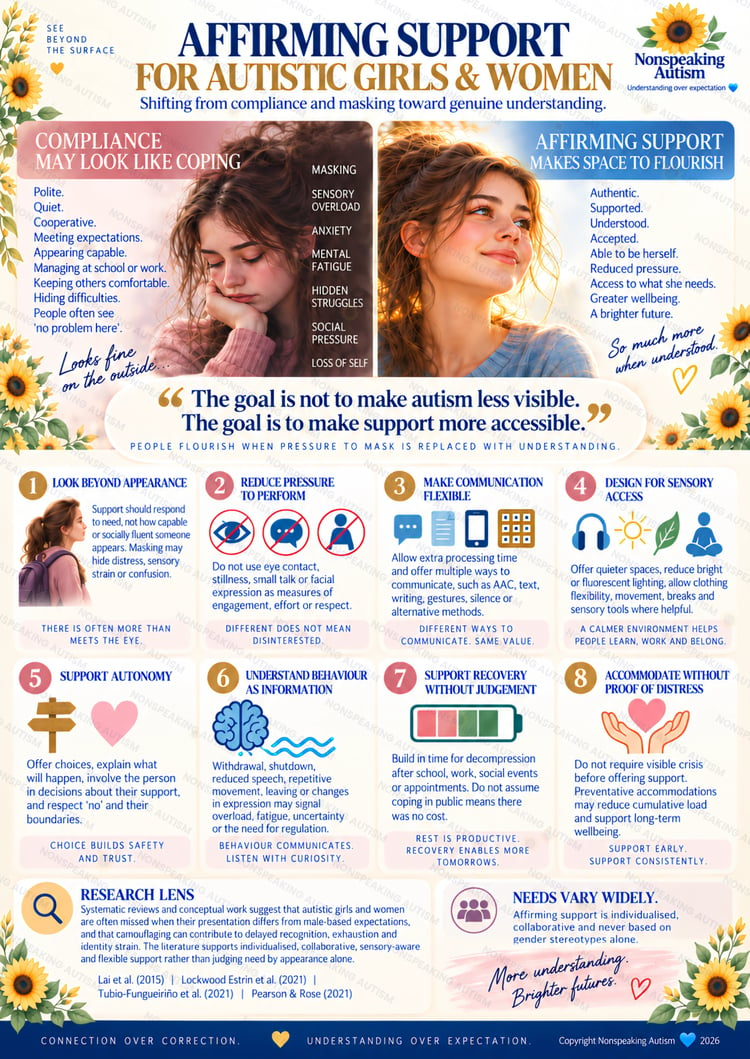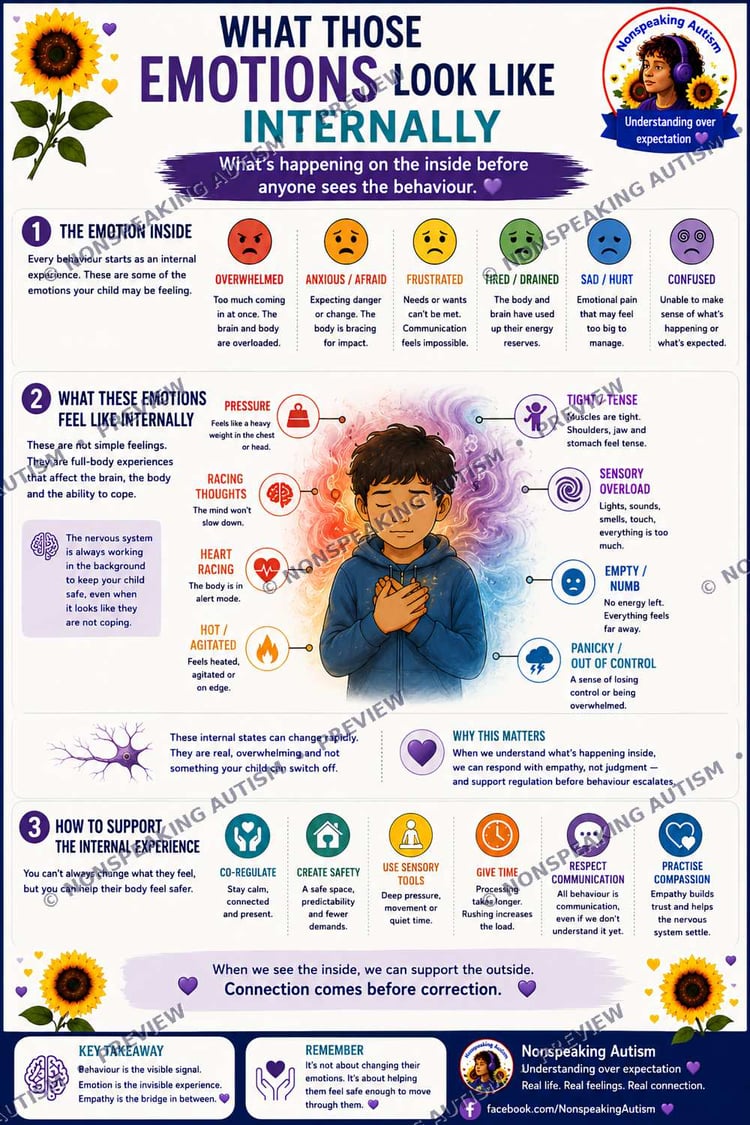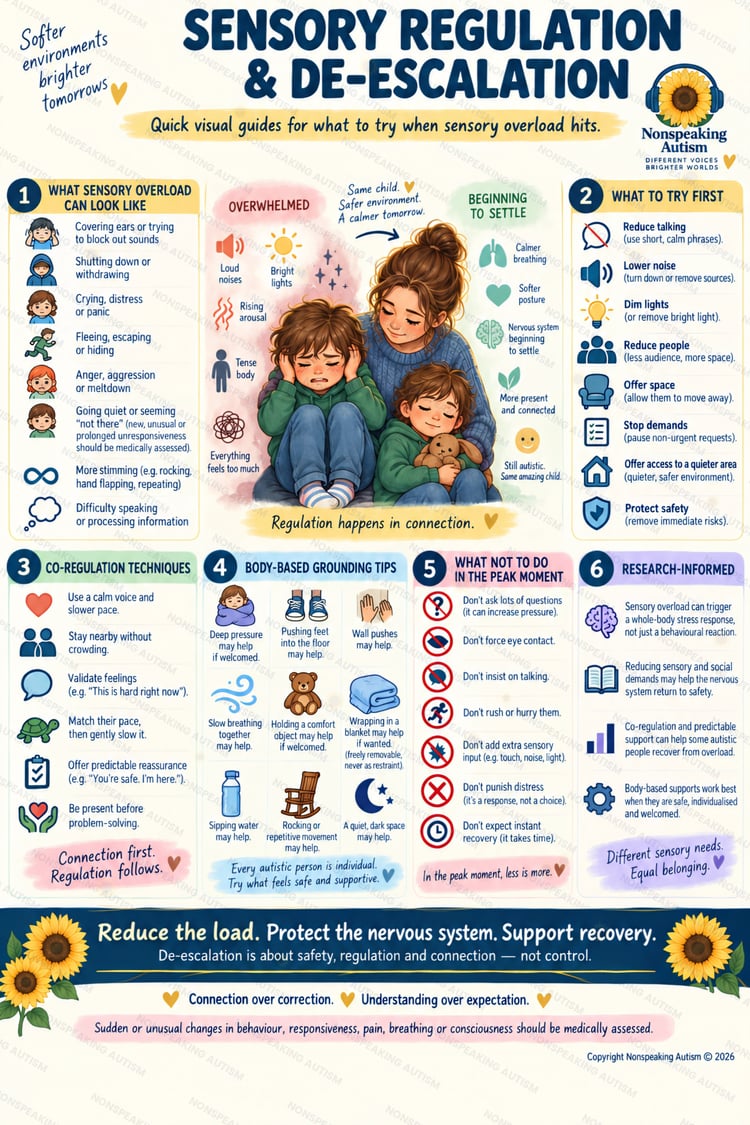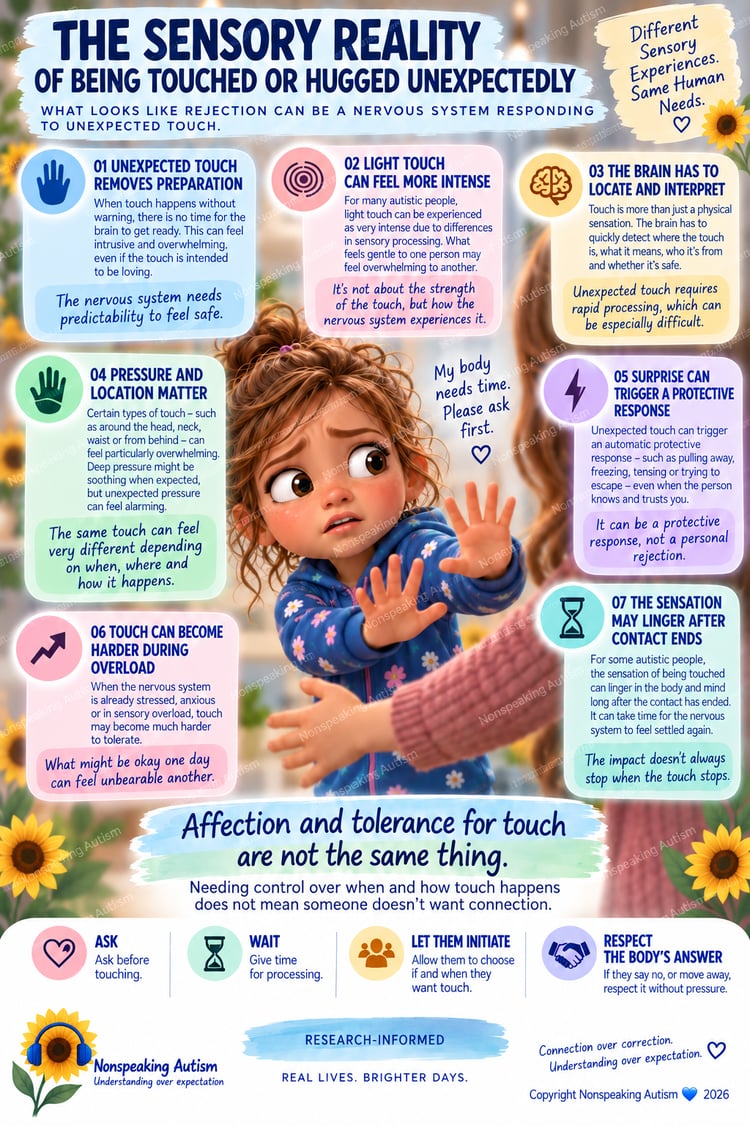

Understanding Speech Access Variability
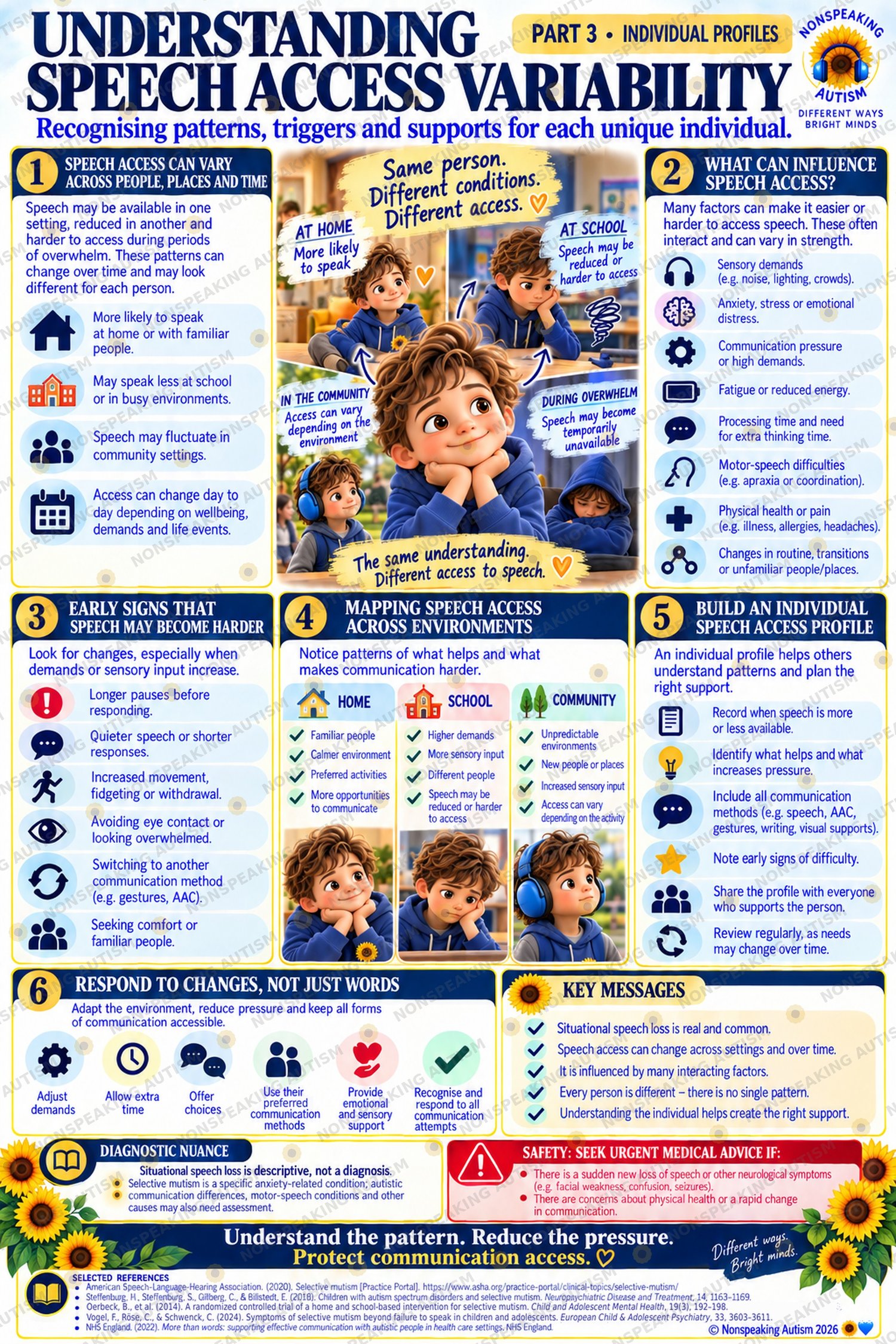
Understanding Speech Access Variability — Part 3: Individual Profiles
Recognising patterns, triggers and supports for each unique individual
Speech is not always a fixed ability that appears in exactly the same way, in every environment, at every moment.
For some autistic people, spoken communication may be readily accessible at home but much harder at school. It may be available with familiar people but reduced in busy community environments. During periods of overload, fatigue, anxiety, pain or high communication demand, speech may become significantly harder — or temporarily unavailable.
Understanding Speech Access Variability — Part 3: Individual Profiles is a practical, research-informed educational poster designed to help families, caregivers, educators and professionals move beyond the simple question:
“Can this person speak?”
and instead consider:
“When is speech accessible, what makes it harder, and what helps this individual communicate?”
The central message is:
Understand the pattern. Reduce the pressure. Protect communication access. 💛
🧠 What This Poster Explores
This third resource in the series focuses on understanding the individual communication profile, including:
1️⃣ How Speech Access Can Vary Across People, Places & Time
2️⃣ Factors That May Influence Speech Access
3️⃣ Early Signs That Speech Is Becoming Harder
4️⃣ Mapping Communication Across Environments
5️⃣ Building an Individual Speech-Access Profile
6️⃣ Responding to Changes — Not Just Words
The aim is not to place everyone into the same pattern.
It is to discover the individual's pattern.
1️⃣ Speech Access Can Vary Across People, Places & Time
For some people, spoken communication may be available in one setting, reduced in another and much harder during periods of overwhelm.
A person might be:
🏠 More Likely to Speak at Home
Home may provide familiar people, familiar routines, fewer social demands and a more predictable environment.
🏫 Less Able to Access Speech at School
School can introduce additional sensory, social, cognitive and communication demands.
👥 Variable in Community Settings
New people, unfamiliar places, noise, crowds and unpredictable interactions can affect communication.
📅 Different From Day to Day
Sleep, illness, pain, fatigue, emotional wellbeing, accumulated sensory load and life events can all change the demands placed on a person.
This is why a statement such as:
“But they talk perfectly well at home.”
does not necessarily tell us what communication will look like elsewhere.
Same person. Different conditions. Different access.
💛 The Same Understanding — Different Access to Speech
One of the most important ideas in this resource is that spoken output should not be used as the sole measure of understanding.
A person who produces fewer words in a demanding environment may still have meaningful thoughts, preferences and messages to communicate.
At the same time, we should not automatically assume that comprehension remains identical in every situation. Stress, language complexity and processing demands can affect understanding too.
The safest approach is to:
avoid underestimating the person
keep information accessible
maintain alternative communication
and
give them a reliable way to show us what they understand and want to communicate.
🔍 2️⃣ What Can Influence Speech Access?
There is rarely one simple explanation.
Several factors may interact.
🎧 Sensory Demands
Noise, bright lighting, crowds, smells, touch and competing sensory information may increase overall processing demands.
🧠 Anxiety, Stress or Emotional Distress
Anxiety and heightened stress may make communication more difficult for some people.
⚙️ Communication Pressure
Repeated questions, expectations for immediate answers, unfamiliar conversation partners or high language demands can add additional pressure.
🔋 Fatigue & Reduced Energy
Speech can require significant effort. Communication may look different when someone is exhausted.
💬 Processing Time
Some people need additional time to understand incoming information, formulate a response and communicate it.
🗣️ Speech-Motor Difficulties
Speech production can also be affected by motor-speech differences. These require appropriate professional assessment rather than being assumed from observation alone.
🩺 Physical Health & Pain
Illness, headache, gastrointestinal discomfort, allergies, pain and other physical problems may affect communication.
🔄 Changes & Transitions
Unexpected routines, unfamiliar people, new environments and transitions can increase overall demands.
Often, several of these factors occur at the same time.
🚦 3️⃣ Early Signs Speech May Be Becoming Harder
Learning an individual's early signs can allow support to begin before communication becomes substantially more difficult.
Possible signs may include:
longer pauses before responding
quieter speech
shorter responses
increased movement or fidgeting
increased stimming
withdrawal
looking overwhelmed
switching to gestures
switching to AAC
seeking familiar people
needing longer processing time
reduced initiation
These signs should not be treated as a universal checklist.
A long pause does not always mean someone is losing access to speech.
Looking away does not have one fixed meaning.
Stimming does not automatically indicate distress.
The important thing is to learn changes from that person's usual communication pattern.
🗺️ 4️⃣ Mapping Speech Access Across Environments
Rather than asking only whether a person “can talk,” it can be useful to map what communication looks like in different environments.
🏠 HOME
Consider:
Who is present?
How predictable is the environment?
What is the sensory load?
How much communication pressure exists?
Which activities make communication easier?
What communication methods does the person use?
🏫 SCHOOL
Consider:
classroom noise
number of people
verbal instructions
social expectations
time pressure
transitions
unfamiliar staff
performance demands
availability of AAC
🌳 COMMUNITY
Consider:
unpredictability
new people
new places
crowding
sensory demands
the purpose of the activity
whether a trusted person is present
whether alternative communication remains available
The aim is to discover:
What helps? What makes communication harder? What changes first?
📝 5️⃣ Build an Individual Speech-Access Profile
An individualized communication profile can help everyone supporting the person understand what they need.
Useful information might include:
📋 When Speech Is More or Less Accessible
Record environments and circumstances where noticeable changes occur.
💡 What Helps & What Increases Pressure
Identify helpful environmental adjustments as well as common barriers.
💬 Every Communication Method
Include:
speech
AAC
typing
writing
gesture
symbols
visual supports
and other established methods.
⭐ Early Signs
Record the individual's own signs that communication is becoming more difficult.
👥 Share Relevant Information
Where appropriate and with respect for privacy, make sure important supporters understand the person's communication needs.
🔄 Review the Profile
Communication needs can change.
A useful profile should therefore be a living document, not a permanent label.
🌻 An Individual Profile Should Describe — Not Restrict
A speech-access profile should never become:
“This is what this person can do.”
Instead, it should help explain:
“These are the conditions in which communication currently seems easier or harder, and these are the supports that appear helpful.”
The purpose is not to create a ceiling.
It is to create better access.
❤️ 6️⃣ Respond to Changes — Not Just Words
When early signs appear, support does not need to wait until speech disappears completely.
Consider:
⚙️ Adjusting Demands
Reduce unnecessary cognitive, social or verbal pressure.
⏳ Allowing Extra Time
Give the person time to process and formulate their response.
💬 Offering Choices
Accessible choices may reduce expressive demands where appropriate.
📱 Using the Person's Preferred Communication
Keep AAC, typing, writing, symbols and other established communication methods available.
🌿 Supporting Emotional & Sensory Regulation
Consider whether the environment itself needs changing.
✅ Responding to Communication Attempts
Do not wait for the message to arrive in your preferred format before respecting it.
Respond to the person — not simply the presence or absence of spoken words.
📱 Protect AAC Access
If someone uses AAC when speech becomes difficult, their AAC should not disappear simply because they are speaking at another time.
A person might use:
speech at home
short speech + gestures at school
AAC in a busy environment
typing when exhausted
and a different combination tomorrow.
That does not make their communication inconsistent or invalid.
It makes it multimodal.
♾️ Every Person Is Different
There is no single pattern of situational speech difficulty.
One person's speech may be most affected by anxiety.
Another person's communication may change primarily during sensory overload.
Another may experience substantial fatigue.
Another may have co-occurring motor-speech or language difficulties.
For another person, pain or illness may be responsible for an unexpected change.
And for many people, several factors may interact.
This is why support should be based on:
the individual + the environment + the context
rather than assuming that everyone with the same diagnosis will communicate in the same way.
🔬 Research-Informed
This resource draws on broader evidence concerning autism, selective mutism, anxiety, communication differences, AAC and environmental influences on communication.
Research supports the importance of recognizing that communication can vary according to setting, anxiety and contextual demands.
However, there is an important evidence distinction.
“Situational speech loss” is a descriptive term — not a formal diagnosis.
Selective mutism is a recognized anxiety disorder with defined diagnostic criteria.
Autistic people may also experience communication differences for other reasons, including sensory demands, language or motor-speech differences, fatigue, overload and individual communication profiles.
These experiences should not automatically be labelled selective mutism.
Likewise, a person with selective mutism should not have their difficulty reduced to a general assumption of autistic “shutdown.”
Individual assessment and context matter.
📚 Selected References & Guidance
American Speech-Language-Hearing Association (ASHA). Selective Mutism — Practice Portal. Clinical information covering assessment and support for selective mutism.
Steffenburg, H., Steffenburg, S., Gillberg, C., & Billstedt, E. (2018). Children with autism spectrum disorders and selective mutism. Neuropsychiatric Disease and Treatment, 14, 1163–1169.
Oerbeck, B., et al. (2014). A randomized controlled trial of a home and school-based intervention for selective mutism. Child and Adolescent Mental Health, 19(3), 192–198.
Vogel, F., Rose, C., & Schwenck, C. (2024). Symptoms of selective mutism beyond failure to speak in children and adolescents. European Child & Adolescent Psychiatry, 33, 3603–3611.
NHS England. (2022). More than words: supporting effective communication with autistic people in health care settings.
Evidence Note
The evidence base for selective mutism is more established than research specifically examining the broader experiences sometimes described as situational speech loss in autistic people.
This poster therefore uses speech-access variability and situational speech loss descriptively, rather than presenting a single universal mechanism or new diagnostic category.
👨👩👧 Who Is This Resource For?
This resource may be useful for:
- autistic children and young people
- autistic adults
- people with variable access to speech
- nonspeaking and minimally speaking people
- AAC users
- parents and caregivers
- families
- teachers and teaching assistants
- SENCOs and SEND professionals
- speech and language therapists
- occupational therapists
- psychologists and mental-health professionals
- support workers
- early-years practitioners
- autism and disability organizations
- multidisciplinary teams
It may be particularly useful when different people are reporting very different communication abilities in different settings.
📦 What You Receive
This download includes:
1 × Understanding Speech Access Variability — Part 3: Individual Profiles educational poster
1 × high-resolution printable PDF
The downloaded file is supplied clear and without the promotional preview watermark shown on the Payhip listing image.
Preview watermarks are used for copyright protection only and will not appear on the downloadable resource.
💛 FREE DIGITAL DOWNLOAD
This educational resource is provided free of charge through Payhip to help make practical, neurodiversity-affirming communication information more accessible to families, educators and professionals.
Digital download only — no physical product will be shipped.
⚠️ Important Educational, Communication & Medical Disclaimer
This resource is provided for educational and informational purposes only.
It is not medical advice, diagnosis, speech and language assessment, selective-mutism assessment, neurological assessment, psychological assessment, AAC assessment, therapy or an individualized communication plan.
“Situational speech loss” and “speech-access variability” are used descriptively in this resource and should not be interpreted as formal diagnoses.
Changes in speech can have many possible causes. Reduced or unavailable speech should not automatically be attributed to autism, anxiety, sensory overload, shutdown or nervous-system regulation.
🚨 Seek appropriate urgent medical assistance for a sudden loss of speech or other new neurological symptoms.
Particular concern is warranted where sudden speech changes occur alongside symptoms such as facial weakness, weakness elsewhere in the body, confusion, seizure activity, altered consciousness or other acute physical or neurological changes.
Persistent, significant or unexplained changes in established communication should also receive appropriate professional consideration.
Individual strategies should be adapted to the person's communication profile, language, established AAC, sensory and motor needs, physical and emotional health, preferences and circumstances.
💛 The Message Behind the Resource
Two adults can meet the same child and come away saying:
“They talk all the time.”
and:
“They hardly speak.”
Both may be describing what they genuinely observed.
The missing information is context.
Who was there?
How noisy was it?
How tired was the person?
How much pressure were they under?
Did they know what was going to happen?
Was their AAC available?
Did they have enough processing time?
Were they in pain?
Did they feel comfortable?
What happened immediately before communication changed?
Instead of asking only:
“Can they speak?”
start asking:
“What helps this person communicate?”
Learn their patterns.
Notice early changes.
Reduce unnecessary pressure.
Protect AAC access.
Share what works.
And remember that communication does not become less meaningful because it arrives through a different route.
Understand the pattern. Reduce the pressure. Protect communication access. 💛
Same person. Different conditions. Different access.
Different Ways. Bright Minds.
Connection over correction. Understanding over expectation.
© Nonspeaking Autism 2026 🌻💙