
Generator & UPS Load Test Log: standby generator and UPS test log with fuel autonomy in Excel
Full description
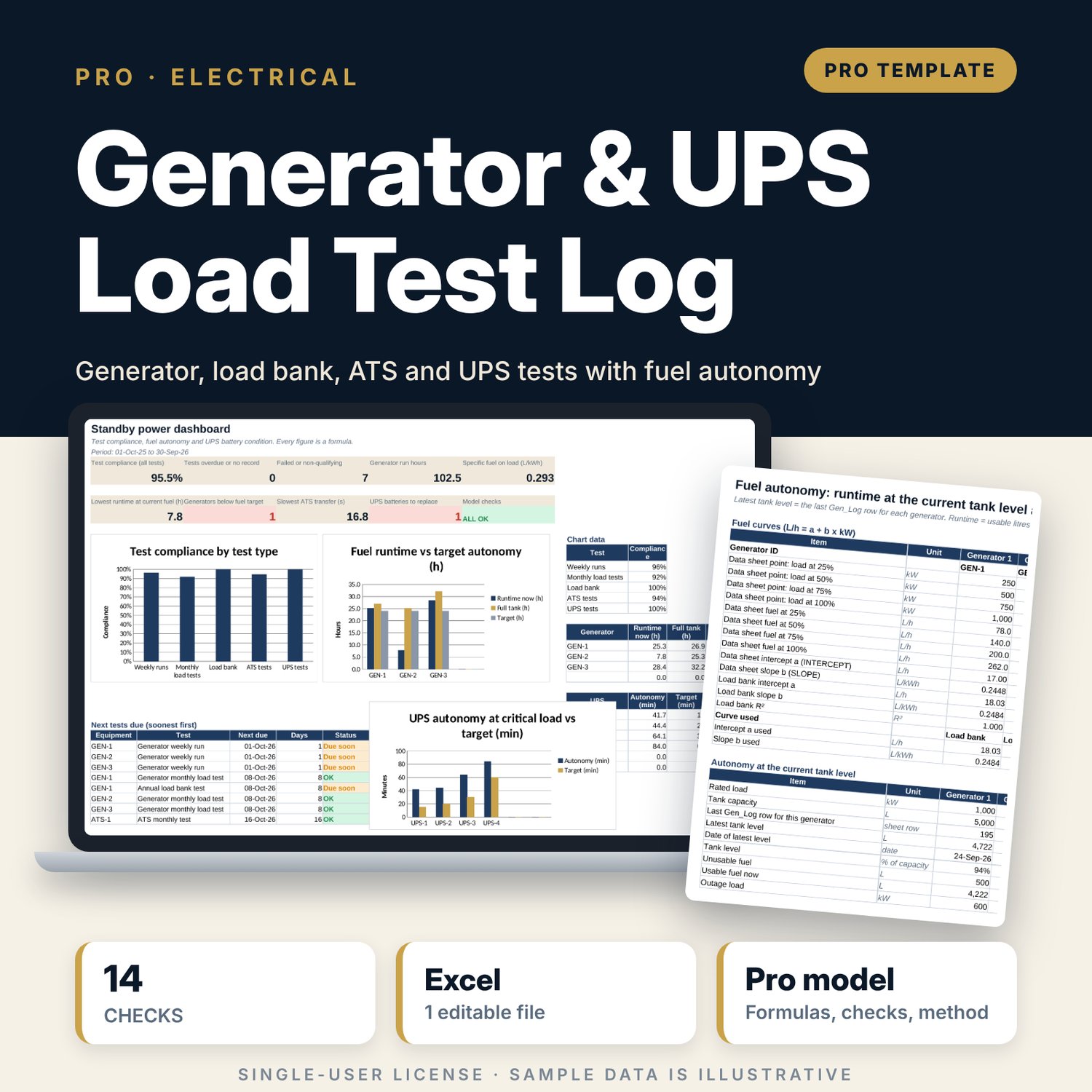
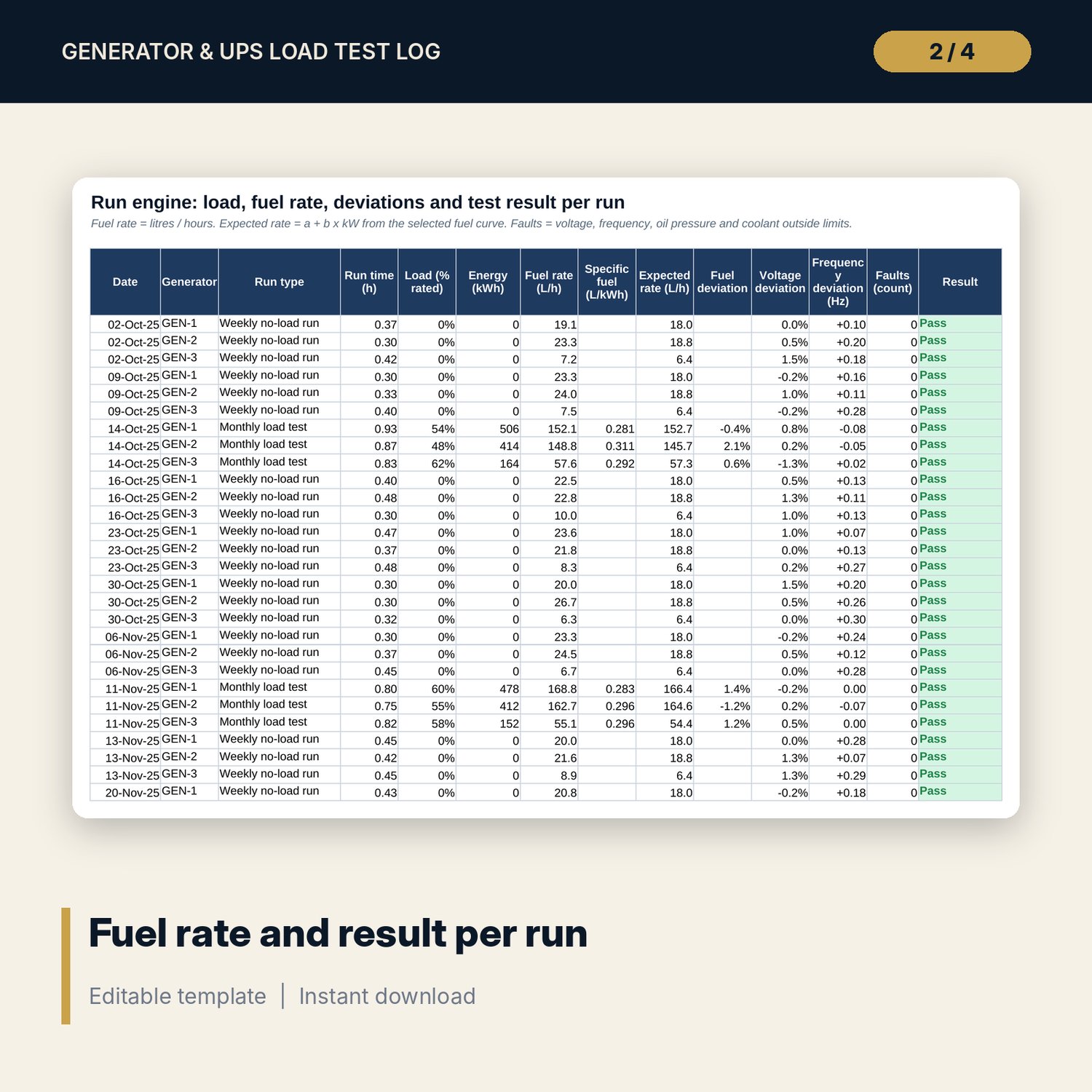
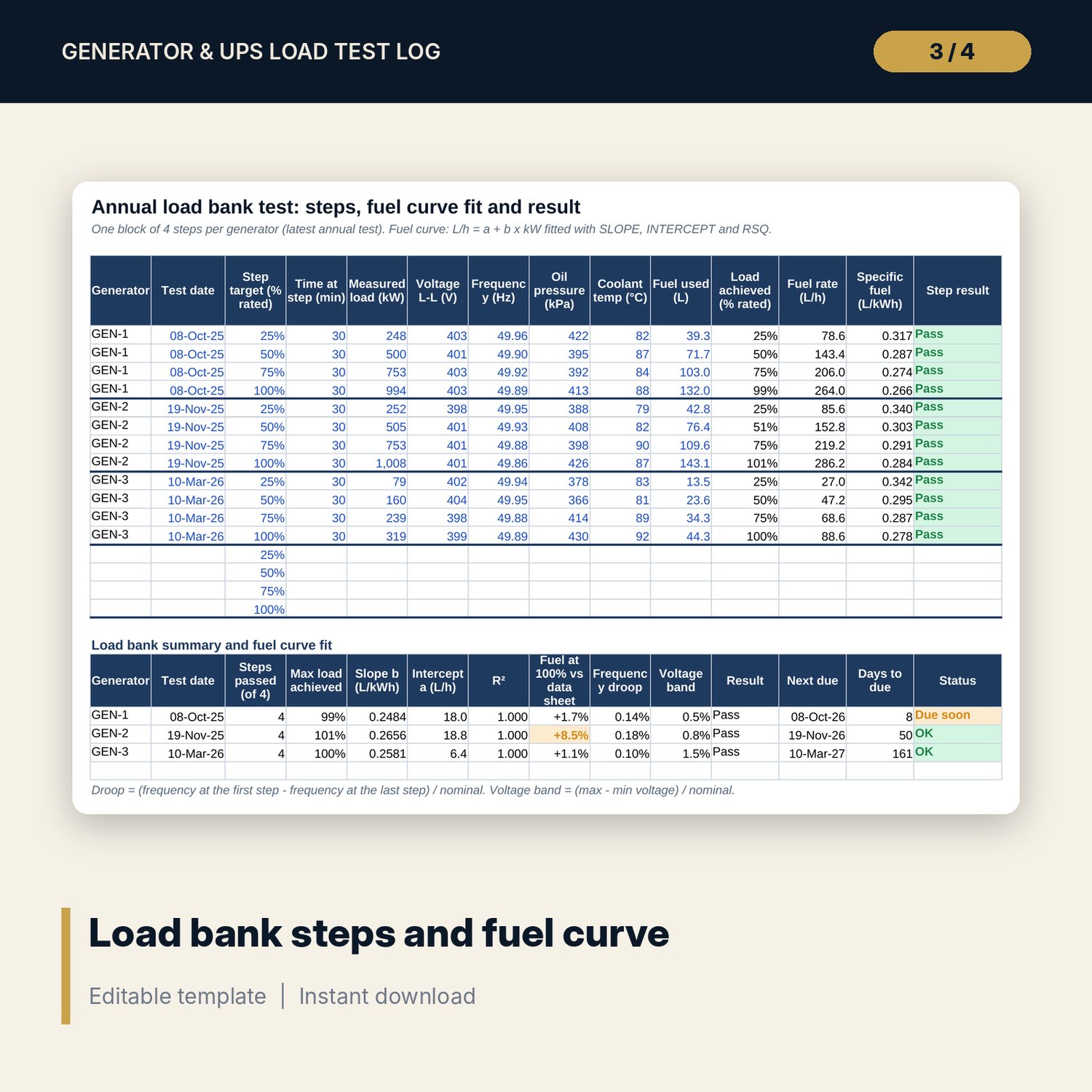
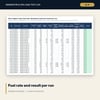
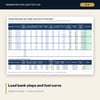
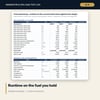
For chief engineers, engineering managers, general managers and auditors who need evidence that standby power will carry the hotel through an outage. You log weekly no-load runs, monthly load tests and real mains failures with run time, load, voltage, frequency, oil pressure, coolant temperature, fuel used and tank level. Each run gets load %, fuel rate (L/h), L/kWh, an expected fuel rate from a fuel curve, a fault count against your acceptance limits and a Pass, Fail, Short run or Not qualifying result. The annual load bank test is entered in four steps (25/50/75/100%); the workbook fits the fuel curve L/h = a + b x kW with SLOPE, INTERCEPT and RSQ, and reports droop, voltage band and fuel at full load against the data sheet. Fuel_Autonomy turns the latest tank level into runtime at your outage load and compares it with the target hours. Transfer switch times are checked against their limits, and UPS runtime tests give battery capacity against design and autonomy at the critical load. A compliance tab counts qualifying tests in every complete week, month and quarter, with next due dates and overdue flags.
Save with a bundle: this workbook is also in the Hotel Engineering & MEP Pro Bundle, 25 workbooks for $59 instead of $319. All 100 Pro workbooks are in the Pro Library for $119, and all 241 templates and workbooks are in the Ultimate Hospitality Library for $149.
What is inside
- Generator_UPS_Load_Test_Log.xlsx: 12 tabs, 11,102 formulas, 3 native charts, 14 integrity checks, 20-row Method tab
- Gen_Log: 600 rows, with 193 illustrative runs for 3 generators over 12 months (weekly runs, monthly load tests, 2 mains failures)
- Gen_Calc engine: 14 columns per run (run hours, load %, kWh, fuel rate, L/kWh, expected rate, fuel deviation, voltage and frequency deviation, faults, result)
- Load_Bank: 4 blocks of 4 steps (12 illustrative steps for 3 generators) and a summary with SLOPE/INTERCEPT/RSQ fuel curve fit, droop and next due date
- ATS_Log: 200 rows, with 41 illustrative transfer tests and outage transfers for 3 switches
- UPS_Log: 120 rows, with 16 illustrative quarterly runtime tests for 4 UPS systems (capacity, autonomy at critical load, battery life factor)
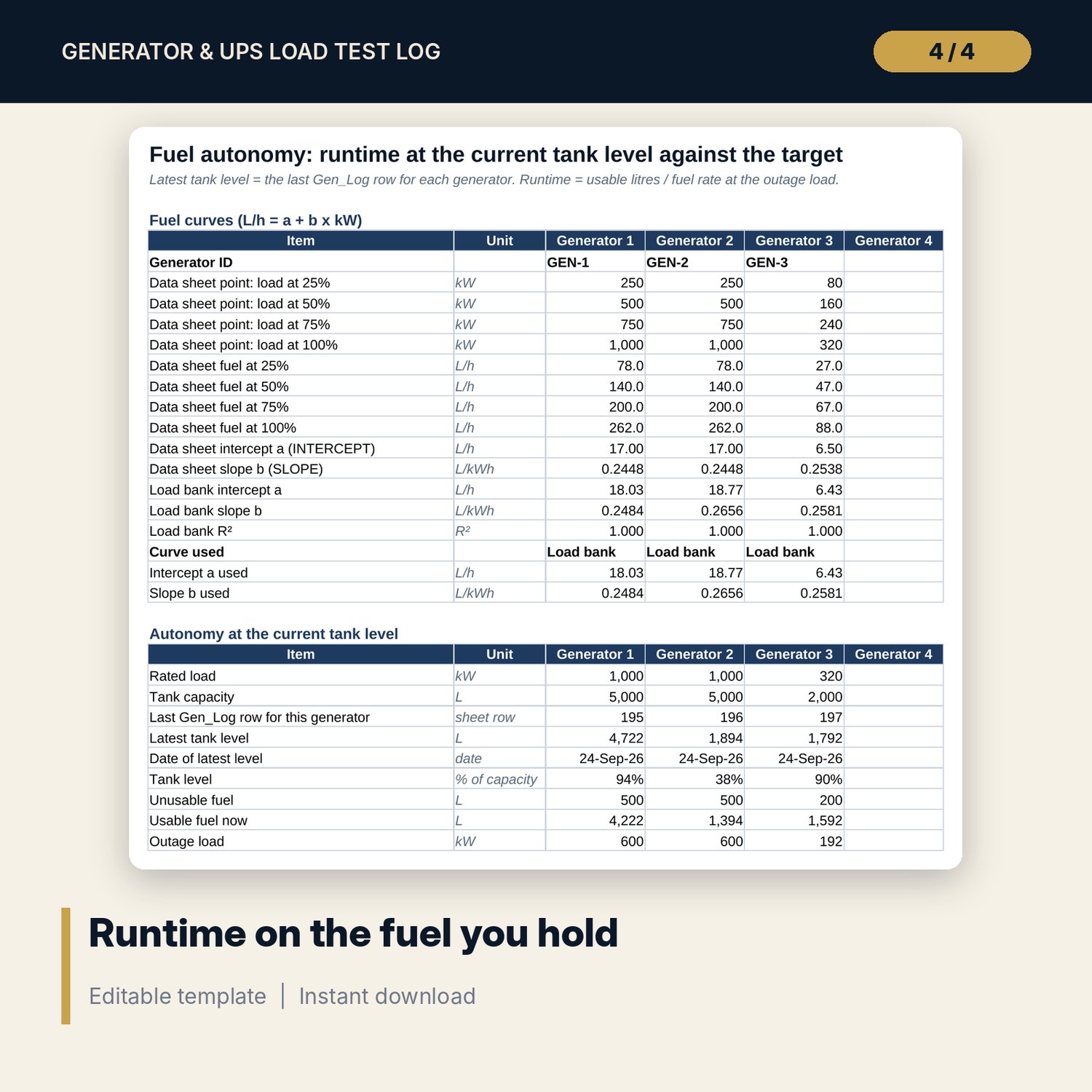
- Fuel_Autonomy: data sheet and load bank fuel curves, latest tank level, runtime now and with a full tank, fuel to order, 7 x 7 runtime grid
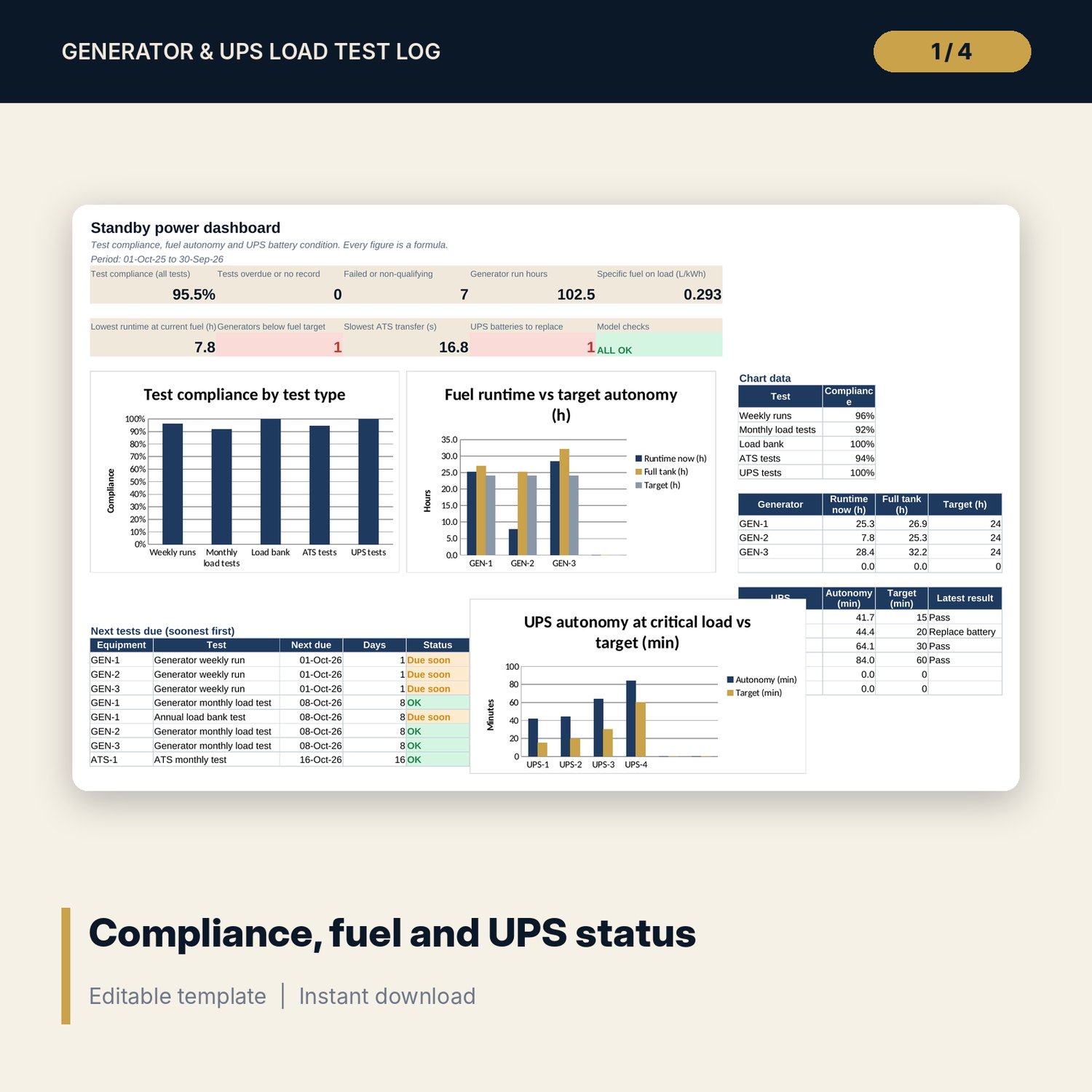
- Compliance: required vs done for 22 equipment-test lines, next due dates and status, weekly, monthly and quarterly calendars, monthly run totals
- Settings: 19 editable inputs with units, tables for up to 4 generators, 4 transfer switches and 6 UPS systems, 5 test intervals
- Dashboard: 9 KPI tiles, check status, 3 charts and the next tests due on one page
- README.txt and LICENSE-and-Terms.txt
How it works
- Enter the period, acceptance limits, test conditions and your generators, transfer switches and UPS systems on Settings.
- Log every generator run on Gen_Log, every transfer test on ATS_Log and every UPS runtime test on UPS_Log.
- Enter the four steps of each annual load bank test on Load_Bank and choose the load bank or data sheet fuel curve.
- Read Fuel_Autonomy for runtime on the fuel you hold and the litres to order to reach your target hours.
- Check Compliance and the Dashboard for overdue tests, failed runs and UPS batteries due for replacement.
Details
- Format: one XLSX workbook
- Language: English
- Units: kW, kVA, V, Hz, kPa, °C, litres, minutes and hours; conversions on Settings
- Software: Excel 2016 or later (Windows or Mac) or LibreOffice Calc; also opens in Google Sheets, where chart styling may differ
- No macros, no array formulas, no external links
- Delivery: instant download
Good to know
- Sample data is illustrative. Replace it with your own records.
- This is a record and planning tool, not engineering advice or a statutory test certificate.
- Test intervals, minimum loads and run times, transfer time limits, autonomy targets and acceptance limits are editable inputs. Verify local requirements and the manufacturer data.
- Load tests and transfer tests on live systems need authorised staff and a written procedure.
- Single-user license.
FAQ
How is runtime on the current fuel calculated?
Usable fuel = latest tank level minus the unusable share. Runtime = usable litres / (a + b x outage kW), where a and b come from the load bank fit or the data sheet curve.
Why does a monthly load test show Not qualifying?
The run was below the minimum load or shorter than the minimum time set on Settings. Light-load running does not prove the set can carry the building and can cause wet stacking.
How is UPS autonomy estimated from a test at part load?
Runtime scales with (load ratio)^k. The measured runtime is scaled to the critical load for autonomy, and compared with the design runtime at the test load for battery capacity.
Can I use 60 Hz, a different voltage or more equipment?
Yes. Nominal voltage and frequency are inputs. The tables hold up to 4 generators, 4 transfer switches and 6 UPS systems.
What counts toward compliance?
Each complete week, month or quarter in the period needs at least one qualifying test. Compliance = blocks with a qualifying test / blocks required, by equipment and by test.