

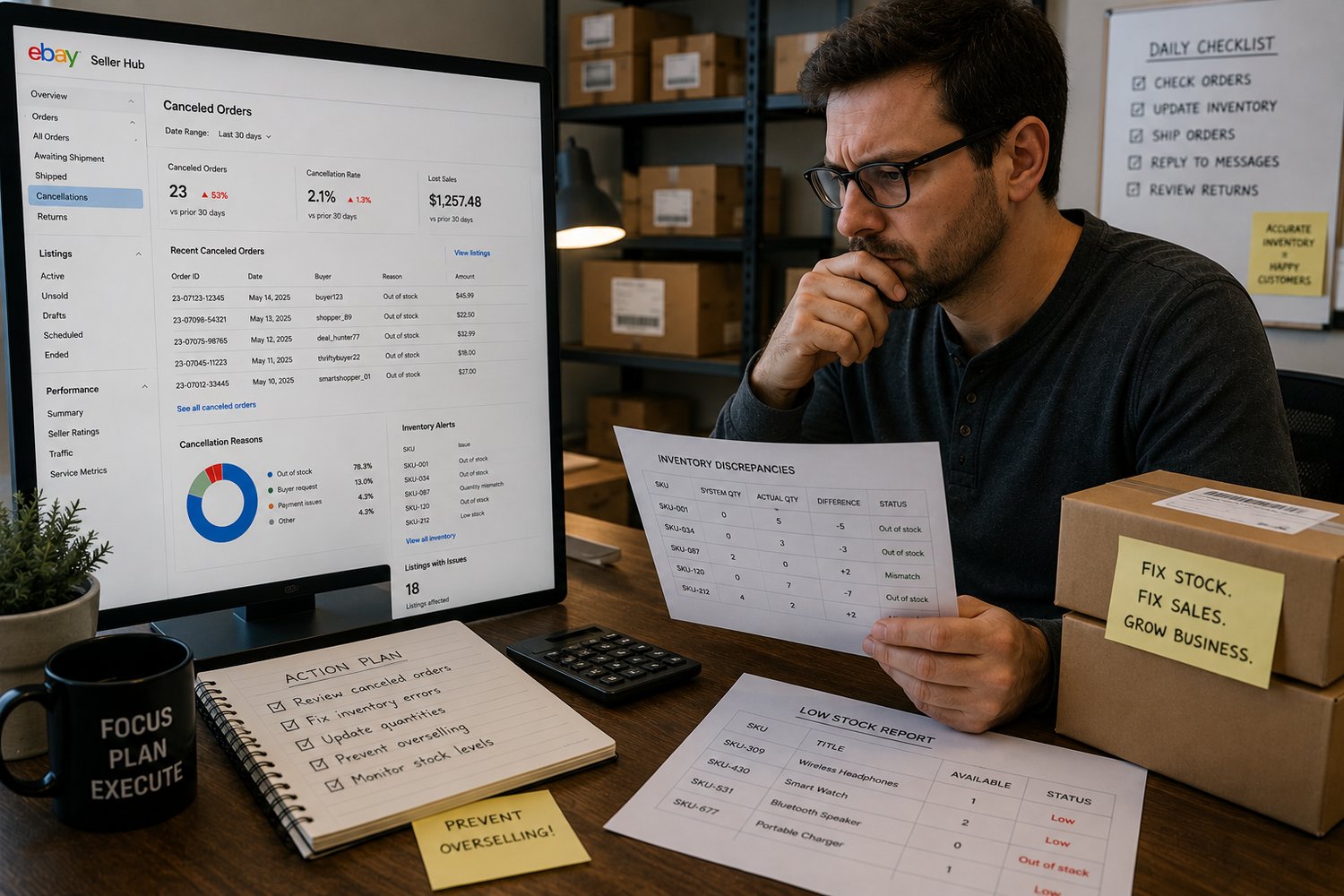
The Operational Failure That Usually Happens Before the Cancellation
Learn why eBay order cancellations often result from earlier operational failures such as overselling, inventory inaccuracies, supplier delays, fulfillment breakdowns, and unmet buyer expectations.
Most Sellers Treat Cancellations as Isolated Events
A buyer places an order.
Something goes wrong.
The order is canceled.
The seller apologizes, issues a refund, and moves on.
The cancellation feels like a single unfortunate event.
But experienced eBay operators know something important:
The cancellation was rarely the first problem.
By the time an order is canceled, the operational failure has often already happened.
The cancellation is simply the moment the business becomes aware of it.
This is why repeated eBay order cancellations are far more dangerous than they appear.
They don't just affect one order.
They reveal weaknesses in inventory management, fulfillment, supplier coordination, communication, and workflow control.
The Cancellation Is Usually the Final Symptom
Think of an order cancellation like a warning light on a dashboard.
The warning light is not the engine problem.
It is evidence that the engine problem already exists.
The same principle applies to eBay operations.
A cancellation may occur because:
- inventory was inaccurate
- the item was oversold
- a supplier could not fulfill the order
- shipping could not be completed on time
- buyer expectations were not managed properly
The cancellation is visible.
The operational failure is usually hidden.
Overselling Is an Operations Problem, Not an Inventory Problem
Many sellers believe overselling happens because inventory counts are wrong.
Sometimes that's true.
More often, overselling happens because inventory information moves through a weak workflow.
For example:
- a quantity was not updated quickly enough
- a canceled order was not restored correctly
- multiple listings referenced the same stock
- inventory synchronization failed
- manual adjustments were delayed
The physical inventory may have been accurate.
The operational process was not.
When the buyer purchases an unavailable item, the cancellation becomes unavoidable.
But the real issue began earlier in the workflow.
Inventory Inaccuracies Create a Chain Reaction
One incorrect inventory update rarely affects only one order.
It can trigger:
- overselling
- delayed fulfillment
- buyer inquiries
- refund requests
- negative feedback
- account performance concerns
This is why inventory inaccuracies are expensive.
Not because they create one cancellation.
Because they create a cascade of operational work that consumes time, money, and buyer trust.
Supplier Delays Quietly Increase Cancellation Risk
Many eBay sellers rely on suppliers, distributors, warehouses, or dropshipping partners.
When supplier performance becomes inconsistent, cancellations often increase.
Common scenarios include:
- inventory available yesterday but unavailable today
- delayed supplier shipments
- discontinued products
- warehouse processing delays
- inaccurate supplier stock feeds
The seller may not have caused the problem.
But the buyer experiences the cancellation as a seller problem.
This is why supplier reliability is an operational issue, not just a sourcing issue.
Fulfillment Failures Create Preventable Cancellations
Not every cancellation is caused by missing inventory.
Some occur because the order could not move through fulfillment correctly.
Examples include:
- the item could not be located
- incorrect SKU labeling
- damaged inventory discovered during packing
- shipping label errors
- missed handling-time deadlines
- fulfillment backlog
The product technically exists.
But operationally, the business cannot deliver it reliably.
This is one of the clearest signs that the fulfillment process needs stronger controls.
Buyer Expectations Matter More Than Many Sellers Realize
Sometimes the seller could still fulfill the order.
The cancellation happens because the buyer no longer wants to wait.
This often occurs when:
- shipping timelines change unexpectedly
- communication is delayed
- tracking is unclear
- fulfillment progress is uncertain
- estimated delivery dates become unrealistic
The buyer loses confidence before the order is completed.
At that point, cancellation becomes a trust decision.
Not just a logistics decision.
The Hidden Pattern Behind Repeated Cancellations
One cancellation may be random.
Repeated cancellations are data.
Look for patterns such as:
- same product category
- same supplier
- same warehouse location
- same employee shift
- same fulfillment step
- same inventory adjustment process
Patterns reveal operational weaknesses that individual orders hide.
For example:
If cancellations consistently occur after weekends, inventory updates may be delayed.
If cancellations cluster around specific suppliers, purchasing controls may be weak.
If cancellations increase during growth, fulfillment capacity may be insufficient.
The pattern matters more than the individual order.
Why Cancellations Increase Around 10–30 Orders Per Day
Many eBay stores experience a noticeable increase in operational errors after reaching 10–30 orders per day.
This stage is important because manual processes begin failing under volume.
At lower order counts, sellers can personally verify inventory, monitor shipments, and catch mistakes.
As order volume increases:
- inventory changes faster
- more orders compete for attention
- supplier coordination becomes harder
- fulfillment exceptions increase
- communication becomes less consistent
The business becomes more dependent on systems than memory.
Without standardized workflows, cancellation rates often rise.
Every Cancellation Has a Hidden Cost
Most sellers calculate the refunded revenue.
Few calculate the operational cost.
A cancellation may involve:
- payment processing fees
- customer service time
- inventory investigation
- supplier communication
- relisting work
- account performance impact
- lost future purchases
- negative feedback risk
The financial damage often extends far beyond the canceled order itself.
Repeated cancellations can quietly reduce profitability even when sales remain strong.
Strong eBay Stores Investigate Every Cancellation
High-performing sellers ask a different question.
Instead of:
"Why was this order canceled?"
They ask:
"What operational process allowed this cancellation to become necessary?"
That shift changes everything.
They investigate:
- inventory synchronization
- supplier reliability
- fulfillment workflow
- communication timing
- process ownership
- exception handling
The goal is not simply reducing cancellations.
The goal is eliminating the workflow failures that create them.
Cancellations Are a Leading Indicator
Many sellers view cancellations as an annoying outcome.
In reality, they are often an early warning signal.
Rising cancellation rates may indicate:
- inventory control problems
- fulfillment capacity issues
- supplier instability
- workflow inconsistency
- operational bottlenecks
- declining buyer confidence
These problems usually affect much more than cancellations.
They can eventually impact returns, feedback, seller performance, and account health.
Final Thoughts
An eBay order cancellation is rarely just a canceled order.
It is often the visible result of an invisible operational failure.
Most cancellations originate from:
- overselling
- inventory inaccuracies
- supplier delays
- fulfillment failures
- expectation management problems
- repeated workflow breakdowns
The strongest eBay sellers don't simply process refunds faster.
They build systems that make cancellations less likely in the first place.
Because the cancellation wasn't the first problem.
It was the first one you noticed.
Related Reading
- Why eBay Inventory Problems Usually Start Outside Inventory Management
- Why eBay Seller Metrics Often Decline During Growth
- Why Some eBay Stores Constantly Operate in Recovery Mode
- Why eBay Buyers Open "Item Not Received" Cases Even When Tracking Exists
- Why Top Rated Seller Status Is Really an Operations Metric
Download the Free eBay Seller Compliance Risk Audit
Order cancellations are often symptoms of deeper operational problems.
Strengthen your inventory controls, fulfillment workflows, supplier coordination, and buyer communication systems to reduce preventable eBay cancellations before they affect your profit and account performance.
👉 eBay Seller Compliance Risk Audit
 About the Author
I work with Shopify and eBay sellers to identify and stabilize operational systems before fulfillment pressure turns into customer complaints, refunds, and margin loss.
My focus is helping stores handling 10–30 orders per day build resilient workflows that scale without creating hidden operational stress.
👉 Download the free fulfillment audit: eBay Seller Compliance Risk Audit
📢 Share This
Found this useful? Share it with other operators: