

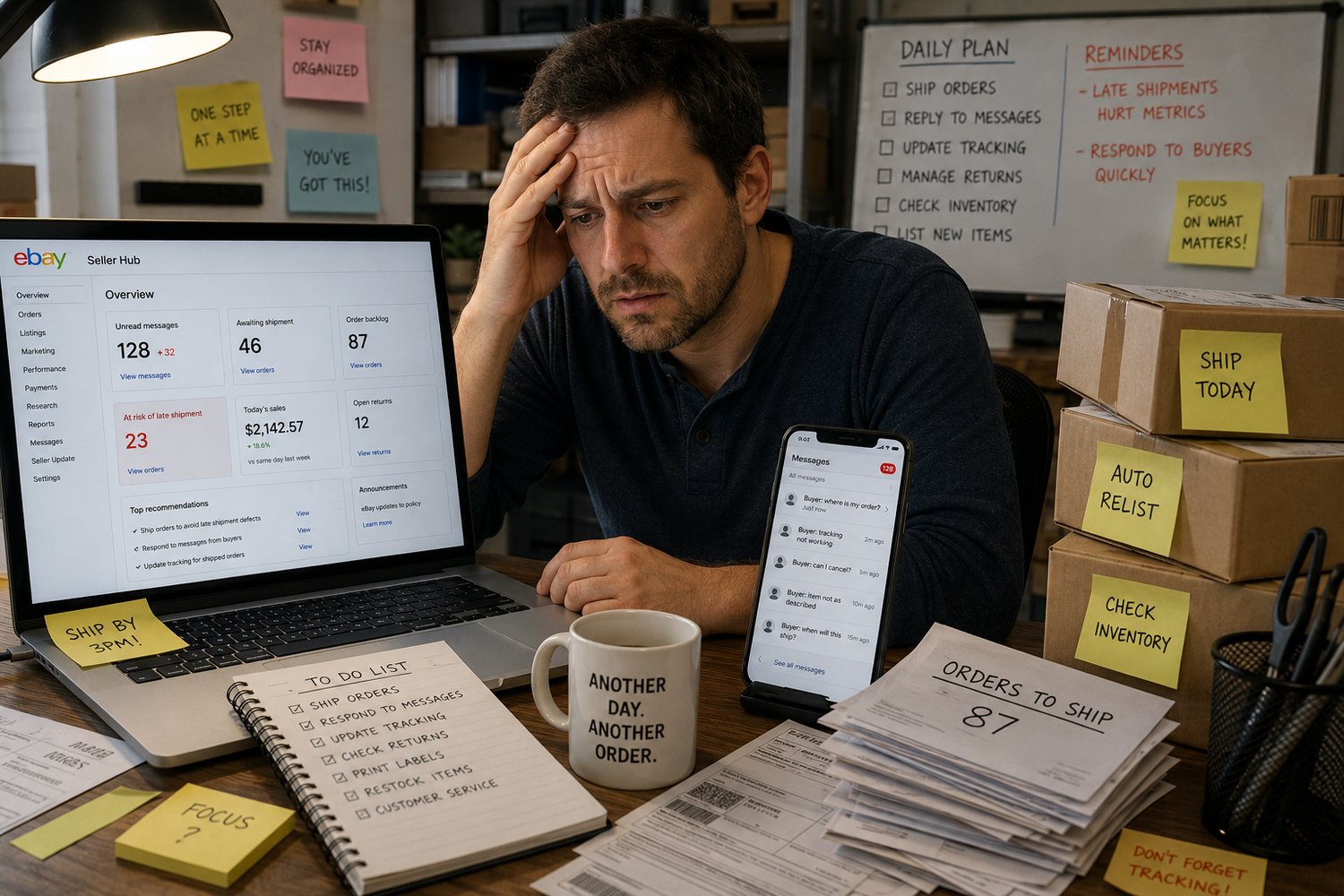
Discover why many eBay sellers spend every day fixing yesterday's mistakes. Learn how reactive operations, fulfillment backlogs, workflow instability, and support overload hurt seller performance.
Do You Start Every Morning Behind?
Many eBay sellers begin the day with good intentions.
Then reality takes over.
Before shipping today's orders, they're already dealing with:
- buyer messages from yesterday
- delayed shipments
- inventory corrections
- return requests
- negative feedback
- tracking issues
- canceled orders
Instead of moving forward, the day becomes an exercise in catching up.
If this sounds familiar, you're not alone.
Many sellers believe they simply need to work harder.
But constant recovery mode is rarely caused by a lack of effort.
It's usually a sign that the eBay seller workflow is becoming reactive instead of predictable.
Recovery Mode Feels Productive—But It Isn't
There's a difference between being busy and making progress.
Recovery mode creates the illusion of productivity because you're always solving problems.
You're answering messages.
Fixing orders.
Updating tracking.
Correcting listings.
Handling returns.
By the end of the day, you've worked nonstop.
Yet tomorrow begins exactly the same way.
Why?
Because most of today's work involved correcting yesterday's mistakes instead of preventing tomorrow's.
Reactive Operations Create an Endless Cycle
Reactive businesses don't follow a plan.
They follow emergencies.
The day is controlled by whatever demands attention first.
A buyer sends an urgent message.
A shipment is delayed.
An item oversells.
A return request appears.
Everything else gets pushed aside.
Over time, this creates an operation where priorities constantly change.
Instead of managing the business, the business manages you.
Yesterday's Small Mistakes Become Today's Big Problems
Operational problems rarely stay isolated.
One small issue often creates several new ones.
For example:
An inventory count is wrong.
The wrong item sells.
The order is canceled.
The buyer contacts support.
Negative feedback follows.
Seller performance declines.
What started as one inventory mistake becomes five separate tasks.
The next day begins with even more work than the day before.
This is how recovery mode develops.
Repeated Corrections Are a Warning Sign
Every business makes mistakes.
The real concern is repetition.
Ask yourself:
- Are you correcting the same listings every week?
- Are buyers asking the same questions repeatedly?
- Are inventory adjustments becoming routine?
- Are shipping errors happening more often?
- Are customer complaints becoming predictable?
If the answer is yes, the problem isn't individual mistakes.
The problem is that your workflow allows those mistakes to happen again.
Fulfillment Backlogs Create Operational Pressure
Many eBay sellers notice recovery mode after reaching 10–30 orders per day.
At lower volumes, it's possible to catch up manually.
At higher volumes, delays begin to compound.
A small backlog can quickly affect:
- order processing
- handling time
- shipping deadlines
- inventory updates
- buyer communication
As pressure increases, employees and owners naturally focus on speed.
Unfortunately, rushing often creates more errors.
Those errors become tomorrow's backlog.
The cycle repeats.
Support Overload Is Usually an Operational Problem
When support requests increase, many sellers assume buyers have become more demanding.
Often the opposite is true.
Customers are reacting to operational friction.
Common support messages include:
- "Has my order shipped?"
- "Why hasn't tracking updated?"
- "Can you confirm my item?"
- "When will this arrive?"
Each question takes time to answer.
As support volume grows, sellers have less time for fulfillment.
Fulfillment slows.
More buyers ask questions.
Support increases again.
This feedback loop is one of the biggest causes of workflow instability.
Workflow Instability Makes Every Day Feel Unpredictable
Stable businesses operate consistently.
Recovery-mode businesses operate emotionally.
Some days everything runs smoothly.
Other days feel chaotic.
The difference often isn't order volume.
It's process consistency.
Signs of workflow instability include:
- changing priorities every hour
- constant interruptions
- missed deadlines
- forgotten tasks
- repeated manual fixes
- difficulty planning ahead
When processes change every day, employees cannot develop reliable routines.
Consistency disappears.
Mistakes increase.
The Hidden Cost of Always Catching Up
Recovery mode affects more than daily operations.
It impacts long-term business performance.
Constant firefighting can lead to:
- slower handling times
- more buyer complaints
- increasing return requests
- negative feedback
- account health risks
- employee frustration
- owner burnout
Many sellers believe these are separate issues.
In reality, they often share the same root cause:
An unstable workflow.
Strong eBay Sellers Spend Less Time Fixing Problems
Successful sellers still experience unexpected issues.
The difference is that problems remain exceptions—not daily routines.
They build workflows that emphasize:
- clear task ownership
- standardized fulfillment
- accurate inventory updates
- proactive buyer communication
- regular operational reviews
Instead of asking:
"How do we solve today's problem?"
They ask:
"How do we prevent this from happening again?"
That shift changes everything.
Recovery Mode Is a Signal—Not a Strategy
Working harder can temporarily reduce today's backlog.
It rarely prevents tomorrow's.
If every day begins with yesterday's unfinished work, the issue isn't motivation.
It's workflow design.
The goal isn't to become faster at fixing mistakes.
The goal is to create systems that generate fewer mistakes in the first place.
That's how sustainable eBay businesses grow.
Final Thoughts
Many eBay sellers believe constant pressure is simply part of running an online business.
It doesn't have to be.
Recovery mode often develops because of:
- reactive operations
- repeated corrections
- fulfillment backlogs
- support overload
- workflow instability
These issues rarely disappear on their own.
But they can be reduced with consistent operational systems.
The strongest eBay stores aren't the ones that solve the most problems each day.
They're the ones that create the fewest problems to solve tomorrow.
Related Reading
- Why eBay Seller Metrics Often Decline During Growth
- Why Inventory Errors Multiply as Stores Scale
- Why Customer Complaints Usually Start Before Customers Complain
- The Real Reason eBay Buyers Leave Negative Feedback
- Why Fast Shipping Doesn't Always Create Happy Customers
Download the Free eBay Seller Compliance Risk Audit
If every day feels like you're fixing yesterday's mistakes, it's time to evaluate your workflow—not just your workload.
A structured eBay workflow helps reduce operational friction, improve fulfillment consistency, and free your business from constant recovery mode.
👉 eBay Seller Compliance Risk Audit
 About the Author
I work with Shopify and eBay sellers to identify and stabilize operational systems before fulfillment pressure turns into customer complaints, refunds, and margin loss.
My focus is helping stores handling 10–30 orders per day build resilient workflows that scale without creating hidden operational stress.
👉 Download the free fulfillment audit: eBay Seller Compliance Risk Audit
📢 Share This
Found this useful? Share it with other operators: