

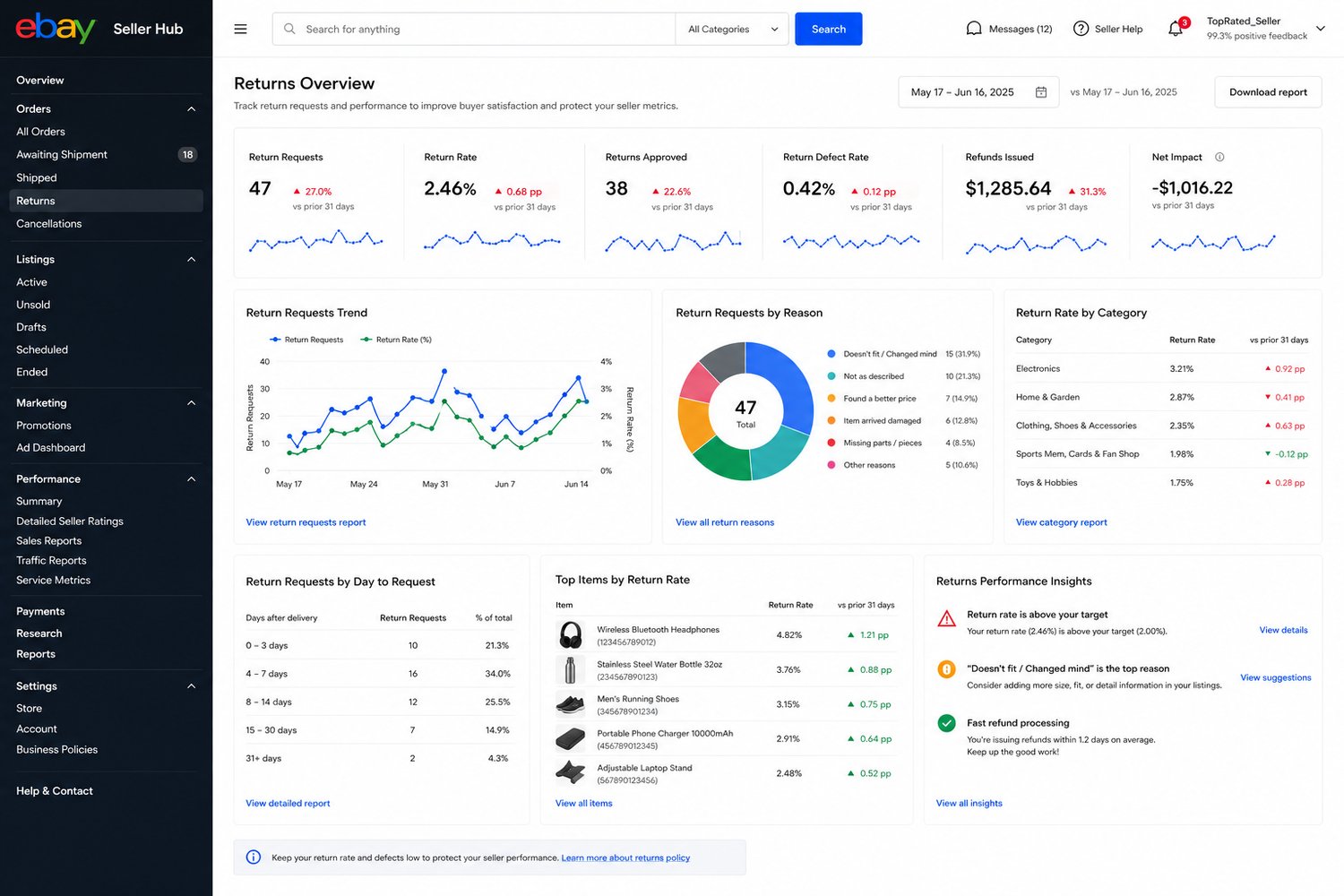
Learn why eBay return requests often increase even when product quality remains unchanged. Discover how listing accuracy, buyer expectations, shipping experience, and operational friction influence return rates.
"Nothing Changed... So Why Are Returns Increasing?"
This is one of the most frustrating questions eBay sellers ask.
The supplier hasn't changed.
The products are identical.
Quality control remains consistent.
Packaging is the same.
Yet return requests continue to rise.
Many sellers immediately blame:
- difficult buyers
- poor product quality
- changing customer expectations
But in many cases, the product isn't the problem.
The buying experience is.
Most return requests begin long before the buyer clicks "Return this item."
Buyers Return Experiences—Not Just Products
When sellers think about returns, they usually think about defects.
Broken items.
Damaged products.
Incorrect orders.
Those certainly happen.
But many eBay return requests involve products that work exactly as intended.
Why?
Because buyers don't evaluate products in isolation.
They evaluate the entire purchasing experience.
That includes:
- the listing
- communication
- delivery
- packaging
- expectations
- confidence after receiving the item
When the experience creates doubt, returns become much more likely.
Listing Accuracy Builds Buyer Confidence
One of the biggest causes of preventable returns is expectation mismatch.
Even when a listing is technically accurate, buyers may imagine something different.
Small details matter.
For example:
- photos make the item appear larger
- descriptions assume prior knowledge
- condition notes are overlooked
- compatibility information isn't prominent
- important limitations are buried deep in the listing
The buyer receives exactly what was sold.
But not what they expected.
That's enough to trigger a return.
The problem wasn't product quality.
It was expectation management.
The Shipping Experience Shapes Product Perception
Many sellers think the shipping process ends when the package is delivered.
For buyers, that's often when the experience becomes most memorable.
Imagine receiving a product after:
- delayed tracking updates
- uncertain delivery dates
- limited communication
- multiple shipping delays
Even if the product is perfect, the buyer's perception has already been influenced.
Psychologists call this the halo effect.
A frustrating delivery experience can negatively affect how buyers evaluate the product itself.
The item didn't change.
The buyer's mindset did.
Small Frustrations Often Lead to Big Decisions
Returns rarely happen because of one major event.
More often, they're the result of several smaller frustrations.
For example:
The tracking doesn't update.
The seller responds slowly.
The package arrives one day later than expected.
The instructions feel unclear.
The product requires more setup than anticipated.
None of these issues alone may justify a return.
Together, they create enough friction for the buyer to decide:
"I'll just send it back."
Buyer Confidence Determines Return Decisions
Every purchase involves uncertainty.
The seller knows the product.
The buyer does not.
Throughout the transaction, buyers continuously ask themselves:
- Did I make the right choice?
- Is this what I expected?
- Can I trust this seller?
- Will this work for me?
Every interaction either strengthens or weakens buyer confidence.
Confidence reduces returns.
Uncertainty increases them.
This explains why two sellers can offer the exact same product while experiencing very different return rates.
Growth Often Increases Return Requests
Many eBay sellers notice rising returns after reaching approximately 10–30 orders per day.
The products haven't changed.
Operations have.
As order volume increases:
- listings receive fewer updates
- buyer messages take longer to answer
- fulfillment becomes more rushed
- communication becomes less personal
The business grows.
But the customer experience becomes less consistent.
Returns often follow.
Growth doesn't create return problems.
Growth exposes operational weaknesses that were easier to hide at lower order volumes.
Return Requests Often Reveal Workflow Problems
Every return tells a story.
When similar reasons appear repeatedly, they usually point toward operational issues rather than isolated buyer behavior.
Patterns worth monitoring include:
- "Not as expected"
- "Doesn't fit my needs"
- "Item different than expected"
- "Changed my mind"
- "Arrived later than expected"
Instead of viewing these individually, ask:
What happened before the return request?
Did buyers receive enough information?
Were expectations realistic?
Did communication create confidence?
Operational reviews often reveal patterns that product inspections never will.
Reducing Returns Starts Before the Sale
Many sellers try to reduce returns after buyers request them.
The better strategy is preventing the need altogether.
Focus on improving:
Listing Clarity
Remove ambiguity before buyers purchase.
Buyer Expectations
Be realistic about processing and delivery.
Communication
Keep buyers informed without waiting for them to ask.
Shipping Visibility
Reduce uncertainty throughout fulfillment.
Operational Consistency
Deliver the same reliable experience on every order.
These improvements often reduce return requests without changing the product itself.
The Best Sellers Study Return Patterns
High-performing eBay sellers don't simply count returns.
They analyze them.
They look for recurring operational signals.
Questions they ask include:
- Are buyers misunderstanding listings?
- Do returns increase after shipping delays?
- Are specific products generating expectation issues?
- Has response time changed recently?
- Are similar complaints appearing across different categories?
Returns become valuable operational data.
Not just business expenses.
Final Thoughts
If your eBay return requests are increasing while product quality remains consistent, the issue may not be your inventory.
It may be your operation.
Many returns are influenced by:
- listing accuracy
- expectation mismatches
- shipping experience
- buyer confidence
- operational friction
The sellers with the lowest return rates don't always have better products.
They often deliver a better buying experience.
Because buyers don't only return products.
They return experiences that failed to meet expectations.
Related Reading
The Real Reason eBay Buyers Leave Negative Feedback
Why Fast Shipping Doesn't Always Create Happy Customers
Why eBay Buyers Open "Item Not Received" Cases Even When Tracking Exists
Why Customer Complaints Usually Start Before Customers Complain
Why eBay Seller Metrics Often Decline During Growth
Download the Free eBay Seller Compliance Risk Audit
Reducing return requests isn't always about improving products.
It's often about improving the buying experience.
Build stronger operational systems that create accurate expectations, increase buyer confidence, and reduce preventable eBay returns before they happen.
👉 eBay Seller Compliance Risk Audit
 About the Author
I work with Shopify and eBay sellers to identify and stabilize operational systems before fulfillment pressure turns into customer complaints, refunds, and margin loss.
My focus is helping stores handling 10–30 orders per day build resilient workflows that scale without creating hidden operational stress.
👉 Download the free fulfillment audit: eBay Seller Compliance Risk Audit
📢 Share This
Found this useful? Share it with other operators: