

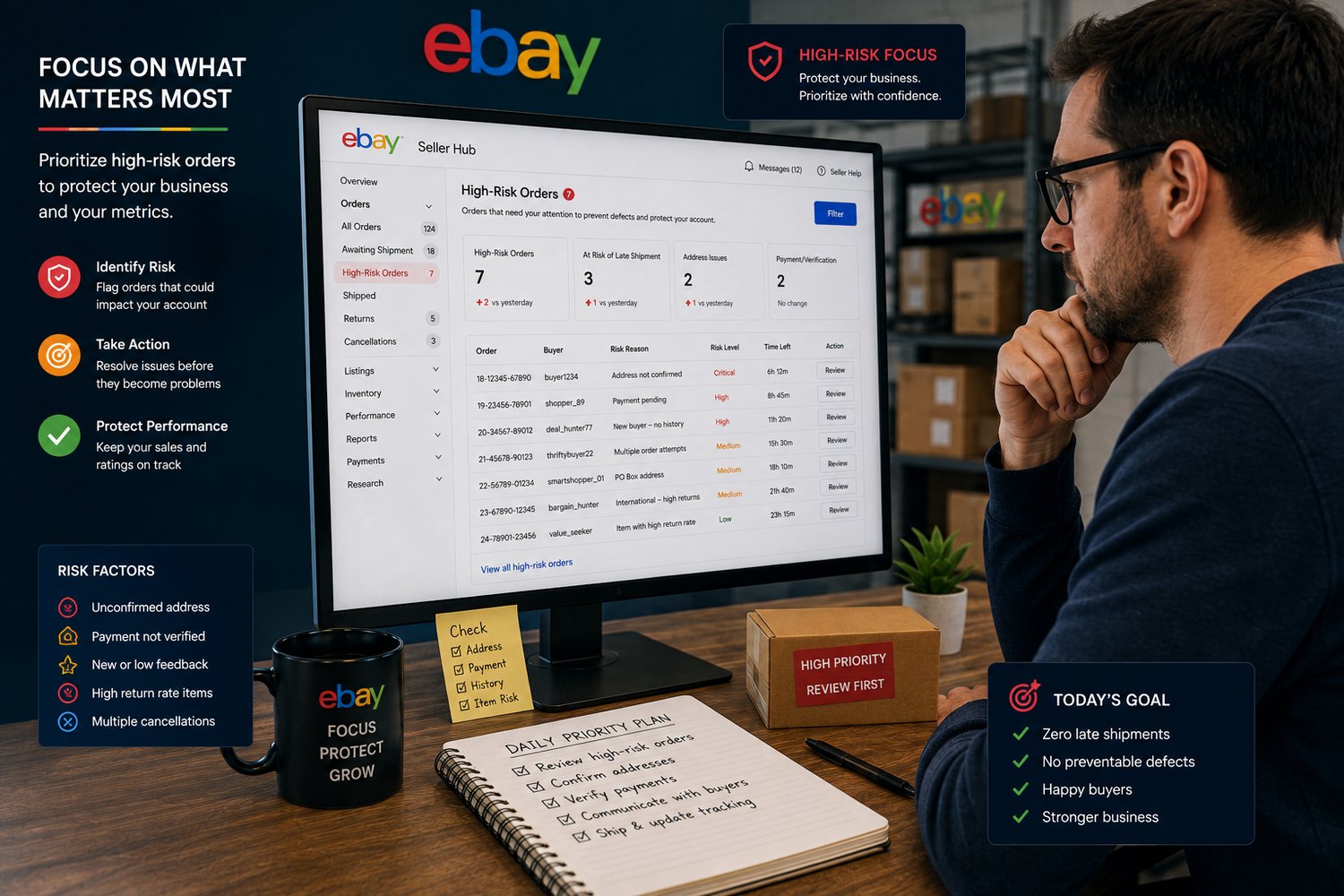
The eBay Order Management Mistake That Quietly Creates Late Shipments, Cases, and Negative Feedback
Learn why eBay sellers often miss the highest-risk orders in their queue. Discover how priority orders, handling-time deadlines, special instructions, and exception-based order management improve eBay order management.
The Dangerous Lie Most eBay Sellers Believe
When an eBay seller opens their order queue, they usually see a list of orders waiting to be processed.
The natural assumption is simple:
Every order should be processed in the order it was received.
It feels fair.
It feels organized.
It feels efficient.
But in real eBay operations, this assumption creates hidden risk.
Because not every order deserves the same attention.
Some orders can wait an hour.
Others can damage your account if they wait 15 minutes too long.
The most expensive mistake many sellers make is treating all orders as equally important.
The strongest eBay operations don't simply process orders.
They identify which orders can hurt the business first.
Your Queue Is Not a To-Do List
Think about how most sellers work.
They open the queue.
Print labels.
Pack items.
Ship everything they can.
This works surprisingly well at low volume.
But as an eBay store grows—especially around 10–30 orders per day—the queue stops being a simple list.
It becomes a collection of different operational risks.
Inside the same queue, you may have:
- orders approaching handling-time deadlines
- expensive items requiring verification
- fragile products needing special packaging
- buyer messages waiting for a response
- address issues
- inventory exceptions
- replacement shipments
- repeat buyers with active conversations
Treating all of these orders the same is like treating every patient in an emergency room the same.
The problem is not the number of orders.
The problem is the inability to distinguish routine orders from high-risk orders.
The Order That Costs More Than All the Others
Imagine two orders.
Order A
- $15 item
- standard shipping
- three days of handling time remaining
- no buyer messages
Order B
- $250 item
- handling deadline in two hours
- buyer already requested a shipping update
- signature confirmation required
Both orders are sitting in the same queue.
If you process them strictly by time received, you may ship Order A first.
Operationally, that is a mistake.
Order B carries significantly higher risk.
A delay could create:
- late shipment metrics
- buyer frustration
- a negative feedback event
- an Item Not Received case
- a return dispute
- higher financial exposure
The queue did not tell you which order mattered most.
Your workflow should.
Handling-Time Deadlines Are Not Suggestions
Many sellers monitor shipping at the end of the day.
Successful sellers monitor handling-time risk throughout the day.
An order approaching its handling deadline deserves disproportionate attention.
Why?
Because once the deadline is missed, the operational damage has already occurred.
Late shipment performance is often the result of poor prioritization rather than slow fulfillment.
The seller was working.
They were shipping orders.
They were being productive.
They were simply working on the wrong orders first.
High-Risk Shipments Require a Different Workflow
Not all products carry the same operational exposure.
High-risk shipments may include:
- high-value items
- fragile products
- collectibles
- electronics
- items requiring authentication or signature confirmation
- international shipments
These orders often need additional verification steps.
Skipping those steps to move faster can become extremely expensive.
A damaged $15 item is frustrating.
A mishandled $300 shipment can affect profit, feedback, and seller performance simultaneously.
Priority is not only about speed.
It is about exposure.
Special Instructions Are Operational Traps
Many eBay problems begin with information that was available but overlooked.
Examples include:
- combine shipping requests
- alternate shipping instructions
- buyer messages after purchase
- address corrections
- packaging requests
- delivery timing requests
These instructions often live outside the standard fulfillment flow.
If your workflow does not surface them clearly, they become easy to miss.
A missed instruction may result in:
- returns
- negative feedback
- additional shipping costs
- customer service work
- preventable disputes
The order itself was not difficult.
The workflow failed to identify the exception.
Exception-Based Order Management Changes Everything
Most sellers practice volume-based order management.
The goal is to process as many orders as possible.
High-performing operations practice exception-based order management.
The goal is to identify the small percentage of orders that can create disproportionate problems.
These exceptions may include:
- inventory mismatches
- buyer communication pending
- shipping delays
- damaged inventory
- supplier uncertainty
- address verification issues
- handling-time deadlines
- high-value orders
When exceptions are surfaced early, routine orders can move quickly while risky orders receive additional attention.
This improves both efficiency and account protection.
Why Growing Stores Miss More Important Orders
Many sellers notice increasing operational stress after reaching 10–30 orders per day.
This is not only because there are more orders.
It is because there are more exceptions.
More orders create:
- more buyer messages
- more shipping variations
- more inventory adjustments
- more returns
- more special requests
- more opportunities for prioritization mistakes
Without a system for identifying priority orders, important orders become hidden inside routine work.
The seller feels busy.
But critical tasks remain unnoticed until they become urgent.
The Queue Should Tell You What Can Hurt You Today
A powerful eBay order management system answers one question immediately:
Which orders can damage the business if they are not handled next?
This is different from:
- Which orders arrived first?
- Which orders are easiest?
- Which orders are closest?
- Which orders can be packed fastest?
Priority should be determined by operational risk, not convenience.
That single shift changes how fulfillment is managed.
A Better Order Prioritization Framework
Instead of one undifferentiated queue, mentally separate orders into categories.
Immediate Priority
- handling-time deadline approaching
- buyer waiting for a response
- shipping exception
- address issue
- high-value shipment
Operational Priority
- inventory verification needed
- supplier confirmation required
- special packaging required
- replacement shipment
Routine Processing
- standard in-stock orders
- no buyer communication
- no deadline pressure
- standard shipping workflow
This is not about creating complexity.
It is about preventing expensive mistakes.
The Order That Deserves the Most Attention Is Usually the One You Almost Missed
Think back to the last serious operational problem you experienced.
A late shipment.
A cancellation.
A negative feedback event.
A case escalation.
A costly return.
Chances are, the warning signs existed earlier.
The buyer had messaged.
The inventory looked uncertain.
The deadline was approaching.
The shipment required special handling.
The information was available.
It was simply buried inside the queue.
Final Thoughts
Most eBay sellers do not lose money because they fail to process orders.
They lose money because they fail to identify which orders matter most.
Strong eBay order management requires more than processing speed.
It requires:
- priority order identification
- handling-time awareness
- high-risk shipment control
- visibility of special instructions
- exception-based workflows
- intelligent order prioritization
The most dangerous order in your queue is rarely the oldest one.
It is the one with the highest operational risk.
Because not every order deserves the same attention.
The best eBay operators know which order deserves it first.
Related Reading
- Why eBay Seller Metrics Often Decline During Growth
- Why Some eBay Stores Constantly Operate in Recovery Mode
- Why eBay Cases Escalate Faster Than Sellers Expect
- Why eBay Order Cancellations Are More Dangerous Than They Look
- Why Top Rated Seller Status Is Really an Operations Metric
Download the Free eBay Seller Compliance Risk Audit
Your order queue is not just a list of shipments—it is a list of operational risks.
Build a workflow that identifies priority orders, surfaces exceptions early, and protects your eBay account before routine work hides the orders that matter most.
👉 eBay Seller Compliance Risk Audit
 About the Author
I work with Shopify and eBay sellers to identify and stabilize operational systems before fulfillment pressure turns into customer complaints, refunds, and margin loss.
My focus is helping stores handling 10–30 orders per day build resilient workflows that scale without creating hidden operational stress.
👉 Download the free fulfillment audit: eBay Seller Compliance Risk Audit
📢 Share This
Found this useful? Share it with other operators: