

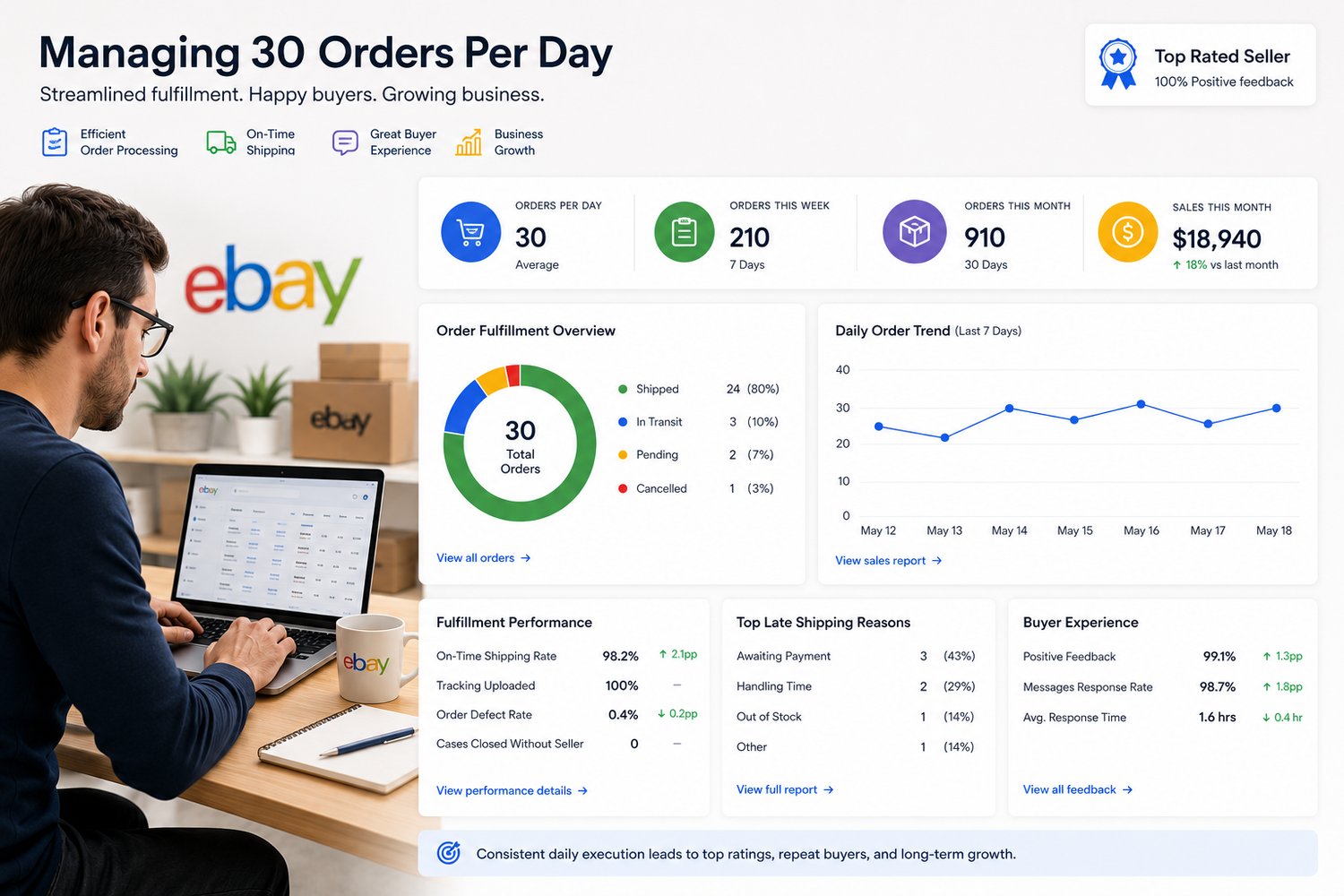
Why eBay Stores Struggle After Reaching 30 Orders Per Day
Discover why eBay stores struggle after reaching 30 orders per day. Learn how fulfillment complexity, staffing pressure, process gaps, and operational bottlenecks affect eBay store growth.
10 Orders a Day Feels Busy.
30 Orders a Day Feels Different.
Many eBay sellers assume growth is linear.
If they can manage 10 orders per day, they believe they can simply do the same thing three times to manage 30.
But that's not how operations work.
At 10 orders per day, the owner can often compensate for weak systems through personal effort.
They remember things.
They check everything.
They solve problems quickly.
At 30 orders per day, that same approach starts breaking down.
Not because the seller suddenly became less capable.
Because the operation has become more complex than the old workflow can handle.
The systems that worked at 10 orders often fail at 30.
The 30 Orders Per Day Breaking Point
The exact number is different for every business.
For some sellers, the pressure appears at 15 orders per day.
For others, it happens at 30 or even 50.
But the pattern is similar.
At a certain volume, the business crosses an operational threshold.
Suddenly:
- orders arrive faster than they can be processed
- inventory updates become harder to maintain
- buyer messages accumulate
- shipping exceptions require attention
- returns compete with new orders
- the owner becomes the bottleneck
Growth creates more than more sales.
It creates more decisions.
And eventually, the old way of working cannot keep up.
Why 10 Orders Per Day Can Hide Serious Problems
At 10 orders per day, many eBay stores still rely on informal systems.
The owner knows:
- where inventory is located
- which orders need special attention
- which buyers are waiting for updates
- which tasks need to be completed next
This information often exists in the owner's memory.
The operation appears efficient.
But the efficiency is actually dependent on one person.
That creates a hidden risk.
When order volume increases, one person's memory cannot scale with the business.
The system starts showing cracks.
Fulfillment Complexity Increases Faster Than Order Volume
An order isn't just an order.
Every sale creates a chain of operational tasks.
For each order, someone may need to:
- Confirm the item
- Verify inventory
- Pick the product
- Check the order details
- Pack the shipment
- Apply the correct label
- Upload tracking
- Monitor exceptions
- Respond to buyer questions
At 10 orders per day, this may feel manageable.
At 30 orders per day, small inefficiencies multiply.
A few extra minutes per order can create hours of additional work.
The problem isn't always the number of orders.
It's the number of operational decisions attached to each order.
The Owner Becomes the Bottleneck
Many eBay sellers reach a point where every problem comes back to them.
The team asks:
- Is this item available?
- Should this order be canceled?
- What do we do with this return?
- Should we contact the buyer?
- How should this shipping issue be handled?
At first, the owner answers these questions quickly.
Eventually, the questions become a queue.
The business cannot move faster than the person everyone depends on.
This is one of the clearest signs that the operation has outgrown its workflow.
Staffing Doesn't Automatically Solve the Problem
Hiring another person seems like the obvious answer.
But adding people to an unclear process can create more problems.
Without standardized workflows, employees may:
- process the same task differently
- make different decisions
- update inventory inconsistently
- communicate with buyers in different ways
- create duplicate work
More people do not automatically create more capacity.
More people create more capacity only when the process is clear.
Otherwise, staffing can increase operational variation.
Process Variation Creates Hidden Errors
Imagine three employees processing the same type of order.
Employee A checks inventory before printing the label.
Employee B prints the label first.
Employee C relies on the listing quantity.
All three believe they are doing the job correctly.
But the business now has three different workflows.
This creates inconsistency.
And inconsistency creates risk.
The more a store grows, the more expensive process variation becomes.
Standardization is not about controlling every movement.
It's about making sure critical steps happen consistently.
The Fulfillment Backlog Becomes a Warning Signal
A growing backlog is not always caused by too many orders.
It may indicate that the workflow is inefficient.
Look for signs such as:
- orders waiting for inventory confirmation
- items difficult to locate
- packing materials running out
- shipments waiting for review
- returns mixed with sellable inventory
These delays may seem minor.
But they accumulate.
A backlog creates pressure.
Pressure creates rushed decisions.
Rushed decisions create more errors.
The cycle continues.
Operational Bottlenecks Hide in Unexpected Places
The biggest bottleneck isn't always packing.
It could be:
- inventory verification
- order review
- product locating
- listing updates
- buyer communication
- returns processing
- shipping exception management
A business can have enough employees and still operate slowly.
Why?
Because one step in the workflow is restricting everything else.
This is why growing eBay stores need to identify where work stops moving—not simply hire more people.
Growth Increases the Cost of Small Mistakes
At lower volume, one error may affect one order.
At higher volume, the same process weakness can affect dozens.
For example:
A listing quantity is not updated correctly.
One order is oversold.
The seller manually corrects it.
The process remains unchanged.
The same issue happens again.
As volume grows, repeated errors become expensive.
They can lead to:
- canceled orders
- buyer complaints
- negative feedback
- additional support work
- seller performance risk
Growth magnifies process weaknesses.
The Real eBay Store Growth Challenge Is Control
Many sellers think growth means handling more orders.
In reality, growth means maintaining control while handling more orders.
Can you still:
- locate inventory quickly?
- process orders consistently?
- maintain accurate listings?
- respond to buyers?
- monitor delayed shipments?
- manage returns?
- prevent repeated errors?
If the answer becomes "not consistently," the business has reached an operational limit.
Sales growth without operational control creates fragile growth.
What Changes After 30 Orders Per Day?
Successful eBay stores usually make several important changes.
They move from:
Memory → Documented Workflows
Important tasks no longer depend on one person's memory.
Individual Decisions → Standard Procedures
Common situations have defined next steps.
Reactive Support → Proactive Monitoring
Problems are identified before buyers complain.
Owner Dependency → Clear Ownership
Each task has a responsible person.
Manual Corrections → Error Prevention
The goal becomes preventing repeated mistakes.
This is the transition from simply selling more to operating a real ecommerce business.
The 30-Order Lesson
The goal isn't to reach 30 orders per day and hope everything works.
The goal is to build systems before growth exposes their weaknesses.
Ask yourself:
- What happens if orders double next month?
- Can someone else follow the fulfillment process?
- What happens when inventory doesn't match the listing?
- Who handles delayed shipments?
- Who monitors buyer concerns?
- What happens when the owner is unavailable?
If the answer to every question is:
"I handle it."
Then the business may already have a scaling problem.
Final Thoughts
Many eBay stores don't struggle after reaching 30 orders per day because demand disappears.
They struggle because the operation has outgrown its original systems.
The challenges usually involve:
- increasing fulfillment complexity
- staffing pressure
- inconsistent processes
- unclear ownership
- operational bottlenecks
The systems that worked at 10 orders per day may have been perfectly adequate for 10 orders.
But growth requires a different level of operational control.
Because the biggest challenge in eBay store growth isn't getting more orders.
It's making sure the business can handle them consistently.
At 10 orders a day, effort can carry the operation.
At 30 orders a day, systems have to.
Related Reading
- Why eBay Seller Metrics Often Decline During Growth
- Why Some eBay Stores Constantly Operate in Recovery Mode
- Why eBay Inventory Problems Usually Start Outside Inventory Management
- Why Some eCommerce Teams Create More Errors as They Grow
- Why Top Rated Seller Status Is Really an Operations Metric
Download the Free eBay Seller Compliance Risk Audit
Growing from 10 to 30 orders per day is not simply a sales achievement.
It's an operational test.
If your eBay store is growing, build the workflows, ownership systems, and fulfillment controls needed to handle more orders before growth turns into daily chaos.
👉 eBay Seller Compliance Risk Audit
 About the Author
I work with Shopify and eBay sellers to identify and stabilize operational systems before fulfillment pressure turns into customer complaints, refunds, and margin loss.
My focus is helping stores handling 10–30 orders per day build resilient workflows that scale without creating hidden operational stress.
👉 Download the free fulfillment audit: eBay Seller Compliance Risk Audit
📢 Share This
Found this useful? Share it with other operators: