
Parent & Carer Safety Plan — When Distress Behaviour Is Frequent
Parent & Carer Safety Plan — When Distress Behaviour Is Frequent
A practical, compassionate safety-planning resource for reducing harm, supporting regulation and understanding what distress may be communicating
When a child experiences frequent periods of intense distress, families can find themselves trying to make difficult decisions in highly pressured moments.
What should we do first?
Could the child be in pain?
How can we make the environment safer?
What should we do if hitting, biting, self-injury or dangerous behaviour occurs?
When is professional support needed?
And when does the situation become a medical emergency?
The Parent & Carer Safety Plan — When Distress Behaviour Is Frequent has been designed to help families think about these questions before a crisis happens.
Its central principle is simple:
Safety is not about winning the moment.
It is about reducing harm, supporting the nervous system and meeting needs.
This UK-focused resource brings together early-warning signs, possible physical and environmental contributors, communication access, de-escalation, parent/carer safety, emergency thresholds, recovery and longer-term pattern tracking.
🧠 What This Safety Plan Covers
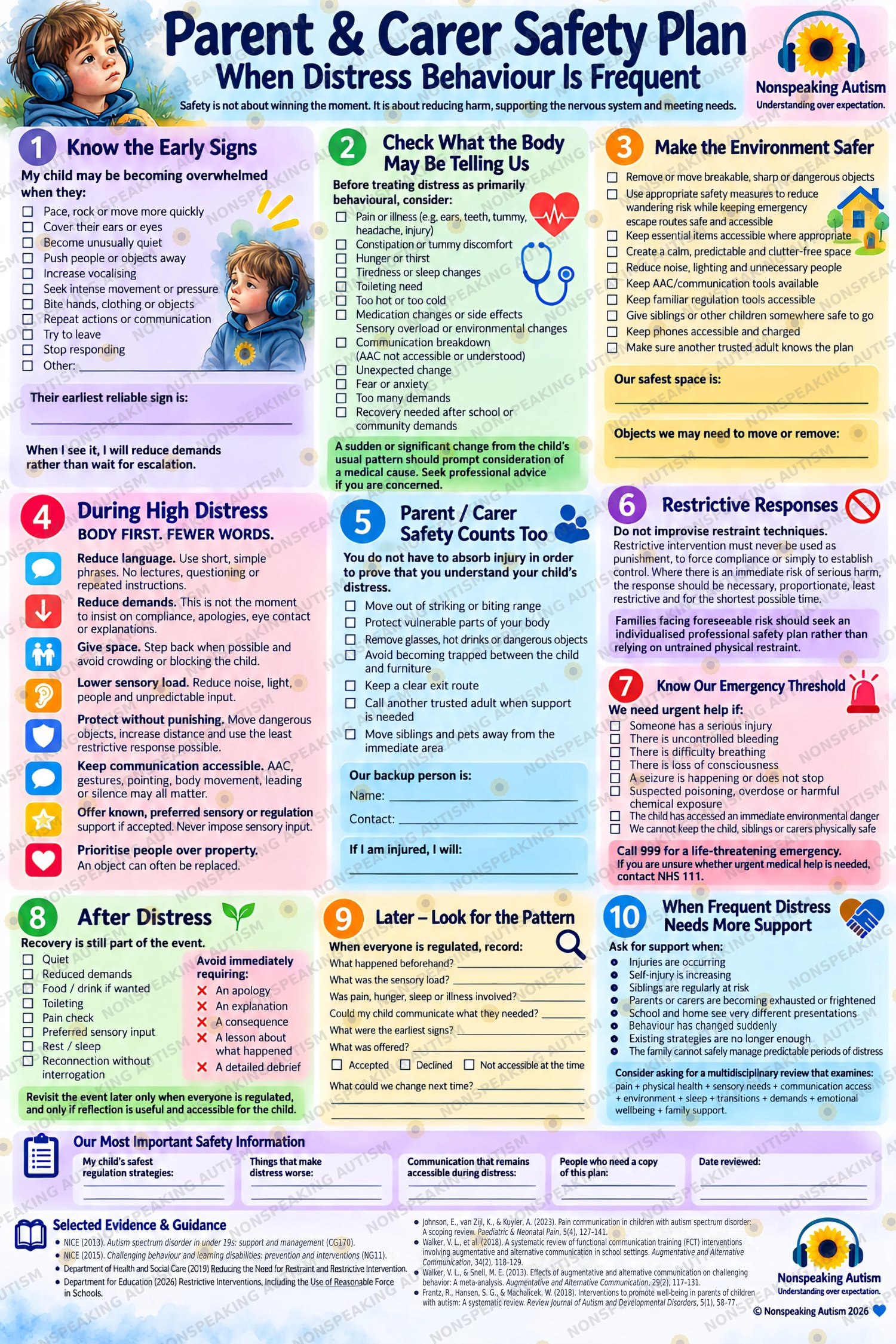
The poster takes families through 10 practical areas:
- Know the Early Signs
- Check What the Body May Be Telling Us
- Make the Environment Safer
- During High Distress — Body First, Fewer Words
- Parent / Carer Safety Counts Too
- Restrictive Responses
- Know Your Emergency Threshold
- After Distress
- Later — Look for the Pattern
- When Frequent Distress Needs More Support
It also provides dedicated spaces for recording the family's most important individualized safety information.
1️⃣ Know the Early Signs
Distress does not always begin with an obvious crisis.
For some children there may be earlier changes such as:
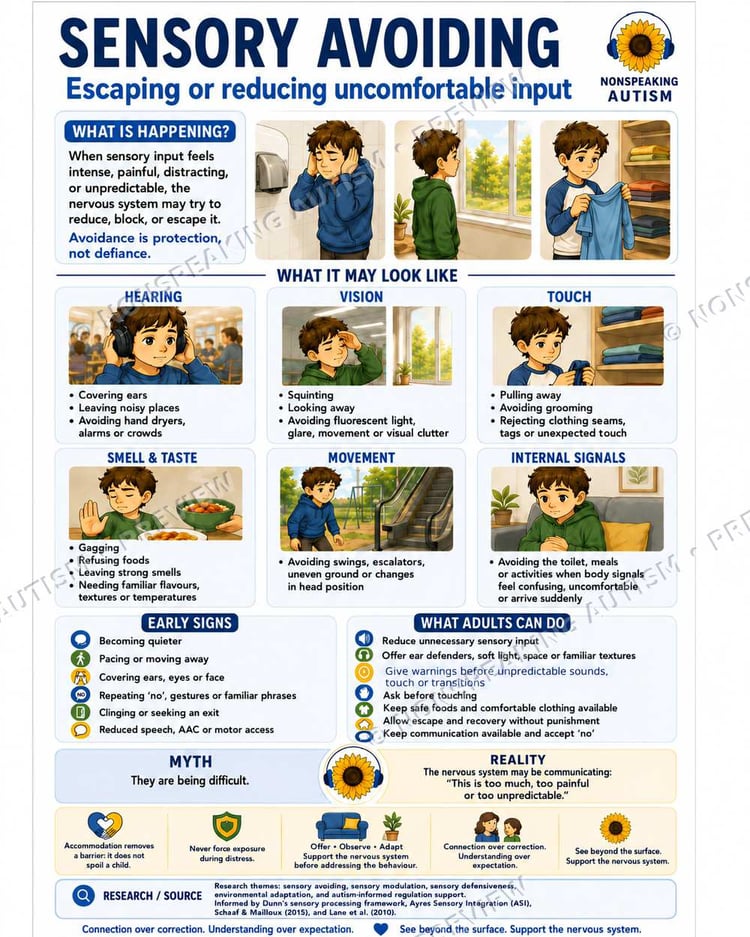
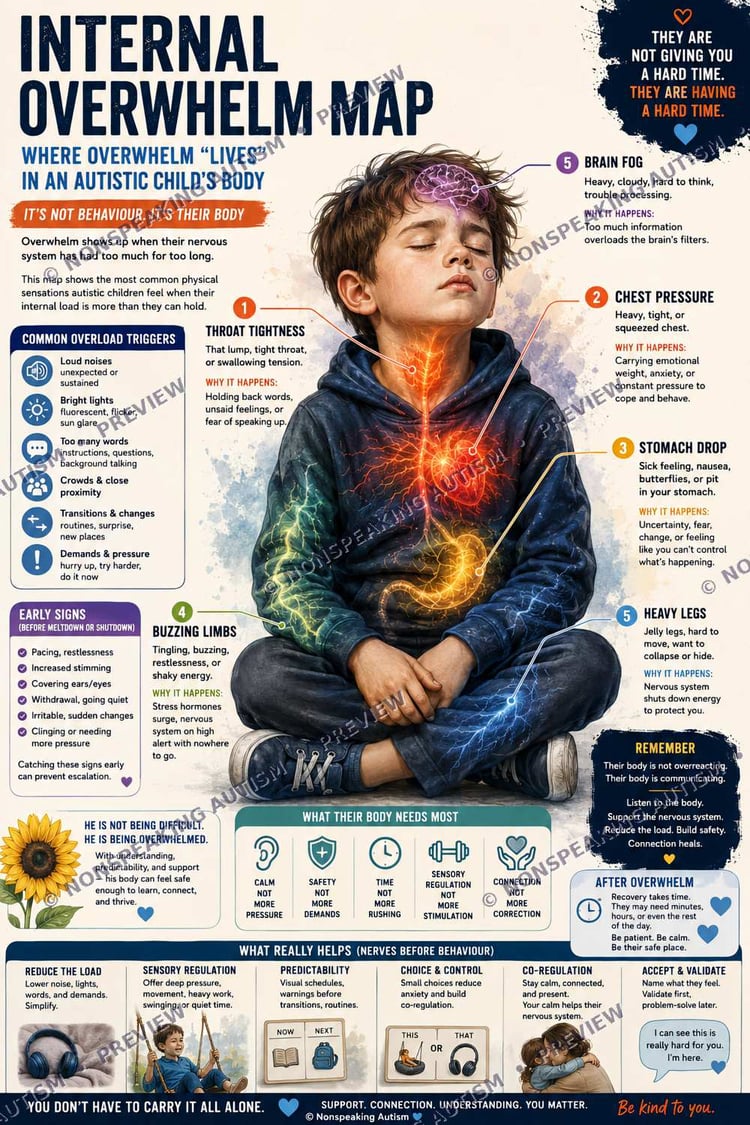
pacing or moving more quickly
covering their ears or eyes
becoming unusually quiet
pushing people or objects away
increased vocalizing
seeking intense movement or pressure
biting hands, clothing or objects
repeating actions or communication
trying to leave
reduced responsiveness
Recognizing a child's earliest reliable signs may give adults an opportunity to reduce demands, modify the environment or offer support before distress escalates.
NICE guidance for autistic children and young people recommends considering factors such as communication difficulties, pain or gastrointestinal problems, anxiety, lighting and noise, changes in routine and lack of predictability when assessing behaviour that challenges. Nice
2️⃣ Check What the Body May Be Telling Us
A significant message within this resource is:
Distress should not automatically be treated as “just behaviour.”
Possible contributors can include:
pain or illness
constipation or gastrointestinal discomfort
hunger or thirst
tiredness or sleep changes
toileting needs
being too hot or cold
medication changes or side effects
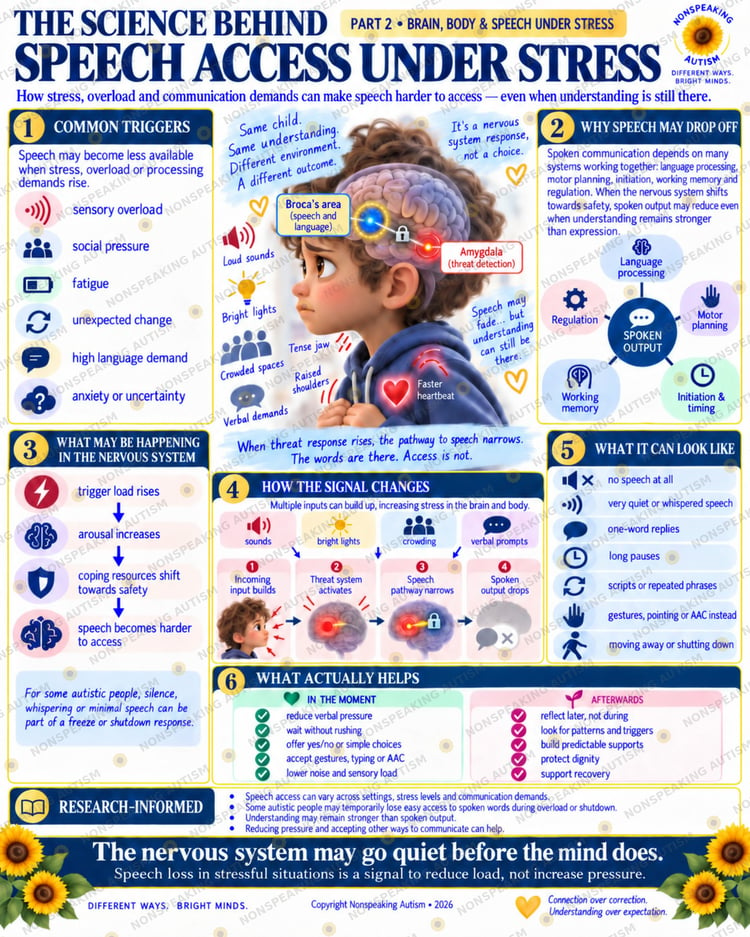
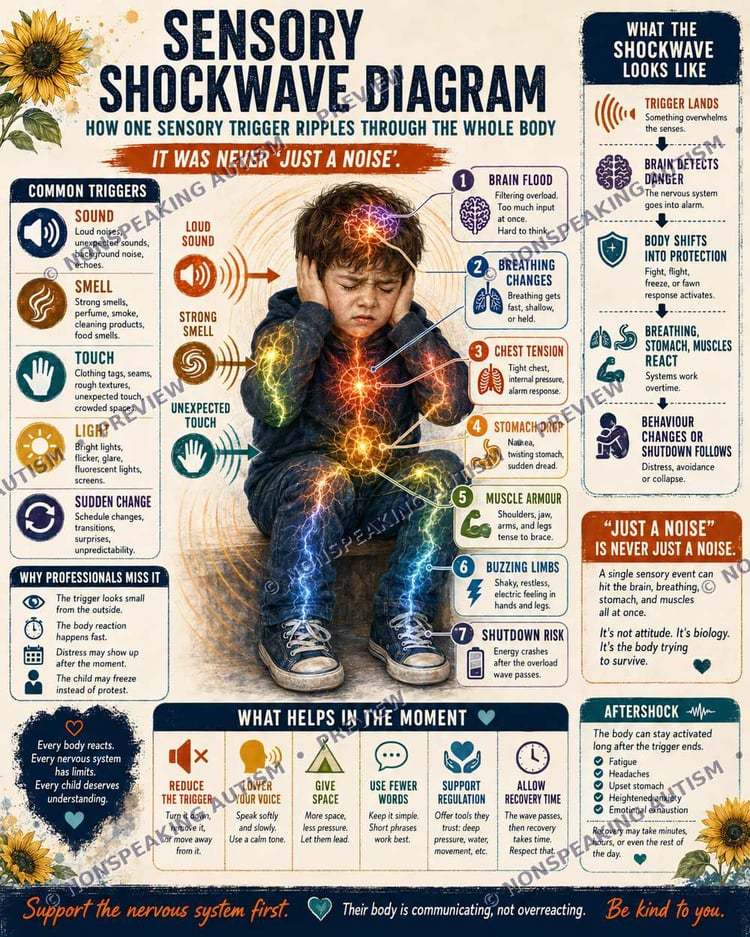
sensory overload
communication breakdown
unexpected change
fear or anxiety
too many demands
a need for recovery
Pain can also be communicated differently. A 2023 scoping review found autistic children may communicate pain through a range of verbal and non-verbal responses, reinforcing the importance of not relying solely on conventional verbal pain reports. PubMed
A sudden or significant change from a child's usual pattern should prompt consideration of a medical or other underlying cause.
3️⃣ Make the Environment Safer
Safety planning is easier before a high-distress event than during one.
The resource encourages families to consider practical preparation such as:
moving breakable, sharp or dangerous objects
keeping emergency exits accessible
creating a calmer, more predictable space
reducing unnecessary noise, lighting or people
keeping AAC and communication tools available
keeping familiar regulation supports accessible
identifying somewhere siblings or other children can safely go
keeping phones accessible and charged
making sure another trusted adult knows the plan
NICE recommends considering environmental and sensory factors and, where relevant, changing environments to reduce triggers and increase predictability. Nice
The poster also provides spaces to record:
Our safest space is: ______
and
Objects we may need to move or remove: ______
4️⃣ During High Distress — Body First, Fewer Words
When someone is already highly distressed, lengthy explanations or repeated questioning may add further demands.
The poster provides practical prompts including:
💬 Reduce Language
Use short, simple phrases rather than lectures or repeated instructions.
⬇️ Reduce Demands
A crisis is generally not the moment to insist on apologies, explanations, eye contact or unnecessary compliance.
↔️ Give Space
Step back where safely possible and avoid unnecessarily crowding or blocking the child.
👂 Lower Sensory Load
Reduce avoidable noise, bright light, people and unpredictable input where this helps the individual.
🛡️ Protect Without Punishing
Move dangerous objects and prioritize immediate safety.
💬 Keep Communication Accessible
AAC, gestures, pointing, body movement, leading an adult or silence may all carry information.
⭐ Offer Familiar Support
Make known, preferred sensory or regulation supports available where appropriate.
❤️ Prioritize People Over Property
An object can often be replaced. A person's physical safety comes first.
Communication support is particularly important: research has found that AAC interventions can support functional communication and, in relevant intervention studies, can be associated with reductions in challenging behaviour. Taylor & Francis Online
5️⃣ Parent & Carer Safety Counts Too
Supporting a distressed child does not mean a parent or caregiver must accept preventable injury.
The plan encourages caregivers to think about their own safety too.
This might mean:
moving out of striking or biting range
protecting vulnerable parts of the body
removing glasses, hot drinks or dangerous objects
avoiding becoming trapped between the child and furniture
keeping an exit route available
calling another trusted adult when support is needed
moving siblings and pets away from immediate danger
The poster includes spaces for recording:
Our backup person
and:
If I am injured, I will…
Planning for caregiver safety is not a rejection of the child.
It is part of creating a sustainable safety plan for everyone involved.
6️⃣ Restrictive Responses — An Important Safety Boundary
This section is deliberately cautious.
Do not improvise restraint techniques.
Restrictive intervention should not be used as punishment, to force compliance or simply to establish control.
NICE guidance states that reactive strategies should be used as a last resort, with least-restrictive alternatives considered first. Where restrictive intervention is used, NICE calls for risk assessment, documentation and review, and says planned restrictive intervention should be necessary and proportionate to the risk of immediate and significant harm. Nice
For schools in England, current Department for Education guidance “Restrictive interventions, including the use of reasonable force, in schools” has applied since 1 April 2026. It replaced the previous reasonable-force guidance. GOV.UK
Families dealing with a foreseeable risk of serious injury should seek an individualized professional safety plan rather than relying on untrained physical restraint.
🚨 7️⃣ Know Your Emergency Threshold
Families should know in advance when a situation has moved beyond something that can safely be managed at home.
The poster identifies urgent warning signs such as:
serious injury
uncontrolled bleeding
difficulty breathing
loss of consciousness
a seizure that is not stopping or does not resolve as expected
suspected poisoning, overdose or harmful chemical exposure
an immediate environmental danger that cannot safely be controlled
a situation where the safety of the child, siblings or caregivers cannot be maintained
For the UK resource, the emergency wording is:
Call 999 for a life-threatening emergency.
The NHS confirms that 999 is for life-threatening emergencies. If urgent medical help is needed but it is not a life-threatening emergency—or you are unsure whether 999 is required—NHS 111 can assess symptoms and advise what to do next. nhs.uk
This distinction makes the poster suitable specifically for a UK audience.
🌿 8️⃣ After Distress
The end of the visible crisis does not necessarily mean recovery is complete.
Afterwards, the poster suggests considering:
quiet
reduced demands
food or drink if wanted
toileting
a pain check
preferred sensory input
rest or sleep
reconnection without interrogation
The resource specifically advises avoiding an immediate demand for:
❌ an apology
❌ an explanation
❌ a consequence
❌ a lesson about what happened
❌ a detailed debrief
That does not mean an incident should never be discussed.
It means timing matters.
Revisit the event later, when everyone is regulated and only if reflection is useful and accessible for the child.
🔎 9️⃣ Later — Look for the Pattern
Once everyone is safe and regulated, the incident can provide useful information.
The worksheet section encourages caregivers to record:
What happened beforehand?
What was the sensory load?
Was pain, hunger, sleep or illness involved?
Could my child communicate what they needed?
What were the earliest signs?
What support was offered?
Was it accepted, declined or inaccessible at the time?
What could we change next time?
NICE recommends a functional understanding of behaviour, considering physical health, communication, sensory needs, environment, recent changes and other personal and contextual factors rather than examining behaviour in isolation. Nice
The purpose is not to find someone to blame.
It is to find patterns that may help prevent future harm.
🤝 10️⃣ When Frequent Distress Needs More Support
A home safety plan should not become a substitute for professional assessment when a family is dealing with repeated or increasing risk.
The poster encourages seeking additional support when:
injuries are occurring
self-injury is increasing
siblings are regularly at risk
parents or caregivers are becoming exhausted or frightened
school and home see very different presentations
behaviour has changed suddenly
existing strategies are no longer sufficient
the family cannot safely manage predictable periods of distress
Depending on the circumstances, a multidisciplinary review may consider areas such as:
pain and physical health
sensory needs
communication access
environment
sleep
transitions
demands
emotional wellbeing
family support
NICE recommends access to coordinated specialist assessment when initial management has not been effective or needs are more complex. Nice
📋 Your Most Important Safety Information
The bottom of the poster provides dedicated spaces to record:
My child's safest regulation strategies
Things that make distress worse
Communication that remains accessible during distress
People who need a copy of this plan
Date reviewed
This turns the resource from a general educational poster into something families can individualize and revisit over time.
A safety plan should not simply be written once and forgotten.
Needs, risks, communication and effective supports can change.
🔬 Research-Informed & Guidance-Based
This resource draws on established clinical guidance and research relating to autism, behaviour that challenges, communication, pain, AAC, environmental support, restrictive intervention and safety planning.
Importantly, the evidence does not support assuming that every episode of distress has the same cause.
NICE guidance specifically directs attention to communication, physical and mental health, sensory factors, environmental conditions, changes in routine and predictability when trying to understand behaviour that challenges. Nice
The poster therefore takes a needs-first and safety-first approach:
Observe → Protect → Reduce unnecessary demands → Maintain communication → Consider underlying causes → Recover → Review the pattern → Seek additional support when needed.
📚 Selected Evidence & Guidance
National Institute for Health and Care Excellence (NICE). (2013, updated). Autism spectrum disorder in under 19s: support and management (CG170). Nice
National Institute for Health and Care Excellence (NICE). (2015, updated). Challenging behaviour and learning disabilities: prevention and interventions for people with learning disabilities whose behaviour challenges (NG11). Nice
Department for Education. (2026). Restrictive interventions, including the use of reasonable force, in schools. Effective in England from 1 April 2026. GOV.UK
Department for Education guidance
Johnson, E., van Zijl, K., & Kuyler, A. (2023). Pain communication in children with autism spectrum disorder: A scoping review. Paediatric and Neonatal Pain, 5(4), 127–141. DOI: 10.1002/pne2.12115. PubMed
Walker, V. L., & Snell, M. E. (2013). Effects of augmentative and alternative communication on challenging behavior: A meta-analysis. Augmentative and Alternative Communication, 29(2), 117–131. DOI: 10.3109/07434618.2013.785020. PubMed
NHS. When to call 999 and When to use NHS 111 online or call 111. nhs.uk
👨👩👧 Who Is This Resource For?
This resource may be useful for parents and carers of autistic children or young people who experience frequent, intense or potentially unsafe periods of distress.
It may also support conversations with teachers, SENCOs, school staff, healthcare professionals, occupational therapists, speech and language therapists and other professionals involved in the child's support.
It is designed as a planning and communication resource, not as restraint training or a substitute for individualized professional assessment.
📦 What You Receive
1 × Parent & Carer Safety Plan — When Distress Behaviour Is Frequent
1 × high-resolution printable PDF
The purchased file is supplied clear and without the promotional preview watermark shown on the Payhip listing image.
Preview watermarks are used for copyright protection only.
Digital download only — no physical product will be shipped.
⚠️ Important Safety & Medical Disclaimer
This resource is provided for educational and safety-planning purposes only.
It is not medical advice, emergency medical training, restraint training, behavioural treatment, safeguarding advice, legal advice or a substitute for individualized assessment by appropriately qualified professionals.
The poster must not be used as instruction for performing physical restraint or other restrictive interventions.
Where there is a foreseeable risk of serious harm, repeated injury, significant self-injury or frequent situations in which caregivers cannot maintain safety, seek individualized professional support.
A sudden or significant change in behaviour should not automatically be attributed to autism. Pain, illness, medication effects, sleep problems and other medical or environmental factors may require assessment.
In a life-threatening emergency in the UK, call 999. If urgent medical help is needed but it is not life-threatening, or you are unsure what service is appropriate, contact NHS 111. nhs.uk
💛 The Message Behind the Resource
When distress becomes frequent, families can begin living from one crisis to the next.
But safety planning can shift some of the thinking from:
“What do we do when everything goes wrong?”
towards:
“What can we understand, prepare and change before we reach that point?”
Notice the early signs.
Check the body.
Keep communication accessible.
Reduce unnecessary sensory and environmental pressure.
Protect the child.
Protect siblings.
Protect caregivers.
Allow recovery.
Then, when everyone is safe and regulated, look for the pattern.
Because distress is not simply a moment to control.
It may contain information about pain, communication, sensory load, fear, demands, exhaustion, environment or unmet needs.
Safety is not about winning the moment.
It is about reducing harm, supporting the nervous system and meeting needs.
Connection over correction. Understanding over expectation.
© Nonspeaking Autism 2026