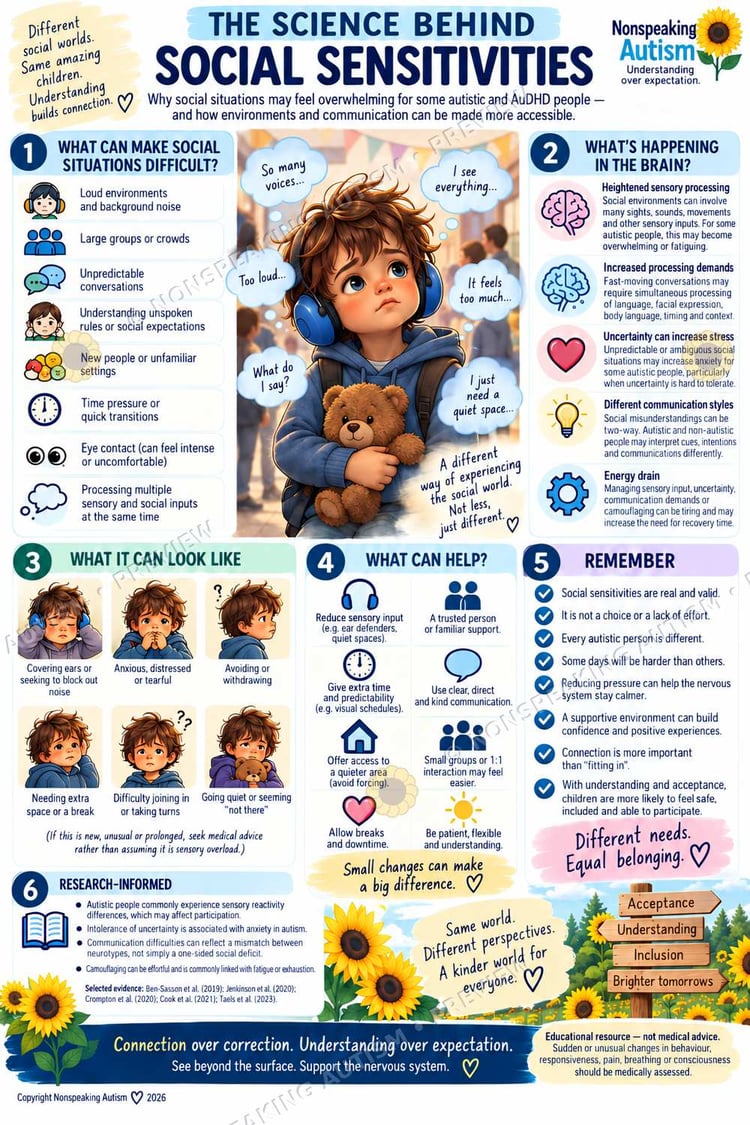

Connecting the Evidence to Support Needs
🌻 Part 3 — Connecting the Evidence to Support Needs
What the Pattern May Be Showing About Support, Access and Participation
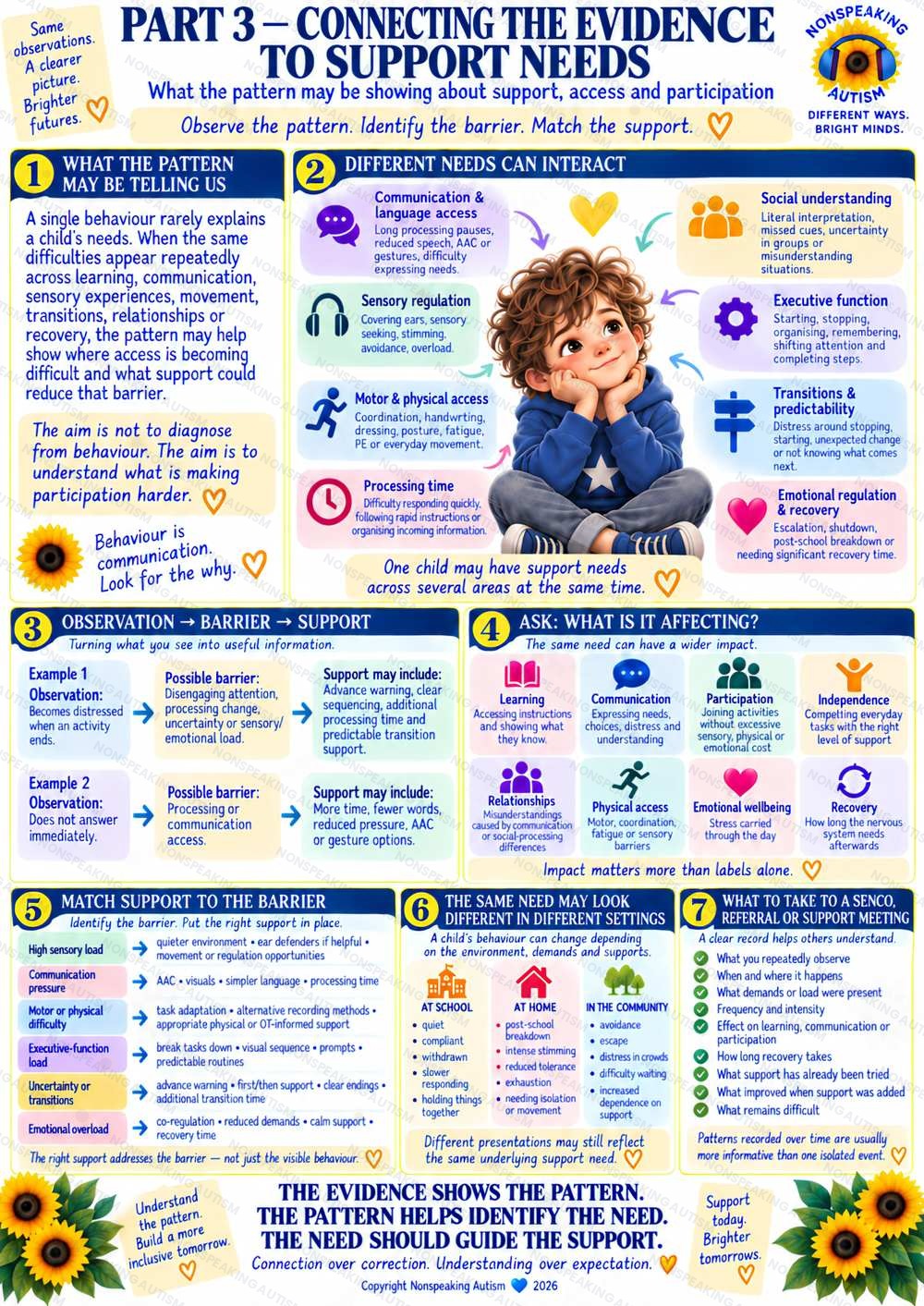
A single behaviour rarely explains a child’s needs. When the same difficulties appear repeatedly across learning, communication, sensory experiences, movement, transitions, relationships or recovery, looking at the pattern as a whole can provide much more useful information.
Part 3 — Connecting the Evidence to Support Needs builds on the observations gathered in Parts 1 and 2 and helps families and professionals move from simply recording what happens to asking a more useful question:
What might be making access or participation harder — and what support could reduce that barrier?
The focus is not on diagnosing a child from behaviour or finding a label for every difficulty. It is about observing the pattern, identifying possible barriers and matching support to the child's needs.
Different Needs Can Interact
Children do not experience communication, sensory processing, movement, executive functioning and emotional regulation as completely separate systems.
A child may have support needs across several areas at the same time, including communication and language access, sensory regulation, motor or physical access, processing time, social understanding, executive functioning, transitions and predictability, and emotional regulation and recovery.
Looking across these areas can help adults build a fuller picture of why participation may become difficult in particular situations.
🔎 Observation → Barrier → Support
The poster introduces a practical way of thinking about observations.
Rather than stopping at the visible behaviour, it encourages adults to consider the possible barrier underneath it and then identify support that may reduce that barrier.
For example, distress when an activity ends could relate to disengaging attention, processing change, uncertainty or sensory and emotional load. Helpful support might therefore include advance warning, clearer sequencing, additional processing time or more predictable transition support.
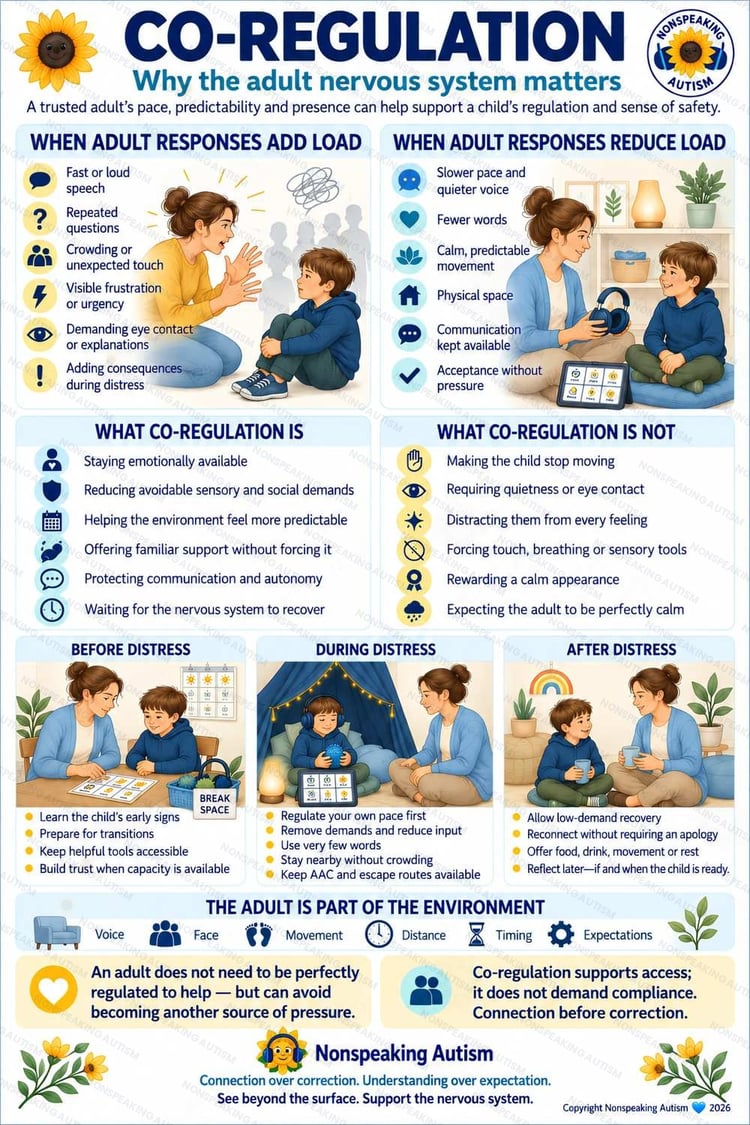
A child who does not answer immediately may need additional processing time or may be experiencing communication-access difficulties. Support could include more time, fewer words, reduced pressure, AAC, visual information or gesture options.
The aim is to support the barrier — not simply correct the visible behaviour.
💙 Ask: What Is It Affecting?
The same underlying need can have an impact across several parts of a child's life.
This poster encourages consideration of the effect on:
Learning • Communication • Participation • Independence • Relationships • Physical Access • Emotional Wellbeing • Recovery
Looking at impact can provide more useful information than relying on labels alone.
🌻 Match Support to the Barrier
The resource provides examples of ways support might be matched to different barriers.
These include quieter environments and sensory or movement opportunities for high sensory load; AAC, visuals, simpler language and processing time for communication pressure; appropriate task adaptations for motor or physical difficulties; visual sequences, prompts and predictable routines for executive-function demands; advance warnings and clearer transitions for uncertainty; and co-regulation, reduced demands and recovery time during emotional overload.
Support should always be individualised to the child, rather than assuming that one strategy will work for everyone.
🏠 Different Settings, Same Underlying Need
A child's needs may not look identical everywhere.
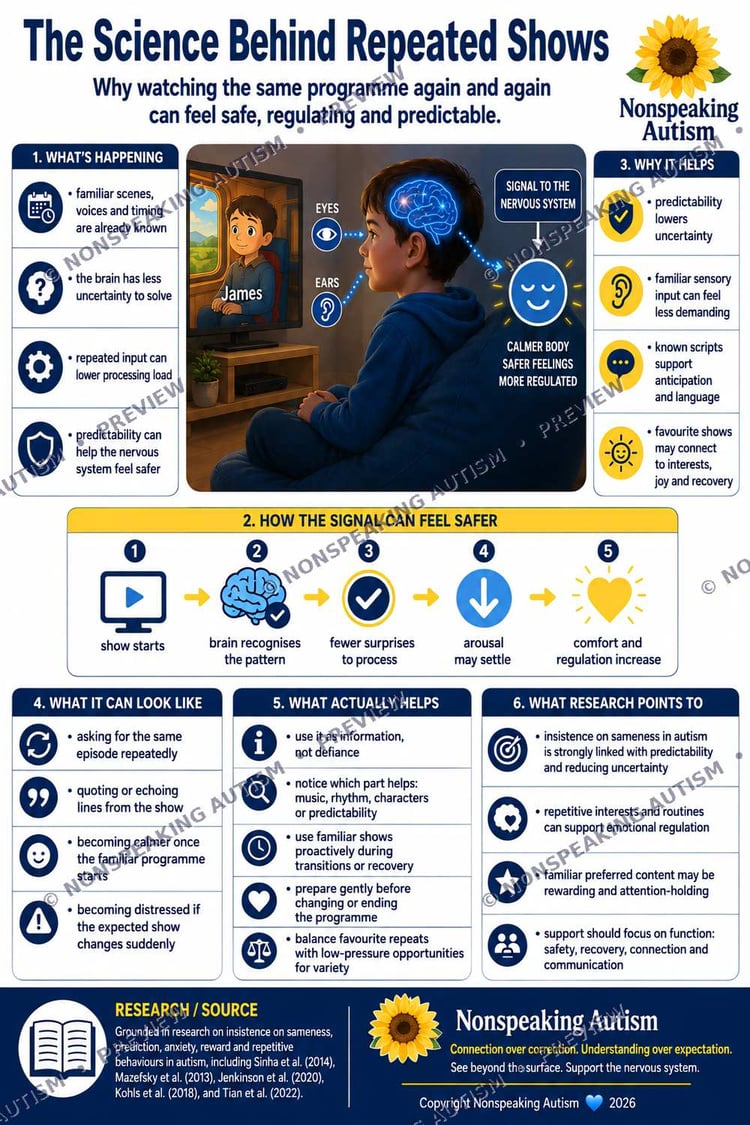
At school, a child may appear quiet, compliant, withdrawn or slower to respond. At home, the same child may experience post-school breakdown, intense stimming, reduced tolerance, exhaustion or a strong need for isolation or movement.
In the community, difficulties may instead appear as avoidance, escape, distress in crowds, difficulty waiting or increased dependence on support.
Different presentations do not necessarily mean unrelated difficulties.
Different environments place different demands on the same child.
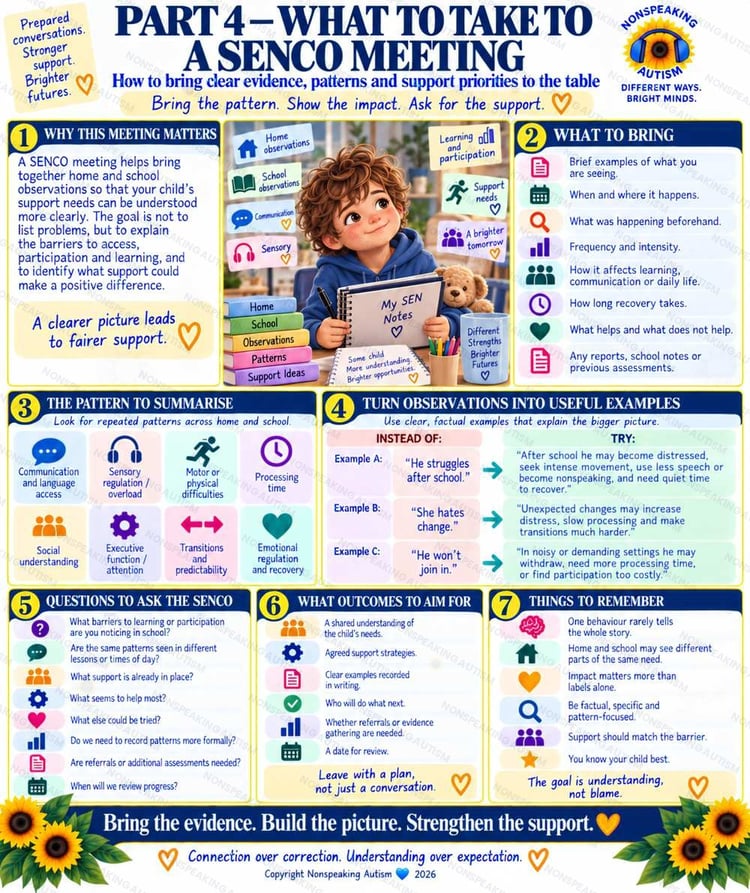
🏫 Preparing for a SENCO, Referral or Support Meeting
The poster also provides a useful checklist for gathering information before a meeting, including what has been repeatedly observed, when and where it happens, what demands or load were present, frequency and intensity, the effect on learning or participation, recovery time, support already tried and whether anything improved when support was added.
Patterns recorded over time can often provide a clearer picture than one isolated incident.
📚 Part of the Putting the Whole SEN Picture Together Series
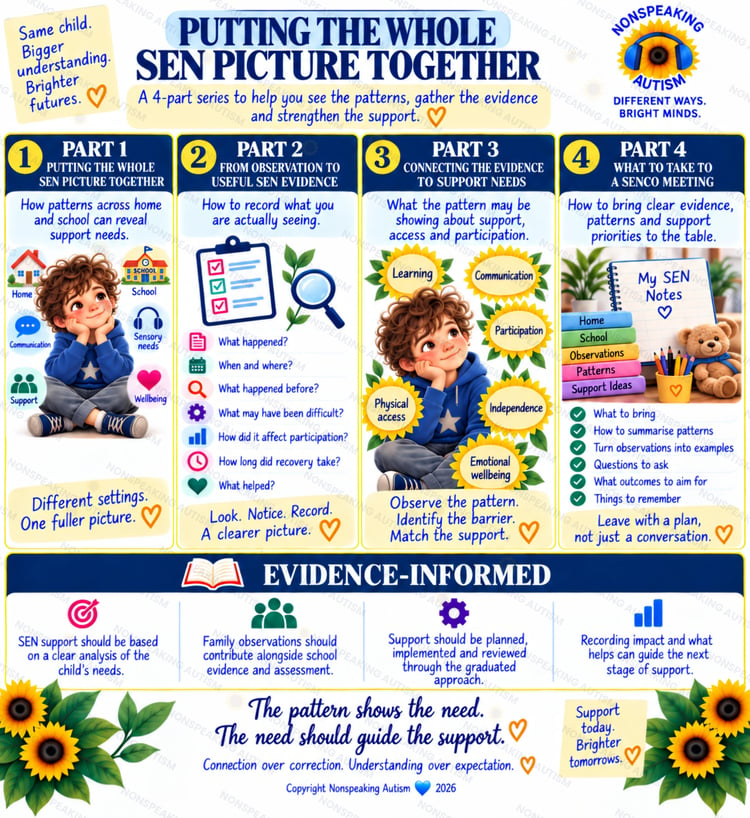
This is Part 3 of the four-part educational series:
Putting the Whole SEN Picture Together
It follows:
Part 1 — Putting the Whole SEN Picture Together
Part 2 — From Observation to Useful SEN Evidence
and helps bridge the next stage:
Evidence → Pattern → Possible Barrier → Support Need
The series is designed to help families organise observations and communicate a child's experiences more clearly when discussing SEN support.
📦 What You Receive
Your purchase includes:
1 × Connecting the Evidence to Support Needs — Part 3
This is a digital educational poster from Nonspeaking Autism.
The purchased version is supplied as a high-quality A2 PDF — exact 420 × 594 mm page size, suitable for professional or home printing.
The purchased PDF is supplied clear and without the promotional preview watermark. Watermarks visible on Payhip listing images are used only for preview and copyright-protection purposes.
Digital PDF download only — no physical product will be shipped.
👨👩👧 Ideal For
This resource may be useful for parents and caregivers, teachers, SENCOs, SEN/SEND staff, teaching assistants, support workers and other professionals involved in understanding and supporting a child's individual needs.
It may be particularly useful when preparing for SENCO meetings, school support discussions, referrals, SEN support planning and reviews, or when bringing together observations from home, school and the wider community.
⚠️ Educational Disclaimer
This resource is provided for educational and informational purposes only.
It is not a diagnostic or assessment tool and does not diagnose autism, ADHD, sensory processing differences, learning difficulties or any other developmental, medical or psychological condition.
The examples of possible barriers and supports are illustrative and should not be interpreted as establishing the cause of a particular behaviour or as recommendations for an individual child.
Every child is different. Appropriate support should be based on the child's individual needs and, where necessary, discussed with their educational setting and relevant qualified professionals.
This resource does not replace professional, educational or medical assessment or advice.
© Copyright & Permitted Use
Copyright © Nonspeaking Autism. All rights reserved.
Purchase permits use by the purchaser for personal or individual professional educational purposes.
The digital file may not be resold, redistributed, shared publicly, uploaded to file-sharing platforms, reproduced as another commercial product or claimed as another person's work without permission.
The evidence shows the pattern.
The pattern helps identify the need.
The need should guide the support. 💙
Connection over correction. Understanding over expectation.