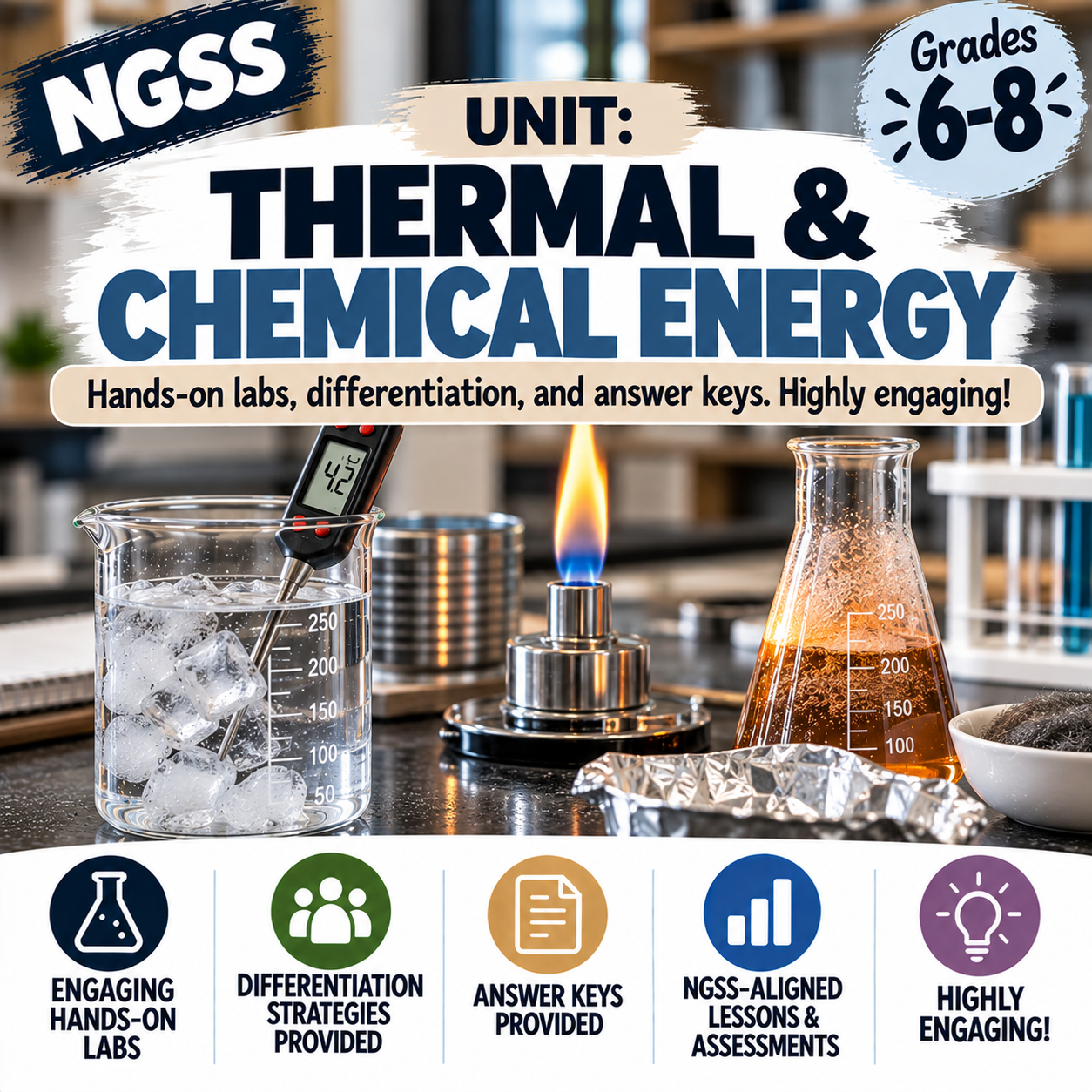
MS: NGSS - Unit: Thermal & Chemical Energy
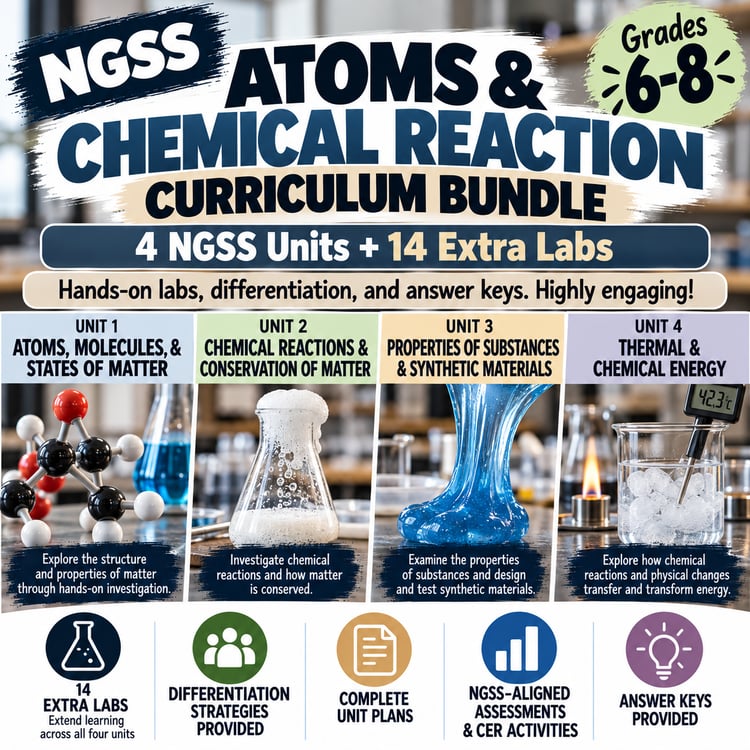
Thermal & Chemical Energy Unit | NGSS MS-PS1-6 | Grades 6–8
Why does a cold pack get cold when you squeeze it? How does a hand warmer heat up with no battery or flame? In this hands-on, NGSS-aligned unit, students find out by measuring, graphing, and engineering. They squeeze cold packs, open hand warmers, and test chemical processes that release or absorb thermal energy. Then they think like engineers: running fair tests, testing insulation, comparing designs against criteria, and finally designing, building, testing, and improving their own hot or cold pack.
Driving Question: How can we use a chemical process to design a device that releases or absorbs thermal energy, and how do we test and improve it?
What's Included
- Teacher Guide (20 pages): unit storyline, full standards breakdown, routines and safety, differentiation, and a two-page plan for every lesson with lesson flow, "Listen for," key science, misconceptions, expected results, a differentiation menu, and the exit ticket
- Student Notes for Lessons 1–6: vocabulary, phenomena, labs, data tables, graphs, energy flow diagrams, analysis questions, and CERs
- Lesson 7 Performance Task: "Design Engineer: Build a Hot or Cold Pack," with 3 Design Briefs, pilot test data, and a 32-point rubric
- Exit Tickets for Lessons 1–6: 3 per page
- End-of-Unit Assessment: 60 points
- Answer Keys: Student Notes (with performance task look-fors), Exit Tickets (with three levels of sample answers), and the End-of-Unit Assessment
Lessons
- Hot or Cold? Energy in Chemical Processes
- Energy-Releasing Processes
- Energy-Absorbing Processes
- Changing the Temperature: Variables
- Controlling Energy Transfer
- Testing & Improving a Design
- Performance Task: Design Engineer
Differentiation for Every Learner
Every student works toward the same standard (MS-PS1-6). The supports change how students get there, not what they're held to. The Teacher Guide includes a unit-wide "Differentiation at a Glance" page, plus a menu of options for each lesson, so you can pick what fits your class.
- ELL / Multilingual Learners: picture word walls, sentence frames, word banks with icons, bilingual partners, and the option to draft in a first language. Students can show understanding with labeled drawings, energy flow diagrams, and data tables, and are scored on the science idea, not English grammar.
- Neurodivergent Learners: a predictable six-part lesson rhythm with a visual agenda and timers, clear group roles, procedures broken into steps with check-offs, pre-filled data tables, pre-weighed materials, and the option to type, dictate, or draw responses. Always follow IEPs and 504 plans.
- Honors / Gifted: go deeper, not further ahead. Students predict results from data trends, explain trade-offs between design criteria, optimize designs with fewer materials, rank designs on several criteria, and add rebuttals to their CERs, all within the standard.
- Performance Task: three Design Briefs at different levels of challenge, so you can match students to the right one. The Sports Cold Pack is the most supported, and the Field Trip Lunch Cooler is the most challenging.
Why Teachers Love It
- Phenomenon-first lessons with a predictable six-part rhythm (about 65 minutes each; easy to split across two shorter periods)
- Stays within the NGSS: students measure amount, time, and temperature only, with no joules or energy calculations
- Inexpensive materials from the grocery store, hardware store, and classroom (ammonium chloride comes from a science supplier)
Standards: MS-PS1-6; PS1.B; ETS1.B; ETS1.C; SEP Constructing Explanations and Designing Solutions; CCC Energy and Matter
Extend the Learning: Pair It With the Lab Bundle!
Pair this unit with the Thermal Energy & Chemical Design Lab Bundle for four extra labs that use completely new chemical processes:
- Food Fuel: Burning Snacks to Heat Water: combustion and capturing more of the energy (after Lesson 2 or 5)
- Magnesium in Vinegar: Does Concentration Matter?: how concentration changes the energy released (after Lesson 4)
- Choosing the Best Cold Pack Chemical: comparing substances with a decision matrix (after Lesson 3 or before Lesson 7)
- Epoxy Heat: Why Thick Pours Get Hot: how amount and shape change the temperature (after Lesson 5)
Each lab includes a Teacher Guide, Student Lab Sheet, and Answer Key, and none of them repeats an activity from the unit.
Terms of Use
This purchase is for single-classroom use only. Please do not share, post, or distribute this resource. If colleagues would like to use it, additional licenses are available at a discount. See the included Terms of Use for full details.
Questions?
If you have questions or need support with this resource, please contact NextWave Science at nextwavescience@gmail.com. Thank you for bringing hands-on science into your classroom!