MS: NGSS - Unit: Cells
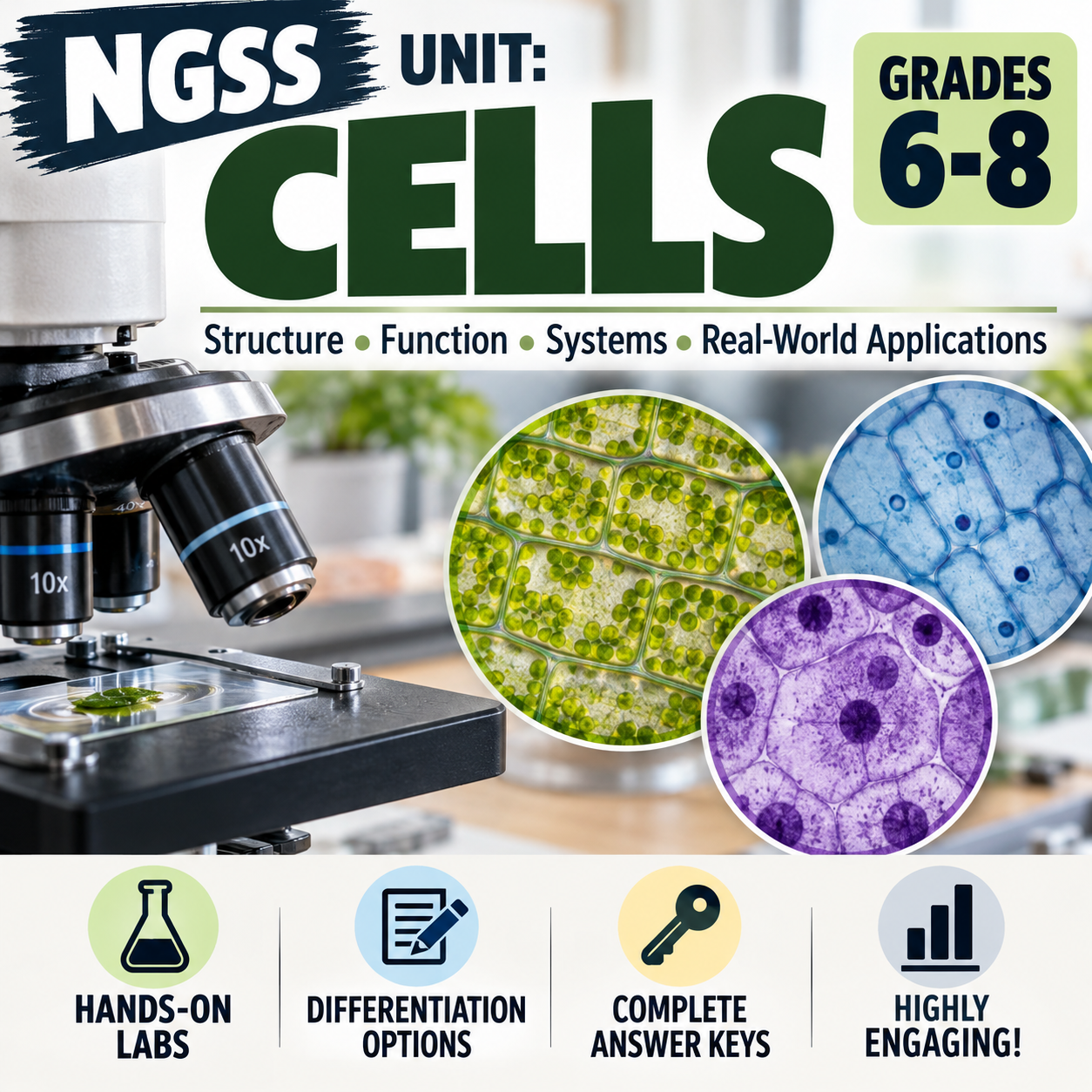
Cells: The Building Blocks of Life Unit | NGSS MS-LS1-1 & MS-LS1-2 | Grades 6–8
Is a seed alive? What about a crystal that grows, or a robot that moves? And what are living things actually made of? This hands-on, NGSS-aligned unit answers those questions as students build a deep understanding of MS-LS1-1 and MS-LS1-2: all living things are made of cells, and the parts of a cell work together as a system to keep it alive.
Students begin with a mystery: two bottles, two inflating balloons, and only one of them is alive. They test look-alike living and nonliving things at stations and sort “mystery samples” as Life Detectives. After a microscope bootcamp, they line up along a human scale line from an ant down to a bacterium. Then they go cell hunting in onion, Elodea, cork, cheek cells, and yeast, along with nonliving “imposters” like salt and sand. They use that evidence to write a claim-evidence-reasoning argument that all living things are made of one or more cells. In the second half, students model the cell as a system:
- a starch-and-iodine bag shows the cell membrane letting some things in and keeping others out
- a balloon-in-a-cup stack test shows how the cell wall holds a plant up
- the whole class acts out a living cell, then “knocks out” one part at a time to see what happens
The unit closes with students designing 3D cell models and running a Cell Museum. They answer “What If?” challenges with their models, then revise them based on feedback and evidence.
Driving Question: What are living things made of, and how do the parts of a cell work together to keep it alive?
What’s Included:
- Read Me First with pacing, a full materials list, and teaching tips
- 31-page Teacher Guide covering:
- unit storyline, standards alignment, and a lesson-by-lesson standards table
- a lesson flow with timings for every lesson
- “Listen for” student talk and common misconceptions with quick fixes
- routines and safety notes used throughout the unit
- a differentiation menu for ELL/multilingual, neurodivergent, and honors/gifted learners
- 12 lessons of Student Notes
- Station Cards for Lessons 1 and 5, Role Cards for the Lesson 10 cell simulation, and What-If Cards for the Lesson 12 Cell Museum
- Lesson 6 CER Rubric and Lesson 12 Model Rubric
- 10 Exit Tickets, printed 3 per page
- End-of-Unit Assessment (28 points) with multiple choice, data and scale analysis, a cell model drawing, and “what if” cause-and-effect questions
- Complete Answer Keys for the notes, exit tickets, and assessment, with leveled sample responses
Lessons:
- Alive or Not? The Mystery Bottles
- Life Detectives: Testing the Signs of Life
- Seeing the Invisible: Microscopes and Scale
- Cell Hunters, Part 1: Investigating Plants
- Cell Hunters, Part 2: Animals, Microbes, and Imposters
- The Evidence Is In: One Cell or Many?
- The Cell as a System: Parts and Jobs
- The Gatekeeper: Investigating the Cell Membrane
- Built to Stand: Investigating the Cell Wall
- Power Plants and Powerhouses: Living Cell Simulation
- Cell Architects: Designing a 3D Cell Model
- Cell Museum: Using and Revising Our Models
Every lesson in the Teacher Guide follows the same layout (Lesson Flow, Listen For, Watch For, Differentiation Menu, and Exit Ticket), so planning is quick. Most materials are inexpensive classroom and grocery-store supplies. The unit also includes options for classrooms without enough microscopes. Each lesson runs about 65 minutes, and the Read Me shows how to stretch the unit across about 19–20 days for 45-minute periods.
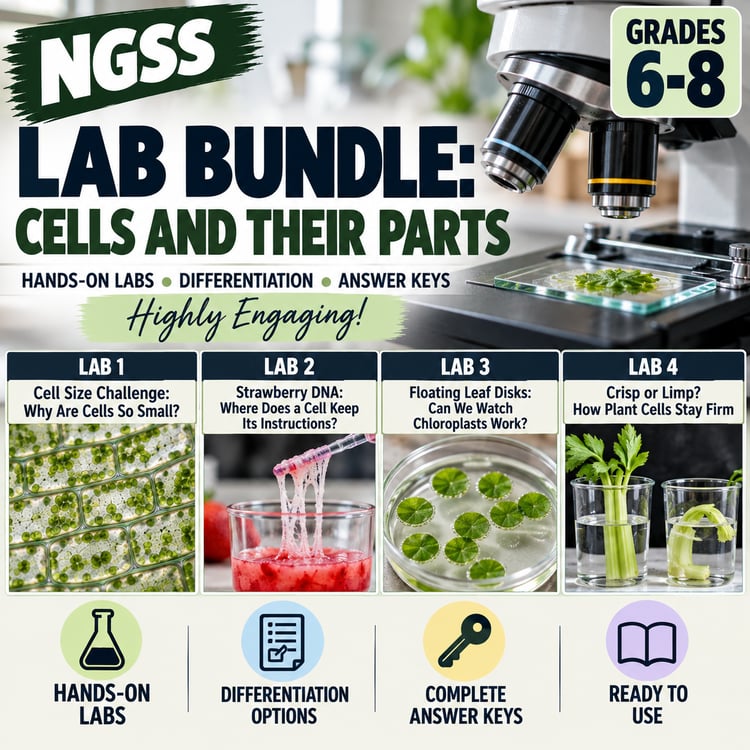
Pair It With the Cells & Their Parts Lab Bundle!
Want to take learning even further? These four extension labs fit right into the unit. Each one targets a different cell idea and a common misconception:
- Cell Size Challenge: Why Are Cells So Small? Purple gelatin “cells” soak in vinegar, and students measure how far the pink color travels. The small cube changes almost completely, but the big cube’s center stays purple. Real cell data then shows why large living things are made of many small cells, not one giant cell. (Fits after Lesson 6 or Lesson 8.)
- Strawberry DNA: Where Does a Cell Keep Its Instructions? Students pull a stringy white clump of DNA out of strawberries. A soap vs. no-soap fair test proves the membranes must be broken open before the instructions in the nucleus can get out. (Fits after Lesson 7 or Lesson 8.)
- Floating Leaf Disks: Can We Watch Chloroplasts Work? Spinach leaf disks sink, then rise one by one under a lamp as their chloroplasts make food. Disks kept in the dark stay on the bottom, and class data shows the closer the light, the faster they float. (Fits after Lesson 7 or Lesson 10.)
- Crisp or Limp? How Plant Cells Stay Firm Students weigh potato sticks soaked in plain and salty water, graph the percent change, and watch onion cells shrink away from their walls under the microscope. The evidence shows how the cell membrane and cell wall work together to keep a plant firm. (Fits after Lessons 8 and 9.)
Each lab includes:
- a 4-page Teacher Guide
- a Student Lab Sheet with a CER and an Honors Extension
- a full Answer Key with sample data and leveled CER examples
Terms of Use
This purchase is for single-classroom use only. Please do not share, post, or distribute this resource. If colleagues would like to use it, additional licenses are available at a discount. See the included Terms of Use for full details.
Questions or Concerns?
I want you to love this resource! If you have any questions, run into an issue, or need support, please contact me at nextwavescience@gmail.com before leaving a review. I’m happy to help.