MS: NGSS - Kinetic & Potential Energy Lab Bundle
Kinetic & Potential Energy Labs Bundle | NGSS MS-PS3-1 & MS-PS3-2 | 4 Hands-On Labs
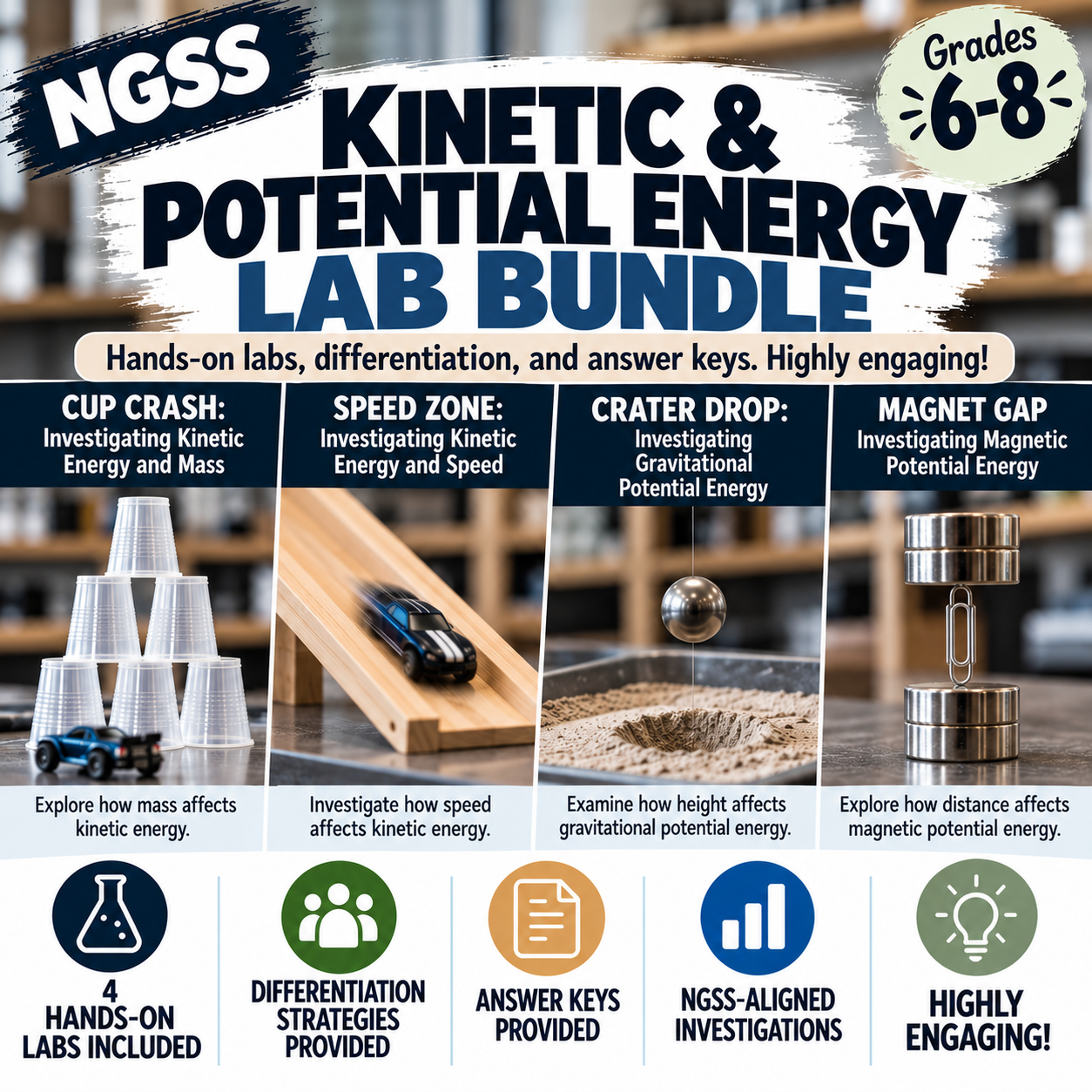
Let students see energy for themselves. In these four hands-on labs for grades 6–8, students crash toy cars into cups, time cars through a speed zone, drop golf balls into flour, and push magnets together. They collect and graph their own data, then explain what they find with a Claim–Evidence–Reasoning (CER) response. Each lab takes about 50 minutes and uses low-cost materials, many of which you may already have.
The Labs
- Cup Crash: Investigating Kinetic Energy and Mass (MS-PS3-1). Students add washers to a toy car, roll it down a ramp into an upside-down cup, and measure how far the cup slides. Their graph shows a straight line: more mass means more kinetic energy.
- Speed Zone: Investigating Kinetic Energy and Speed (MS-PS3-1). Students time the same car across a 100 cm speed zone, calculate speed (distance ÷ time), and measure the cup slide. Their graph curves, and they find that doubling the speed makes the cup slide about 4 times as far.
- Crater Drop: Investigating Gravitational Potential Energy (MS-PS3-2). Students drop a golf ball into flour from four heights and measure the craters. They model the Earth–ball system and explain why it stores more energy when the ball is higher.
- Magnet Gap: Investigating Magnetic Potential Energy (MS-PS3-2). Students tape a magnet to a toy car and test repelling and attracting arrangements. They model how distance and orientation change the energy stored in a magnet–magnet system.
Each Lab Includes
- Teacher Guide: what the lab does, when to use it, materials, setup tips, safety notes, a timed lesson flow, "Listen for" and "Watch for" notes, CER scoring, and a standards alignment table
- Student Lab Sheet: predictions, a fair-test plan, data tables with repeated trials and averages, a graph, analysis questions, a real-world connection, a CER, and an optional Honors Extension
- Answer Key: sample data, answers, and CER examples at three levels (Meets / Approaching / Needs Development)
Pair It With the Unit
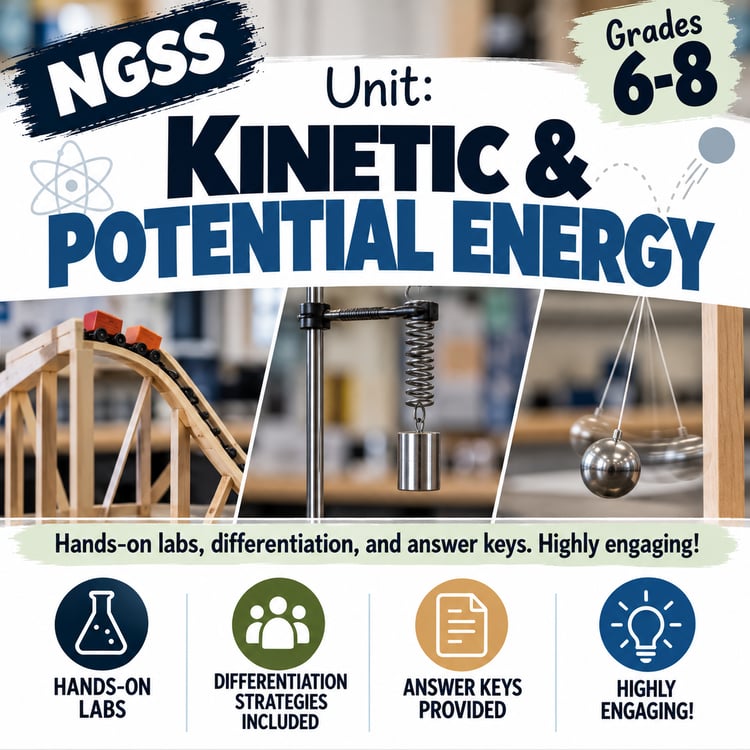
These labs are designed to go with NextWave Science's Kinetic & Potential Energy unit. Use each one as an extra investigation or in place of the in-class lab:
- Cup Crash pairs with Lesson 3, and its data feeds the graphing in Lesson 5.
- Speed Zone pairs with Lesson 4, and its data also feeds Lesson 5.
- Crater Drop pairs with Lessons 6–7.
- Magnet Gap pairs with Lesson 8.
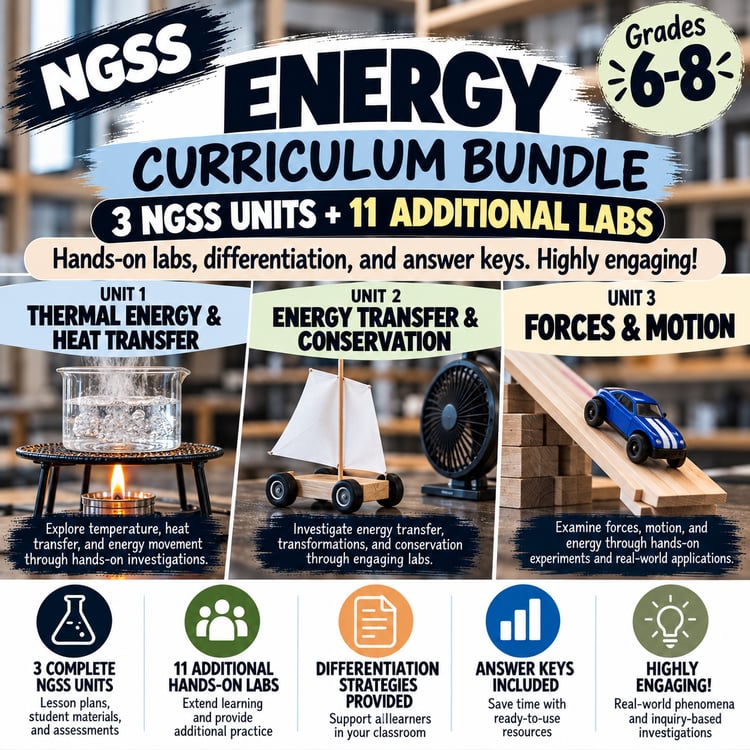
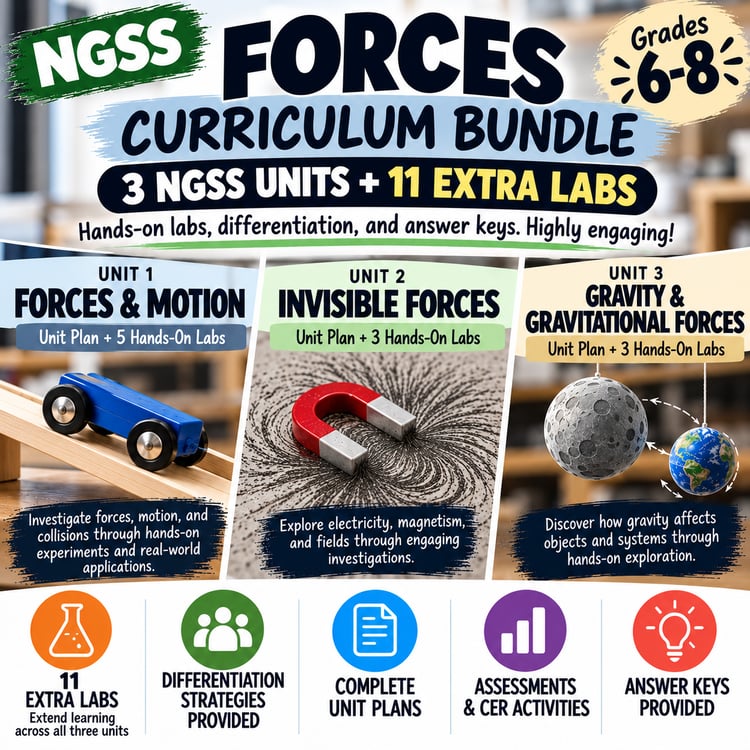
Together, the unit and labs give you a complete, NGSS-aligned energy sequence. They also follow Forces & Motion and reuse its toy cars, washers, ramps and meter sticks. The labs work on their own too, for review, enrichment, or any energy unit.
Built-In Differentiation
Every Teacher Guide includes a differentiation page with options for:
- ELL / Multilingual Learners: picture word banks, sentence frames, acting out key ideas, partner rehearsal of the CER, and labeled drawings accepted as evidence
- Neurodivergent Learners: lab role cards, visual step cards, pre-taped marks, check-ins between parts, heads-ups before noisy moments, and typed or dictated CERs
- Advanced / Honors: an Honors Extension on every lab sheet, plus predicting from graphs, comparing data sets, and critiquing sources of error
Every student works toward the same performance expectation. Differentiation changes how they get there, not the standard they're held to. Always follow students' IEPs and 504 plans.
Standards: NGSS MS-PS3-1, MS-PS3-2 • DCI PS3.A, PS3.C • SEPs: Analyzing & Interpreting Data, Developing & Using Models, Planning & Carrying Out Investigations • CCCs: Scale, Proportion & Quantity; Systems & System Models
Terms of Use
This purchase is for single-classroom use only. Please do not share, post, or distribute this resource. If colleagues would like to use it, additional licenses are available at a discount. See the included Terms of Use for full details.
Questions?
If you have questions or need support with this resource, please reach out to NextWave Science at nextwavescience@gmail.com before leaving feedback. I'm happy to help! Thank you for bringing hands-on science into your classroom.