MS: NGSS - Mass Conservation & Atom Modeling Lab Bundle
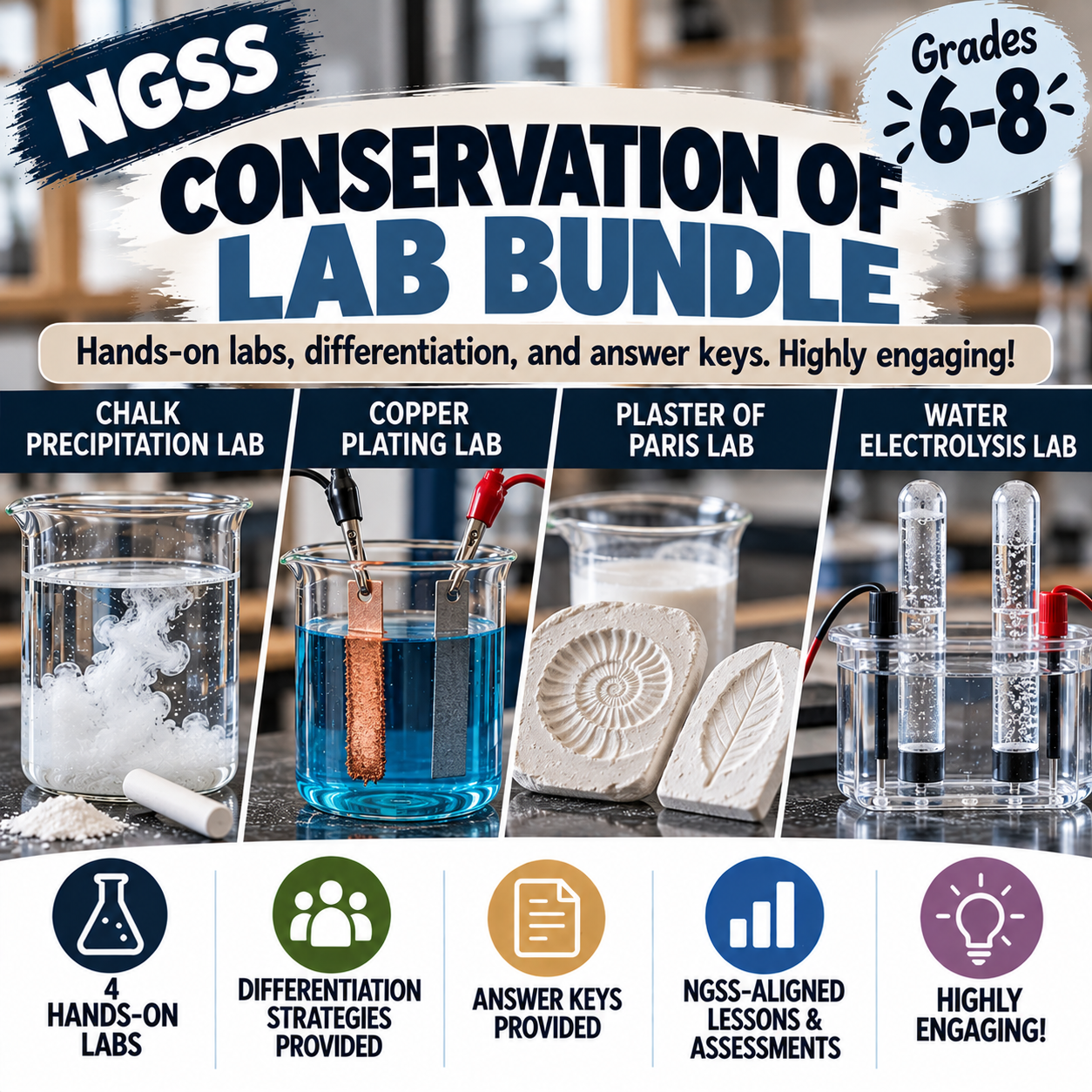
Mass Conservation & Atom Modeling Lab Bundle: 4 NGSS Labs (MS-PS1-2 & MS-PS1-5)
Where do atoms go when substances react, and why doesn't the mass change? This bundle of four hands-on labs for grades 6–8 lets students answer that question again and again with inexpensive, easy-to-find materials. In every lab, students collect property data, measure mass or gas volume, and use an atom model to explain what happened. Then they write a CER.
Labs Included
- Making Chalk from Two Clear Liquids: Students mix two clear solutions and watch a white solid appear instantly. They test the new solid's solubility and reaction with vinegar, and find that mass is conserved even in an open cup because no gas forms.
- Copper Plating a Nail: Students clean dull pennies in vinegar and salt, then use the same liquid to copper-plate a steel nail. A control nail proves where the copper came from. Students trace copper atoms from the penny, into the liquid, and onto the nail.
- Plaster of Paris: Where Did the Water Go?: Water seems to vanish as plaster warms and hardens, but the mass of the covered cup doesn't change. Drying data show the dry solid weighs more than the powder alone, so the water's atoms became part of a new substance.
- Splitting Water with Electricity: Students use a 9-volt battery and pencil leads to split water into hydrogen and oxygen. They collect both gases and connect the 2-to-1 volume pattern to the atom model.
Each Lab Includes
- Teacher Guide (4 pages): lesson flow, materials and prep, "Listen for" signs of understanding, common misconceptions with quick fixes, a differentiation menu (ELL/multilingual, neurodivergent, advanced/honors), CER scoring guide, and a full standards alignment
- Student Lab Sheet (6 pages): background, vocabulary, prediction, procedure with sketch boxes, data tables, analysis questions with an atom model, Higher-Order Thinking, an optional design challenge, CER, and an exit ticket
- Answer Key: sample data, model answers, and CER examples at three levels (Meets, Approaching, Needs Development), each with ready-to-use student feedback
Each lab takes about 50 minutes and works as an extension, enrichment, or review activity.
Standards Covered
- MS-PS1-2: Analyze and interpret data on the properties of substances before and after the substances interact to determine if a chemical reaction has occurred.
- MS-PS1-5: Develop and use a model to describe how the total number of atoms does not change in a chemical reaction and thus mass is conserved.
- Disciplinary Core Ideas:
- PS1.A Structure and Properties of Matter
- PS1.B Chemical Reactions, including atoms regrouping into new substances and the conservation of each type of atom
- Science and Engineering Practices:
- Analyzing and Interpreting Data
- Developing and Using Models
- Planning and Carrying Out Investigations
- Engaging in Argument from Evidence
- Crosscutting Concepts: Patterns; Energy and Matter
All four labs stay within the NGSS assessment boundaries. Students analyze only the properties named in MS-PS1-2, and they model reactions with pictures and atom counts instead of balancing equations or using atomic masses.
Pair It With the Full Unit
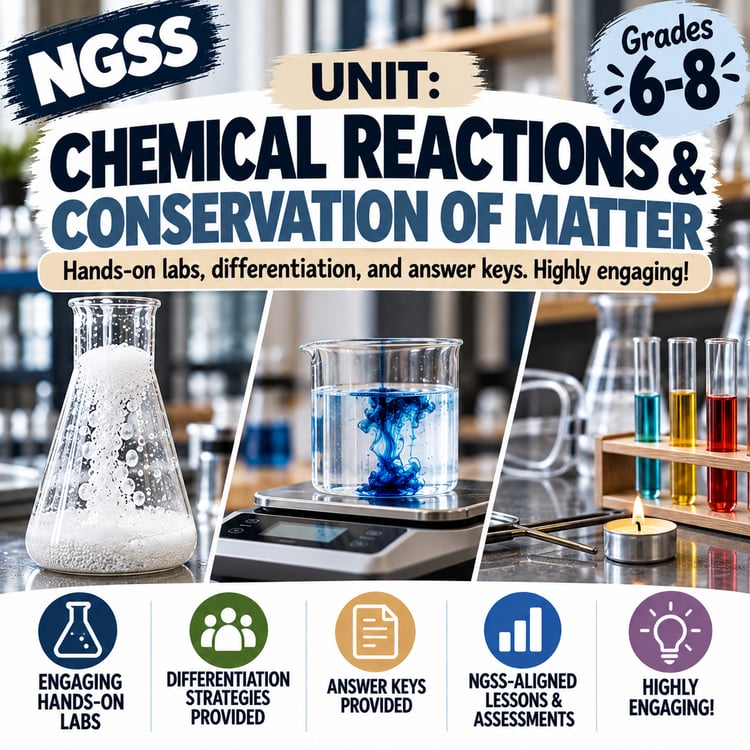
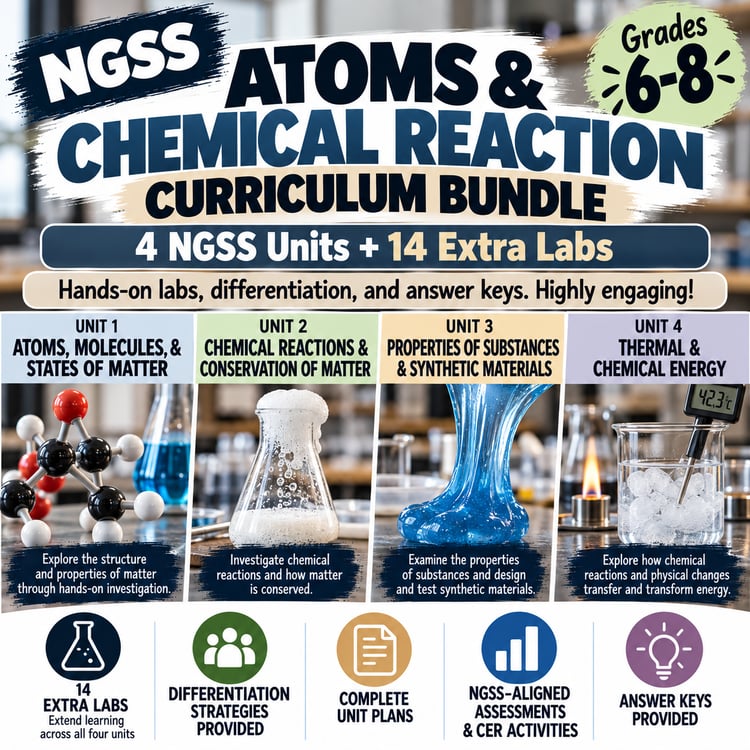
These labs are designed to pair with the Chemical Reaction & Conservation of Matter unit, an 11-lesson NGSS unit covering the same standards. None of the labs repeats a unit activity, and each Teacher Guide tells you exactly where it fits:
- Copper Plating a Nail: after Lesson 6 (Modeling Chemical Reactions)
- Making Chalk from Two Clear Liquids: after Lesson 7 (Conservation of Mass in a Closed System)
- Plaster of Paris: after Lesson 9 (Burning & Rusting)
- Splitting Water with Electricity: after Lesson 6 or Lesson 10 (Elephant Toothpaste)
Together, the unit and the lab bundle give students many chances to see the same big idea from different angles: substances react in characteristic ways, atoms regroup, and matter is always conserved.
Terms of Use
This purchase is for single-classroom use only. Please do not share, post, or distribute this resource. If colleagues would like to use it, additional licenses are available at a discount. See the included Terms of Use for full details.
Questions or Concerns?
I want you to love this resource! If you have any questions, run into an issue, or need support, please contact me at nextwavescience@gmail.com before leaving a review. I'm happy to help.