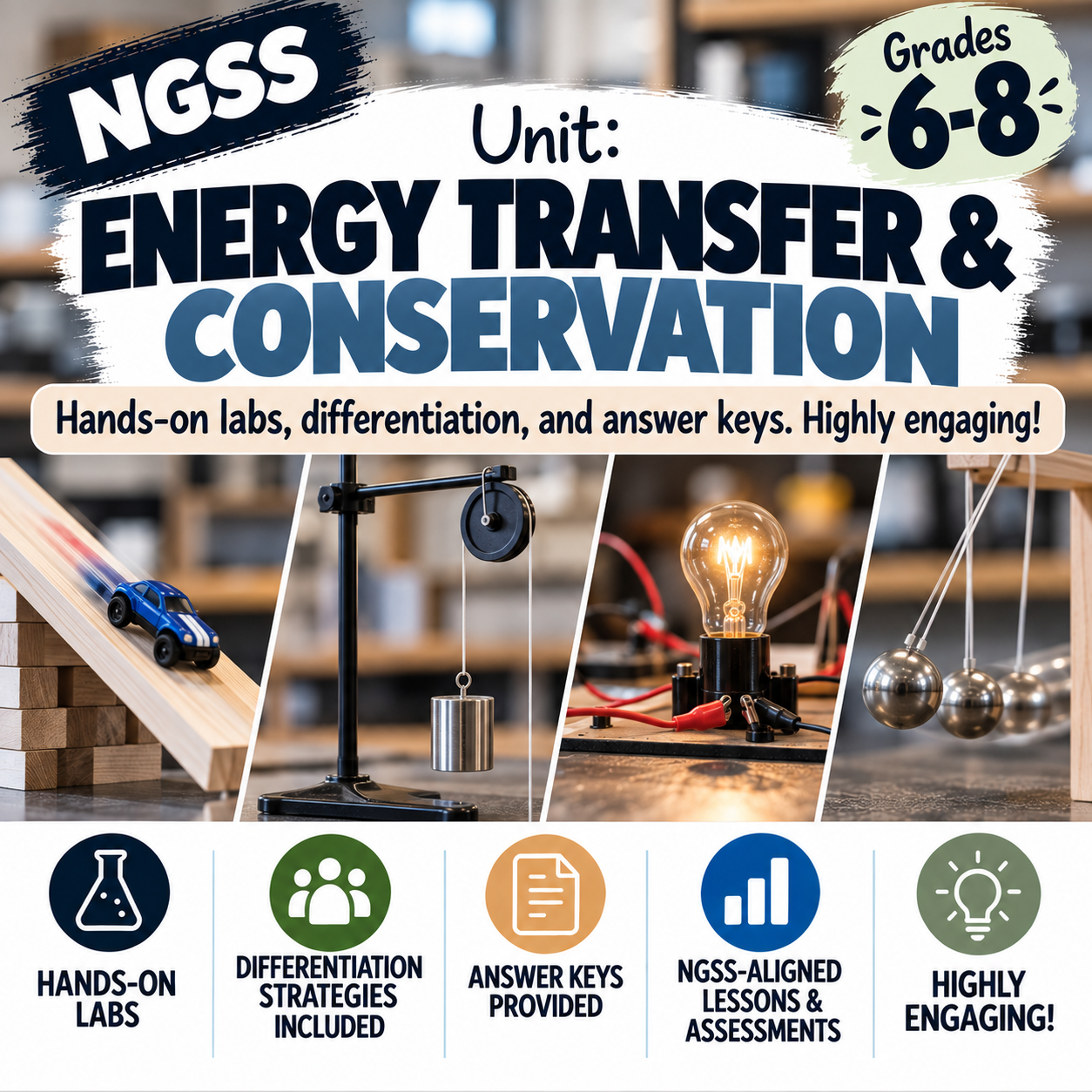
MS: NGSS - Unit: Energy Transfer & Conservation
Energy Transfer & Conservation Unit | NGSS MS-PS3-5 | Grades 6–8
When a car crashes and stops, where does its motion go? Why does a bouncing ball bounce a little lower each time? Is energy ever really "used up"? This hands-on, NGSS-aligned unit answers those questions while students build a deep understanding of MS-PS3-5: when an object's motion energy changes, energy is transferred to or from the object.
Students begin by tracing where motion goes at four energy-change stations. Next they roll marbles into cups to show that energy passes from one object to another. From there, they measure temperature changes as friction turns motion into thermal energy. They then build an energy inventory for a bouncing ball and graph their own data. At a set of collision stations, they gather evidence and write rebuttals to the claim that energy is "used up." The unit closes with students writing, presenting, and critiquing their own evidence-based argument that energy is transferred, not lost. The unit picks up right where Forces & Motion leaves off: Lesson 1 opens with the same cart-and-barrier collision, so the year's curriculum flows together.
Driving Question: When an object's motion changes, where does the energy come from and where does it go?
What's Included:
- Read Me First with pacing, a full materials list, and teaching tips
- 18-page Teacher Guide covering:
- unit storyline, standards alignment, and a lesson-by-lesson standards table
- a lesson flow with timings for every lesson
- "Listen for" student talk and common misconceptions with quick fixes
- routines used throughout the unit
- a differentiation menu for ELL/multilingual, neurodivergent, and honors/gifted learners
- 6 lessons of Student Notes, plus Station Cards for Lessons 1, 3, and 5
- Lesson 6 Argument Rubric (50 points)
- 5 Exit Tickets, printed 3 per page
- End-of-Unit Assessment (27 points) with data and graph analysis, an argument-analysis case study, and a constructed argument
- Complete Answer Keys for the notes, exit tickets, and assessment, with leveled sample responses
Lessons:
- Where Did the Motion Go? Noticing Energy Changes
- Passing It On: Energy Transfer Between Objects
- Feeling the Heat: Motion Energy and Thermal Energy
- Energy Inventory: Tracking Energy Before and After
- Used Up or Passed On? Building an Argument About Energy
- Making Our Case: Presenting Arguments About Energy Transfer
Every lesson in the Teacher Guide follows the same layout (Lesson Flow, Listen For, Watch For, Differentiation Menu, and Exit Ticket), so planning is quick. Most materials are inexpensive classroom supplies, and many carry over from Forces & Motion. Each lesson runs about 65 minutes, and the Read Me shows how to stretch the unit across about 10 days for 45-minute periods.
Pair It With the Energy Transfer Bonus Lab Bundle!
Want to take learning even further? These three extension labs fit right into the unit. Each one targets a different common misconception:
- Magnet Launch: Energy Without a Push. A slow steel ball rolls toward a magnet, and a different ball rockets off the other side. Students compare 0, 1, and 2 magnet stages to discover that energy stored in a magnetic field can be transferred without any contact, and why the launcher still isn't "free energy." (Fits after Lesson 2 or alongside Lesson 5.)
- Sail Cart Challenge: Catching Energy from Moving Air. Can something invisible transfer energy? Students test sails of different sizes in front of a fan. Then they use a tissue-paper strip to show that the air slows down as the cart speeds up. (Fits after Lesson 2.)
- Swing Swap: Tracking Energy Between Pendulums. Two pendulums hang from one string. As the first slows almost to a stop, the second, which no one touched, starts swinging wider, and then the swing passes back. It's powerful proof that a stopped object's energy isn't gone. (Fits after Lesson 4 or alongside Lesson 5.)
Each lab includes a Teacher Guide, a Student Lab Sheet with a CER and an Honors Extension, and a full Answer Key.
Terms of Use
This purchase is for single-classroom use only. Please do not share, post, or distribute this resource. If colleagues would like to use it, additional licenses are available at a discount. See the included Terms of Use for full details.
Questions or Concerns?
I want you to love this resource! If you have any questions, run into an issue, or need support, please contact me at nextwavescience@gmail.com before leaving a review. I'm happy to help.