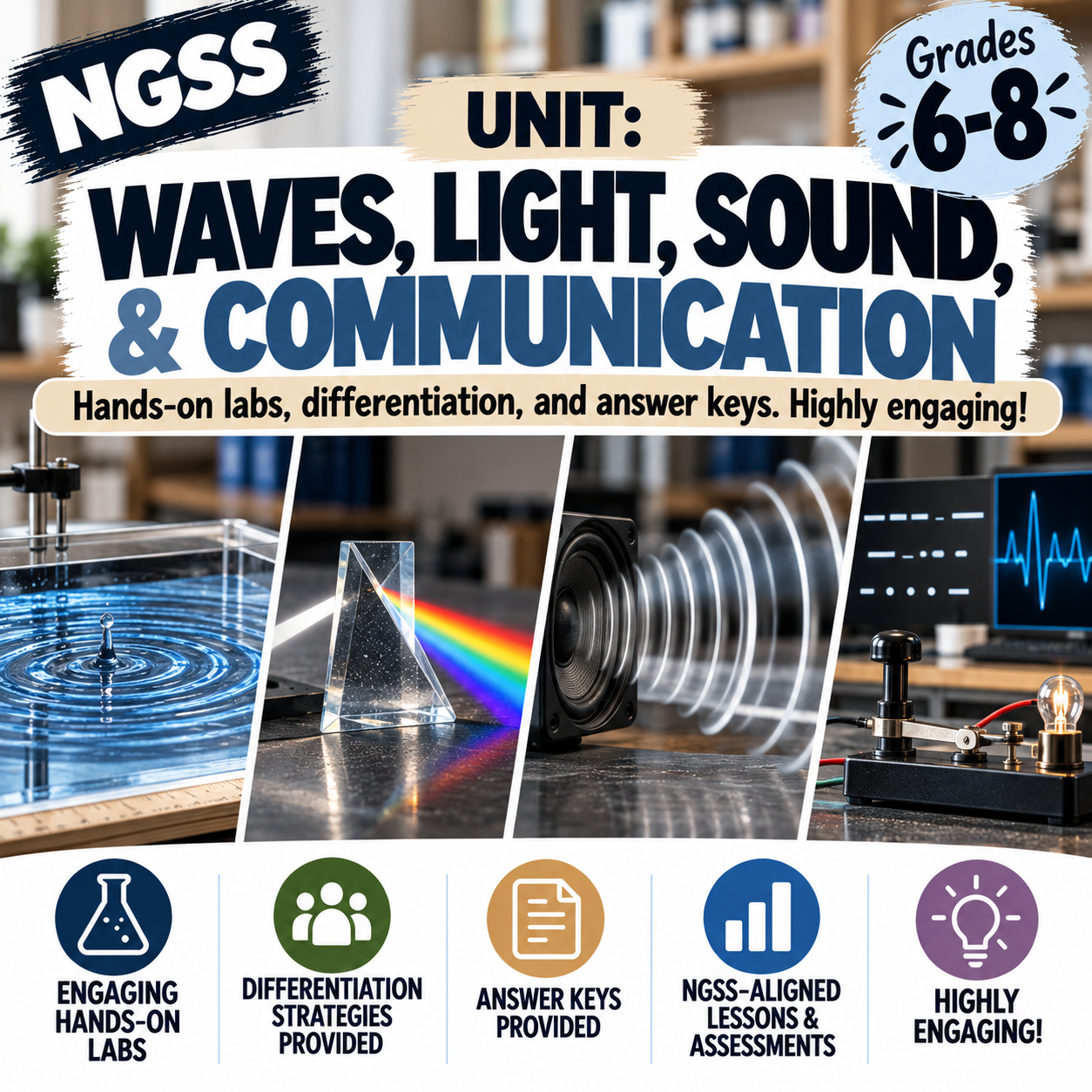
MS: NGSS - Unit: Waves, Light Sound, & Communication
Waves, Light, Sound, & Communication: Investigating How Waves Carry Energy and Information
Grades 6–8 • NGSS-aligned • 16 lessons + end-of-unit assessment
How do waves carry energy and information from place to place, and why do our devices send messages as digital signals? In this hands-on unit, middle school students answer that question through labs, stations, data analysis, and an engineering performance task. They start by watching a cork bob on rippling water and finish by designing, testing, and improving their own wave signaling system, then defending it with evidence.
What Students Do
- Lessons 1–5: Explore what a wave is through Making Waves stations, then describe waves with numbers. Students measure amplitude and wavelength, calculate frequency and wave speed with a Slinky Speed Lab, and discover in the Wave Energy Lab that doubling a wave's amplitude about quadruples its energy. They graph the frequency–wavelength pattern.
- Lessons 6–8: Investigate sound. Students test how sound travels through solids, liquids, and gases, connect pitch to frequency and loudness to amplitude in a Bottle Pitch Lab, and line shoeboxes with different materials to find which ones reflect and which absorb sound.
- Lessons 9–12: Explore light. Students measure reflection angles with mirrors, rotate through Light & Materials stations to test what transmits, reflects, and absorbs light, trace refraction in water, and explain color with a wave model of light.
- Lessons 13–15: Compare analog and digital signals. Students pass analog and digital pictures through five rounds of copying, send light-pulse messages across the room with and without "noise," and use an Information Jigsaw on fiber optics, Wi-Fi, and digital media to support the claim that digital signals are more reliable.
- Lesson 16: Take on the Communication Engineer performance task. Students choose one of three design briefs (Cave Rescue Light Link, Library Quiet Signal, or Noisy Stadium Signal), build and test a signaling system, change one variable, retest, and explain their results in a Claim–Evidence–Reasoning (CER) write-up scored with a 32-point rubric.
Standards
- MS-PS4-1: Use mathematical representations to describe a simple model for waves that includes how the amplitude of a wave is related to the energy in a wave
- MS-PS4-2: Develop and use a model to describe that waves are reflected, absorbed, or transmitted through various materials
- MS-PS4-3: Integrate qualitative scientific and technical information to support the claim that digitized signals are a more reliable way to encode and transmit information than analog signals
- Every lesson lists its disciplinary core idea, science and engineering practice, and crosscutting concept. Content stays within NGSS limits:
- Students find the amplitude–energy pattern from data and use wave speed = wavelength × frequency, but never calculate energy in joules.
- Light and sound interactions stay qualitative, with no Snell's law or decibel math.
- Digital signals are taught as on/off pulses, with no binary counting or device-specific mechanisms.
Built-In Differentiation
Every lesson includes a Differentiation Menu with options for:
- English learners: picture word walls, sentence frames, word banks, gestures for wave motion, partner rehearsal, and credit for labeled wave sketches and arrow models
- Neurodivergent learners: a predictable six-part lesson routine, visual timers, lab role cards, chunked procedures with check-offs, pre-drawn wave grids and data tables, a quieter option during sound labs, and choice in how to respond
- Advanced, gifted, and honors students: extensions that go deeper into the same standards, such as predicting results from graph trends, comparing sound and light in one model, weighing trade-offs between design criteria, and defending claims against counter-arguments
The Teacher Guide also explains how to differentiate within the NGSS. Every student works toward the same performance expectations; differentiation changes how students get there, not the standard.
What's Included
- Teacher Guide:
- Unit storyline, standards tables, routines, safety notes, and a two-page plan for each lesson
- Each plan has a timed lesson flow, "Listen for" signs of understanding, expected results, common misconceptions with quick fixes, and a differentiation menu
- Student Notes for Lessons 1–15, plus the Lesson 16 Performance Task handout with three design briefs, pilot test data, and a 32-point rubric
- Exit tickets for Lessons 1–15 (printed 3 per page)
- End-of-unit written assessment (60 points)
- Answer keys for the student notes, the assessment, and the exit tickets (with sample responses at three levels)
- Printable station cards for Lessons 1 and 10
- Materials list for the whole unit, using inexpensive, reusable classroom supplies and free phone apps (sound meter, tone generator, tuner, and light meter)
Pacing
16 lessons of about 65 minutes each (Lesson 16 runs about 70), or roughly 17 class days including the assessment. With 45–50 minute periods, teach each lesson over two days and plan about 33 days.
Continue Building on This Resource
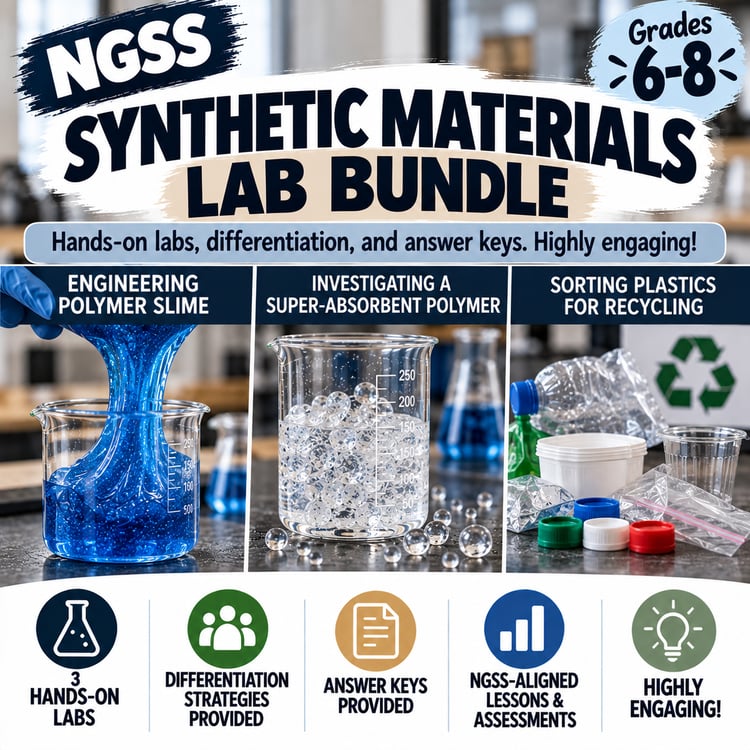
- Waves, Light & Sound Lab Bundle: 3 Hands-On Extension Labs
Three additional hands-on, NGSS-aligned labs that cover new ideas the unit doesn't teach, giving students more chances to predict, test, collect evidence, and explain. Each lab runs about 50 minutes and fits a specific point in this unit:
- Standing Waves and Resonance Investigation (MS-PS4-1): after Lesson 5. Students shake a Slinky at different rhythms to make steady standing waves with 1, 2, and 3 loops, calculate the frequency and wavelength of each, and discover why only certain frequencies make a wave grow. It also bridges into Lesson 7 by explaining how instruments make different notes.
- Pinhole Camera Investigation (MS-PS4-2): after Lesson 9, before Lesson 11. Students build a pinhole camera and use a ray model to explain why the image is upside down. They measure how the image grows as the camera gets longer and test the trade-off between a bright image and a sharp one.
- Engineering a Coastal Breakwater (MS-PS4-2, with MS-PS4-1 and engineering connections): after Lesson 8, or as a warm-up for the Lesson 16 performance task. Students test five barriers in a water-wave tank, measure wave height at the "shore," and then design, test, and improve a breakwater that protects the town without bouncing dangerous waves back toward the boat channel.
Each lab includes a teacher guide, a student lab sheet, an answer key with CER examples at three levels, and differentiation for diverse learners. It's a good fit for teachers who want more lab time without creating new investigations from scratch.
Terms of Use
This purchase is for single-classroom use only. Please do not share, post, or distribute this resource. If colleagues would like to use it, additional licenses are available at a discount. See the included Terms of Use for full details.
Questions or feedback? Contact NextWave Science at nextwavescience@gmail.com. If this resource was helpful in your classroom, a review is always appreciated.