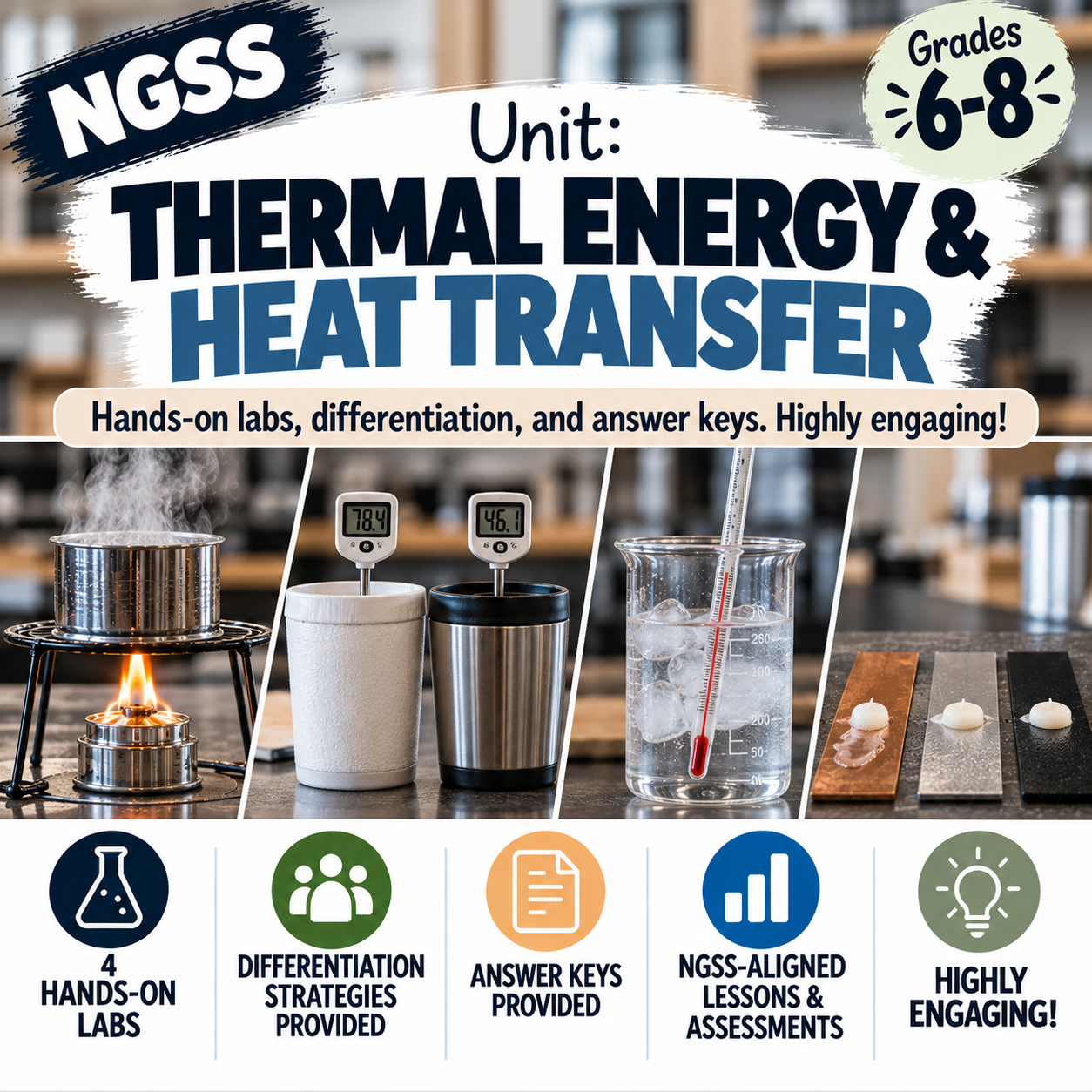
MS: NGSS - Unit: Thermal Energy & Heat Transfer
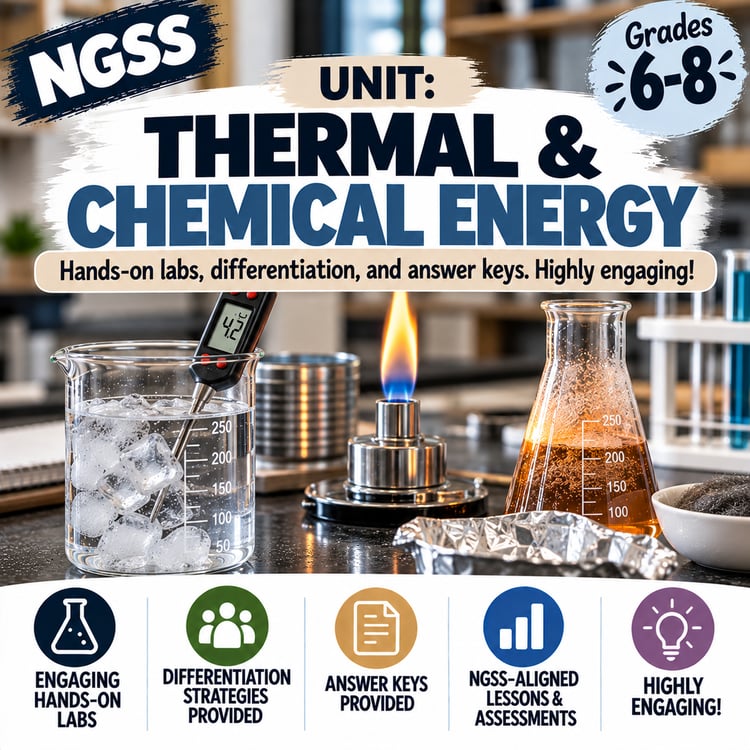
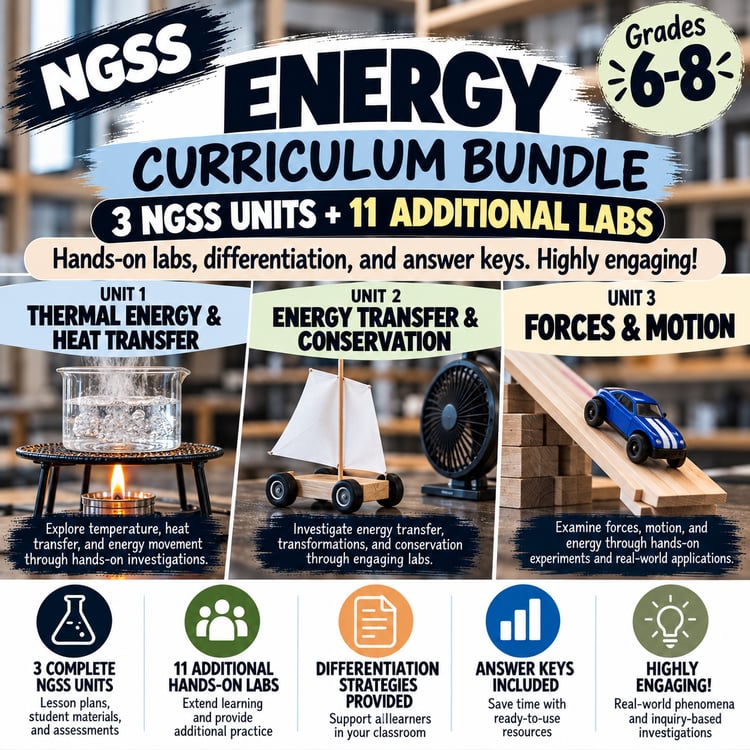
Thermal Energy & Heat Transfer: Investigating and Controlling Energy Flow
Grades 6–8 • NGSS-aligned • 12 lessons + end-of-unit assessment
How does thermal energy move, and how can we control it? In this hands-on unit, middle school students answer that question through labs, stations, data analysis, and an engineering design challenge. They start by watching food coloring swirl through hot and cold water. They finish by designing, testing, and improving their own insulated container, then defending it with evidence.
What Students Do
- Lessons 1–3: Discover what thermal energy is. Students rotate through Thermal Energy stations to see that hotter particles move faster. In an Ice-Melt Challenge, they find that a large cup of warm water has more thermal energy than a small cup at the same temperature. They then explore conduction, convection, and radiation through Heat Transfer stations.
- Lessons 4–7: Investigate what affects temperature change. In a Hot & Cold Cup Lab, students track two cups for 10 minutes and show that energy always moves from hotter to colder until the temperatures match. They plan and run their own fair test on how the mass of water affects its temperature change. Then they graph their data to find the pattern: more mass, smaller change.
- Lessons 8–9: Explore how materials affect energy transfer. Students heat equal masses of sand and water under a lamp to see how the type of matter changes the result, and connect it to hot beaches and mild coastal weather. They test spoons, wrapped cups, and wrapped ice cubes in Conductors & Insulators stations, then argue from evidence about which materials slow energy transfer best.
- Lessons 10–12: Take on the Keep It Hot! design challenge. Students define criteria and constraints and compare ideas in a decision matrix. They build an insulated container, test it against an unwrapped control cup, change one variable, and retest. Finally, they explain their results in a Claim–Evidence–Reasoning (CER) write-up scored with a 50-point rubric.
Standards
- MS-PS3-3: Apply scientific principles to design, construct, and test a device that either minimizes or maximizes thermal energy transfer
- MS-PS3-4: Plan an investigation to determine the relationships among the energy transferred, the type of matter, the mass, and the change in the average kinetic energy of the particles as measured by the temperature of the sample
- Supporting engineering connections: MS-ETS1-1, MS-ETS1-2, MS-ETS1-3, and MS-ETS1-4
- Every lesson lists its disciplinary core idea, science and engineering practice, and crosscutting concept. Content stays within NGSS limits:
- Students compare temperature changes using subtraction and averages, but never calculate thermal energy in joules or calories.
- There is no Q = mcΔT or specific heat math. Mass and type of matter are compared qualitatively and proportionally.
- Conduction, convection, and radiation are explained with a particle model, not equations.
Built-In Differentiation
Every lesson includes a Differentiation Menu with options for:
- English learners: picture word banks, vocabulary cards with icons, sentence frames, and gestures for conduction, convection, and radiation. Students can rehearse with a partner first and get credit for labeled particle drawings and energy-arrow diagrams.
- Neurodivergent learners:
- Predictable lesson routines, visual timers, and timers that beep for timed temperature readings
- Lab role cards and step cards
- Pre-printed data tables and graph grids
- Gloves or an observer role for students sensitive to textures or hot and cold materials
- Choice in how to respond: write, draw, speak, or type
- Advanced, gifted, and honors students: extensions that go deeper into the same standards, such as:
- Predicting untested values from graph trends
- Calculating averages and percent change
- Designing extra test conditions
- Explaining all three types of transfer in one design
- Defending claims against counter-arguments
The Teacher Guide also explains how to differentiate within the NGSS. Every student works toward the same performance expectations; differentiation changes how students get there, not the standard.
What's Included
- Teacher Guide:
- Unit storyline, standards tables, routines, and safety notes, plus a one- to two-page plan for each lesson
- Each plan has a timed lesson flow, "Listen for" signs of understanding, common misconceptions with quick fixes, and a Differentiation Menu
- Student Notes for Lessons 1–12, including the Engineering Design Rubric (Lesson 11) and CER Rubric (Lesson 12)
- Exit tickets for Lessons 1–11 (printed 3 per page)
- End-of-unit written assessment (27 points)
- Answer keys for the student notes, the assessment, and the exit tickets (with sample responses at three levels)
- Printable station cards for Lessons 1, 3, and 9
- Materials list for the whole unit, using inexpensive, reusable classroom supplies (cups, thermometers, ice, hot tap water, desk lamps, and everyday insulating materials)
Pacing
12 lessons of about 65 minutes each, or roughly 13 class days including the assessment. With 45–50 minute periods, plan about 1.5 periods per lesson, or about 19 days.
Continue Building on This Resource
- Thermal Energy & Heat Transfer Lab Bundle: 4 Hands-On Extension Labs
Four more hands-on, NGSS-aligned labs that take the unit's ideas deeper. They give students more chances to predict, test, collect evidence, and explain. Each lab runs about 55 minutes and fits a specific point in this unit:
- Melting Race: Investigating Conduction (MS-PS3-3): after Lesson 3, or alongside Lesson 9. Students stand metal, plastic, and wooden spoons in hot water, each with a dab of butter and a bead near the top, and time how long each bead takes to drop. The Honors Extension has students calculate rates of temperature change to explain why pots are metal but their handles are not.
- Rising & Sinking: Investigating Convection Currents (MS-PS3-3, with MS-PS3-4): after Lesson 3, or before Lesson 10. Students release hot, room-temperature, and cold colored water into a tank and time whether each one rises, sinks, or stays. They use a particle model to explain convection currents. The Honors Extension applies the same idea to sea and land breezes.
- Soak Up the Sun: Investigating Radiation and Color (MS-PS3-3): after Lesson 3, or before Lesson 10. Students track the temperature of water in black, white, foil-covered, and clear cups under a lamp to see which surfaces absorb and which reflect radiant energy. The Honors Extension challenges them to design a solar cooker, a device that maximizes energy transfer.
- Ice Cube Keeper: Investigating Insulators (MS-PS3-3, with MS-ETS1-2): after Lesson 9, or as a warm-up for the Lesson 10 design challenge. Students wrap identical ice cubes in different materials, measure the meltwater after 20 minutes, and pool class data to rank insulators. The Honors Extension uses a decision matrix and a budget to choose materials for a lunch cooler.
Each lab includes a teacher guide, a student lab sheet, an answer key with CER examples at three levels, an Honors Extension, and differentiation for diverse learners. It's a good fit for teachers who want more lab time without creating new investigations from scratch.
Terms of Use
This purchase is for single-classroom use only. Please do not share, post, or distribute this resource. If colleagues would like to use it, additional licenses are available at a discount. See the included Terms of Use for full details.
Questions or feedback? Contact NextWave Science at nextwavescience@gmail.com. If this resource was helpful in your classroom, a review is always appreciated.