MS: NGSS - Unit: Forces and Motion
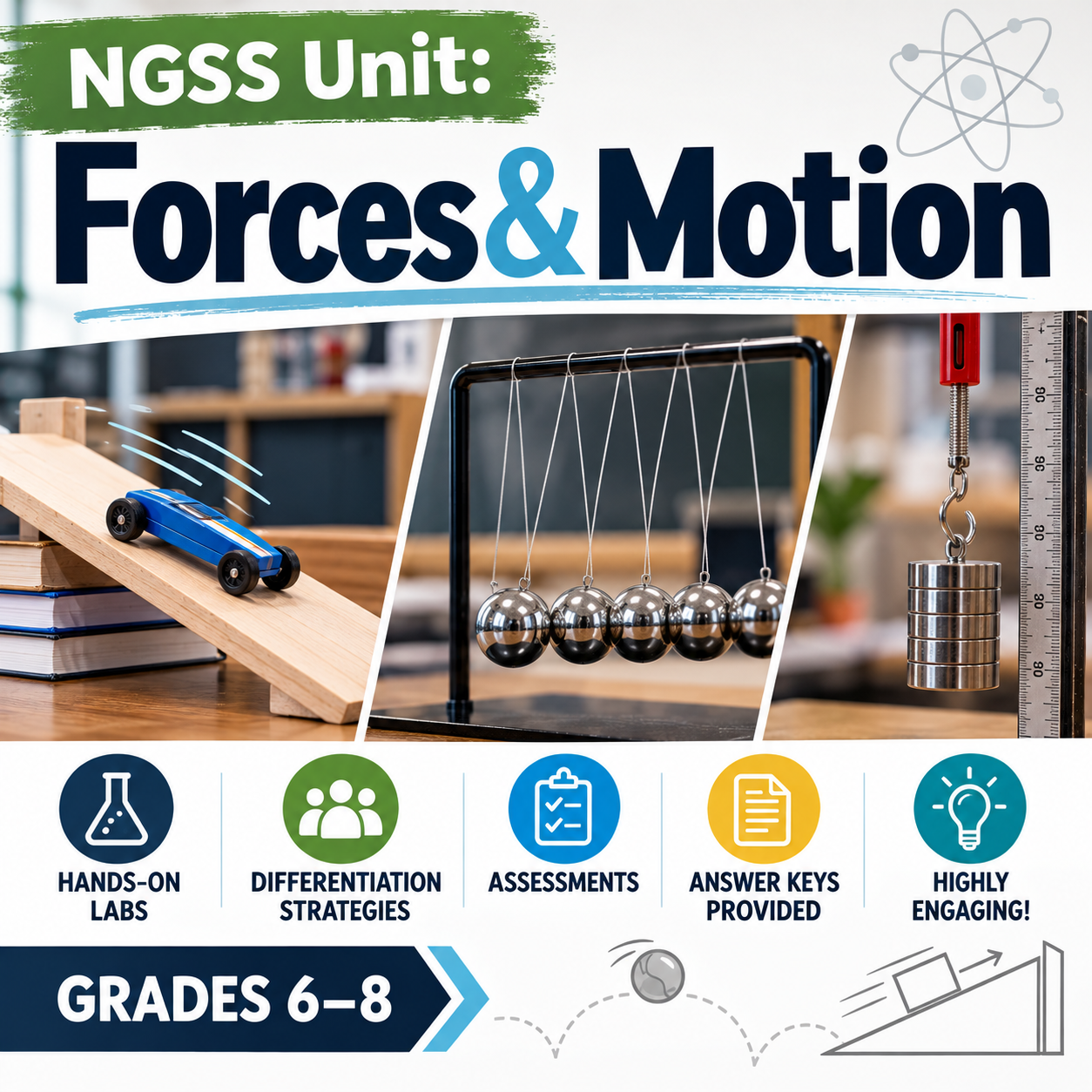
Forces & Motion: Investigating Interactions and Collisions
Grades 6–8 • NGSS-aligned • 15 lessons + end-of-unit assessment
How do forces and mass affect the motion and interactions of objects? In this hands-on unit, middle school students answer that question through labs, stations and an engineering challenge. They start with simple pushes and pulls and finish by designing a safer collision and defending the design with evidence.
What Students Do
- Lessons 1–3: Explore forces, balanced and unbalanced forces, and inertia (Newton's First Law) through stations and a tug-of-war mini lab.
- Lessons 4–8: Investigate how force and mass change motion (Newton's Second Law) with a rubber-band launcher lab. Students then plan their own controlled investigation, carry it out, analyze the data and graph the results.
- Lessons 9–12: Discover Newton's Third Law with balloon rockets and action–reaction stations, then run and analyze cart collision experiments.
- Lessons 13–15: Take on an engineering design challenge: build a barrier that protects a "passenger" during a collision, then test it, improve it, and explain the results in a Claim–Evidence–Reasoning (CER) write-up.
Standards
- MS-PS2-1: Apply Newton's Third Law to design a solution to a problem involving two colliding objects
- MS-PS2-2: Plan an investigation showing that the change in an object's motion depends on the sum of the forces on it and its mass
- Engineering connections: MS-ETS1-1, MS-ETS1-3 and MS-ETS1-4
- Every lesson lists its disciplinary core idea, science and engineering practice, and crosscutting concept. Content stays within NGSS limits: comparisons of force, mass and motion are qualitative, motion is in one dimension, and students change one variable at a time.
Built-In Differentiation
Every lesson includes a Differentiation Menu with options for:
- English learners: visuals, sentence frames, word banks, partner rehearsal, and credit for labeled diagrams
- Neurodivergent learners: predictable routines, visual timers, lab role cards, chunked tasks, warnings before noisy moments, and choice in how to respond
- Advanced, gifted and honors students: extensions that go deeper into the same standards, such as designing extra conditions, quantifying results, analyzing sources of error, and defending claims against counter-arguments
What's Included
- Teacher Guide: unit storyline, standards tables, routines, and a one- to two-page plan for each lesson. Each plan has a timed lesson flow, "Listen for" signs of understanding, common misconceptions with quick fixes, and a differentiation menu.
- Student Notes for all 15 lessons, with the Engineering Design and CER rubrics included
- Exit tickets for Lessons 1–14 (printed 3 per page)
- End-of-unit written assessment (27 points, about 40 minutes)
- Answer keys for student notes, the assessment, and exit tickets (with sample responses at three levels)
- Printable station cards for Lessons 1, 3 and 10
- Materials list for the whole unit, using inexpensive, reusable classroom supplies
Pacing
15 lessons of about 65 minutes each, roughly 16 class days including the assessment. With 45-minute periods, plan about 23 days.
Continue Building on This Resource
- Newton's Laws Lab Bundle + Friction: 4 Hands-On Investigations
Four additional hands-on, NGSS-aligned labs that give students more chances to predict, test, collect evidence and explain. Each fits a specific point in this unit:
- Tablecloth Pull Challenge (Newton's First Law): after Lesson 3, as a new inertia phenomenon
- Rubber Band Launch (Newton's Second Law): with Lessons 4–5, or as review before Lessons 6–8
- Balloon Hover Disc (Newton's Third Law): with Lessons 9–10, as a vertical force-pair example to compare with the balloon rocket
- Sliding Surface Lab (friction): after Lesson 3, to answer "What makes a rolling ball stop?", or as an extension after Lesson 6
Each lab includes a teacher guide, a student lab sheet, an answer key with CER examples, and differentiation for diverse learners. It's a good fit for teachers who want more lab time without creating new investigations from scratch.
- Forces and Motion CER Practice (Free)
Short forces-and-motion scenarios that give students structured practice writing Claim–Evidence–Reasoning responses:
- a guided example, independent practice, a real-world application, and a Newton's Third Law challenge
- standard and modified versions, so the whole class can work on the same scenarios
- two answer keys with examples at three levels
Use it after Lesson 10, or just before the Lesson 15 CER presentation, to strengthen students' written explanations.
Questions or feedback? Contact NextWave Science at nextwavescience@gmail.com. If this resource was helpful in your classroom, a review is always appreciated.