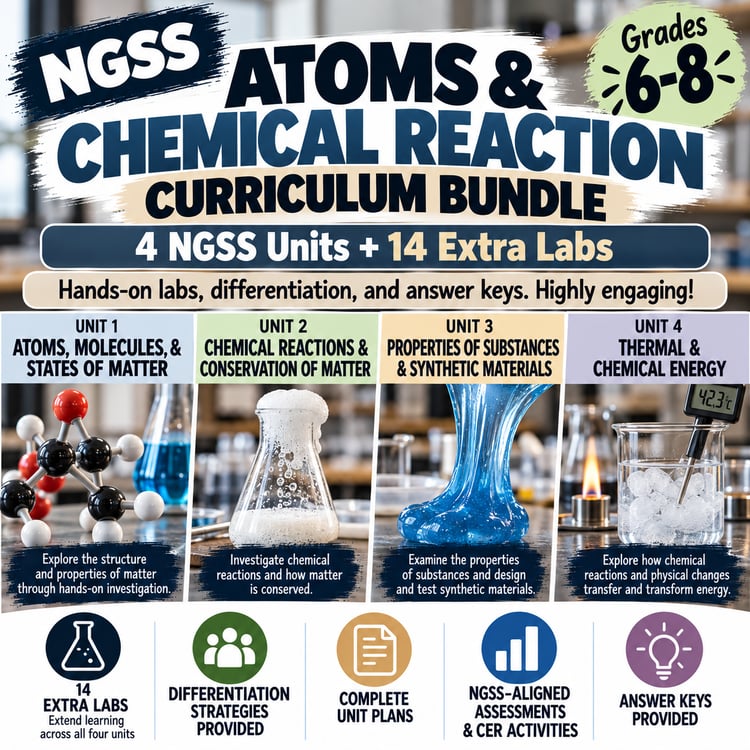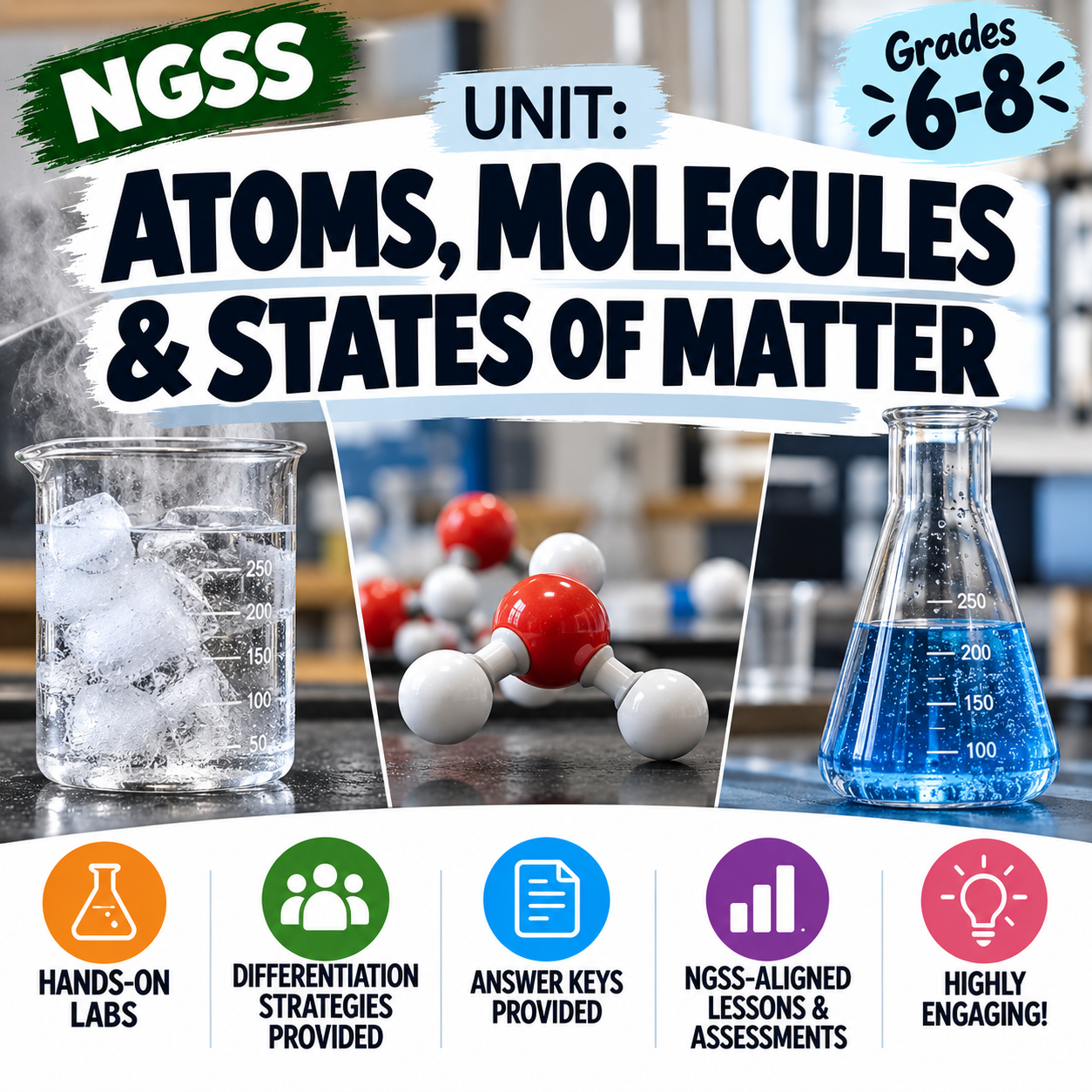
MS: NGSS - Unit: Atoms, Molecules & States of Matter
What is matter made of, and what happens to its particles when it heats up or cools down? In this hands-on unit, students in grades 6–8 find out by building and testing models. They build atoms, molecules, and extended structures like salt, diamond, and graphite, and test how a material's structure affects its properties. Then they use particle models to explain solids, liquids, gases, state changes, gas pressure, and heating and cooling curves, and explain their results using Claim–Evidence–Reasoning (CER).
The unit includes two performance tasks. In the first, students build and explain a labeled model of a substance. In the second, they graph a heating or cooling curve and model what happens to the particles at each state change.
Aligned to NGSS
- MS-PS1-1: Develop models to describe the atomic composition of simple molecules and extended structures
- MS-PS1-4: Develop a model that predicts and describes changes in particle motion, temperature, and state of a pure substance when thermal energy is added or removed
- Includes the matching disciplinary core ideas, science and engineering practices, and crosscutting concepts, with a standards-by-lesson table
What's Included
- Teacher Guide (36 pages). Each of the 15 lessons includes an objective, materials and prep, a timed lesson flow, "Listen for" signs of understanding, key science background for the teacher, "Watch for" common misconceptions with quick fixes, a differentiation menu, and an exit ticket.
- Student Notes for Lessons 1–7 and 9–14
- Two Performance Tasks (Lessons 8 and 15), each with a 32-point rubric
- 13 Exit Tickets, printed 3 per page
- End-of-Unit Assessment (80 points): classifying matter, analyzing lab data, particle models, heating curves, a gas-pressure case study, and a CER
- Answer Keys for the student notes, performance tasks, exit tickets, and assessment, including CER examples at multiple levels
- Read Me First guide with pacing and a full materials list
Lesson Sequence
- Introduction to Matter & Atoms
- Elements vs. Molecules vs. Compounds
- Building Simple Molecules
- Extended Structures
- Comparing Molecular Structures
- Modeling Matter
- Molecular Properties Investigation
- Performance Task + CER
- States of Matter Introduction
- Particle Motion & Energy
- Thermal Energy Investigation
- States of Matter Modeling
- Gas Behavior Investigation
- Heating & Cooling Curve Investigation
- Performance Task: Modeling State Changes
Differentiation Built In
Every lesson includes options for:
- ELL / multilingual learners: picture word walls, sentence frames, oral rehearsal, and labeled models accepted as evidence
- Neurodivergent learners: visual timers, clear group roles, chunked stations with check-offs, and pre-drawn particle templates
- Advanced / gifted & honors students: model critiques, structure comparisons, data graphing, and rebuttals that go deeper without leaving the standards
Pacing: 15 lessons of about 65 minutes each, plus an assessment day (about 16 class days). Using 45-minute periods? Teach each lesson over two days.
Materials: Uses simple, inexpensive supplies you can reuse across lessons: marshmallows or gumdrops, toothpicks, clay, beads, salt, sugar, pencil lead, foil, balloons, capped syringes, thermometers, ice, and food coloring.
Make It Even Better: Pair It With These
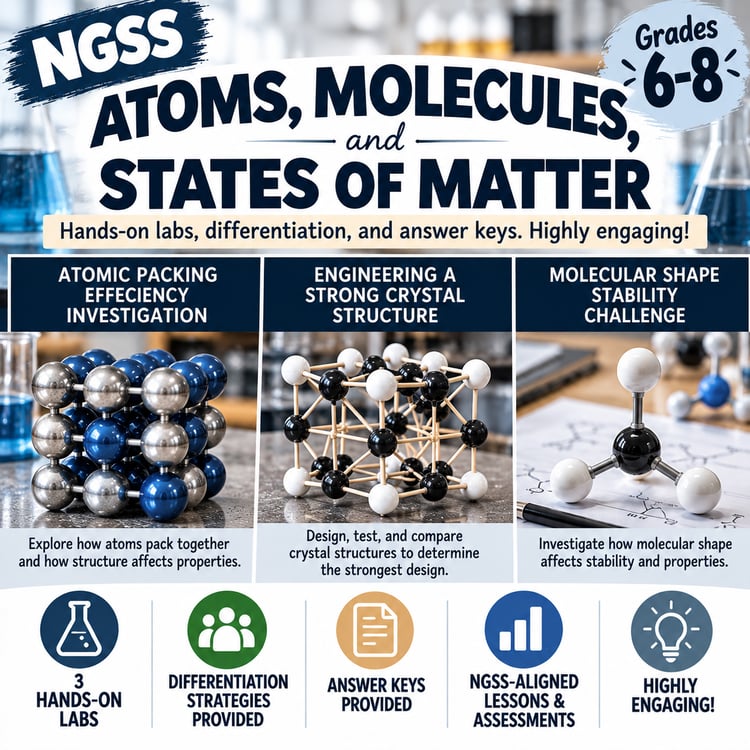
- Atoms, Molecules, and States of Matter Lab Bundle. Three hands-on labs that extend the unit:
- Atomic Packing Efficiency Investigation: build and compare random, row, and layered particle arrangements to see how arrangement affects empty space, organization, and stability
- Engineering a Strong Crystal Structure: build two repeating crystal-like structures and test which arrangement holds the most weight
- Molecular Shape Stability Challenge: build chain and triangle models from the same pieces, and test how atom arrangement affects stability
Each lab includes a teacher guide, a student lab sheet, an answer key with CER examples, and differentiation for diverse learners.
Questions or feedback? Contact NextWave Science at nextwavescience@gmail.com. If this resource was helpful in your classroom, a review is always appreciated.