MS: NGSS - Waves, Light & Sound Lab Bundle
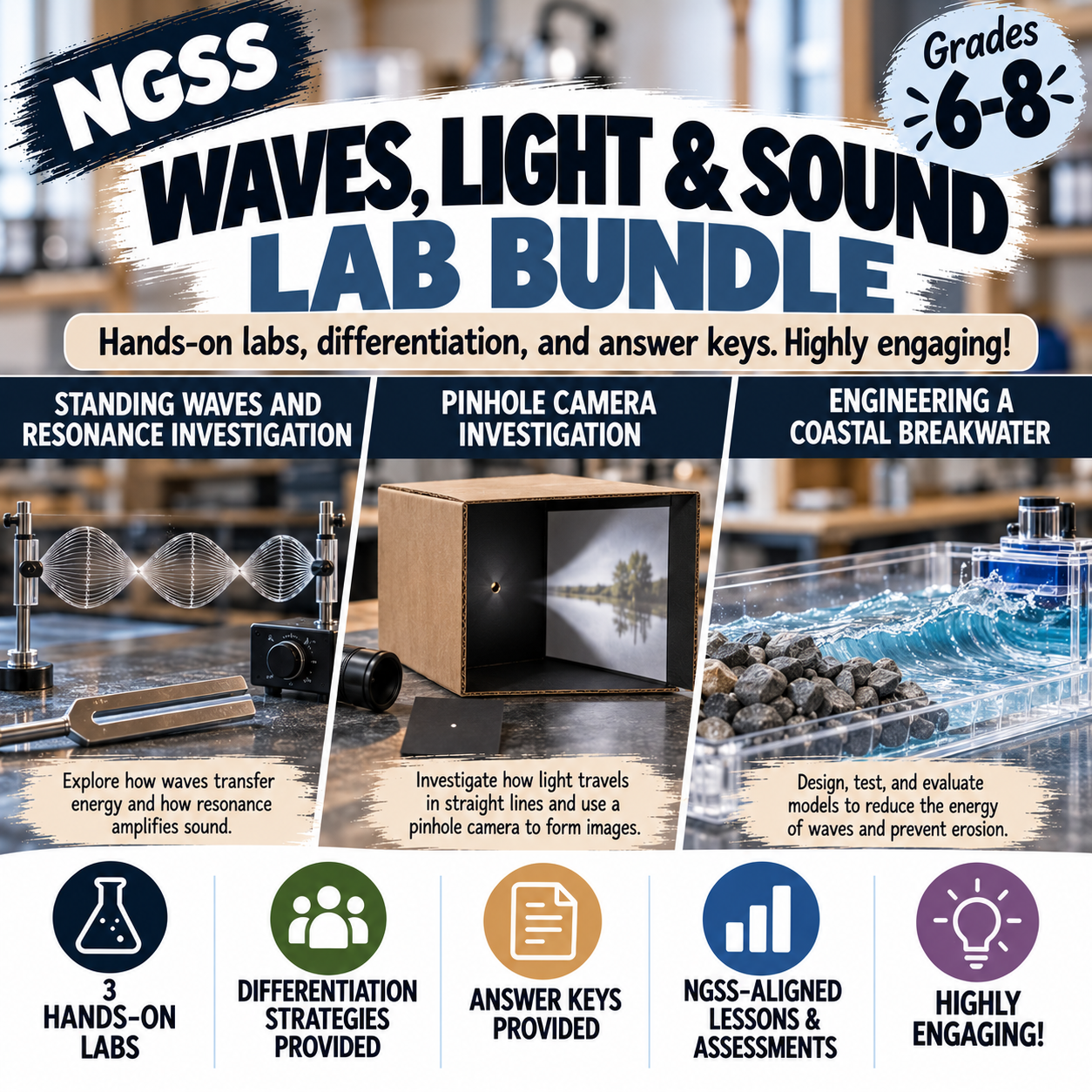
Waves, Light & Sound Lab Bundle: 3 Hands-On Extension Labs
Grades 6–8 • NGSS-aligned • 3 labs, about 50 minutes each
Why do only some rhythms make a wave grow? How can a box with a tiny hole and no lens make a picture? How do engineers protect a coastline from wave energy? In these three hands-on labs, middle school students predict, test, collect evidence, and explain ideas that go beyond a typical waves unit. Each lab covers a different kind of science work: a measuring investigation, a model-building lab, and an engineering design challenge.
The Labs
- Standing Waves and Resonance Investigation (MS-PS4-1)
- Students shake a stretched Slinky at different rhythms to find the special frequencies that make steady standing waves with 1, 2, and 3 loops.
- They count shakes, calculate the frequency and wavelength of each pattern, and find that wavelength × frequency stays about the same.
- They discover why a rhythm in between makes a messy wave.
- They explain resonance, and why matching a natural frequency makes a wave grow bigger and carry more energy, with real-world links to guitar strings, swings, and bridges.
- Pinhole Camera Investigation (MS-PS4-2)
- Students build a pinhole camera from a box or nested tubes, foil, and wax paper, then use a ray model to explain why the image of a lit arrow is upside down and reversed.
- They measure the image at three camera lengths and find that it doubles when the camera length doubles.
- They test three hole sizes to discover the trade-off between a bright image and a sharp one, and connect the pinhole to the pupil of the eye.
- Engineering a Coastal Breakwater (MS-PS4-2, with MS-PS4-1 and engineering connections)
- Students build a wave tank and test five barriers: no barrier, solid wall, sponge, gravel bag, and slatted fence. They measure wave height at the "shore" and rate the waves that bounce back toward the boat channel.
- Using their data, they design, test, and improve their own breakwater. It must keep shore waves at 5 mm or less without sending large waves back toward boats.
- Along the way, they discover that solid walls reflect wave energy while rough, porous materials absorb it.
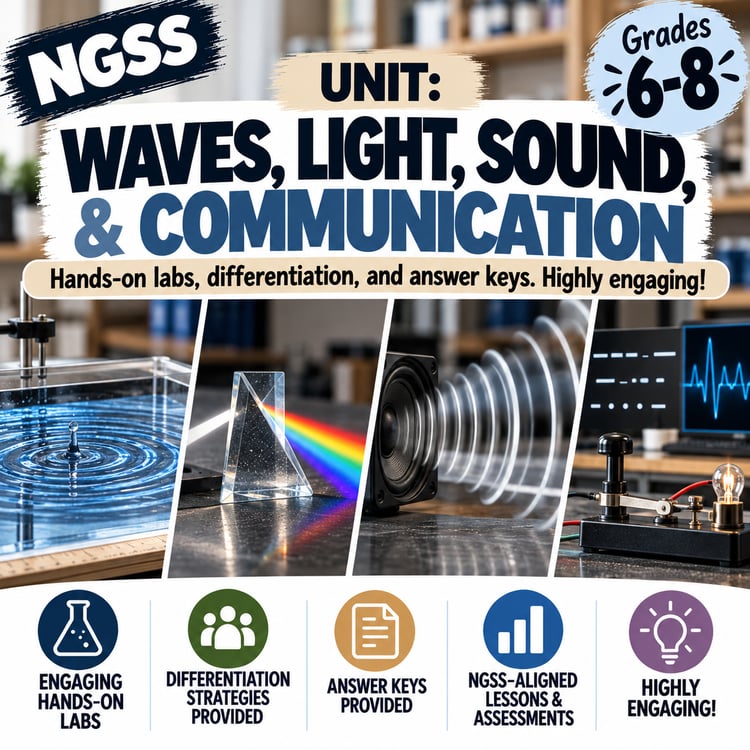
Pairs With: Waves, Light, Sound, & Communication Unit
Each lab covers new ideas that the unit doesn't teach: standing waves and resonance, how a pinhole forms an image, and barriers for water waves. Each one is built to fit a specific point in the unit and reuses its vocabulary and routines:
- Standing Waves and Resonance: after Lesson 5 (Patterns in Wave Data), using the same Slinky setup and 2 m/s wave speed from Lessons 3–5. It also works as a bridge into Lesson 7 (Pitch & Loudness).
- Pinhole Camera: after Lesson 9 (Light Travels & Reflects) and before Lesson 11 (Refraction), so students can later compare a pinhole image with an image made by a lens.
- Engineering a Coastal Breakwater: after Lesson 8 (Sound: Reflected, Absorbed, or Transmitted), applying the same three behaviors to water waves. It also links to Lesson 4 (Amplitude & Energy) and works as a warm-up for the Lesson 16 engineering performance task.
The labs also stand alone and work in any middle school waves unit, as review, enrichment, sub-friendly lab days, or early-finisher extensions.
Standards
- MS-PS4-1: Use mathematical representations to describe a simple model for waves that includes how the amplitude of a wave is related to the energy in a wave
- MS-PS4-2: Develop and use a model to describe that waves are reflected, absorbed, or transmitted through various materials
- Engineering connections: MS-ETS1-1 and MS-ETS1-3 (Coastal Breakwater)
- Each Teacher Guide includes a standards table listing the disciplinary core idea, science and engineering practices, and crosscutting concepts, along with a "Staying Within the NGSS" note. Content stays within NGSS limits: no harmonic or lens formulas, no energy calculations in joules, and light and water-wave interactions stay qualitative.
Built-In Differentiation
Every lab includes a Differentiation section with options for:
- English learners: picture word banks, gestures, sentence frames, CER frames, and credit for labeled sketches as evidence
- Neurodivergent learners: lab role cards, visual step cards, a predictable build → test → record routine, short table answers, and the option to jigsaw the lab
- Advanced, gifted, and honors students: an Honors Extension page on every lab sheet that goes deeper into the same standard, such as predicting new results from a pattern, explaining real-world resonance, comparing the pinhole to the human eye, or weighing design trade-offs
Each Teacher Guide also explains how to differentiate within the NGSS. Every student works toward the same performance expectation; differentiation changes how students get there, not the standard.
What's Included (for each lab)
- Teacher Guide (4 pages): what the lab does, when to use it, materials, prep, a timed lesson flow, "Listen for" signs of understanding, common misconceptions with quick fixes, differentiation, a CER scoring guide, and standards alignment
- Student Lab Sheet (6 pages): demo observations, Think Like a Scientist questions, key vocabulary, notes, a step-by-step investigation with sketch boxes, a data table, analysis questions, Patterns We Noticed, a CER, a reflection, an Honors Extension, and an exit ticket
- Answer Key (5 pages): model answers, sample data, "Sketch should show" guidance, and CER examples at three levels (Meets / Approaching / Needs Development)
- Terms of Use
Materials
Inexpensive, reusable classroom supplies:
- Standing Waves: Slinky (or elastic cord), masking tape, meterstick, timer; optional metronome app
- Pinhole Camera: shoebox or two nested tubes, aluminum foil, wax paper, pushpin, flashlight, and a card with an arrow cut out
- Coastal Breakwater: clear plastic storage bin, water, a ruler or block as the wave maker, sand or a towel for the beach, a ruler, sponge, gravel in a mesh bag, craft sticks, and a block
Pacing
Each lab takes about 50 minutes. Short on time (30–35 minutes)? Each Teacher Guide explains how to jigsaw the lab so groups share data, with the Reflection moved to homework.
Terms of Use
This purchase is for single-classroom use only. Please do not share, post, or distribute this resource. If colleagues would like to use it, additional licenses are available at a discount. See the included Terms of Use for full details.
Questions or feedback? Contact NextWave Science at nextwavescience@gmail.com. If this resource was helpful in your classroom, a review is always appreciated.