MS: NGSS - Gravity and Gravitational Forces (3 Labs)
Gravity & Gravitational Forces Lab Bundle | 3 Hands-On Labs | NGSS Middle School (MS-PS2-4, MS-ESS1-2, MS-PS3-1, MS-PS2-2, MS-ETS1)
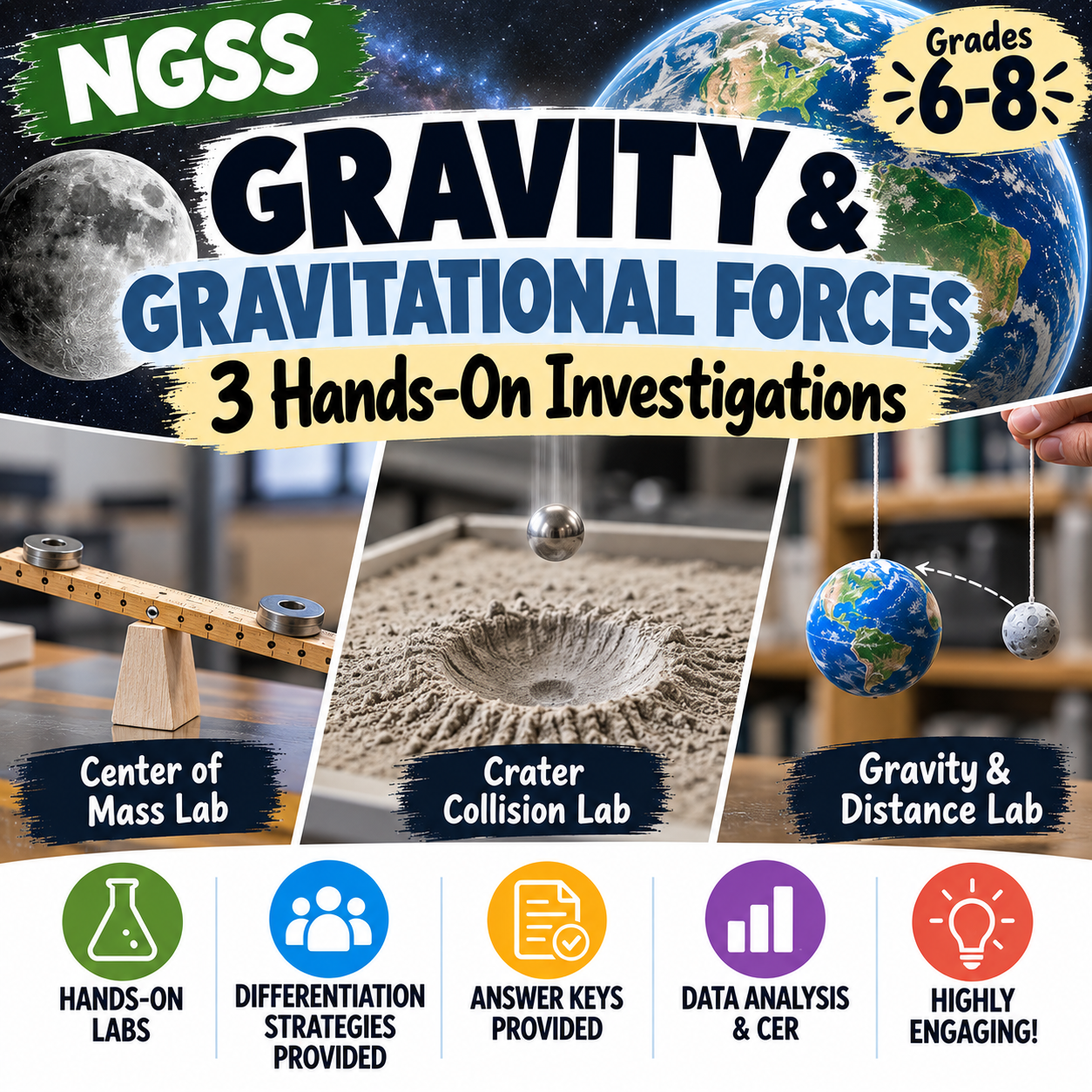
Why do some towers tip over while others stand tall? What makes a bigger crater? How does gravity keep the planets in orbit? These three ready-to-teach labs for grades 6–8 let students investigate gravity with their own hands and their own data. Each lab uses inexpensive materials and builds the same core skills: planning a fair test, collecting data across repeated trials, analyzing patterns, and writing a Claim–Evidence–Reasoning (CER) explanation. Each lab takes about 50 minutes.
What's Inside
- Center of Mass Challenge: What Makes Things Tip Over?
Students find the balance point of a ruler and watch it shift as they add washers. Then they measure how far a cup tower can tilt with a clay ball placed low, in the middle, or high. Finally, they redesign the tower to survive the biggest tilt. They discover that a low center of mass over a wide base is hardest to tip.
- Crater Collision Investigation: What Makes a Bigger Crater?
Students drop a ping-pong ball and a golf ball (same size, different mass) into a flour tray. Then they drop the golf ball from four heights, measure the crater widths, and graph the results. They find that more mass and more speed mean more kinetic energy and a bigger crater, and they connect their results to craters on the Moon.
- Gravity and Distance Lab: Does Gravity Get Weaker?
Students whirl a stopper on a string, using hanging washers to stand in for the Sun's pull, and time how fast it orbits. Then they graph real NASA planet data. Putting the two together, they argue from evidence that gravity weakens with distance but never reaches zero.
Each Lab Includes
- Teacher Guide (4 pages): materials and prep, a timed lesson flow, "Listen for" signs of understanding, "Watch for" common misconceptions with quick fixes, a differentiation menu, a CER scoring guide, and a full NGSS alignment page
- Student Lab Sheet: key vocabulary, Observe & Predict, safety, background, setup diagrams, Plan a Fair Test, procedure, data tables, graphs, analysis questions, a CER with sentence starters, and an optional Honors Extension
- Answer Key: sample data, completed graphs, answers, and CER examples at three levels (Meets, Approaching, and Needs Development)
Differentiation Built In
- ELL / multilingual learners: pre-teaching with real objects and gestures, labeled diagrams, sentence frames, and a Key Vocabulary table
- Neurodivergent learners: role cards, visual step cards, sensory-friendly options, and typed or dictated CERs
- Honors / gifted students: Honors Extensions with evaluating claims, comparing energy, analyzing NASA data patterns, and design-your-own tests
Aligned to NGSS
- MS-PS2-4: gravitational interactions are attractive and depend on mass
- MS-ESS1-2: gravity's role in motions within the solar system
- MS-PS3-1: kinetic energy depends on mass and speed
- MS-PS2-2: balanced and unbalanced forces
- MS-ETS1-1 to 4: engineering design in the Center of Mass Challenge
- Practices and concepts: developing models, analyzing data, arguing from evidence, systems, stability and change, cause and effect
Simple Materials
Rulers, washers, paper cups, craft sticks, clay, flour, cocoa powder, a ping-pong ball and a golf ball, rubber stoppers, string, a stopwatch, and other classroom basics.
Pair It With the Unit Plan
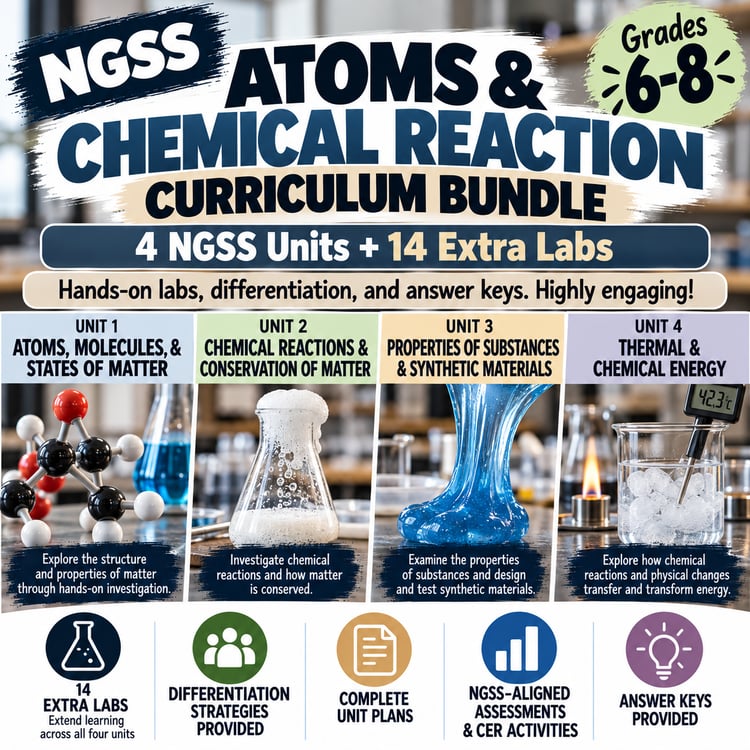
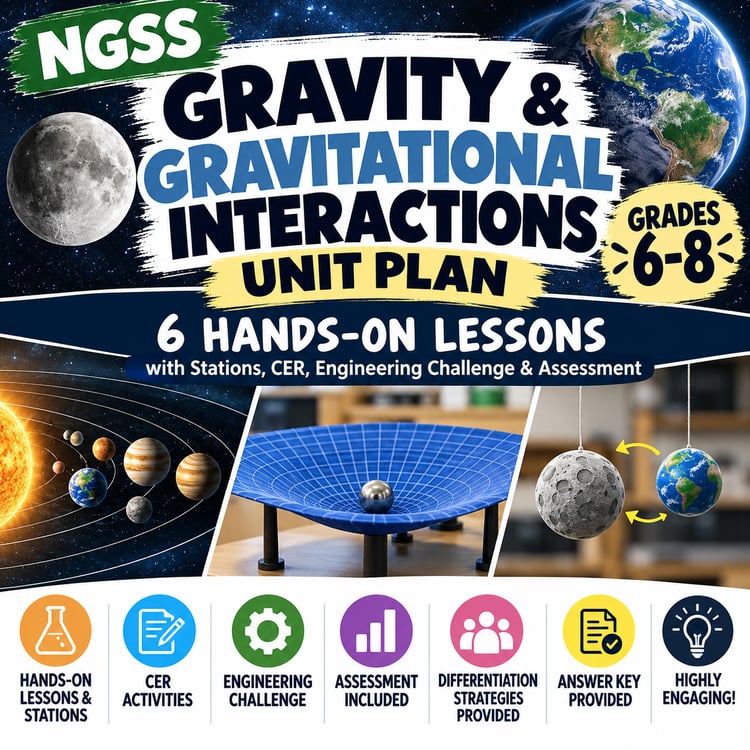
This bundle is designed to work alongside the Gravity & Gravitational Interactions Unit Plan, a complete 6-lesson NGSS unit with a teacher guide, student notes, station cards, exit tickets, an end-of-unit assessment, and answer keys. The labs slot right in:
- the Crater Collision Investigation with Lesson 2 (gravity and mass)
- the Gravity and Distance Lab with Lesson 4 (evidence for gravitational interactions)
- the Center of Mass Challenge with Lesson 6 (the engineering challenge)
Together, the unit and the lab bundle give students more hands-on data, more practice planning fair tests, and more chances to explain their results with evidence.
Terms of Use: This resource is for single-classroom use. Please purchase additional licenses for colleagues.