MS: NGSS Thermal Energy & Chemical Design Lab Bundle
Thermal Energy & Chemical Design Lab Bundle | NGSS MS-PS1-6 | Grades 6–8
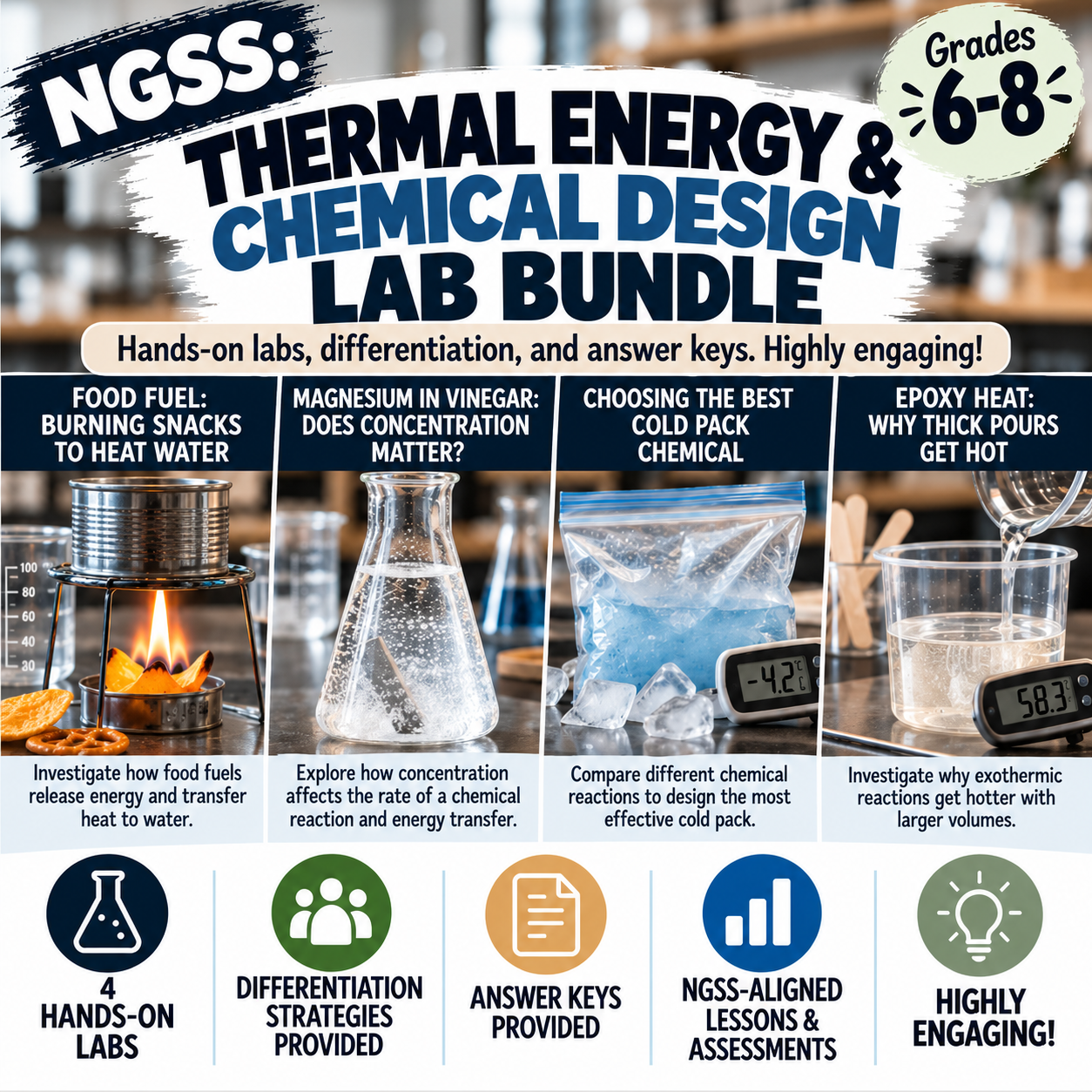
Can a cheese puff boil water? Why does stronger vinegar make magnesium heat up faster? Why would a company put fertilizer in a cold pack? And why can a thick pour of epoxy glue get hot enough to smoke? This bundle of four hands-on labs gives students new phenomena that release or absorb thermal energy. Each one puts students in the role of engineers who test a design, look at the data, and make it better.
What's Included
Four complete labs, each in its own folder, with:
- Teacher Guide (4 pages): what the lab does, when to use it, materials and prep, lesson flow, "Listen for," misconceptions with quick fixes, a differentiation menu, a CER scoring guide, standards alignment, and "Staying Within the NGSS" notes
- Student Lab Sheet (6 pages): background, vocabulary, a prediction, a design rule and safety notes, the procedure with sketch boxes, data tables, reference data, analysis with an energy flow model, higher-order thinking, an optional challenge, a CER, and an exit ticket
- Answer Key (4 pages): sample data, model answers, and CER examples at three levels (Meets, Approaching, Needs Development), each with ready-to-use feedback for students
The Labs
- Food Fuel: Burning Snacks to Heat Water. Students burn a cheese puff under a can of water and measure how much the water warms. Then they redesign the heater with a foil chimney and test it again. Key idea: combustion releases thermal energy, but most of it escapes unless the device is designed to capture it.
- Magnesium in Vinegar: Does Concentration Matter? Students drop magnesium ribbon into 100%, 50%, and 25% vinegar, plus a water control. Key idea: the concentration of a reactant changes how much thermal energy is released and how fast. Students connect their results to the self-heating meal packs used by soldiers and campers.
- Choosing the Best Cold Pack Chemical. Students test four new substances (urea, potassium chloride, Epsom salt, and sodium thiosulfate). Then they score each one for temperature, cost, and safety in a weighted decision matrix. Key idea: engineers weigh trade-offs, because no chemical is best on every criterion.
- Epoxy Heat: Why Thick Pours Get Hot. Students mix small batches of 5-minute epoxy in cups and spread one batch thin, tracking the temperature with an infrared thermometer. Key idea: the amount of a substance controls how much energy is released, and the shape controls how fast it escapes. Students use their data to design a safer pour.
Each lab takes about 50 minutes. Each one uses a different chemical process and focuses on a different design factor, so the labs never repeat one another.
Differentiation for Every Learner
Every student works toward the same standard (MS-PS1-6). The supports change how students get there, not what they're held to. Every Teacher Guide includes a differentiation menu and a "How to Differentiate Within the NGSS" section.
- ELL / Multilingual Learners: word banks, picture cards, sentence frames, and color-coded materials. Students can show what they know with labeled sketches, graphs, and a completed decision matrix, and are scored on the science idea, not English grammar.
- Neurodivergent Learners: role cards (measurer, timer, reader, recorder), step cards with check boxes, pre-measured materials, pre-filled time columns, and the option to type or dictate the CER. Always follow IEPs and 504 plans.
- Advanced / Honors: go deeper, not further ahead. Students test a third design, compare graph slopes, test surface area, write their own decision-matrix weights, or plan an epoxy pour that stays under a set temperature, all without energy calculations.
Why Teachers Love It
- Fresh phenomena that don't repeat the cold packs, hand warmers, or insulation labs from the unit
- Real-world connections: camp stoves, self-heating meal packs, store-bought cold packs, and resin tables
- Stays within the NGSS: students measure amount, time, and temperature only
- Ready-to-use CER scoring guides and sample answers at three levels
Standards: MS-PS1-6; PS1.B; ETS1.B; ETS1.C; SEP Constructing Explanations and Designing Solutions; CCC Energy and Matter
Pair It With the Full Unit!
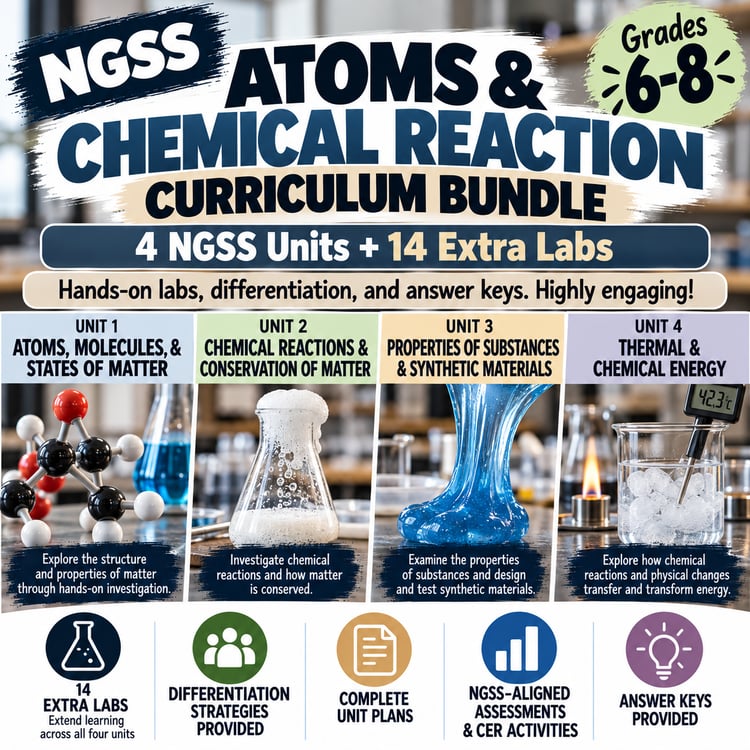
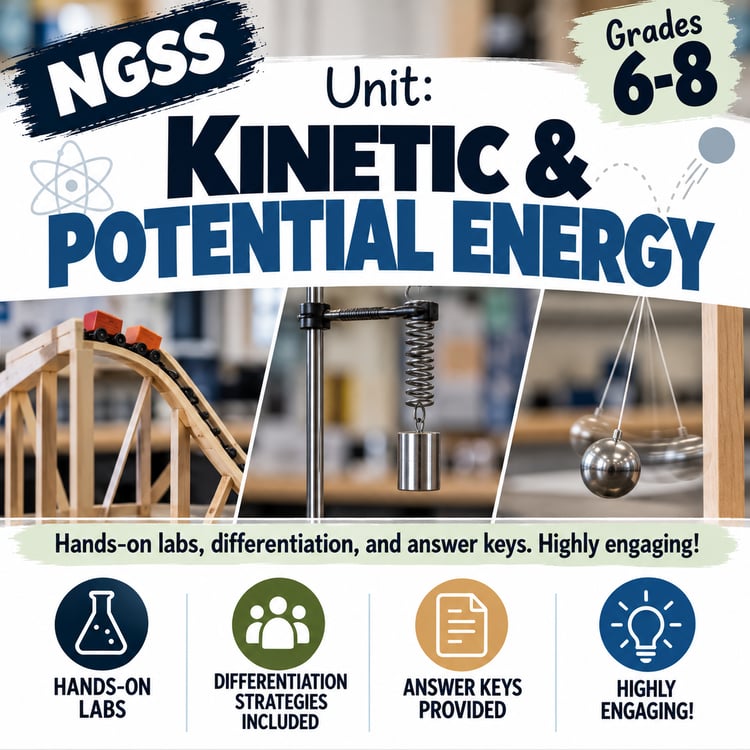
These labs were designed to go with the Thermal & Chemical Energy Unit, a 7-lesson NGSS unit. The unit includes a 20-page Teacher Guide, Student Notes, Exit Tickets, a design performance task, a 60-point End-of-Unit Assessment, and full answer keys. Each lab's Teacher Guide shows where it fits:
- Food Fuel: after Lesson 2 (Energy-Releasing Processes) or Lesson 5 (Controlling Energy Transfer)
- Magnesium in Vinegar: after Lesson 4 (Changing the Temperature: Variables)
- Choosing the Best Cold Pack Chemical: after Lesson 3 (Energy-Absorbing Processes) or just before the Lesson 7 Performance Task
- Epoxy Heat: after Lesson 5 (Controlling Energy Transfer)
Together, the unit and the bundle give students a complete MS-PS1-6 experience with more chances to design, test, and improve.
Terms of Use
This purchase is for single-classroom use only. Please do not share, post, or distribute this resource. If colleagues would like to use it, additional licenses are available at a discount. See the included Terms of Use for full details.
Questions?
If you have questions or need support with this resource, please contact NextWave Science at nextwavescience@gmail.com. Thank you for bringing hands-on science into your classroom!