MS: NGSS - Energy Transfer & Conservation Lab Bundle
Energy Transfer Lab Bundle | 3 Hands-On Bonus Labs | NGSS MS-PS3-5 | Grades 6–8
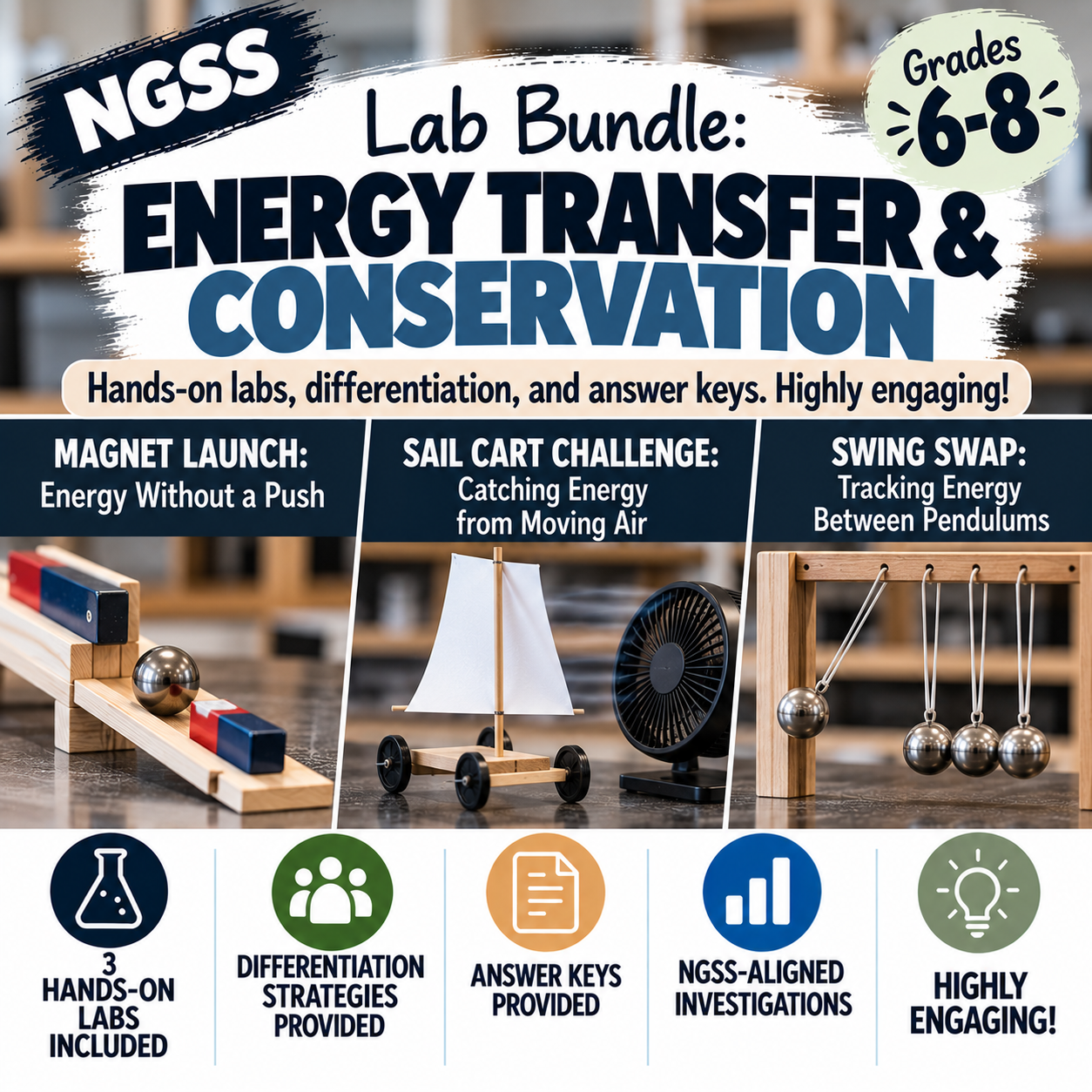
Can a magnet launch a ball without a push? Can air you can't even see move a cart? When a swinging pendulum stops, where does its energy go? This bundle of three hands-on labs helps students see that whenever an object speeds up or slows down, energy is transferred to or from it, and it is never simply "used up."
Each lab tackles a different common misconception, so students get something new from every investigation:
- Magnet Launch: Energy Without a Push
Students build a simple magnetic launcher on a grooved ruler. A slow steel ball rolls toward a magnet, and a different ball shoots off the far side. Students compare launches with 0, 1, and 2 magnet stages and measure how far the launched ball rolls. They discover that energy stored in a magnetic field can be transferred without any contact. Then they find out why the launcher still isn't "free energy": resetting it means pulling the stuck ball off the magnet.
Focus: energy transfer at a distance through a field.
- Sail Cart Challenge: Catching Energy from Moving Air
Is air really "nothing"? Students attach small, medium, and large sails to a toy cart and measure how far a fan pushes it. A simple tissue-paper strip held in front of and behind the sail shows that the air slows down as the cart speeds up. Students connect their results to sailboats and wind turbines.
Focus: tracking energy as it moves from something invisible to a moving object.
- Swing Swap: Tracking Energy Between Pendulums
Students hang two pendulums from one string stretched between two chairs. As the first pendulum slows almost to a stop, the second one, which no one touched, starts swinging wider. Then the swing passes back. Students compare matched and unmatched pendulum lengths and record both swings every 10 seconds. It's powerful proof that a stopped object's energy isn't gone.
Focus: correcting the idea that energy is used up when something stops.
Each lab includes:
- Teacher Guide (4 pages):
- lesson flow with timings
- materials and prep list
- "Listen for" student talk and common misconceptions with quick fixes
- differentiation for ELL/multilingual, neurodivergent, and advanced learners
- a CER scoring guide
- standards alignment
- Student Lab Sheet (4 pages):
- prediction
- fair-test plan
- data tables with repeated trials
- observations and analysis questions
- an energy-transfer diagram to label
- CER
- optional Honors Extension with rate-of-change questions
- Answer Key (3 pages): sample data and answers, plus CER examples at three levels (Meets, Approaching, Needs Development), each with a note explaining the score
Each lab takes about 55 minutes and uses inexpensive, easy-to-find materials like marbles and steel balls, a desk fan, cardstock, string, washers, and two classroom chairs.
Pairs Perfectly With the Energy Transfer & Conservation Unit!
These labs were designed as extensions for the 6-lesson Energy Transfer & Conservation Unit. In that unit, students:
- trace where motion goes at energy-change stations
- show that energy passes from one object to another in a ramp-and-cup lab
- measure temperature changes as friction turns motion into thermal energy
- build an energy inventory for a bouncing ball and graph their data
- gather collision evidence and write rebuttals to the claim that energy is "used up"
- finish by writing and presenting their own evidence-based argument
Each bonus lab's Teacher Guide shows exactly where it fits:
- Magnet Launch: after Lesson 2 or alongside Lesson 5
- Sail Cart Challenge: after Lesson 2
- Swing Swap: after Lesson 4 or alongside Lesson 5
The labs also work on their own for any middle school energy or physical science lesson.
Terms of Use
This purchase is for single-classroom use only. Please do not share, post, or distribute this resource. If colleagues would like to use it, additional licenses are available at a discount. See the included Terms of Use for full details.
Questions or Concerns?
I want you to love this resource! If you have any questions, run into an issue, or need support, please contact me at nextwavescience@gmail.com before leaving a review. I'm happy to help.