MS: NGSS - Thermal Energy & Heat Transfer Lab Bundle
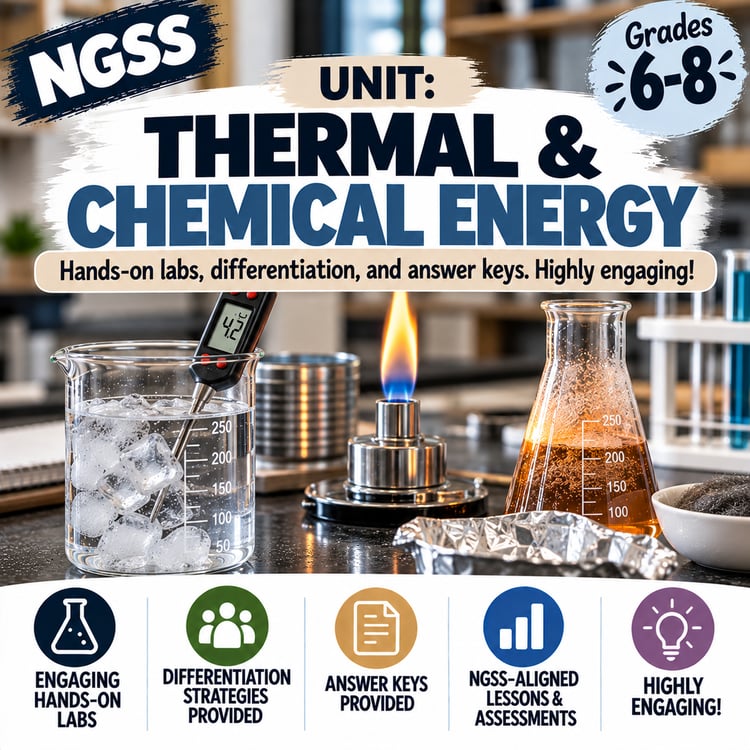
Heat Transfer Lab Bundle: Conduction, Convection, Radiation & Insulation | NGSS MS-PS3-3 & MS-PS3-4 | Grades 6–8
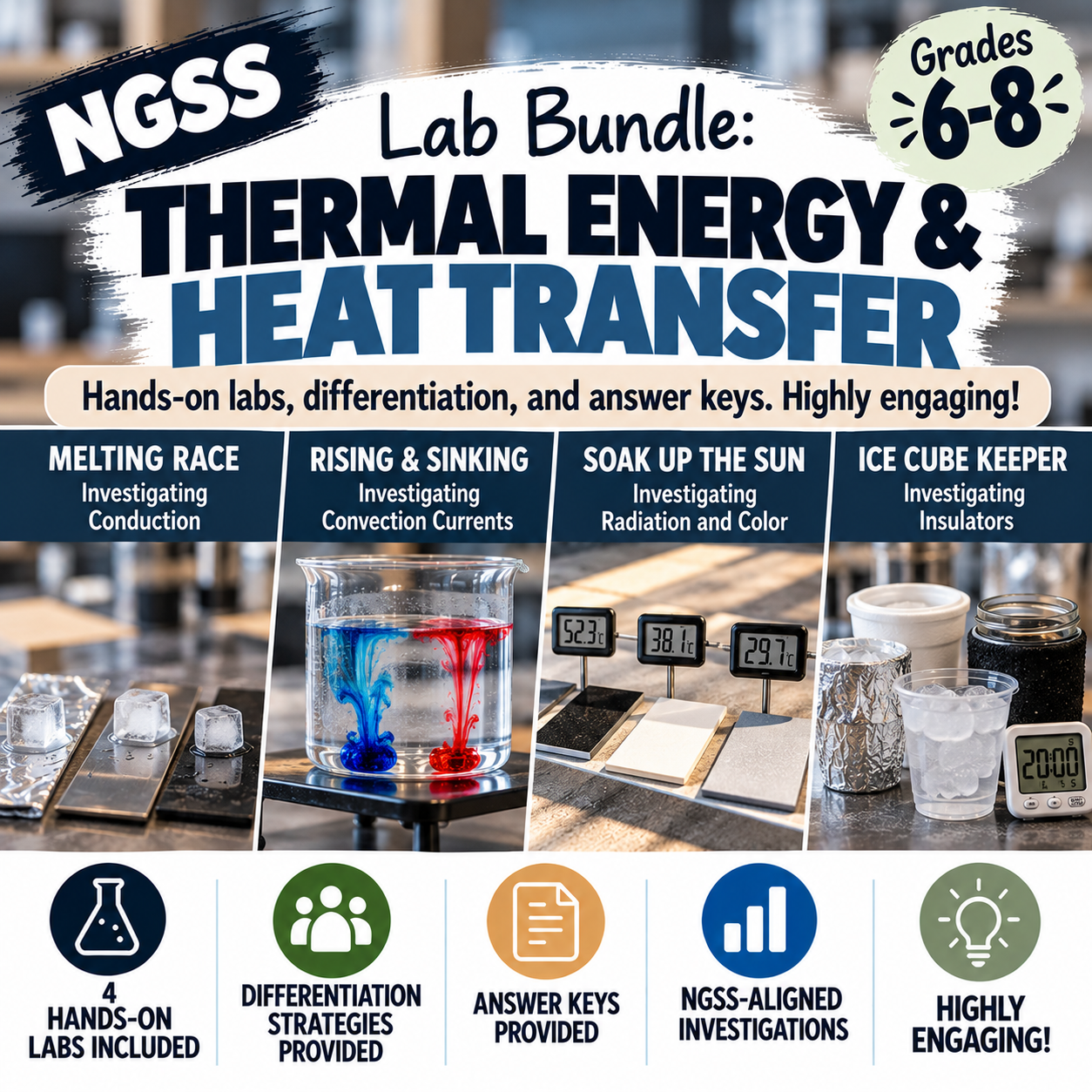
Why does a metal spoon in hot soup burn your fingers when a wooden one doesn't? Why does hot water rise and cold water sink? Why do people wear light colors in summer? And which wrapping keeps an ice cube frozen the longest? This bundle of four hands-on labs gives students a full investigation for each type of heat transfer. Each lab puts students in the role of scientists who plan a fair test, collect repeated data, and use the results to explain how thermal energy moves and how to control it.
What's Included
Four complete labs, each in its own folder, with:
- Teacher Guide (4 pages):
- What the lab does, when to use it, materials and prep, and the lesson flow
- "Listen for" signs of understanding, plus common misconceptions with quick fixes
- A differentiation menu, a CER scoring guide, and "How to Differentiate Within the NGSS"
- Standards alignment and "Staying Within the NGSS" notes
- Student Lab Sheet (4 pages):
- A prediction, a fair-test plan (independent, dependent, and controlled variables), a data table with repeated trials or timed readings, and observations
- Analysis questions, including an energy-transfer diagram to complete
- A CER and an optional Honors Extension
- Answer Key (3 pages): sample data, model answers, a completed diagram, and CER examples at three levels (Meets, Approaching, Needs Development), each with a short note explaining why it earned that level
- Terms of Use
The Labs
- Melting Race: Investigating Conduction. Students stand metal, plastic, and wooden spoons in hot water, each with a dab of butter and a bead near the top of the handle. They time how long each bead takes to drop over three trials. Key idea: in conduction, particles pass energy to their neighbors, and some materials do this much faster than others. Students connect their results to why pots are metal but their handles are plastic or wood.
- Rising & Sinking: Investigating Convection Currents. Students release hot, room-temperature, and cold colored water into a container of water. They record whether each one rises, sinks, or stays, and time how fast it moves. Key idea: warmer fluid has faster, more spread-out particles, so it rises while cooler fluid sinks, setting up a convection current that carries energy. Students apply it to heaters, air conditioners, and sea breezes.
- Soak Up the Sun: Investigating Radiation and Color. Students place identical cups of water covered in black paper, white paper, aluminum foil, or nothing under a lamp. They record the temperature every 2 minutes for 10 minutes. Key idea: radiant energy needs no contact; dark surfaces absorb more of it, while light and shiny surfaces reflect it. Students use their data to design a solar cooker.
- Ice Cube Keeper: Investigating Insulators. Students wrap identical ice cubes in foil, felt, bubble wrap, newspaper, or nothing. After 20 minutes they measure the meltwater and pool data with other groups. Key idea: energy moves from the warm room into the ice, and insulators that trap air slow that transfer. Students weigh performance against cost to choose materials for a lunch cooler.
Each lab takes about 55 minutes. Each one targets a different type of transfer and a different variable (material, temperature, surface color, and wrapping), so the labs never repeat one another.
Differentiation for Every Learner
Every student works toward the same standards. The supports change how students get there, not what they're held to. Every Teacher Guide includes a differentiation menu and a "How to Differentiate Within the NGSS" section.
- ELL / Multilingual Learners:
- Picture word banks and sentence frames
- Hands-on experience first: touching each spoon, watching the colors move, feeling a flashlight on black and white paper
- Oral rehearsal of the CER with a partner
- Students can show what they know with labeled drawings and are scored on the science idea, not English grammar
- Neurodivergent Learners:
- Role cards (timer, reader, recorder) and visual step cards
- Pre-marked butter lines, pre-printed time columns, and timers that beep every 2 minutes
- Starting with fewer conditions before adding the rest
- Sensory options, such as gloves, a seat farther from the lamp, and a plain white background
- The option to type or dictate the CER
- Always follow IEPs and 504 plans.
- Advanced / Honors: go deeper, not further ahead. Each lab has an Honors Extension, all without energy calculations:
- Calculating rates of temperature change in °C per minute
- Explaining sea and land breezes
- Designing a solar cooker
- Choosing materials with a budget and a decision matrix
- Adding a new condition and predicting its rank
Why Teachers Love It
- Turns quick station activities into full fair tests with repeated trials, averages, and class data
- Covers all three types of heat transfer plus insulation, so students see the full picture
- Real-world connections: pot handles, room heaters, sea breezes, summer clothing, solar cookers, thermoses, and lunch coolers
- Stays within the NGSS: students measure time, temperature, and volume only, with no Q = mcΔT or calculations in joules or calories
- Ready-to-use CER scoring guides and sample answers at three levels
Standards: MS-PS3-3; MS-PS3-4 (connection); MS-ETS1-2 (connection); PS3.A; PS3.B; ETS1.B; SEP Planning and Carrying Out Investigations; CCC Energy and Matter
Pair It With the Full Unit!
These labs were designed to go with the Thermal Energy & Heat Transfer Unit, a 12-lesson NGSS unit. The unit includes:
- A 31-page Teacher Guide
- Student Notes for every lesson and exit tickets
- Printable station cards
- A Keep It Hot! engineering design challenge
- A 27-point End-of-Unit Assessment
- Full answer keys
Each lab's Teacher Guide shows where it fits:
- Melting Race: after Lesson 3 (Heat on the Move: Conduction, Convection, and Radiation) or alongside Lesson 9 (Conductors & Insulators)
- Rising & Sinking: after Lesson 3, or before the Lesson 10 design challenge (Designing to Control Heat)
- Soak Up the Sun: after Lesson 3, or before the Lesson 10 design challenge
- Ice Cube Keeper: after Lesson 9 (Conductors & Insulators), or as a warm-up for the Lesson 10 design challenge
Together, the unit and the bundle give students a complete MS-PS3-3 and MS-PS3-4 experience with more chances to investigate, design, and improve.
Terms of Use
This purchase is for single-classroom use only. Please do not share, post, or distribute this resource. If colleagues would like to use it, additional licenses are available at a discount. See the included Terms of Use for full details.
Questions?
If you have questions or need support with this resource, please contact NextWave Science at nextwavescience@gmail.com. Thank you for bringing hands-on science into your classroom!