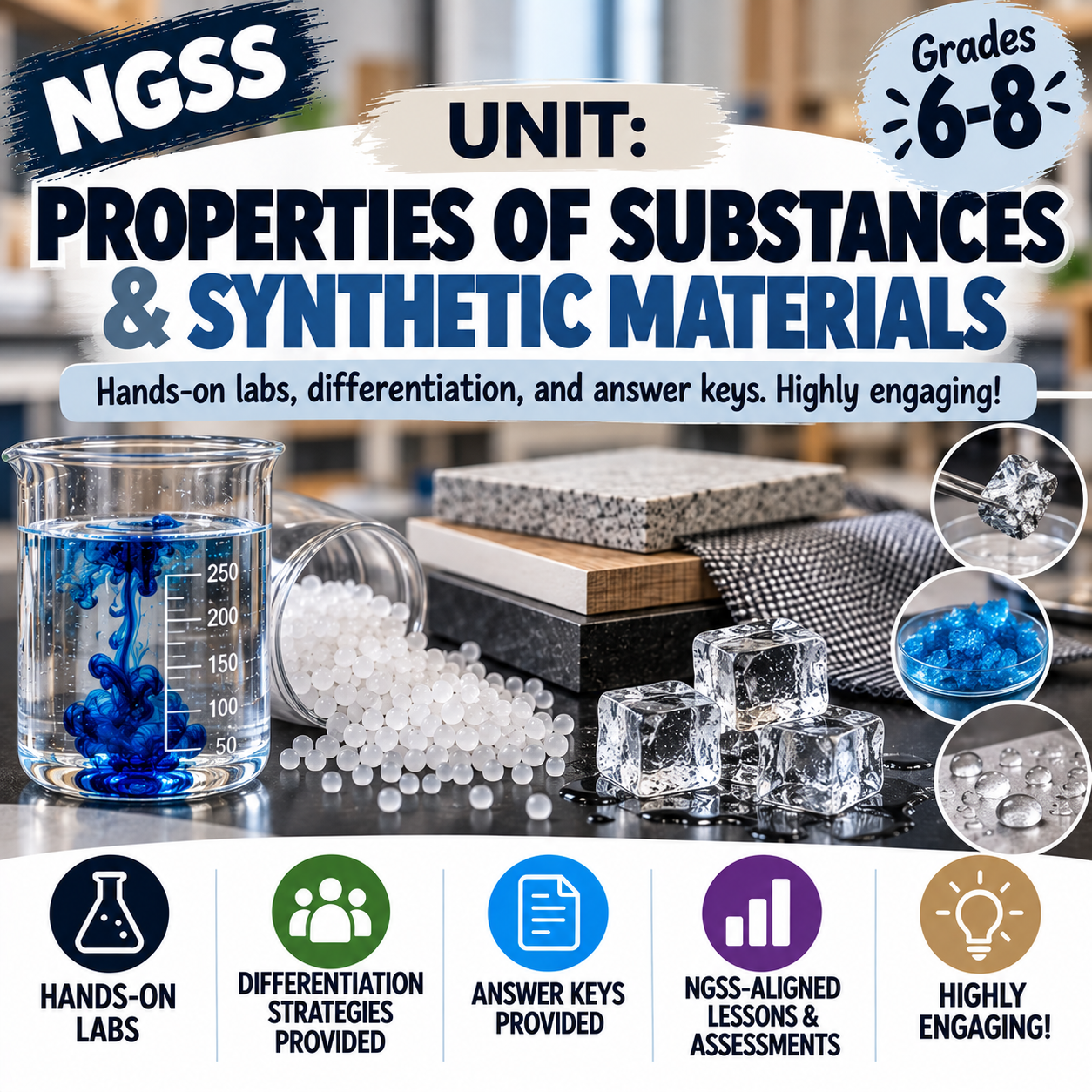
MS: NGSS - Unit: Properties of Substances & Synthetic Materials
Properties of Substances & Synthetic Material Unit | NGSS MS-PS1-3 | Grades 6–8
Where does a nylon jacket come from? Can milk really become plastic? Should your school ban plastic forks? This hands-on, NGSS-aligned unit answers those questions while students build a deep understanding of MS-PS1-3: synthetic materials come from natural resources and impact society.
Students begin by acting as detectives, using characteristic properties to identify a mystery powder. Next they gather evidence of chemical reactions and model how atoms regroup into new substances. From there, they trace everyday products back to their natural resources, test natural and synthetic fabrics, and turn milk into plastic in the lab. They then read real-world sources on nylon, aspirin, biodiesel, and plant-based plastic, learning to spot bias and judge credibility. They also tackle a cafeteria case study that weighs the benefits and costs of synthetic materials. The unit closes with a performance task in which each student creates a "Synthetic Material Profile" that traces a material from its natural resource all the way to its impact on society.
Driving Question: How do scientists use properties to identify substances, and how do synthetic materials made from natural resources impact our world?
What's Included:
- Read Me First with pacing, a full materials list, and teaching tips
- 20-page Teacher Guide covering:
- unit storyline and standards alignment
- a lesson flow with timings for every lesson
- "Listen for" student talk and common misconceptions with quick fixes
- key science background
- a differentiation menu for ELL/multilingual, neurodivergent, and honors/gifted learners
- 6 lessons of Student Notes, plus Station Source Cards for the research lesson
- Lesson 7 Performance Task with a 32-point rubric
- 6 Exit Tickets, printed 3 per page
- End-of-Unit Assessment (60 points) with a real-world case study and a CER
- Complete Answer Keys for the notes, exit tickets, and assessment, with leveled sample responses
Lessons:
- Properties of Substances: Mystery Powder Lab
- Chemical Reactions & New Substances
- Natural Resources vs. Synthetic Materials: Fiber Testing Lab
- Making a Synthetic Material: Milk Plastic Lab
- Researching Synthetic Materials: Which Sources Can We Trust?
- Synthetic Materials & Society: The Cafeteria Utensil Decision
- Performance Task: Synthetic Material Profile
Every lesson follows the same six-part routine (Engage, Introduce, Model, Investigate, Make Sense, Exit Ticket), so planning is quick and students know what to expect. Most materials are inexpensive kitchen and classroom supplies. Each lesson runs about 65 minutes, and the Teacher Guide shows how to split lessons across two days for 45–50 minute periods.
Pair It With the Synthetic Materials Bonus Lab Bundle!
Want to take learning even further? These three extension labs fit right into the unit, and each one builds a different skill:
- Engineering Polymer Slime. Students become materials engineers. They change one variable to make three batches of slime, then test stretch, flow, and bounce to discover how linking polymer chains creates a brand-new material. (Fits after Lesson 4.)
- Investigating a Super-Absorbent Polymer. What's really inside a diaper? Students find that 1 gram of this synthetic powder holds far more water than cotton or paper towel. Then they weigh the trade-offs for parents, farmers, and landfills. (Fits after Lesson 3 or before Lesson 6.)
- Sorting Plastics for Recycling. Using float-and-sink tests and other characteristic properties, students identify mystery plastics. Then they design a sorting flowchart like the ones used in real recycling plants. (Fits after Lesson 1 and connects to Lesson 6.)
Each lab includes a Teacher Guide, a Student Lab Sheet with a CER and exit ticket, and a full Answer Key.
Terms of Use
This purchase is for single-classroom use only. Please do not share, post, or distribute this resource. If colleagues would like to use it, additional licenses are available at a discount. See the included Terms of Use for full details.
Questions or Concerns?
I want you to love this resource! If you have any questions, run into an issue, or need support, please contact me at nextwavescience@gmail.com before leaving a review. I'm happy to help.