MS: NGSS - Unit: Invisible Forces
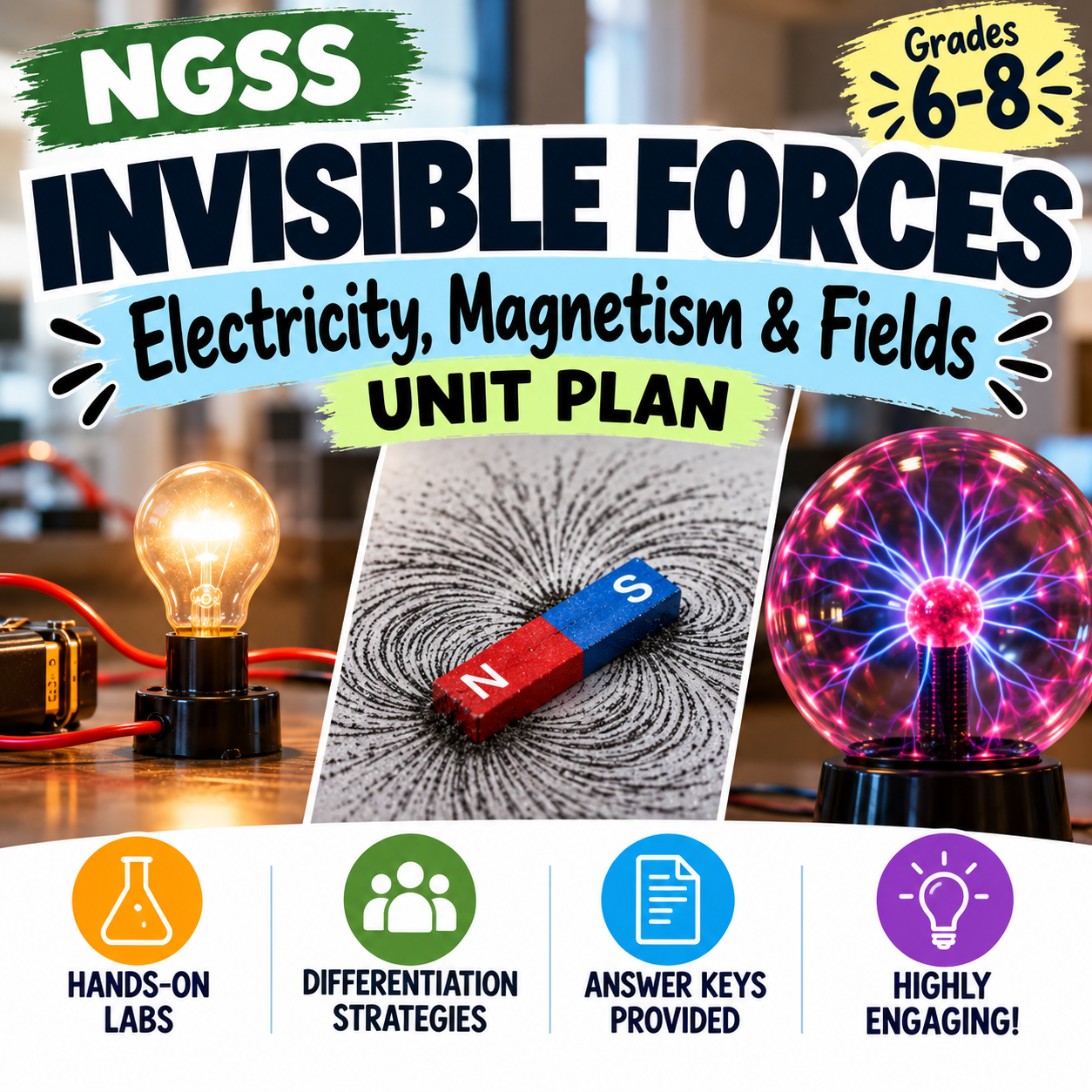
How can forces act without touching, and what affects how strong they are? In this hands-on unit, students in grades 6–8 find out by investigating. They reveal magnetic fields with iron filings and compasses, explore static electricity, build and test electromagnets, design their own investigations, and explain results using Claim–Evidence–Reasoning (CER).
The unit ends with an engineering challenge: build the strongest electromagnet possible within real constraints.
Aligned to NGSS
- MS-PS2-3: Ask questions about data to determine the factors that affect the strength of electric and magnetic forces
- MS-PS2-5: Conduct an investigation and evaluate the experimental design to provide evidence that fields exist between objects not in contact
- MS-ETS1-4: Iterative testing and modification of a design
- Includes the matching disciplinary core idea, science and engineering practices, and crosscutting concepts, with a standards-by-lesson table
What's Included
- Teacher Guide (27 pages). Each of the 11 lessons includes an objective, materials and prep, a timed lesson flow, "Listen for" signs of understanding, "Watch for" common misconceptions with quick fixes, a differentiation menu, and an exit ticket.
- Student Notes for all 11 lessons
- 11 Exit Tickets, printed 3 per page
- End-of-Unit Assessment (55 points): multiple choice, data analysis, experimental design, CER, and engineering questions
- Answer Keys for the student notes, exit tickets, and assessment, including CER examples at three levels
- Printable Station Cards for Lessons 1–4
- Engineering + CER Rubric
- Read Me First guide with pacing and a full materials list
- Welcome Letter for students and families
Lesson Sequence
- Forces Without Touching? Investigating Invisible Forces
- What Is a Field? Exploring Forces in Space
- Mapping Magnetic Fields: Evidence of Invisible Forces
- Electric Forces: Investigating Fields Without Contact
- What Affects Magnetic Force Strength?
- Electromagnets: How Electricity Creates Magnetic Force
- From Data to Patterns: Analyzing Electromagnet Strength
- Design Like a Scientist: Planning an Investigation
- Testing Our Ideas: Conducting Investigations
- Explaining Our Results: Using Data to Make Scientific Claims
- Engineering with Invisible Forces: Designing the Strongest Electromagnet
Differentiation Built In
Every lesson includes options for:
- ELL / multilingual learners: vocabulary visuals, sentence frames, and oral rehearsal
- Neurodivergent learners: visual timers, clear group roles, chunked tasks, and sensory-friendly alternatives
- Advanced / gifted & honors students: extra variables, rebuttals, and deeper data analysis that stays within the standards
Pacing: 11 lessons of about 65 minutes each, plus an assessment day (about 12 class days). Using 45-minute periods? Plan about 1.5 periods per lesson.
Materials: Uses simple, inexpensive supplies you can reuse across lessons: magnets, paperclips, compasses, iron filings in sealed bags, balloons, nails, insulated wire, and D batteries.
Make It Even Better: Pair It With These
- Invisible Forces Lab Bundle. Three hands-on labs that extend the unit:
- Electromagnet Core Lab: test how the core material affects electromagnet strength
- Magnetic Shielding Lab: investigate which materials block a magnetic field
- Static Electricity Lab: measure how distance affects electric force
- FREE Invisible Forces CER Practice. Extra practice writing claim–evidence–reasoning explanations about magnetism, electricity, and fields. It's a great warm-up before Lesson 10!
Each lab includes a teacher guide, a student lab sheet, an answer key with CER examples, and differentiation for diverse learners.
Questions or feedback? Contact NextWave Science at nextwavescience@gmail.com. If this resource was helpful in your classroom, a review is always appreciated.