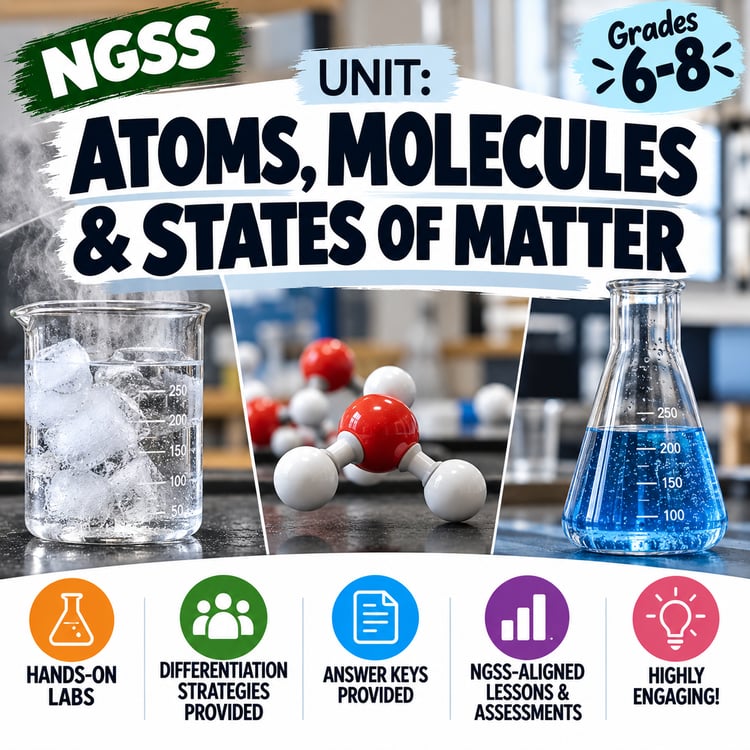
MS: NGSS - Atoms, Molecules, & States of Matter Lab Bundle
What makes one structure strong and another fall apart, and why can the same atoms make very different materials? In these three hands-on labs, students in grades 6–8 find out by building and testing models. They pack particles into different arrangements, test competing crystal-like designs under a load, and push and shake atom-and-bond models. Each lab ends with a Claim–Evidence–Reasoning (CER) explanation.
Aligned to NGSS
- MS-PS1-1: Develop models to describe the atomic composition of simple molecules and extended structures (all three labs)
- MS-ETS1-2: Evaluate competing design solutions using a systematic process to determine how well they meet the criteria and constraints of the problem (Engineering a Strong Crystal Structure)
- MS-ETS1-3: Analyze data from tests to determine similarities and differences among several design solutions to identify the best characteristics of each (Engineering a Strong Crystal Structure)
- MS-PS1-4 connection: students link particle spacing to solids, liquids, and gases (Atomic Packing Efficiency)
- Each lab includes the matching disciplinary core ideas, science and engineering practices, and crosscutting concepts, with a "Staying Within the NGSS" note
What's Included
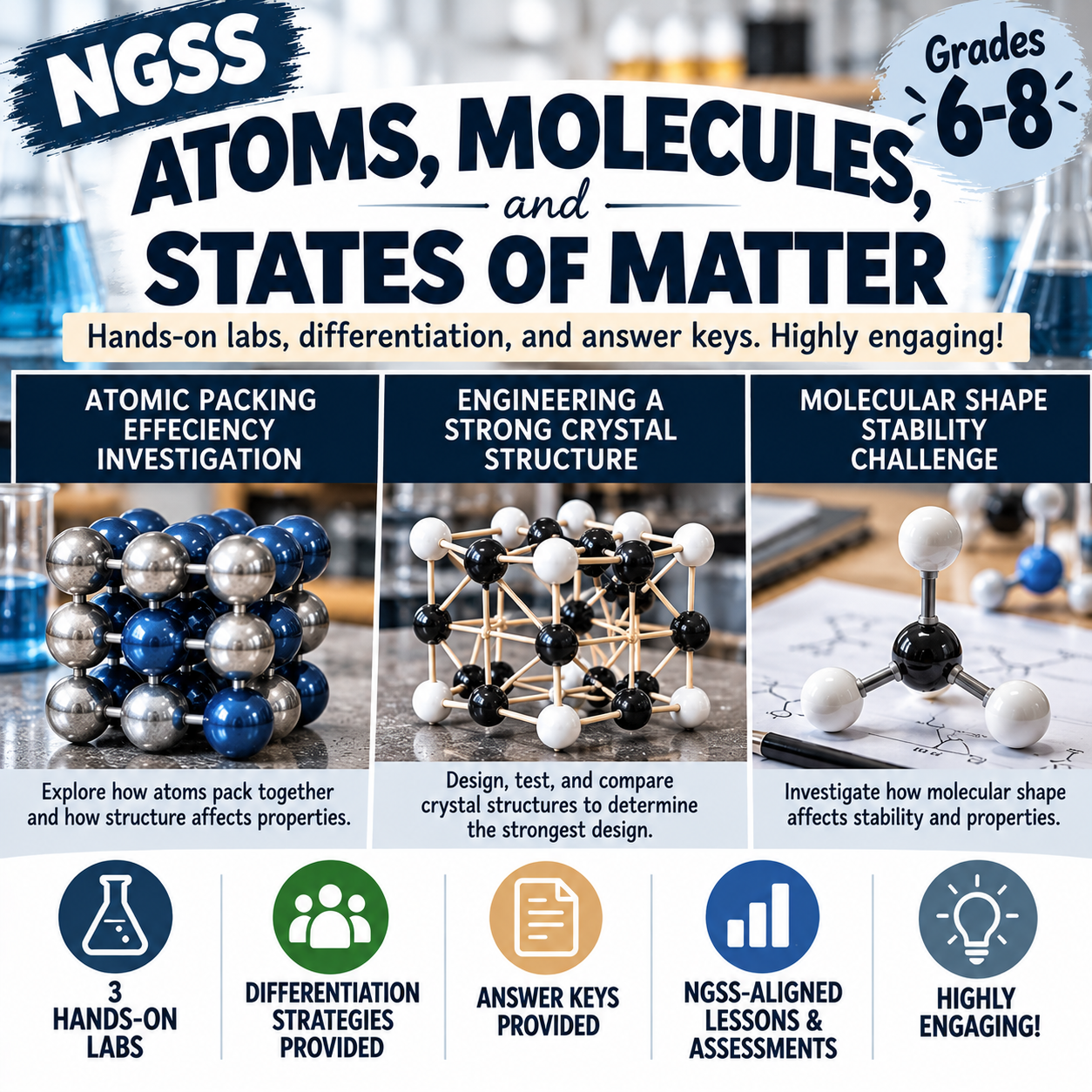
- Atomic Packing Efficiency Investigation: Students build random, tightly packed, and layered particle arrangements, tap the tray to test stability, and connect each arrangement to solids, liquids, and gases.
- Engineering a Strong Crystal Structure: Using the same limited materials, students build a cube pattern and a triangle pattern, load each with weights until it fails, and use their data to explain how arrangement affects strength.
- Molecular Shape Stability Challenge: Students build a line, a triangle, and a square from marshmallow "atoms" and toothpick "bonds," then test them with air and a gentle shake. A 3-atom line and a 3-atom triangle use identical materials but behave very differently.
Each lab includes:
- A Teacher Guide with a timed lesson flow, "Listen for" signs of understanding, "Watch for" misconceptions with quick fixes, a differentiation menu, a CER scoring guide, and a standards alignment table
- A Student Lab Sheet with a prediction, procedure, data table, analysis questions, CER, and exit ticket
- An Answer Key with sample data, answers, and CER examples at three levels (Meets / Approaching / Needs Development)
Differentiation Built In
Every lab includes options for:
- ELL / multilingual learners: picture word banks, sentence frames, and labeled sketches accepted as evidence
- Neurodivergent learners: role cards, visual step cards, pre-bagged materials, and typed or dictated CER options
- Advanced / gifted & honors students: redesign challenges, 3-D builds, strength-to-weight comparisons, and model critiques that go deeper without leaving the standards
Pacing: Each lab takes about 45–50 minutes. Each guide has a short-on-time option.
Materials: Uses simple, inexpensive supplies: pom-poms or beads, a shallow tray, mini marshmallows, toothpicks, index cards, small weights such as books, washers, or pennies, and a fan or index card for fanning.
Make It Even Better: Pair It With the Unit
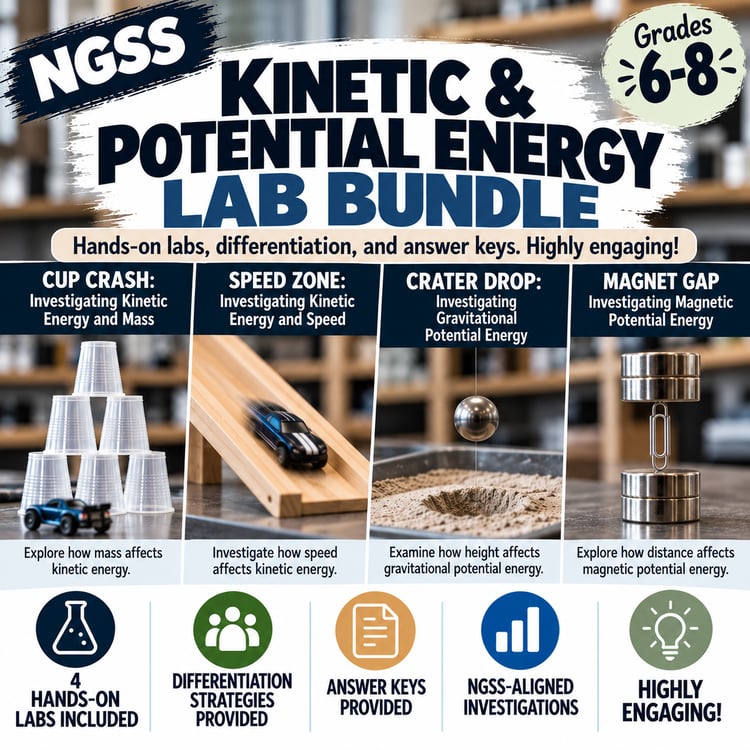
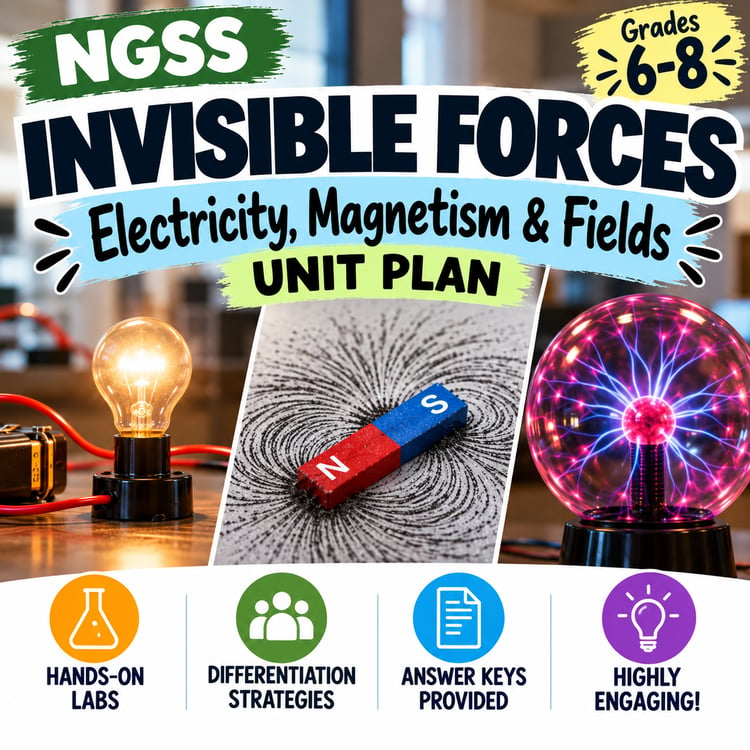
- Atoms, Molecules, and States of Matter Unit. This 15-lesson unit (MS-PS1-1 and MS-PS1-4) takes students from atoms and molecules to extended structures, then to particle motion, thermal energy, state changes, gas pressure, and heating curves. It includes:
- A Teacher Guide
- Student notes
- Two performance tasks with rubrics
- Exit tickets
- An 80-point End-of-Unit Assessment
- Full answer keys
- Each lab's Teacher Guide shows exactly where it fits in the unit.
Questions or feedback? Contact NextWave Science at nextwavescience@gmail.com. If this resource was helpful in your classroom, a review is always appreciated.