MS: NGSS - Full-Year Curriculum Bundle: Physical Science
Middle School NGSS Physical Science: Full-Year Curriculum Bundle
Your whole year of hands-on physical science, planned and ready to teach.
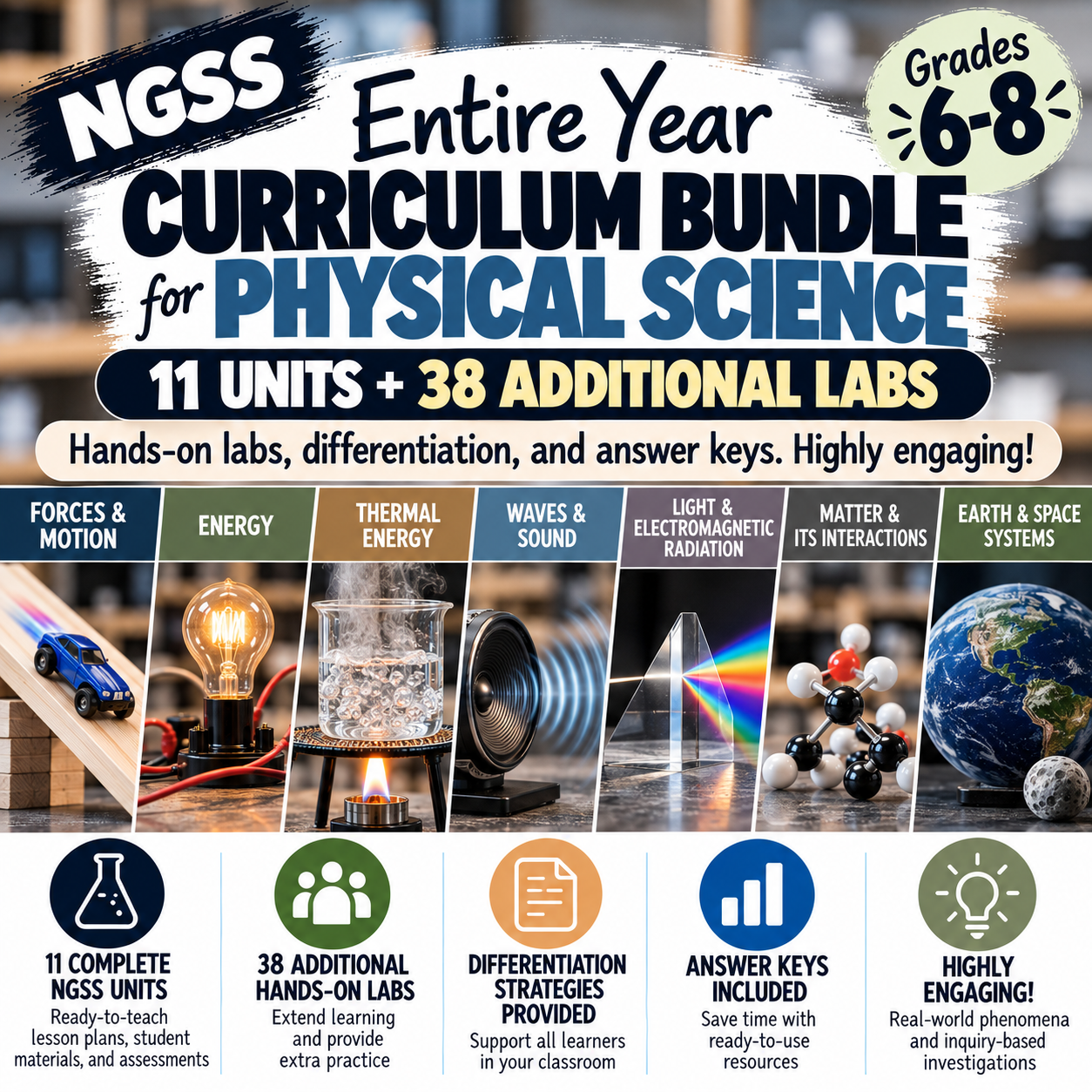
This bundle has 11 complete units, 116 lessons and 38 extension labs, aligned to every middle school NGSS Physical Science performance expectation (MS-PS1 through MS-PS4). Each unit opens with a phenomenon and builds toward a CER explanation or engineering task. Students learn by investigating, collecting data and arguing from evidence.
The core units cover about 127 class days. With the labs added, that's enough for a full school year.
What's Included
11 complete units, each with:
- A Read Me First quick-start guide with the materials list, pacing and printing plan
- A Teacher Guide with the unit storyline, a standards table, and a page or two per lesson. Each lesson covers the lesson flow and timing, "Listen for" student talk, background science for the teacher, common misconceptions with quick fixes, and a differentiation menu for ELL/multilingual, neurodivergent and honors/gifted students.
- Student Notes for every lesson
- Exit Tickets for every lesson
- An End-of-Unit Assessment
- Performance tasks with rubrics (in select units)
- Printable station cards
- Answer keys for the student notes, exit tickets and assessments
38 standalone labs, each with:
- A Teacher Guide with the materials list, prep steps, lesson flow and a short-on-time option
- A Student Lab Sheet with observations, vocabulary, data tables, analysis, a CER, a reflection and an honors extension
- An Answer Key with sample data and CER examples at three levels (Meets / Approaching / Needs Development)
Units & Labs
FORCES (3 units)
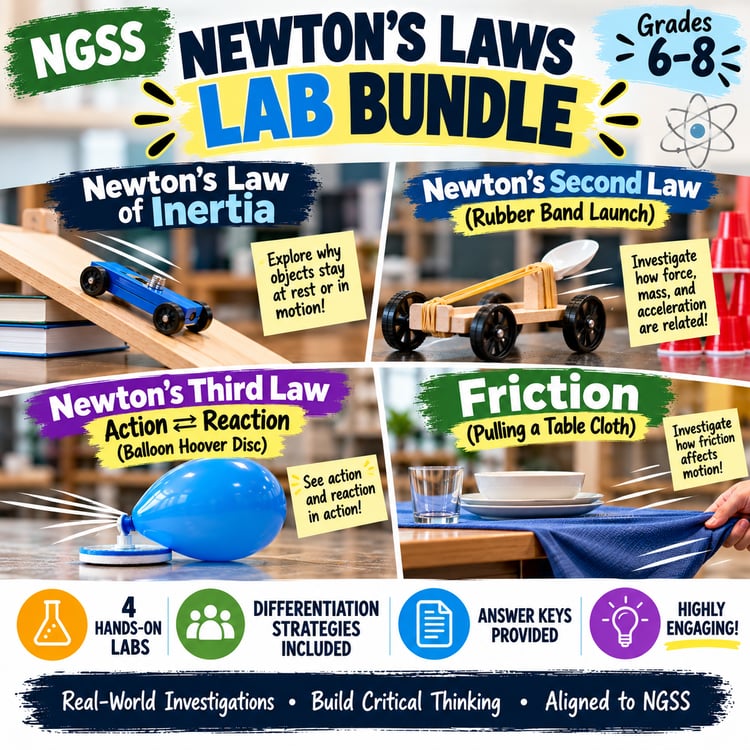
- Forces & Motion (15 lessons): MS-PS2-1, PS2-2
Students discover Newton's Laws through stations and labs, graph their own data, and engineer a safer collision.
Labs: Tablecloth Pull Challenge, Rubber Band Launch, Balloon Hover Disc, Sliding Surface Lab
- Gravity & Gravitational Interactions (6 lessons): MS-PS2-4, ESS1-2, ETS1-1
Students measure Earth's pull with spring scales, analyze orbits, tides and NASA planet data, and engineer a stable tower or a safe lander.
Labs: Gravity and Distance Lab, Center of Mass Challenge, Crater Collision Investigation
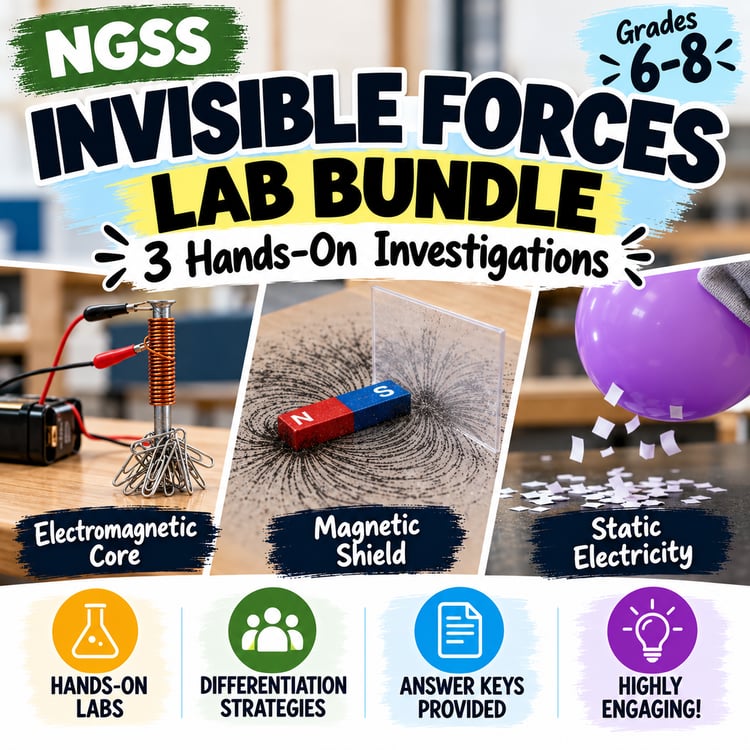
- Invisible Forces: Electricity, Magnetism & Fields (11 lessons): MS-PS2-3, PS2-5, ETS1-4
Students reveal magnetic fields with iron filings, investigate static electricity, design their own investigations, and engineer the strongest electromagnet they can.
Labs: Electromagnet Core Lab, Magnetic Shielding Lab, Static Electricity Distance Lab, plus a CER Practice set with a modified version
ENERGY (3 units)
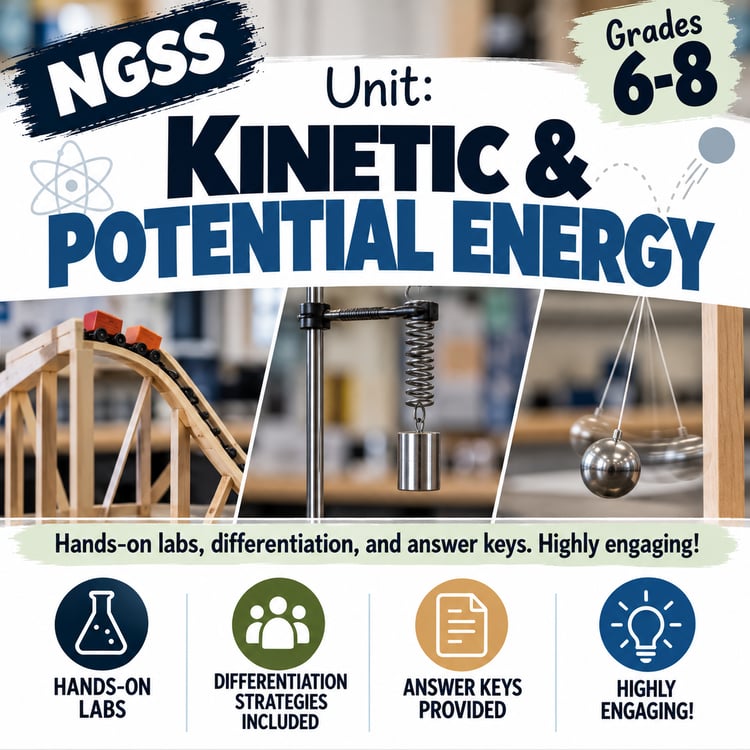
- Kinetic & Potential Energy (10 lessons): MS-PS3-1, PS3-2
Students crash toy cars into cups, drop balls into flour, and build a marble coaster explained with an energy model.
Labs: Cup Crash, Speed Zone, Crater Drop, Magnet Gap
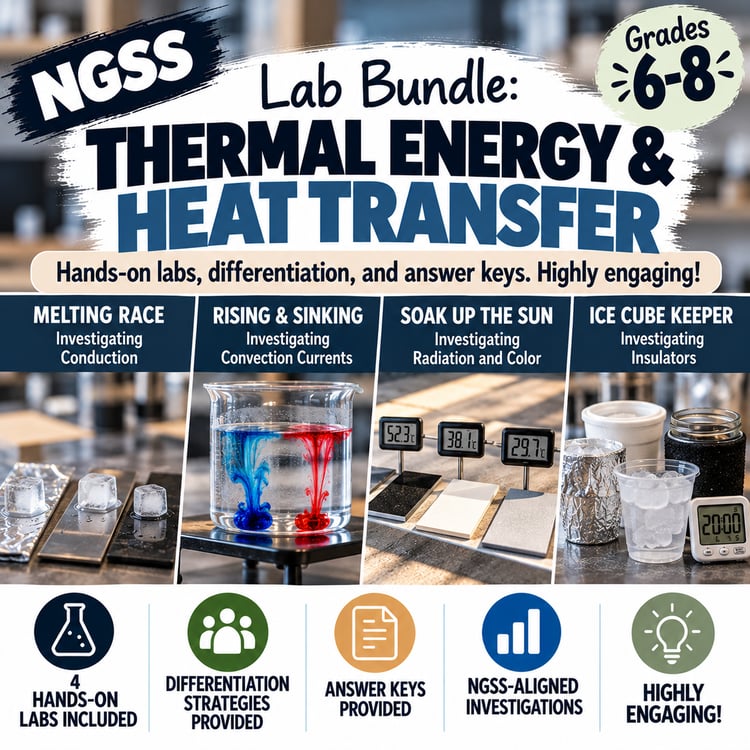
- Thermal Energy & Heat Transfer (12 lessons): MS-PS3-3, PS3-4, ETS1-1 to ETS1-4
Students investigate conduction, convection and radiation, then engineer an insulated container.
Labs: Melting Race, Rising & Sinking, Soak Up the Sun, Ice Cube Keeper
- Energy Transfer & Conservation (6 lessons): MS-PS3-5
Students trace energy through collisions, bounces and friction, and argue that energy is transferred, not used up.
Labs: Swing Swap, Magnet Launch, Sail Cart Challenge
ATOMS & CHEMICAL REACTIONS (4 units)
- Atoms, Molecules, and States of Matter (15 lessons): MS-PS1-1, PS1-4
Students build atom, molecule and crystal models, explain state changes with particle models, and graph heating curves.
Labs: Atomic Packing Efficiency, Engineering a Strong Crystal Structure, Molecular Shape Stability Challenge
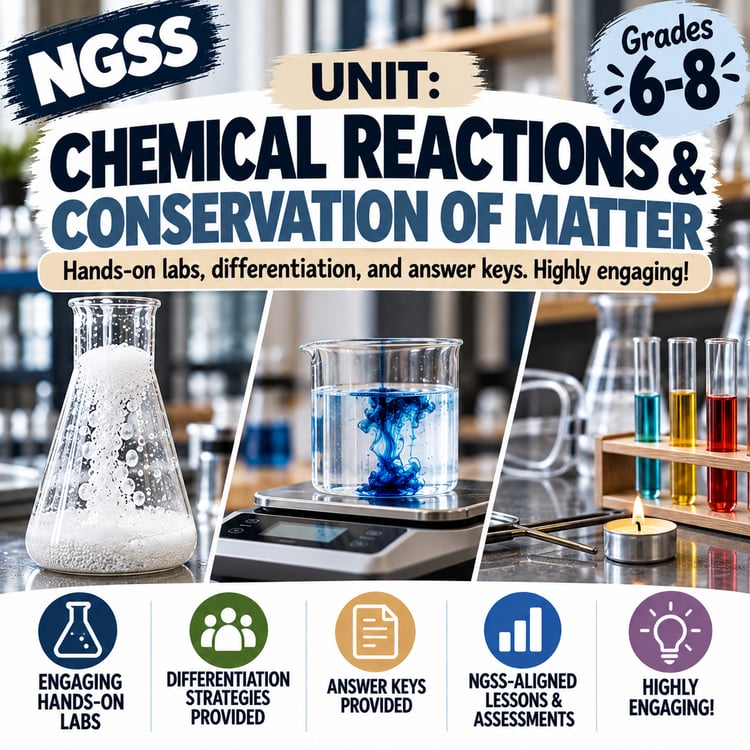
- Chemical Reactions & Conservation of Matter (11 lessons): MS-PS1-2, PS1-5, PS1-6
Students identify mystery substances, model how atoms regroup, and prove conservation of mass with sealed bags, steel wool and elephant toothpaste.
Labs: Copper Plating a Nail, Making Chalk from Two Clear Liquids, Plaster of Paris: Where Did the Water Go?, Splitting Water with Electricity
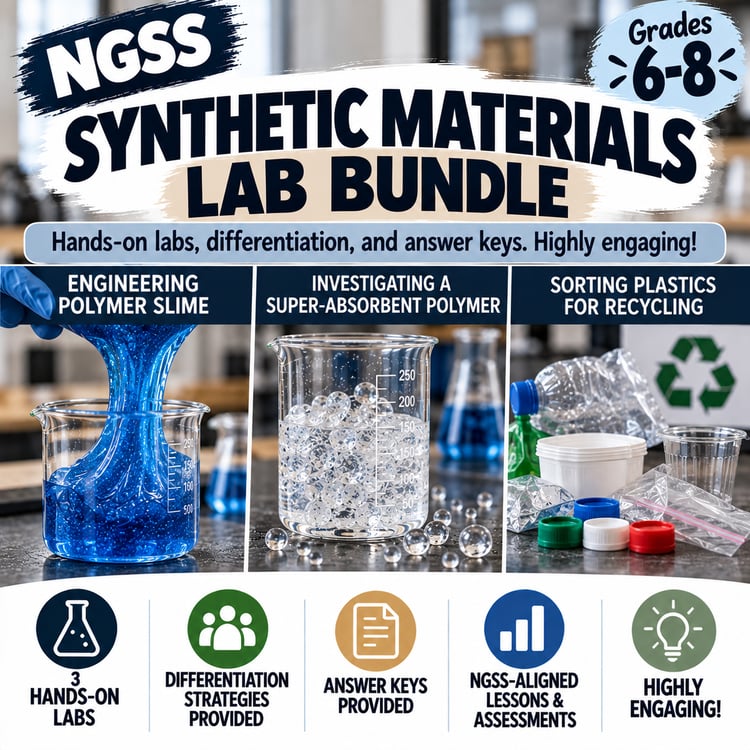
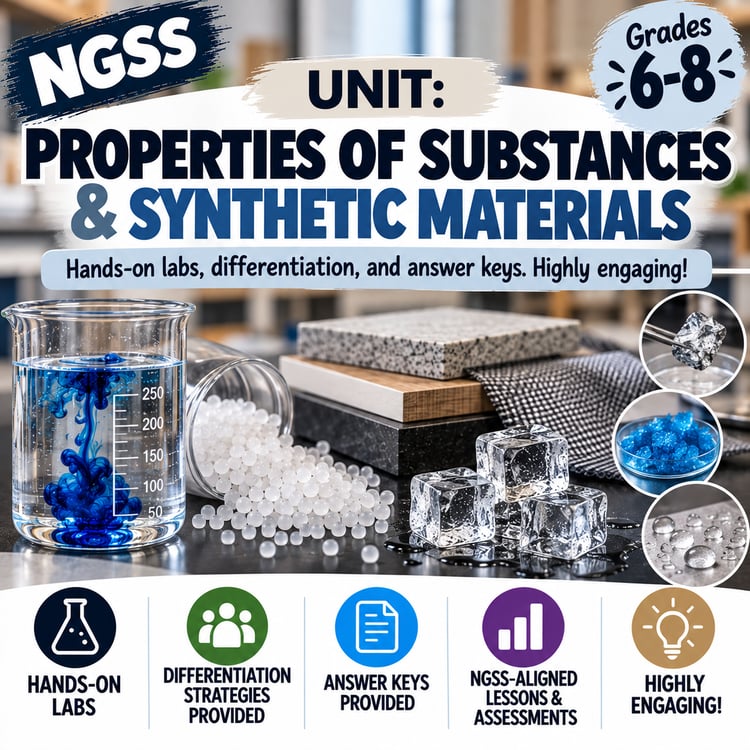
- Properties of Substances & Synthetic Materials (7 lessons): MS-PS1-3, PS1-5, PS1-6
Students turn milk into plastic, trace materials back to natural resources, and weigh how synthetic materials affect society.
Labs: Engineering Polymer Slime, Investigating a Super-Absorbent Polymer, Sorting Plastics for Recycling
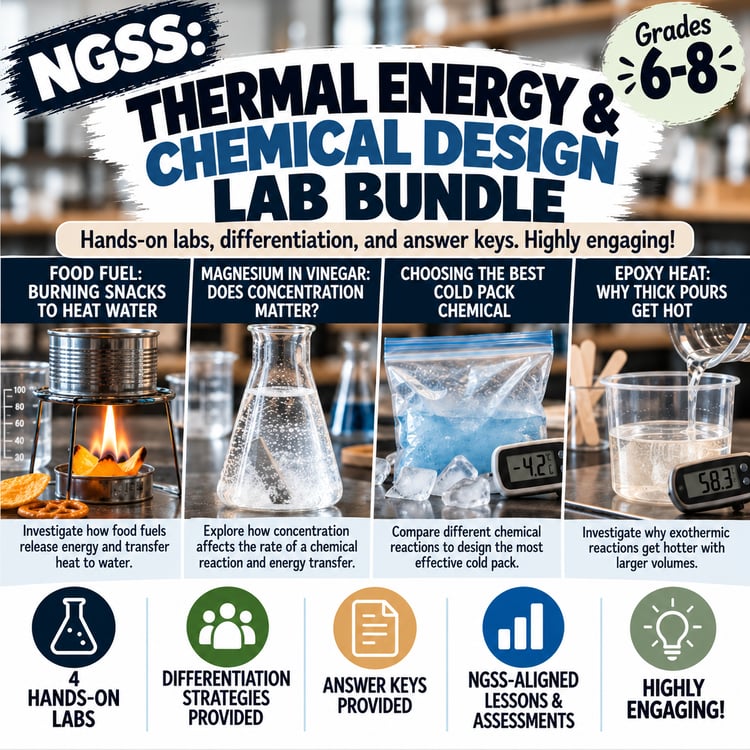
- Thermal & Chemical Energy (7 lessons): MS-PS1-6, ETS1-3, ETS1-4
Students measure exothermic and endothermic processes, then design, build, test and improve their own hot or cold pack.
Labs: Choosing the Best Cold Pack Chemical, Epoxy Heat, Food Fuel: Burning Snacks to Heat Water, Magnesium in Vinegar
WAVES (1 unit)
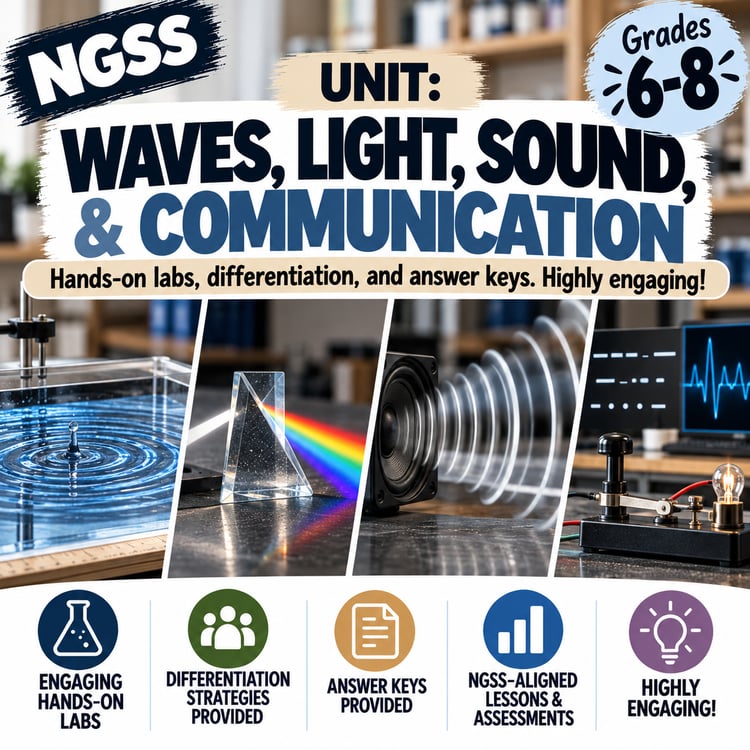
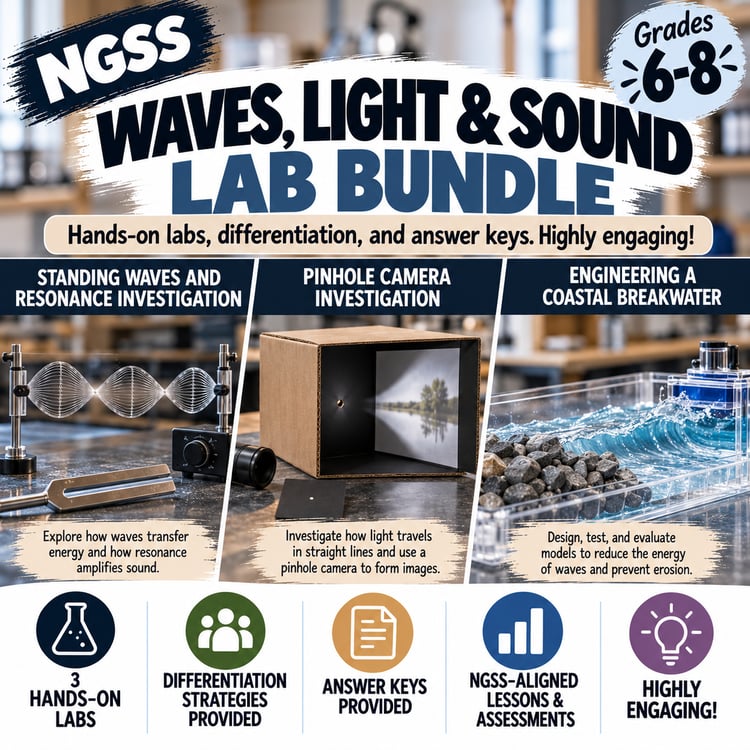
- Waves, Light, Sound, & Communication (16 lessons): MS-PS4-1, PS4-2, PS4-3, ETS1-3
Students measure waves with Slinkies and ropes, soundproof a phone, bend light in water, send light-pulse messages through "noise," and design their own wave signaling system.
Labs: Standing Waves and Resonance, Pinhole Camera Investigation, Engineering a Coastal Breakwater
Why Teachers Love It
- Every MS-PS standard is covered, plus engineering standards (MS-ETS1-1 to ETS1-4) built into the units
- Easy to teach. Every lesson follows the same rhythm, so students know what to expect and you can plan quickly.
- Inexpensive materials. Most supplies come from the classroom, hardware store or dollar store, and many are reused across lessons.
- Flexible pacing. Lessons are planned for about 65 minutes, with notes on splitting them across two days for 45–50 minute periods.
- Differentiation built in for ELL/multilingual, neurodivergent and honors/gifted learners
- Organized folders. Each unit uses the same numbered folders: START HERE → Student Handouts → Assessments → Answer Keys → Station Cards → Labs.
Format
2,146 pages in 499 print-ready PDFs, organized into numbered folders by unit.
Terms of Use
This purchase is for single-classroom use only. Please do not share, post, or distribute this resource. If colleagues would like to use it, additional licenses are available at a discount. See the included Terms of Use for full details.
Questions?
If you have questions or need support with this resource, please email NextWave Science at nextwavescience@gmail.com before leaving a review, so I can help you individually. Thank you for bringing hands-on science into your classroom!