MS: NGSS - Cells and Their Parts Lab Bundle
Cells & Their Parts Lab Bundle: 4 Hands-On Labs | NGSS MS-LS1-1 & MS-LS1-2 | Grades 6–8
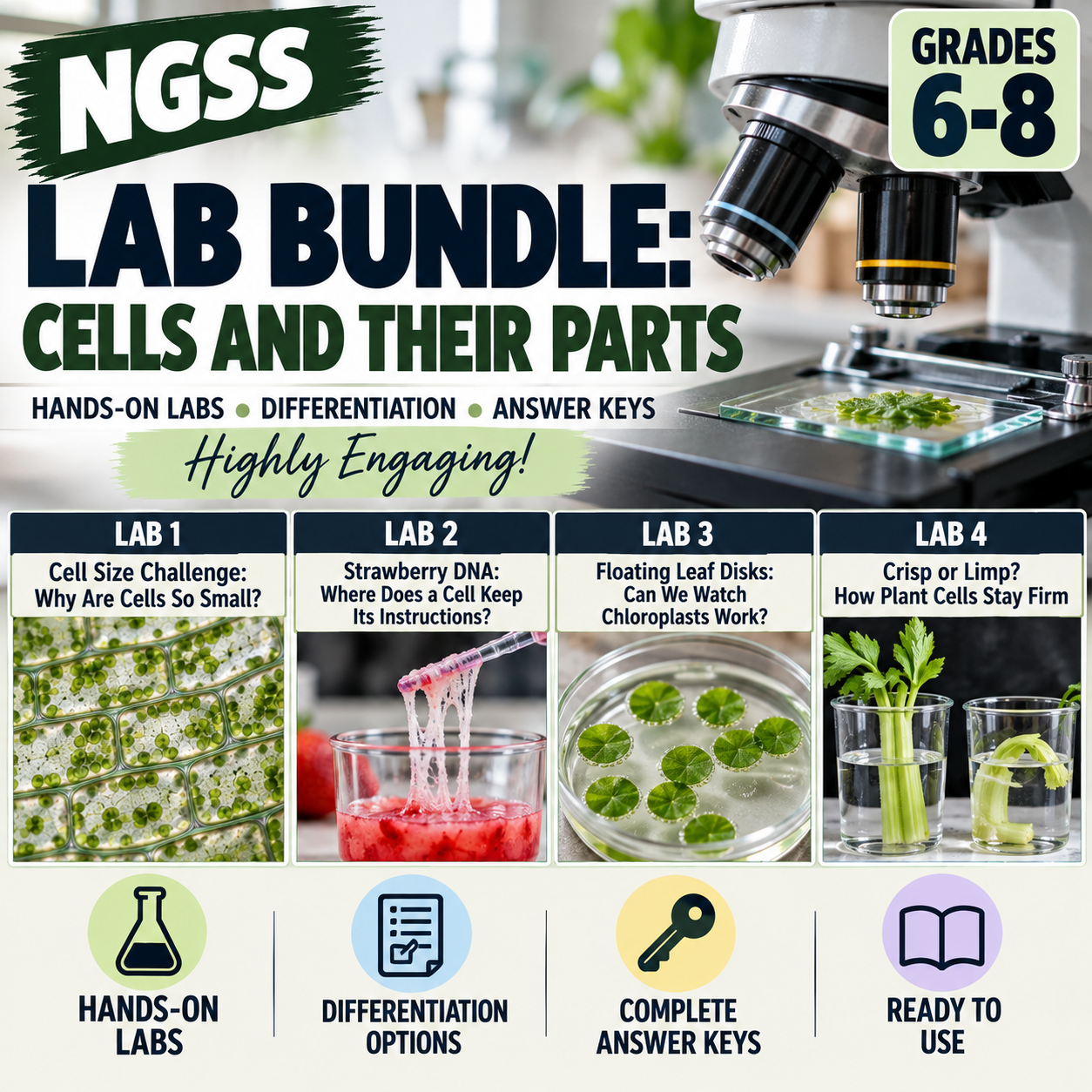
Why are cells so small? Where does a cell keep its instructions? Can you actually watch a chloroplast work? Why does a potato go limp in salt water? These four hands-on, NGSS-aligned labs help students answer real questions about cells using evidence they collect themselves. Each lab targets a different cell idea and a different common misconception, so students build a deeper understanding of MS-LS1-1 and MS-LS1-2: all living things are made of cells, and the parts of a cell work together to keep it alive.
Labs Included:
- Cell Size Challenge: Why Are Cells So Small? Students soak purple cabbage-juice gelatin cubes in vinegar and measure how far the pink color travels. The small cube changes almost completely, while the big cube’s center stays purple. Students then analyze real cell and organism data to explain why large living things are made of many small cells, not one giant cell. (MS-LS1-1 & MS-LS1-2. Fits after Lesson 6 or 8 of the Cells unit.)
- Strawberry DNA: Where Does a Cell Keep Its Instructions? Students pull a white, stringy clump of DNA out of strawberries. A soap vs. no-soap fair test shows that the membranes must be broken open before the instructions stored in the nucleus can get out. Students then test a second fruit and compare. (MS-LS1-2. Fits after Lesson 7 or 8.)
- Floating Leaf Disks: Can We Watch Chloroplasts Work? Tiny spinach leaf disks sink, then rise one by one under a lamp as their chloroplasts use light to make food. Disks kept in the dark stay on the bottom. Groups then pool class data from different lamp distances and graph the pattern. (MS-LS1-2. Fits after Lesson 7 or 10.)
- Crisp or Limp? How Plant Cells Stay Firm Students weigh potato sticks soaked in plain and salty water, calculate percent change, and graph their results. While the sticks soak, they watch red onion cells under the microscope pull away from their walls in salt water. Together, the evidence shows how the cell membrane and cell wall keep a plant firm. (MS-LS1-2. Fits after Lessons 8 and 9.)
Each Lab Includes:
- 4-page Teacher Guide with:
- a lesson flow with timings
- materials and before-class prep
- “Listen for” student talk and common misconceptions with quick fixes
- a differentiation menu for ELL/multilingual, neurodivergent, and honors/gifted learners
- CER scoring guide
- full NGSS standards alignment
- 7-page Student Lab Sheet with:
- key vocabulary
- Observe & Predict
- a fair-test plan
- a setup diagram and step-by-step procedure
- data tables (and a graph where it fits)
- 8 analysis questions
- a CER with sentence starters
- an Honors Extension
- Complete Answer Key with sample data, completed graphs, and CER examples at three levels (Meets / Approaching / Needs Development)
Each lab runs about 50 minutes and uses inexpensive grocery-store and classroom supplies, such as gelatin, vinegar, strawberries, spinach, potatoes, and salt. The labs work on their own or as extensions to any middle school cells unit.
Pair It With the Cells: The Building Blocks of Life Unit!
These labs were designed to fit right into NextWave Science’s 12-lesson Cells unit (NGSS MS-LS1-1 & MS-LS1-2). In the unit, students:
- figure out what makes something alive with the “Mystery Bottles”
- hunt for cells under the microscope in plants, animals, microbes, and “imposters”
- model the cell as a system with a starch-iodine membrane bag, a balloon-in-a-cup cell wall test, and a whole-class living cell simulation
- design 3D cell models and present them in a Cell Museum
Each lab’s Teacher Guide shows exactly which lesson it fits after.
Terms of Use
This purchase is for single-classroom use only. Please do not share, post, or distribute this resource. If colleagues would like to use it, additional licenses are available at a discount. See the included Terms of Use for full details.
Questions or Concerns?
I want you to love this resource! If you have any questions, run into an issue, or need support, please contact me at nextwavescience@gmail.com before leaving a review. I’m happy to help.