MS: NGSS - Unit: Gravity & Gravitational Forces
Gravity & Gravitational Interactions | NGSS Middle School Science Unit (MS-PS2-4, MS-ESS1-2, MS-ETS1)
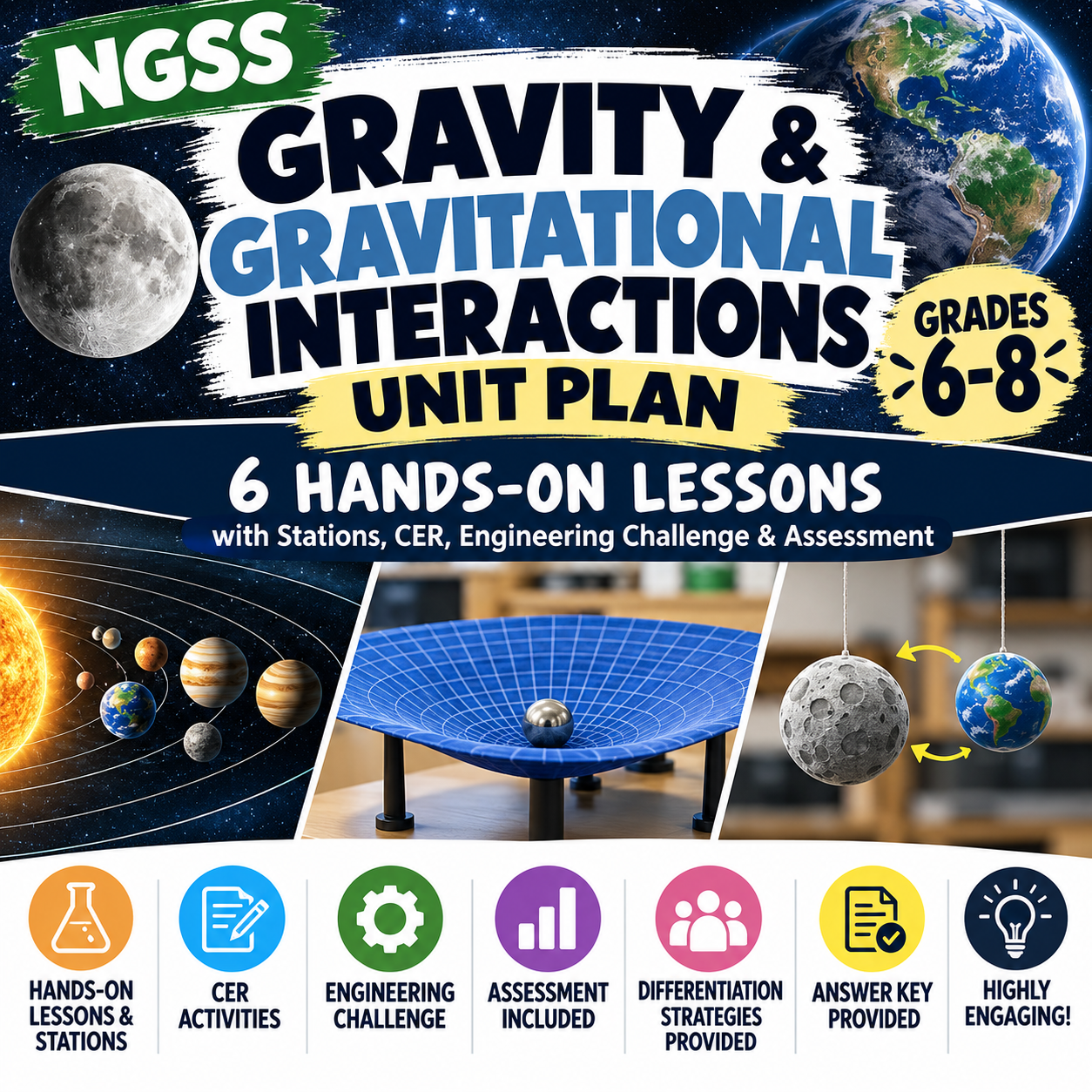
Why does a basketball fall at the same rate as a tennis ball? Why would you jump higher on the Moon? What keeps the planets in orbit? In this hands-on unit, students in grades 6–8 investigate gravity as an invisible, attractive force. They observe falling and swinging objects, measure Earth's pull with spring scales, and discover that two objects pull on each other equally. They analyze orbits, tides, and NASA planet data, write evidence-based arguments, and finish by engineering a stable tower or a safe lander.
Aligned to NGSS
- MS-PS2-4: Construct and present arguments using evidence that gravitational interactions are attractive and depend on the masses of the interacting objects
- MS-ESS1-2: Develop and use a model to describe the role of gravity in the motions within the solar system
- MS-ETS1-1 to 4: Define criteria and constraints, evaluate designs, analyze test data, and improve a design through iterative testing
- Includes the matching disciplinary core ideas, science and engineering practices, and crosscutting concepts, with a standards-by-lesson table
What's Included
- Teacher Guide (17 pages): each lesson includes an objective, materials and prep, a timed lesson flow, "Listen for" signs of understanding, "Watch for" common misconceptions with quick fixes, a differentiation menu, and an exit ticket
- Student Notes for all 6 lessons
- 6 Exit Tickets, printed 3 per page
- End-of-Unit Assessment with multiple choice, data analysis, CER, and engineering questions
- Answer Keys for the student notes, exit tickets, and assessment, including model answers and sample CERs
- Printable Station Cards for Lessons 1–4, plus Planet Comparison Cards
- Engineering + CER Rubric
- Read Me First guide with pacing and a full materials list
Lesson Sequence
- What Is Gravity? Investigating Invisible Attraction
- Gravity and Mass: Does Size Matter?
- Gravity Between Objects: Mutual Attraction
- Evidence for Gravitational Interactions
- Constructing Scientific Arguments About Gravity
- Engineering Challenge: Designing for Gravity
Differentiation Built In
Every lesson includes options for:
- ELL / multilingual learners: picture cards, gestures, sentence frames, and word banks
- Neurodivergent learners: visual timers, clear group roles, chunked tasks, and warnings before loud moments
- Honors / gifted students: graphing NASA data, rebuttals, new variables, and tighter design constraints, all within the standards
Pacing: 6 lessons of about 65 minutes each, plus an assessment day (about 7 class days). Using 45-minute periods? Plan about 1.5 periods per lesson (roughly 10 days).
Materials: Uses simple, inexpensive supplies: balls, string, washers, spring scales (or rubber bands), stretchy fabric for a gravity-well model, and basic building supplies like craft sticks, straws, cups, and tape.
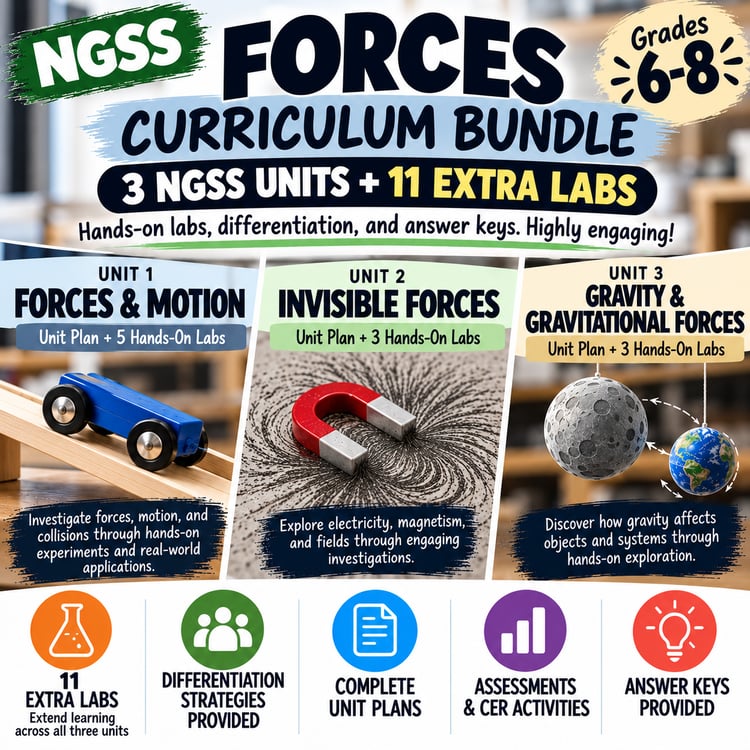
Extend the Unit: Pair It With Three Hands-On Labs
- Center of Mass Lab: explore balance and stability. Pairs with Lesson 6, where students build a stable tower.
- Collision Lab: investigate how mass and drop height affect the impact. Pairs with Lesson 2.
- Gravity and Distance Lab: use an orbit model and NASA data to see how gravity changes with distance. Pairs with Lesson 4.
Together, the unit and the labs give students more hands-on data, more practice planning fair tests, and more chances to explain their results with evidence.
Terms of Use: This purchase is a single-user license for use in your own classroom. Please purchase additional licenses for colleagues.