
The Order Was Profitable. Until It Wasn't.
Discover how eBay sellers lose profit on successfully fulfilled orders through reshipping costs, partial refunds, return shipping, discounts, concessions, and hidden fulfillment expenses.
The Sale Was Successful.
The Order Was Delivered.
The Buyer Wasn't Refunded.
So Why Did the Profit Disappear?
This is one of the most dangerous problems in eBay operations.
Because nothing appears to have gone wrong.
The order was placed.
The item was shipped.
The tracking showed delivery.
The buyer received the product.
From a sales perspective, it looks like a success.
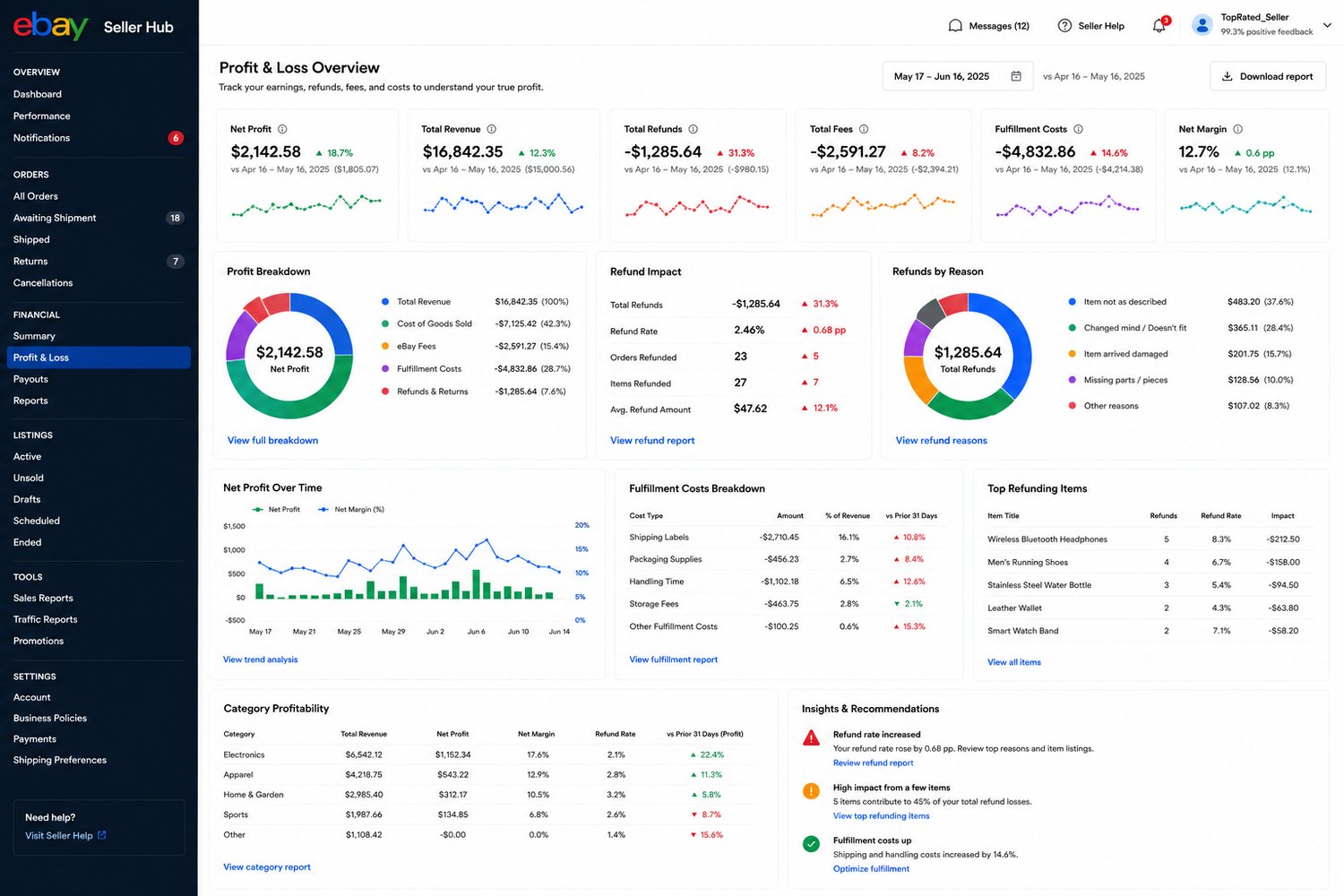
But somewhere between the sale and the final profit, money quietly disappeared.
Maybe it was:
- a reshipment
- a partial refund
- a shipping adjustment
- a discount
- a return
- a customer concession
- extra fulfillment labor
The order was completed.
But the margin was damaged.
This is margin leakage.
And many eBay sellers don't discover it until they wonder:
"How did I make more sales but keep less money?"
Revenue Is Not Profit
This distinction sounds obvious.
But many sellers still manage their businesses around revenue.
They celebrate:
- sales volume
- order growth
- gross revenue
- average order value
Those numbers matter.
But revenue only tells you what came in.
It doesn't tell you what quietly left.
A successful order may generate revenue while simultaneously creating unexpected costs.
The real question is not:
"Did we fulfill the order?"
It's:
"How much profit remained after we fulfilled it?"
The $100 Order That Wasn't Really a $100 Order
Imagine an eBay order generates $100 in revenue.
The seller sees a profitable sale.
But then the real costs appear:
- $40 product cost
- $12 shipping
- $5 marketplace and payment fees
- $8 discount
- $10 partial refund
- $7 additional fulfillment cost
The original margin has changed dramatically.
The order still looks successful in the sales dashboard.
But the actual profit is much smaller than expected.
This is why high sales volume can sometimes hide poor operational performance.
More orders can create more revenue.
They can also create more opportunities for profit to leak away.
Reshipping Costs Can Destroy a Good Margin
One of the most expensive operational mistakes is reshipping.
A buyer reports:
"I never received my order."
The seller sends a replacement.
Later, the original package arrives.
Now the seller has paid for:
- the original shipment
- the replacement shipment
- additional handling
- customer service time
The seller may still complete the transaction successfully.
But the margin has taken a significant hit.
A single reshipment may not seem serious.
Repeated across dozens of orders, it becomes a major profit problem.
The key question is:
How many reshipments are happening—and why?
Partial Refunds Feel Small Until You Add Them Up
Partial refunds are often treated as harmless.
A buyer has a minor complaint.
The seller offers $5.
Another buyer receives $10.
Another order receives $15.
Each decision feels reasonable.
But concessions become expensive when they are not tracked.
The seller may not notice that:
- refund frequency is increasing
- certain products generate more concessions
- specific fulfillment problems trigger refunds
- customer service is using refunds to solve recurring issues
A partial refund is not always a problem.
But repeated untracked refunds are a form of margin leakage.
Return Shipping Can Turn a Sale Into a Loss
Returns are often analyzed only as a customer service issue.
But returns are also financial events.
A return may involve:
- outbound shipping
- return shipping
- labor
- inspection
- repackaging
- refund processing
- damaged inventory
Even when the product is eventually resold, the original transaction may no longer be profitable.
This is why sellers should not only ask:
"How many items were returned?"
They should also ask:
"How much profit did those returns consume?"
Discounts and Concessions Quietly Change the Economics
Discounts are powerful sales tools.
But they also change the margin.
A seller may offer:
- promotional discounts
- buyer-specific discounts
- partial refunds
- shipping concessions
- goodwill credits
Individually, these decisions may make sense.
The danger appears when the seller doesn't know their cumulative effect.
A business can increase sales while gradually training itself to give away more margin.
Revenue grows.
Profit doesn't.
Hidden Fulfillment Costs Are Still Costs
Many sellers calculate product cost and shipping.
Then they stop.
But fulfillment has other costs.
Consider:
- employee time
- packaging materials
- relabeling
- re-picking incorrect orders
- correcting inventory mistakes
- processing returns
- responding to avoidable buyer messages
These costs may not appear clearly on the order screen.
But they still consume profit.
An order that requires twice the labor of a normal order is not equally profitable.
Operational complexity has a financial cost.
The 10–30 Orders Per Day Profit Blind Spot
This problem becomes especially important as eBay stores grow.
At 10–30 orders per day, sellers may have enough volume to generate meaningful revenue but not enough operational visibility to track every source of margin leakage.
A few small losses per order can become significant.
For example:
- one reshipment
- several partial refunds
- recurring packing errors
- excessive discounts
- unnecessary return costs
The business may appear healthy from the outside.
Sales are increasing.
Orders are being fulfilled.
But profit is slowly being consumed by operational friction.
The Most Dangerous Costs Are the Ones That Look Normal
A major expense gets attention.
Small expenses often don't.
That's why margin leakage is so dangerous.
A seller may think:
- "It's only one refund."
- "It's only one reshipment."
- "It's only a small discount."
- "It's only a few extra minutes of labor."
But repeated small costs create large losses.
The problem isn't always one expensive mistake.
Sometimes it's hundreds of ordinary decisions that quietly reduce profitability.
Successful Fulfillment Does Not Guarantee Successful Operations
This is the mindset shift many eBay sellers need.
A completed order is not automatically a profitable order.
The order may have:
- shipped late
- required additional labor
- generated a concession
- required reshipping
- resulted in a return
Yet the transaction still appears completed.
This is why operational performance must be connected to financial performance.
If sellers only track sales, they can miss the real cost of fulfillment.
What Should eBay Sellers Track?
To identify eBay profit loss, sellers should look beyond revenue.
Track patterns such as:
Reshipping Rate
How often are orders shipped again?
Partial Refunds
How frequently are concessions being issued?
Return Costs
What is the total cost of returned orders?
Fulfillment Corrections
How much time is spent fixing mistakes?
Discounts
How much margin is being given away?
Cost Per Exception
What does each operational problem actually cost?
These numbers reveal where profit is leaking.
The Question Every Seller Should Ask
Most sellers ask:
"How many orders did we fulfill?"
A better question is:
"How many orders required extra money, extra labor, or extra concessions to complete?"
That question changes the entire way you see operations.
Because every exception has a cost.
And every repeated exception is a potential profit problem.
Final Thoughts
The order was placed.
The item was shipped.
The buyer received it.
The transaction was completed.
And yet the profit disappeared.
This is why eBay sellers need to look beyond revenue.
Profit can leak through:
- reshipping costs
- partial refunds
- return shipping
- discounts
- customer concessions
- hidden fulfillment costs
The most dangerous margin losses often don't look like disasters.
They look like normal business decisions.
One refund.
One replacement.
One discount.
One return.
Repeated often enough, they quietly change the economics of the entire store.
The best eBay operators don't only ask:
"How many sales did we make?"
They ask:
"How much profit survived the fulfillment process?"
Because the order was profitable.
Until it wasn't.
Related Reading
- Why eBay Return Requests Increase Even When Product Quality Stays Consistent
- Why eBay Sellers Lose Buyer Trust Without Realizing It
- Why eBay Seller Metrics Often Decline During Growth
- Why eBay Inventory Problems Usually Start Outside Inventory Management
- Why Some eBay Stores Constantly Operate in Recovery Mode
Download the Free eBay Seller Compliance Risk Audit
A completed order is not necessarily a profitable order.
Track the operational costs hiding behind refunds, reshipping, returns, concessions, and fulfillment corrections to understand where your eBay profit is actually going.
👉 eBay Seller Compliance Risk Audit
 About the Author
I work with Shopify and eBay sellers to identify and stabilize operational systems before fulfillment pressure turns into customer complaints, refunds, and margin loss.
My focus is helping stores handling 10–30 orders per day build resilient workflows that scale without creating hidden operational stress.
👉 Download the free fulfillment audit: eBay Seller Compliance Risk Audit
📢 Share This
Found this useful? Share it with other operators: