

A Shipping Problem Becomes a Customer Problem When Nobody Takes Control
Learn how eBay shipping exceptions become costly when delayed shipments, missing scans, address issues, and returned packages have no clear owner. Discover how exception ownership prevents disputes and protects seller performance.
The Package Didn't Just "Have a Problem."
It became nobody's problem.
A shipment misses a carrier scan.
Someone notices it.
They assume someone else is checking it.
The buyer sends a message.
The message gets answered later.
The tracking still hasn't moved.
Another day passes.
Then the buyer asks:
"Where is my order?"
Now a simple shipping exception has become a customer-service problem.
Then possibly a case.
Then perhaps a refund, reshipment, negative feedback, or lost profit.
The package didn't suddenly become expensive.
The exception became expensive because nobody owned it.
What Is an eBay Shipping Exception?
An eBay shipping exception is any shipment that doesn't move through the expected fulfillment path.
Examples include:
- delayed shipments
- missing carrier scans
- address problems
- returned packages
- carrier delivery exceptions
- unexpected transit delays
- tracking that stops updating
These situations happen even in well-run stores.
The problem isn't having exceptions.
The problem is allowing exceptions to sit unresolved.
The Most Dangerous Word in Operations Is "Someone"
Consider this:
"Someone should check that package."
That sounds harmless.
But who?
The person packing orders?
Customer service?
The owner?
The warehouse?
Nobody knows.
So everyone assumes someone else will handle it.
This is how operational ownership disappears.
And once ownership disappears, time starts working against you.
A Missing Scan Can Become a Buyer Dispute
Imagine an order is shipped on Monday.
The tracking number is uploaded.
But the carrier doesn't record the expected acceptance scan.
Tuesday passes.
Wednesday passes.
The seller sees the tracking and assumes everything is fine.
The buyer checks tracking.
Nothing has changed.
The buyer sends a message.
No response until later that day.
Now the buyer isn't only worried about the package.
They're questioning whether the seller actually shipped it.
This is where operational visibility matters.
The physical shipment may be moving.
But the customer experience is already failing.
Delayed Shipments Don't Become Dangerous on the Delivery Date
This is one of the biggest mistakes sellers make.
They wait until a shipment is officially late before treating it as a problem.
But warning signs appear earlier.
For example:
Day 1: Tracking doesn't update.
Day 2: Expected scan is still missing.
Day 3: Buyer checks tracking.
Day 4: Buyer sends a message.
Day 5: Seller investigates.
By Day 5, the operational problem has already become a trust problem.
The better question isn't:
"Is this package officially late?"
It's:
"Is this shipment behaving differently from what we expected?"
That shift allows sellers to act before the buyer has to.
Address Issues Need Ownership Too
Address problems can be especially dangerous because they often stop fulfillment entirely.
An order may require clarification.
But if nobody owns the next step, the order simply waits.
Meanwhile:
- handling time continues
- the buyer waits
- the shipment deadline approaches
- the seller becomes increasingly reactive
A clear process should answer:
Who identifies the issue?
Who contacts the buyer?
Who records the response?
Who releases the order?
Without those answers, an address exception can become a missed deadline.
Returned Packages Are Not "Finished Orders"
A returned package creates another operational decision.
Why was it returned?
- incorrect address?
- refused delivery?
- failed delivery attempt?
- carrier issue?
- buyer-related issue?
What happens next?
Does someone:
- inspect the package?
- update inventory?
- contact the buyer?
- issue a refund?
- arrange another shipment?
If nobody owns that decision, the package can sit untouched.
Then the seller gets another message:
"What is happening with my order?"
The original shipping problem has now created a second customer-service problem.
Carrier Exceptions Require a Clock
Carrier exceptions are easy to ignore because the seller doesn't control the carrier.
But not controlling the carrier doesn't mean you don't control the response.
A strong workflow establishes:
When do we check?
When do we contact the carrier?
When do we contact the buyer?
When do we escalate?
The carrier may control the package.
The seller still controls the process surrounding the package.
That distinction is critical.
The 10–30 Orders Per Day Problem
At 10–30 orders per day, sellers often begin encountering enough shipment volume for exceptions to become difficult to track manually.
One delayed package is easy to remember.
Five are harder.
Ten become a queue.
Twenty exceptions spread across different orders, buyers, and carriers can quickly become invisible.
This is where spreadsheets, exception queues, status tracking, and defined ownership become valuable.
You don't need a complicated enterprise system.
You need visibility.
Not Every Shipping Exception Needs the Same Response
This is where experienced operations teams think differently.
They don't treat every exception equally.
A package with a missing scan from yesterday isn't necessarily the same risk as:
- an order approaching its handling deadline
- a high-value shipment with no movement
- a buyer who has already contacted support
- a returned package awaiting action
Exception-based management means prioritizing based on risk and urgency.
The goal isn't to check everything constantly.
It's to make sure the right problem gets attention at the right time.
Ownership Should Follow the Exception
A simple ownership model might look like this:
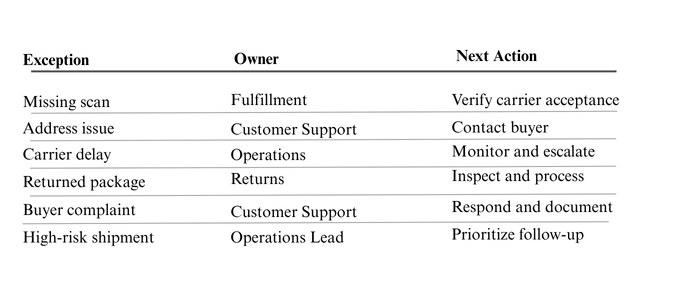
The exact structure can vary.
The important part is that every exception has a next action and an owner.
No "someone."
No "later."
No guessing.
The Real Cost of an Unowned Exception
A shipping exception can create a chain reaction.
Missing scan
↓
Buyer becomes concerned
↓
Message arrives
↓
Response is delayed
↓
Buyer loses confidence
↓
Case or complaint
↓
Refund / reshipment
↓
Additional fulfillment cost
↓
More operational work
One exception.
Multiple consequences.
That's why shipping exceptions aren't simply logistics problems.
They're risk events.
Track Exceptions Before They Become Cases
A mature eBay operation doesn't wait for a buyer to complain before investigating.
It monitors warning signals.
For example:
- shipment has no expected scan
- tracking hasn't moved
- delivery estimate is approaching
- package has been returned
- address requires clarification
- buyer has contacted the seller
- shipment requires manual intervention
These signals create an opportunity.
Intervene before the buyer has to escalate.
The Goal Isn't Zero Exceptions
No seller can eliminate every carrier delay.
Packages get lost.
Scans get missed.
Addresses change.
Weather disrupts transportation.
Carriers make mistakes.
The goal is not perfection.
The goal is controlled recovery.
A strong operation can experience an exception without allowing it to become chaos.
Someone sees it.
Someone owns it.
Someone acts.
Someone records the outcome.
That's operational control.
Final Thoughts
A shipping exception is rarely expensive because of the package itself.
It becomes expensive when the exception sits unnoticed.
A missing scan becomes a buyer message.
A delayed response becomes frustration.
Frustration becomes a dispute.
A dispute becomes a refund or reshipment.
And suddenly a small logistics problem has become a financial and account-performance problem.
The best eBay sellers don't ask:
"Whose job is shipping?"
They ask:
"Who owns this exception until it is resolved?"
That's the difference.
Because a shipping exception without an owner isn't just a delayed package.
It's a problem waiting for a buyer to discover it.
Related Reading
- Why eBay Sellers Miss the Most Important Orders in Their Queue
- Why eBay Cases Escalate Faster Than Sellers Expect
- Why eBay Buyers Open "Item Not Received" Cases Even When Tracking Exists
- Why eBay Sellers Lose Buyer Trust Without Realizing It
- Why Some eBay Stores Constantly Operate in Recovery Mode
Download the Free eBay Seller Compliance Risk Audit
Shipping exceptions are inevitable.
Unmanaged exceptions don't have to be.
Build a fulfillment workflow where every delayed shipment, missing scan, returned package, and carrier exception has a clear owner, next action, and escalation path.
eBay Seller Compliance Risk Audit
 About the Author
I work with Shopify and eBay sellers to identify and stabilize operational systems before fulfillment pressure turns into customer complaints, refunds, and margin loss.
My focus is helping stores handling 10–30 orders per day build resilient workflows that scale without creating hidden operational stress.
👉 Download the free fulfillment audit: eBay Seller Compliance Risk Audit
📢 Share This
Found this useful? Share it with other operators: