Your Cart
Loading

Every control depends on knowing your devices. Do you?

A scanner cannot reach a laptop nobody recorded, and an insurer's question about encryption cannot be answered for devices that never reached device management. Most organizations keep three partial lists, in the management console, the protection console and someone's spreadsheet, and none of them agree.


The gap shows on the worst days: the lost phone nobody wiped, the leaver's laptop that never came back, the reception PC still running a system its vendor stopped supporting.

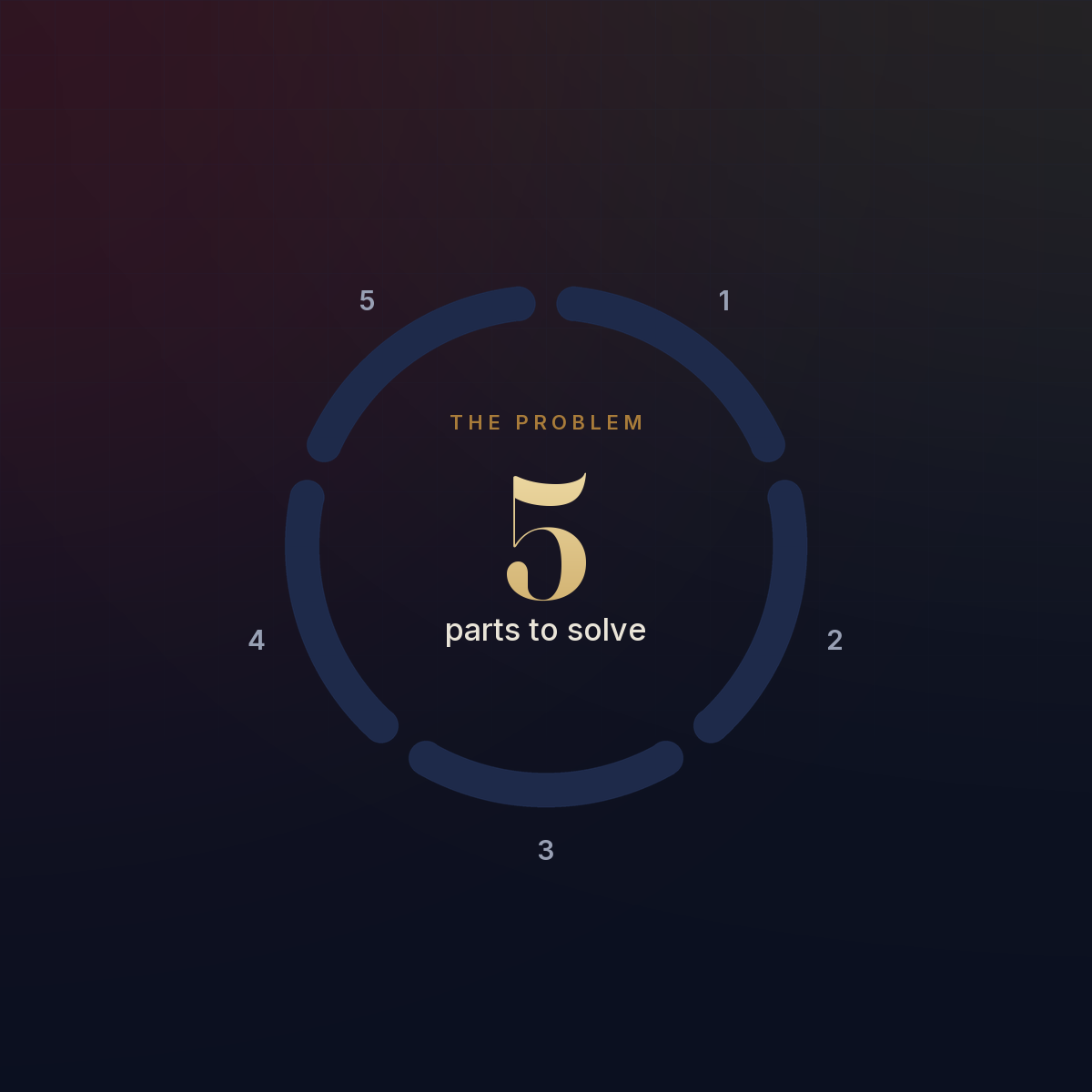
Coverage ring showing the five parts of the problem, all still open.

The problem has five parts.

Asset and endpoint security is not one problem. It is five, and a device management console solves part of the first one at best.


1. Your device lists disagree, and nobody owns them. Laptops bought on a card are never enrolled, software arrives that nobody approved, and most of the list has no owner or status.


2. You cannot prove every device is protected. The protection agent stopped reporting after an update, laptops are unencrypted, and nobody wrote down what a configured device must look like.


3. Old systems and standing admin rights stay forever. Operating systems past end of support keep running, and administrator rights granted for one task never expire.


4. Devices leave and nobody follows them. A lost phone sits unwiped for a week, a leaver keeps a laptop, and disposal happens with no proof the data was destroyed.


5. Nobody has decided the rules. No policy, no standard and no monthly review, and nothing to show an insurer, an auditor or a customer who asks.

Find out which part is hurting you most.

START HERE, FREE


Twenty-four statements across eight capabilities and fifteen minutes. The Asset and Endpoint Health Check places you at Reactive, Emerging, Managed or Integrated, and you only reach Integrated when every capability is at least halfway there, because one unmanaged area, such as personal phones, is enough to undo the rest.


Measures: parts 1 to 4.


Solves: none of them, on purpose. It tells you which capability to fix first.

One inventory, with an owner on every device.

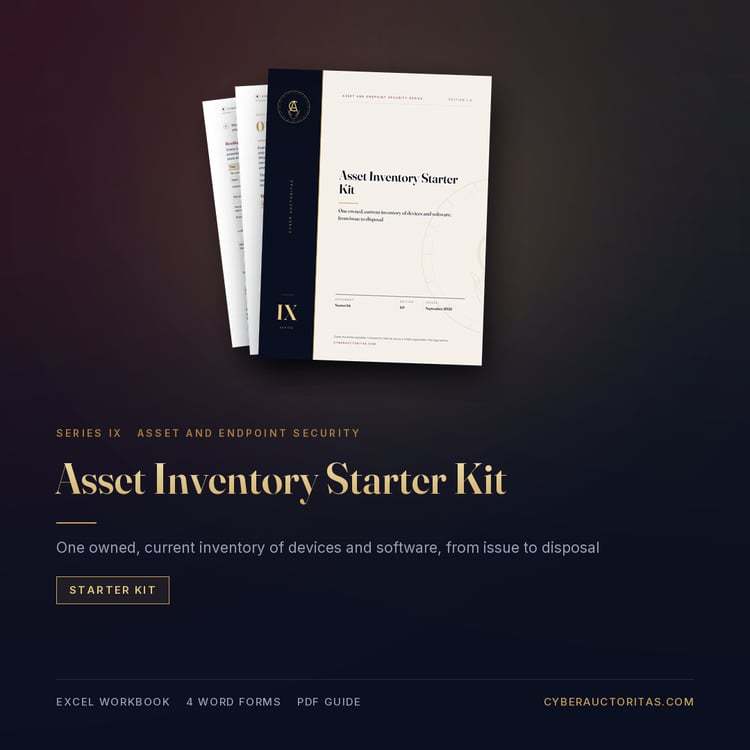
ASSET INVENTORY STARTER KIT, $9


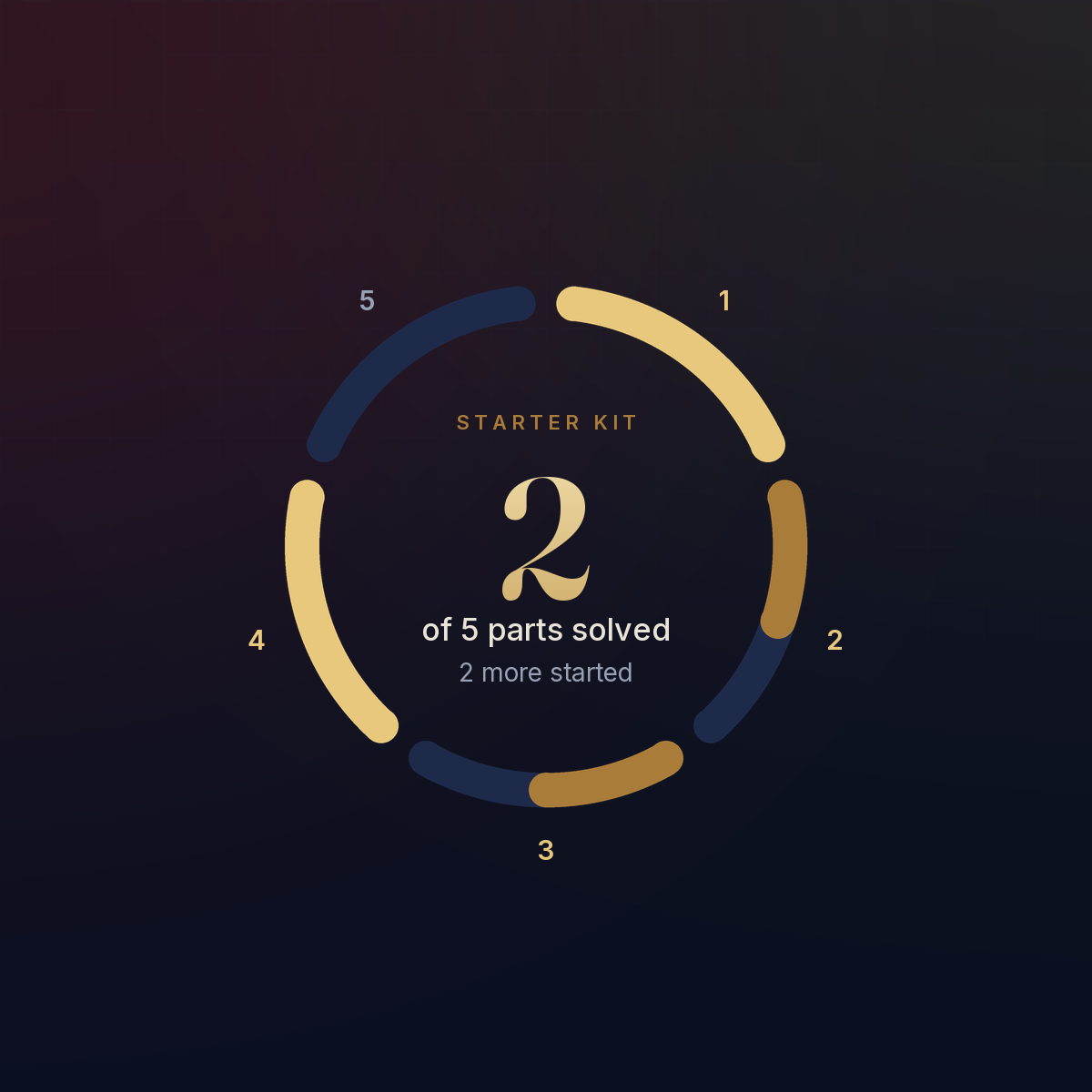
One workbook in place of three lists: a device inventory, a software inventory and a lifecycle log, with four forms for the moments a device changes hands.


Solves part 1. Every device and title has an owner and a status, with flags for stale devices, devices with no owner, unauthorized software and unsupported versions. Reconciling against your other sources to find unknown devices is in the Toolkit.


Starts part 2. Flags for unprotected devices and for laptops and phones without encryption. Coverage targets and the configuration baseline are in the Toolkit.


Starts part 3. Operating systems past end of support are flagged. Administrator rights are tracked in the Toolkit.


Solves part 4. The Lifecycle Log records every assignment, return, loss and disposal, flags lost devices not wiped within 24 hours and keeps sanitization evidence to NIST SP 800-88 Revision 2.


Still open: part 5. Nothing here sets the rules or reports on them yet.

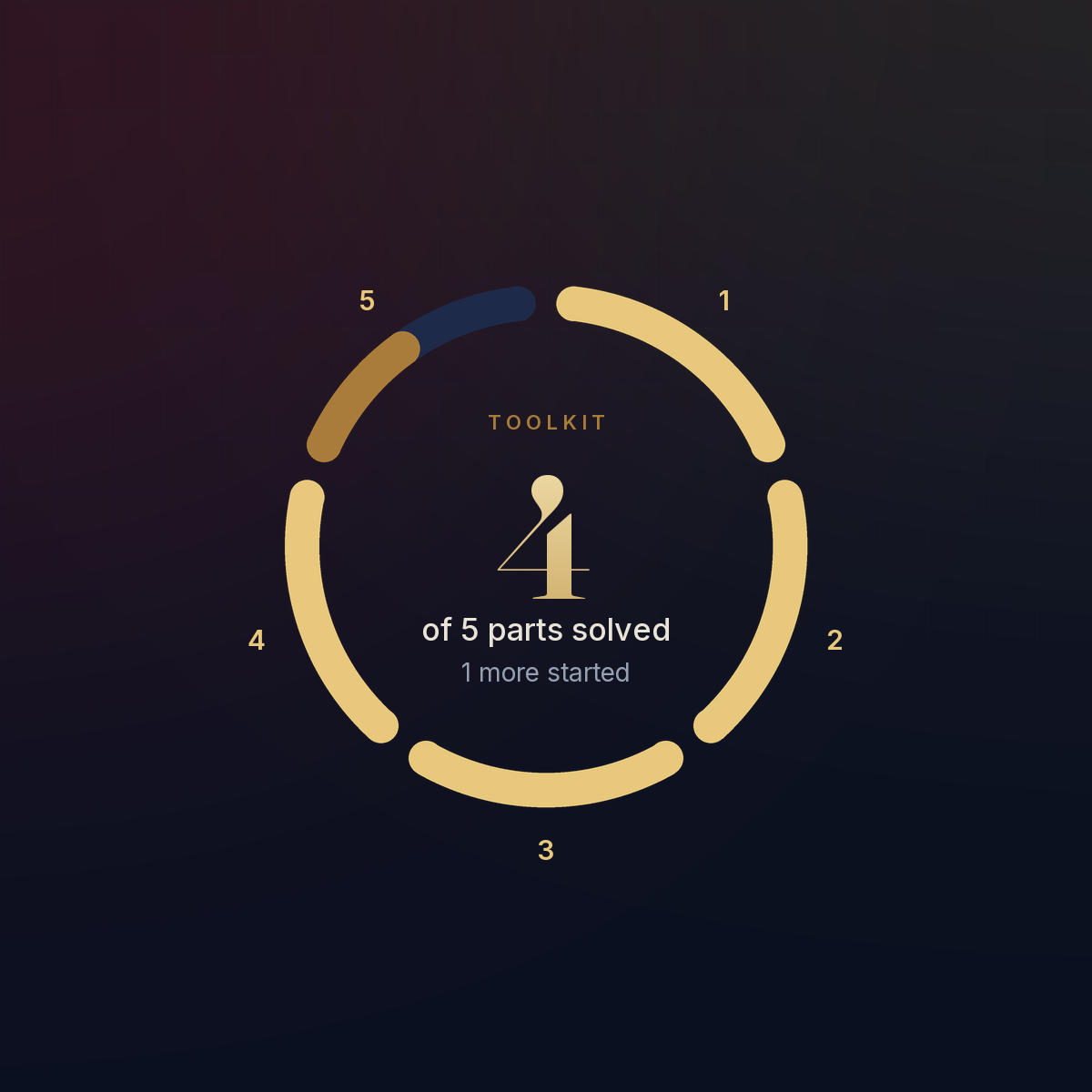
Coverage ring: the Toolkit solves parts 1 to 4 and starts part 5.

Find the devices nobody recorded, and prove the rest are protected.

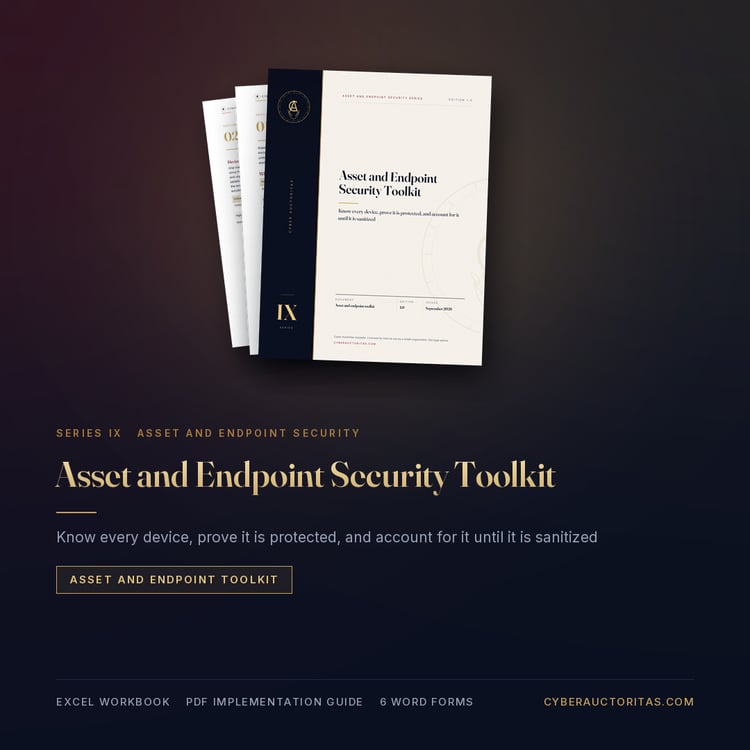
ASSET AND ENDPOINT SECURITY TOOLKIT, $39 AT LAUNCH


Asset and endpoint security fails quietly. The Toolkit makes every one of those failures visible each month, with an owner and a deadline.


Solves part 1. A reconciliation across device management, the protection console, the directory, network discovery and purchase records flags devices seen in fewer than three sources and devices on the network that nobody inventoried.


Solves part 2. Protection coverage against a 98 percent target and encryption coverage on the dashboard, and a configuration baseline worksheet.


Solves part 3. The Admin Rights tab flags rights with no expiry, expired rights still in place and administrator rights on daily accounts, and every system past end of support needs an exception checked against the authority and duration its risk requires.


Solves part 4. Disposals carry the NIST SP 800-88 Revision 2 certificate fields, with flags for a missing certificate or witness.


Starts part 5. A live monthly review agenda and a coverage dashboard. There is no charter, policy or written standard yet.

Coverage ring: the Program-in-a-Box solves all five parts.

Written rules for every device, from issue to disposal.

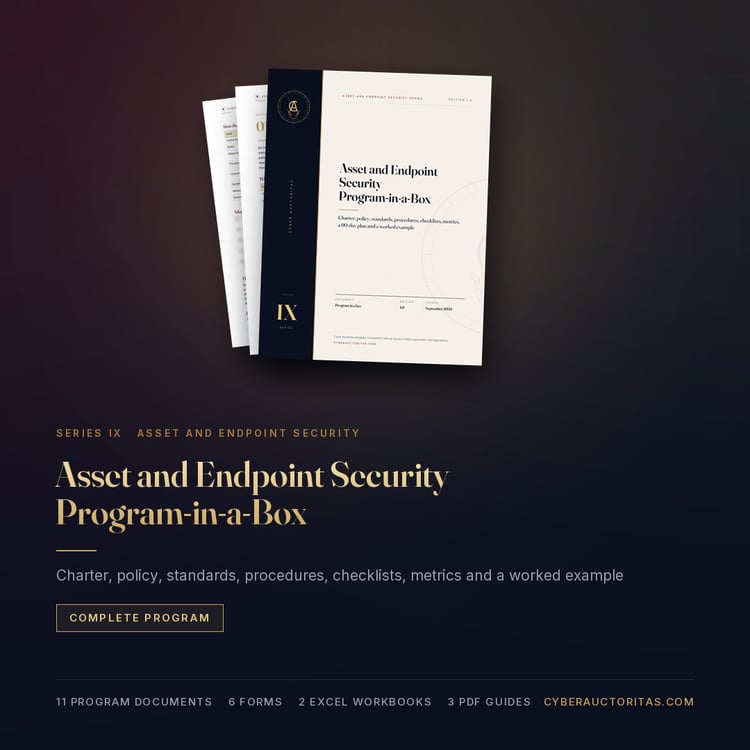
ASSET AND ENDPOINT SECURITY PROGRAM-IN-A-BOX, $129 AT LAUNCH


An inventory is a tool. A program decides how it is used: who owns each device, which sources must agree, what every device must be configured to do, who may hold administrator rights, what happens to a system past end of support, what a personal phone needs before it reaches client data, and how a device leaves. Adopt it in ninety days, after studying a fully worked example of a 130-person home health agency six months in.


Solves parts 1 to 4, with the full Toolkit workbook, extended with program metrics, a quarterly maturity review on the same eight capabilities as the free health check and a 90-day plan tracker.


Solves part 5. An Asset and Endpoint Security Charter and Policy, an Asset Inventory Standard, an Endpoint Security Standard with the configuration baseline, procedures for the asset lifecycle, inventory reconciliation, endpoint protection monitoring, and device disposal and sanitization, and checklists for provisioning and for return and disposal.


Aligned to CIS Controls v8.1 Controls 1, 2, 4 and 10, NIST CSF 2.0, NIST SP 800-124 Revision 2, NIST SP 800-88 Revision 2 and ISO/IEC 27001:2022 Annex A asset and endpoint controls. It supports those requirements; it does not certify against them.

What no template can do for you.

Even a complete program needs someone to run it: to chase the device that dropped off the console, refuse an administrator right with no end date, and tell leadership plainly which systems are past support. If you want that person, the practice provides senior security leadership on retainer.

Choosing the right one

Rather have us run the assessment?

The program is built for your own team to run. If you would rather have a practitioner assess the area that carries your highest risk, such as patching, backup and recovery or incident response, we run focused assessments against the NIST guidance written for each area, booked through our EveryExpert profile.


The prices listed there are for organizations of up to 100 people. If yours is larger, start with a free 30-minute scoping call and we will quote a fixed scope and price.