Kitson Pipeline Forecast Lab: Forecast Your Own Sales Pipeline as a Range, Not a Wish (Opus 5.5)
Your CRM counts every hopeful deal as money coming in. Then the month ends, and it isn't there.
You want to know what's likely to close, where deals get stuck, and which ones have gone quiet. But a column of close dates can make a wish list look like a forecast, and nobody tells you which deals stopped being real.
Kitson Pipeline Forecast Lab reads your own pipeline export and your own closed deals, on your computer:
- The app works out every figure in code: win rates by stage, lead source, rep and deal size, each with an honest range and a warning when the numbers are small; how long your deals really take; how long they sit in each stage and where they stall; stale deals, overdue close dates and close dates that keep slipping; and the weighted pipeline.
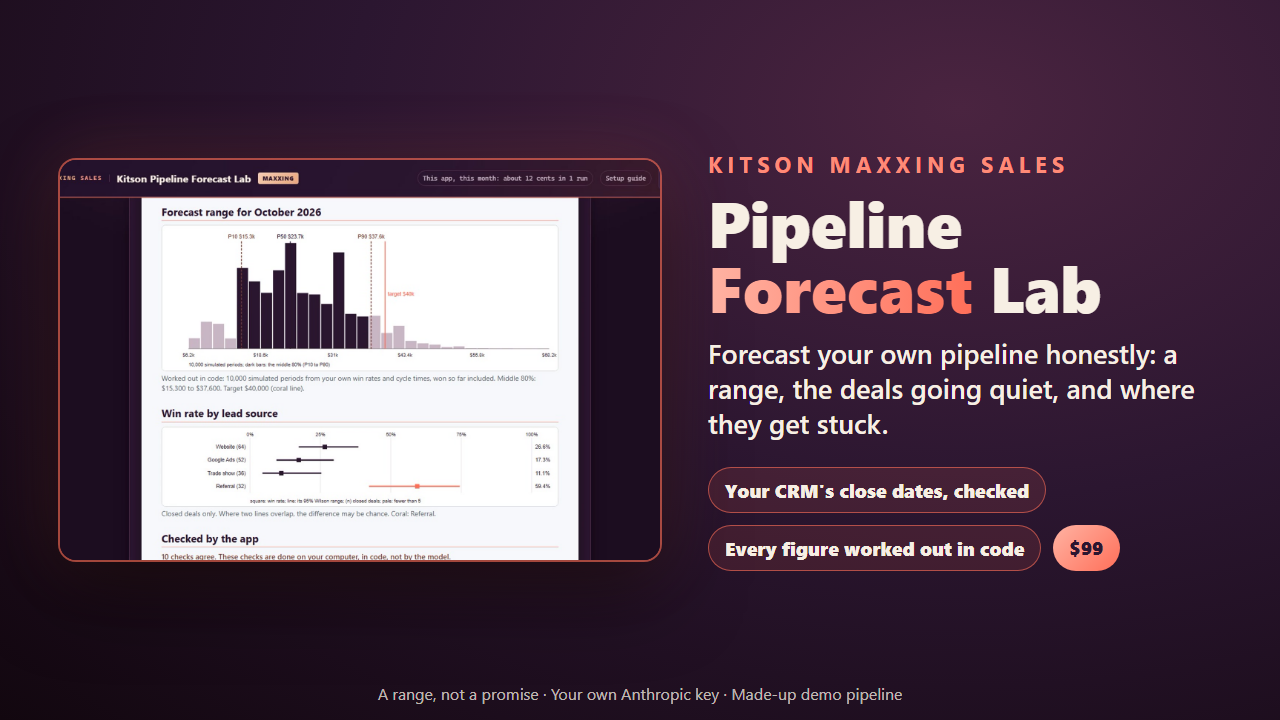
- It runs thousands of simulated months from your own history and gives a forecast range for the period: a low end, a middle and a high end, plus the chance of reaching your target, the gap to it, and what would need to be true.
- It shows what would move the range (if the quiet deals are lost, if win rates land high or low, if you trust your own close dates), compares your past forecasts with what really closed, and ranks your open deals by how often deals like them were won, every score explained.
- Then Claude Opus 5.5 writes a plain-English forecast review, a listen-first question for each stale or slipping deal, and the figures to trust least. The app checks every number Claude writes against its own figures.
What makes it different
- A forecast is a range, not a promise. The app assumes the period behaves like your past ones, and real months can land outside the range. It says so, and it never words a forecast as a sure thing.
- It never contacts a customer and never sends anything. The questions are for you to ask, kindly, in your own words. No pressure, no deadline, no discount to close.
- Your files stay on your computer. Only totals, rates and the flagged deals by code (D-001, with stage, value, lead source and day counts) go to Anthropic, plus the business name and first name if you type them in. Reps are sent as Rep 1, Rep 2, and any company, contact or rep name from your file is masked in lead-source text. No deal name, customer company, contact, email address, phone number, note or rep's name is sent, and nothing is sent to Kitson Workshop. You can see exactly what will be sent before you run it.
- The cost is shown before every run. In our own test on a made-up pipeline of 212 deals, one forecast cost about 12 cents on our own Anthropic account. A bigger pipeline costs a little more.
- Take it with you: a Word forecast memo with every table, a CSV of your open deals with their flags, and every table in Excel.
What you need
- Free Node.js 18+ (Windows, Mac or Linux).
- Your own pipeline export as a CSV file (from HubSpot, Pipedrive or another CRM, or a spreadsheet saved as CSV), with your closed deals of the last 12 to 24 months as well as the open ones. A stage-change history and your past forecasts are optional. A made-up sample is in the zip so you can try it first.
- Your own Anthropic account and API key, with a little credit. A Claude chat subscription does not include API access.
You pay Anthropic directly for what you use, on top of the price of the app.
Watch Biz's review: https://youtu.be/q8EywEeq8s0
Early release, for educational purposes, made by Kitson Workshop. It works only from your own export and the figures you type in: it cannot see your customers, your emails or the economy, and it can misread or miss things. Check every figure against your own records before you rely on it or share it. A forecast is a range, not a promise. If we can't get the app running for you, email kit376351@gmail.com within 14 days for a refund of the app price. Kitson Workshop is not affiliated with or endorsed by Anthropic.